The Knights
(Comedy, Greek, 424 BCE, 1,408 lines)
Introduction
"The Knights" (Gr: "Hippeis") is a comedy by the ancient Greek playwright Aristophanes. It won first prize at the Lenaia festival when it was produced in 424 BCE. The play functions as satire on political and social life in 5th Century BCE Athens, with particular focus as a diatribe against the pro-war populist politician, Cleon. In the narrative, a sausage-seller named Agoracritus competes with Paphlagonian (representing Cleon) for the approval of Demos (symbolizing the Athenian citizenry), ultimately triumphing through contests and miraculously restoring Demos to youth and glory.
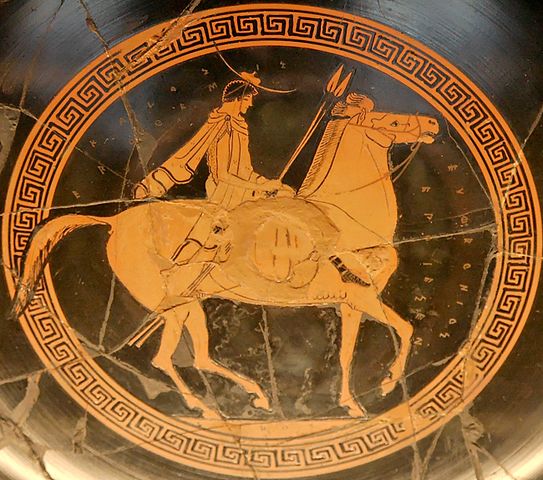
A Greek rider depicted on pottery by Euphronios, representing the Knights class of Athens
Fact | Information |
|---|---|
Author | |
Date produced | 424 BCE |
Genre | Old Comedy |
Setting | Athens, ancient Greece |
Key Themes | Political satire, demagoguery, democracy, corruption, war |
Synopsis - The Knights Summary
Dramatis Personae – Characters
DEMOSTHENES, slave of Demos
NICIAS, slave of Demos
AGORACRITUS, a Sausage-Seller
CLEON (as Paphlagonian)
DEMOS
CHORUS OF KNIGHTS
Plot Summary
Nicias and Demosthenes, two enslaved attendants of elderly Athenian Demos, flee the house complaining of beatings received from fellow slave Paphlagonian (Cleon's representation). Paphlagonian has manipulated their master's trust and regularly takes credit for their work while provoking beatings. After drinking wine, they steal Cleon's secret oracle collection and discover oracles predicting Cleon's replacement by a sausage-seller.
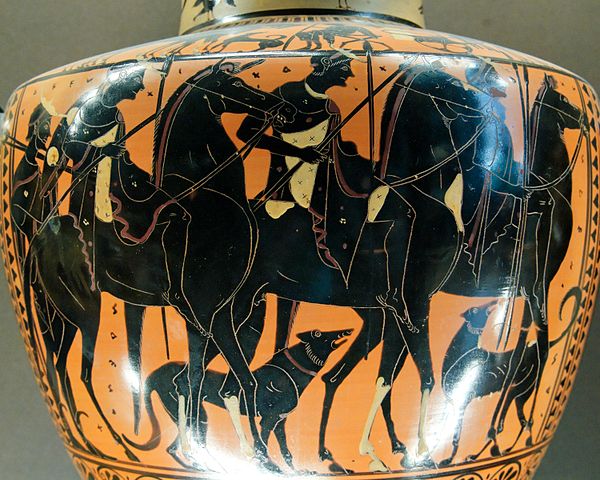
Greek riders depicted on a vase from the Leagros Group, representing the cavalry class that forms the Chorus in the play
When sausage-seller Agoracritus passes by, they inform him of his supposed destiny. Though initially skeptical, Cleon's suspicious reaction confirms something is amiss. Demosthenes appeals to the Knights of Athens for aid. The Chorus of Knights enters, confronting Cleon and accusing him of manipulating the political and legal system for personal gain.
A verbal contest ensues between Cleon and the sausage-seller, each demonstrating shamelessness and unscrupulousness. The Knights declare the sausage-seller victorious, causing Cleon to storm away threatening treason charges.
The Chorus addresses the audience, praising Aristophanes' methodical career approach and honoring the older generation that made Athens great. The passage includes imagery of Greek horses participating in a Corinth assault.
When the sausage-seller returns, he reports winning Council support through extravagant food offerings. Cleon challenges him to submit their dispute directly to Demos. The sausage-seller accuses Cleon of indifference to the war-time sufferings of ordinary people and claims Cleon prolongs the war out of fear that he will be prosecuted when peace returns. Demos accepts these arguments.
The competition escalates into increasingly vulgar exchanges. The sausage-seller wins additional contests involving oracle readings and demonstrations of service to Demos.
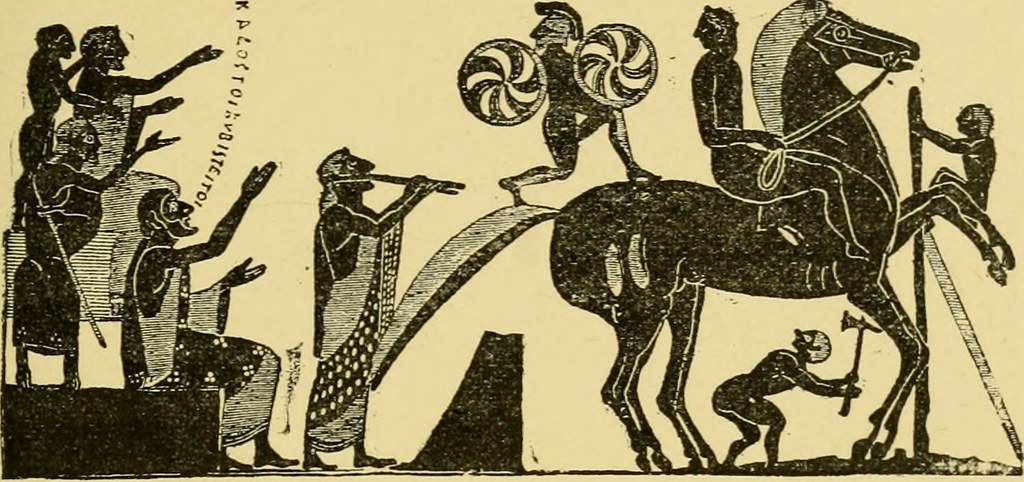
An illustration depicting the satirical contest between Cleon and the sausage-seller in The Knights
Desperate, Cleon presents his oracle, questioning whether the sausage-seller matches the prophesied successor's description in all vulgar details—which he does. Cleon accepts his defeat and surrenders his position.
The Chorus mocks dishonorable figures including Ariphrades and Hyperbolus. Agoracritus announces having rejuvenated Demos through cooking treatment, introducing him restored to youth in Marathon-era clothing. Two beautiful girls representing "Peace-treaties" that Cleon had kept hidden are presented. Demos invites Agoracritus to a state banquet, and all exit cheerfully except Paphlagonian/Cleon, now reduced to selling sausages at the city gate as punishment.
Analysis
The play exemplifies Aristophanes' early satirical approach to Athenian social and political life during the Peloponnesian War, distinguished by its singular focus on one individual: the pro-war populist, Cleon, who had previously prosecuted Aristophanes for slandering the polis.
Aristophanes had promised revenge in "The Acharnians" (425 BCE) and delivers it fully in "The Knights" (424 BCE). Notably, Aristophanes had the prudence not to actually use the name Cleon anywhere in the play, substituting the allegorical Paphlagonian instead but making identification unmistakable.
No mask-maker dared create Cleon's likeness from fear of his faction, so Aristophanes bravely resolved to play the part himself, merely painting his own face. The Knights chorus represented the wealthy class of Athens, politicized and educated enough to see through Cleon's demagoguery.
Accusations leveled include questions about social origins, law court manipulation for personal gain, attempts at political censorship (including of Aristophanes), misuse of state office audits, and manipulation of census lists to impose crippling financial burdens on his choice of victims. Cleon would likely have attended the Lenaia performance.
The play relies heavily on allegory, though critics note it's not entirely successful in this regard. Main characters derive from real life (Cleon as primary villain), but allegorical figures are pure fantasy, with Paphlagonian presented as responsible for almost all evils in the world. This creates awkwardness, with some ambiguities never fully resolved.
Imagery proves crucial to Aristophanes' comic poetry. Paphlagonian/Cleon receives bizarre descriptions: variously described as a monstrous giant, a snoring sorcerer, a mountain torrent, a hook-footed eagle, a garlic pickle, a mud-stirrer, a fisherman watching for shoals of fish, a butchered pig, a bee browsing blooms of corruption, a dog-headed ape, a storm by sea and land, a giant hurling crags, a thieving nurse, a fishermen hunting eels, a boiling pot, a lion fighting gnats, a dog fox and a beggar.
Gluttony emerges as dominant thematic element through imagery, with exaggerated focus on food and drink and food-related puns on some of the names alongside cannibalism references creating a rather nightmarish and nauseating vision of the world, making the final vision of reformed Athens notably brighter by contrast.
Resources
English translation (Internet Classics Archive)
Greek version with word-by-word translation (Perseus Project)