Agamemnon
(Tragedy, Latin/Roman, c. 55 CE, 1,012 lines)
Introduction
"Agamemnon" is a tragedy by the Roman playwright Seneca the Younger, written around 55 CE. Adapted from the much earlier Greek play "Agamemnon" by Aeschylus, it tells the story of the return of the Greek hero Agamemnon to his home in Argos after the Trojan War, and his death at the hands of his wife Clytemnestra and her lover Aegisthus.
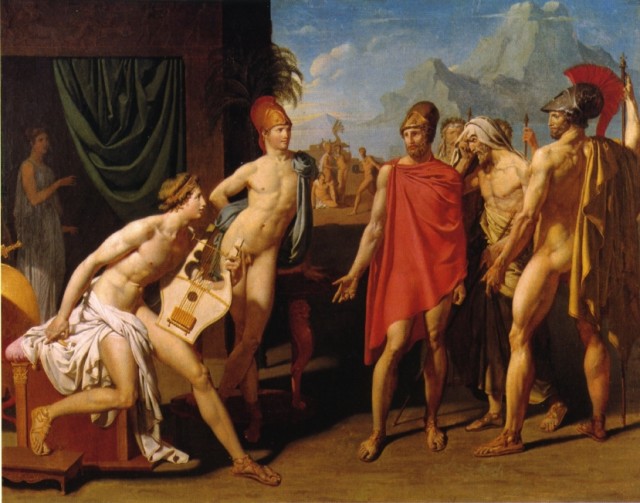
The Envoys of Agamemnon by Jean-Auguste-Dominique Ingres
Synopsis
Dramatis Personae
AGAMEMNON, king of Argos
GHOST OF THYESTES
AEGISTHUS, son of Thyestes
CHORUS OF ARGIVE WOMEN
EURYBATES, messenger of Agamemnon
CASSANDRA, daughter of Priam, captive of Agamemnon
ELECTRA, daughter of Agamemnon
STROPHIUS, king of Phocis
ORESTES, son of Agamemnon (silent)
PYLADES, son of Strophius (silent)
BAND OF CAPTIVE TROJAN WOMEN
The background to the play is that Atreus' son, Agamemnon, king of Argos, has been away for ten years leading the Greek forces in the war against Troy, and is shortly due back to reclaim his own throne. In the meantime, though, Agamemnon's wife Clytemnestra has become the lover of his ambitious cousin Aegisthus, and the two have been ruling Argos together. Clytemnestra also bears another grudge against her husband, dating back to when he agreed to sacrifice their own daughter, Iphigenia, to placate the gods before the start of the Trojan War.
The play opens with the ghost of Agamemnon's uncle, Thyestes, foreseeing the death of Agamemnon. As Agamemnon's return to Argos is imminent, Clytemnestra steels herself for revenge by dwelling on her grievances against him (his sacrifice of their daughter Iphigenia, his infidelities and the danger represented by his Trojan mistress Cassandra). Although she feels some revulsion to the guilty path, she feels she must take, she nevertheless resigns herself to colluding with Aegisthus.
After a Chorus of Argive women sing a hymn of thanksgiving to the gods for Agamemnon's victory in Troy, the herald Eurybates reports Agamemnon's imminent arrival as well as the destruction of much of the Greek fleet on the journey back. A secondary Chorus of Trojan women slaves mourn their situation and recall the episode of the wooden horse that led to the fall of Troy.
Agamemnon's mistress, the Trojan seer Cassandra, also mourns for Troy, but has a vision of the coming events, which she sees as just retribution. By clairvoyance, Cassandra "watches" and describes the murder of Agamemnon by Clytemnestra and Aegisthus in the palace.
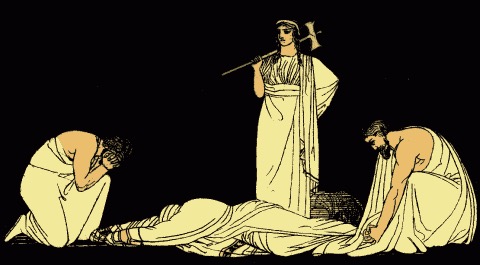
The Murder of Agamemnon
Agamemnon's children, Orestes and Electra leave the palace, Electra entrusting her younger brother to the care of a faithful friend, Strophius, before herself being led away to prison by her mother and Aegisthus. Cassandra is also led away to her execution, rejoicing that Troy's fall has been recompensed by the death of Agamemnon.
Analysis
Seneca's "Agamemnon" is a brilliantly rhetorical piece, widely believed to have been written for study rather than the stage, possibly as part of the education of his student, the young Emperor Nero. Although based in general terms on Aeschylus' much earlier play of the same name, it also includes much new material, and Seneca's Acts I and II and Scenes II and III of Act V have no real precedent in Aeschylus' drama. Seneca's description of the destruction of the Greek fleet, for example, contains three distinct episodes, the first known account of which did not appear until the Hellenistic period, long after the time of Aeschylus.
The tragedy encompassed by the play is multiple, involving not only Agamemnon but also many others, both Greeks and Trojans. The perspectives on the tragedies are also multiple, seen through the eyes of Greek participants in the Trojan War, but also through the eyes of Trojan participants and the Trojan princess and seer Cassandra.
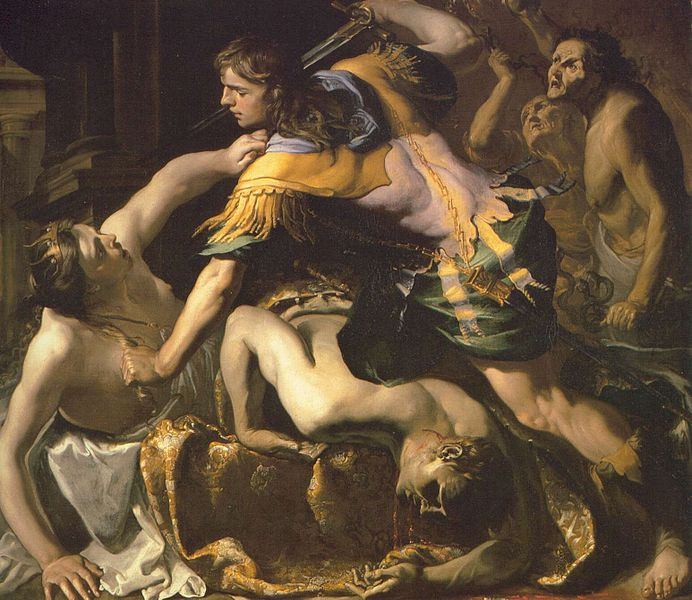
Clytemnestra murdering Agamemnon
The play is also characterized by multiple vision, especially the clairvoyant vision of Cassandra, who sees both into the underworld and the real world, and who watches the killing of Agamemnon as a kind of spectacle, not dissimilar to a gladiatorial fight. Her double image of Argos as Troy (and Agamemnon as Priam) conveys the similarity in the fall of greatness everywhere, and how the vanquishers become the vanquished in turn.
The multiple viewpoints of different characters are used to portray multiple ways of understanding the same events, with none being offered as the definitive version. None of the characters are really central or dominant in the play, least of all Agamemnon himself, who only has 26 lines in the whole play. Even Clytemnestra's motives for her actions are presented as being multiple, with no one motive, event or emotion obviously dominating. She is subject to wild changes of heart, in keeping with Seneca's vision of the workings of human passions, and the resulting characterization of Clytemnestra is actually much more complex than any portrait of her from antiquity.
Aegisthus is presented as essentially just a tool of fate, the whole meaning of his life being to take revenge on the descendants of Atreus. The defiant young women of the play, Electra and Cassandra, both rely on an understanding that death is sometimes preferable to life, and the ghost of Thyestes at the beginning of the play also clearly prefers the world of the dead to that of the living. The Chorus of Trojan women look on death as freedom, both from slavery and from the storms of life.
Resources
English translation by Frank Justus Miller (Theoi.com): http://www.theoi.com/Text/SenecaAgamemnon.html
Latin version (The Latin Library): http://www.thelatinlibrary.com/sen/sen.agamemnon.shtml