Hercules Furens
(Tragedy, Latin/Roman, c. 54 CE, 1,344 lines)
Introduction
"Hercules Furens" ("The Mad Hercules" or "The Madness of Hercules") is a tragedy by the Roman playwright Seneca the Younger, considered one of his best, written in or before 54 CE. Closely modelled on Euripides’ play "Heracles", the play describes the fortunes of the demi-god Hercules (Heracles in Greek) as he is sent mad by the goddess Iris and the Furies and kills his own wife and children.
Synopsis
Dramatis Personae
HERCULES
JUNO
AMPHITRYON, husband of Hercules’ mother, Alcmena
THESEUS, king of Athens
LYCUS, the usurping king of Thebes
MEGARA, wife of Hercules and daughter of Creon
CHORUS OF THEBANS
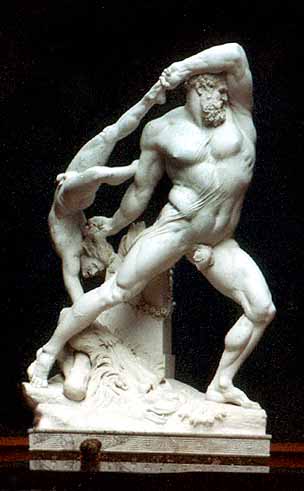
Marble bust of Hercules
The play begins with the goddess Juno giving vent to her anger at Hercules and her frustration at not being able to overcome him, and she determines to use whatever means she can to finally destroy him.
Hercules' father Amphitryon, his wife Megara and all their children, are gathered together at the altar of Jupiter for protection against the tyrant Lycus, who has slain Creon and taken control of the city of Thebes during Hercules’ absence. Amphitryon admits his helplessness against the might of Lycus. When Lycus threatens to kill Megara and her children, she declares herself willing to die and merely asks for some time to prepare herself.
However, Hercules then returns from his Labours and, hearing of Lycus’ plans, awaits his enemy’s return. When Lycus does come back to execute his plans against Megara, Hercules is ready for him and slays him.
The goddess Iris and one of the Furies then appear, at Juno’s request, and excite Hercules to madness and, in his madness, he kills his own wife and children. When he recovers from his insanity, he is mortified by what he has done, and is on the point of killing himself when Theseus arrives and persuades his old friend to give up all ideas of suicide and to follow him to Athens.
Analysis
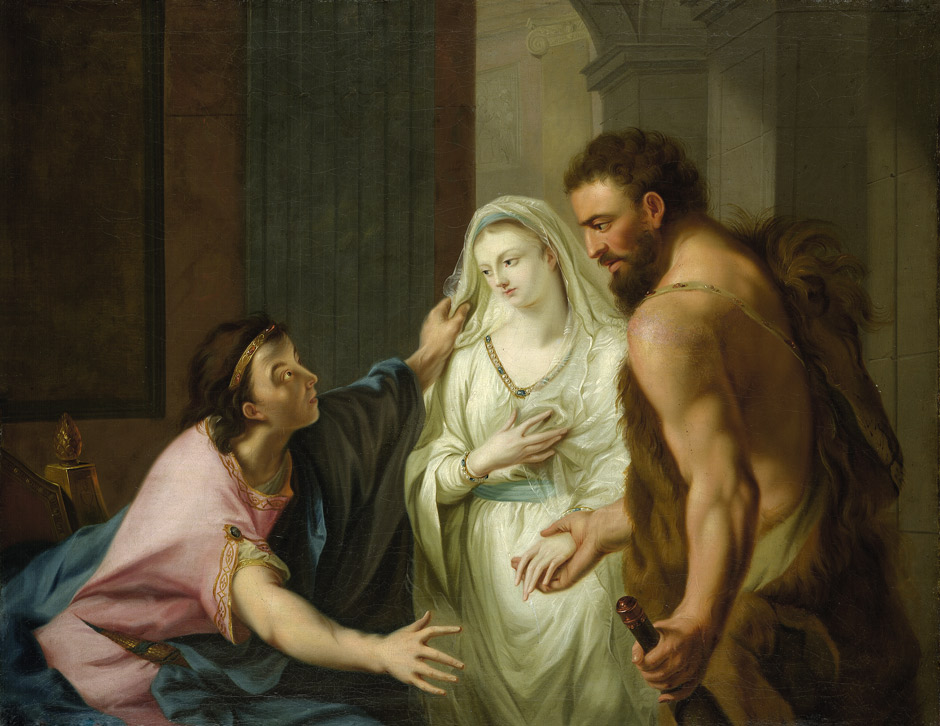
Hercules with Megara and their children in a classical painting
Although "Hercules Furens" suffers from many of the defects of which Seneca’s plays in general are accused (for instance, its excessively rhetorical style and its apparent lack of concern for the physical requirements of the stage), it is also recognized as containing passages of unsurpassed beauty, great purity and correctness of language and faultless versification. It seems to have been designed, no less than the Renaissance dramas of Marlowe or Racine, for its effect on the ear, and indeed may have been written to be read and studied rather than performed on a stage.
Although the plot of the play is clearly based on "Heracles", Euripides’ much earlier version of the same story, Seneca deliberately avoids the main complaint levelled at that play, namely that the unity of the play is actually destroyed by the addition of Hercules’ madness, effectively introducing a separate, secondary plot after the main plot has reached its satisfactory conclusion. Seneca achieves this by introducing, right at the start of the drama, the idea of Juno’s determination to overcome Hercules by any means possible, after which Hercules’ madness becomes no longer just an awkward appendage but rather the most interesting part of the plot, and one which has been foreshadowed since the start of the drama.
While Euripides interpreted Hercules’ madness as a demonstration of the gods’ total lack of concern for man’s suffering and an indication of the impassable distance between the human world and the divine, Seneca uses temporal distortions (particularly the initial prologue by Juno) as a means to reveal that Hercules’ madness is not just a sudden occurrence, but a gradual internal development. It allows much more exploration of psychology than Euripides’ more static approach.
Seneca also manipulates time in other ways, such as where time seems to be completely suspended in some scenes while, in others, much time passes and much action occurs. In some scenes, two simultaneous events are described linearly. Amphitryon’s long and detailed description of Hercules’ murders, late in the play, creates an effect similar to a slow motion sequence in a movie, as well as catering to his audience’s (and his own) fascination with horror and violence.
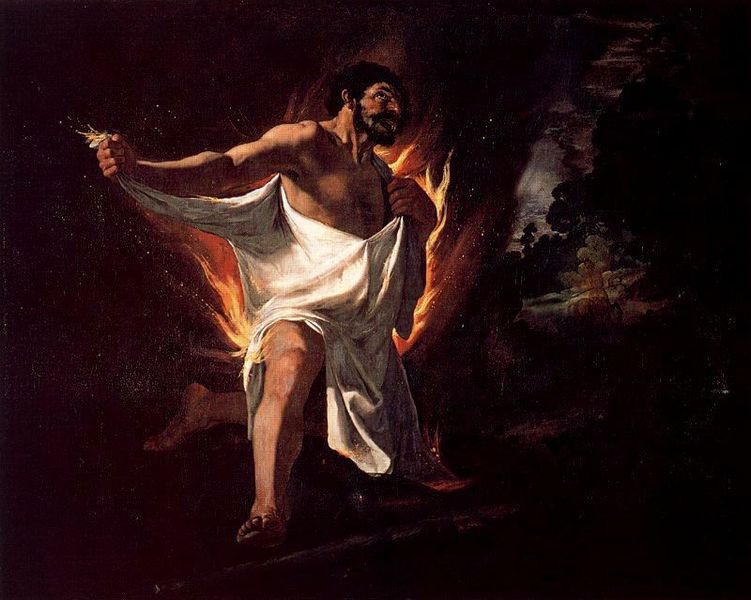
Hercules driven to madness in a classical painting
Thus, the play should not be seen merely as a poor imitation of a Greek original; rather, it exhibits originality in both theme and style. It is a peculiar blend of rhetorical, mannerist, philosophical and psychological drama, distinctly Senecan and definitely not an imitation of Euripides.
In addition, the play is full of epigrams and quotable quotes, such as: "Successful and fortunate crime is called virtue"; "The first art of a monarch is the power to endure hatred"; "Things that were hard to bear are sweet to remember"; "He who boasts of his ancestry praises the merits of another"; etc.
Resources
English translation by Frank Justus Miller (Theoi.com): http://www.theoi.com/Text/SenecaHerculesFurens.html
Latin version (Google Books): https://books.google.ca/books?id=NS8BAAAAMAAJ&dq=seneca%20hercules%20furens&pg=PA2