Vengeance in the Odyssey: Justice Served
The vengeance in the Odyssey is one of the most remarkable themes in Homer's epic poem. It made a huge impact that affected the rest of the story. The characters that notably represented vengeance were Poseidon and Odysseus himself. Poseidon took revenge for his son Polyphemus the Cyclops, whereas Odysseus wreaked vengeance on all the suitors of his wife Penelope. Let us take a closer look at the vengeance in the Odyssey and how it affected the characters and the rest of the events in this epic poem.
Poseidon's Revenge on Odysseus
In Homer's Odyssey, Poseidon exercised revenge against Odysseus by hindering his journey home. Odysseus' journey back home, which should have lasted for just a week or two, lasted for several years instead because of what he did to Polyphemus the Cyclops, the son of the sea god. This is the very first theme of vengeance you will encounter in the Odyssey, which was issued by the god of the sea.
It started when Odysseus and his crew wandered around the island of the cyclops in the hopes of finding some food. However, they ended up in Polyphemus' cave and decided to wait for the owner inside.
When Polyphemus returned and closed the cave entrance with an enormous rock, the giant was surprised to see Odysseus and his crew, thinking they were his piece of food. He immediately grabbed and ate some of Odysseus' men, and then he ate another two for breakfast.
The next morning, while Polyphemus was away, Odysseus devised a plan and sharpened a giant pole in order to get back at him. As the giant came back, Odysseus offered him wine which was poisonous and hence blinded him as he tricked him into thinking that his name was "Nobody." This helped Odysseus and his men break free from the giant, but what they did to Polyphemus was something they could not escape from so easily, and hence there was new vengeance waiting for them.
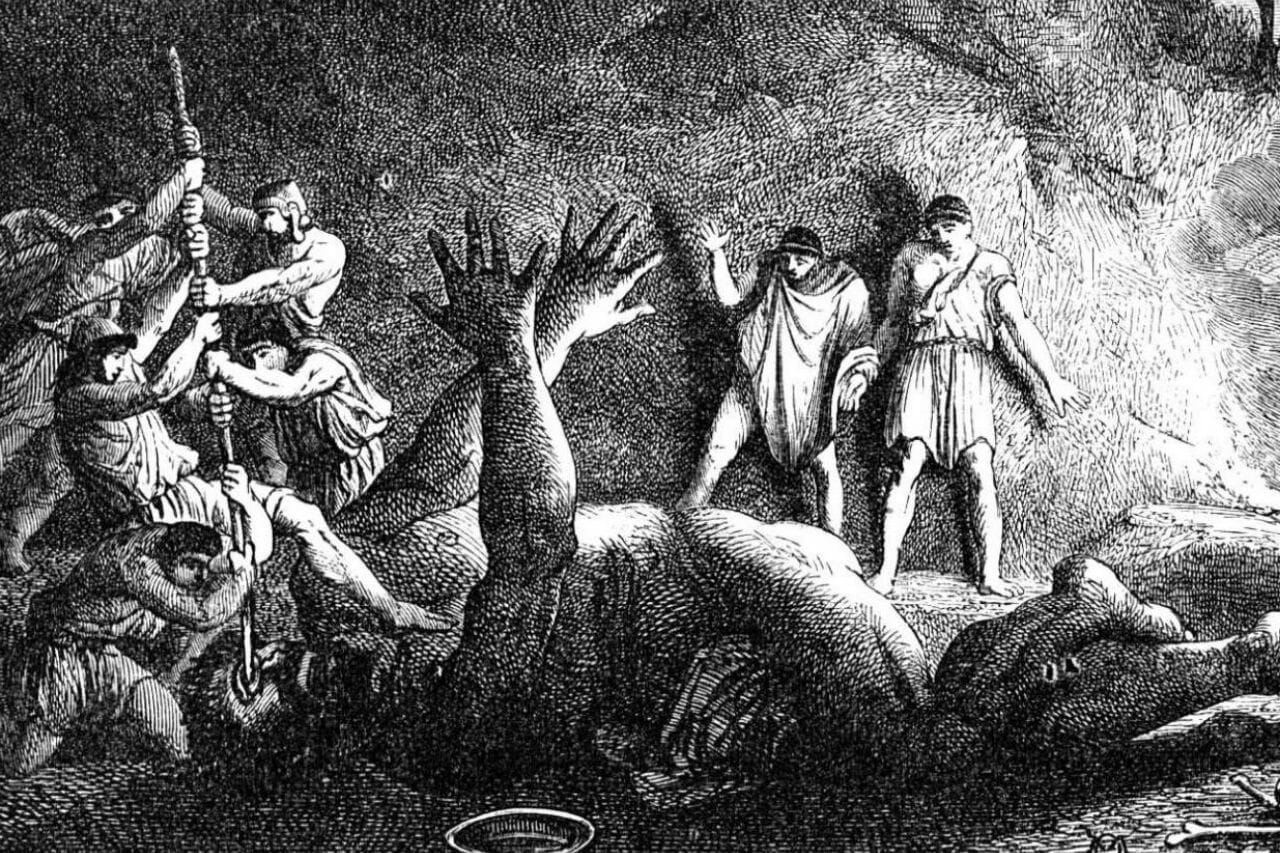
Polyphemus being blinded by Odysseus and his men
Revenge from the Blind Eye
Upon blinding Polyphemus, Odysseus and his crew immediately set sail from the island, in order to escape any type of trouble on their way. As they were about to get away, Odysseus taunted Polyphemus and heedlessly revealed his identity. It did not occur to Odysseus that doing something like this could be used against him anytime soon.
Polyphemus invoked his father, Poseidon, as he was angered by Odysseus' taunts and, most of all, because of losing his eye. The sea god would have done most anything to anyone who harmed his beloved son.
Furthermore, he prayed that if Odysseus was destined to return to his home in Ithaca, he should do this on a stranger's ship, without any of his crew remaining, and he should find trouble when he gets there. Polyphemus asked Poseidon to exercise this exact revenge for the injuries Odysseus inflicted upon him.
Zeus' Retribution
The god of the sky, Zeus, punished Odysseus by throwing a thunderbolt his way which drowned all his men and destroyed their remaining ships. Odysseus was spared; he washed ashore on the island of Ogygia where the nymph Calypso imprisoned him for seven long years. Zeus spared his life; however, he was left with nothing but himself.
This all started when Odysseus and his crew traveled to numerous islands on their way home. When they reached the Island of Titan Helios, once again, they endangered themselves. The blind prophet Teiresias told them to continue toward the island but warned them not to touch the young titan's golden cattle because he loved this livestock more than anything in this world. They rested on the island for days, but their resources had slowly run out, causing them to starve.
Odysseus decided to go to the temple to pray, as a way tp recover from what he had done, but before going, he warned his men to stay away from the temptation of touching the animals. As he was away, one of his men convinced the others to kill the golden cattle. Due to hunger, they all came to an agreement to kill the animals one by one, feast on their meat, and offer the best one to the gods as compensation for their sins.
When Odysseus returned from praying, he found out what his men did, he quickly gathered them into the ships and set sail into the storm. Helios was outraged by their rude action and threatened that he would drag the sun down into the underworld if Zeus would not punish the whole crew. Now, as they were sailing, Zeus killed the whole crew, save for Odysseus, by firing a thunderbolt as a way to get back at them and for the disobedience that they committed.
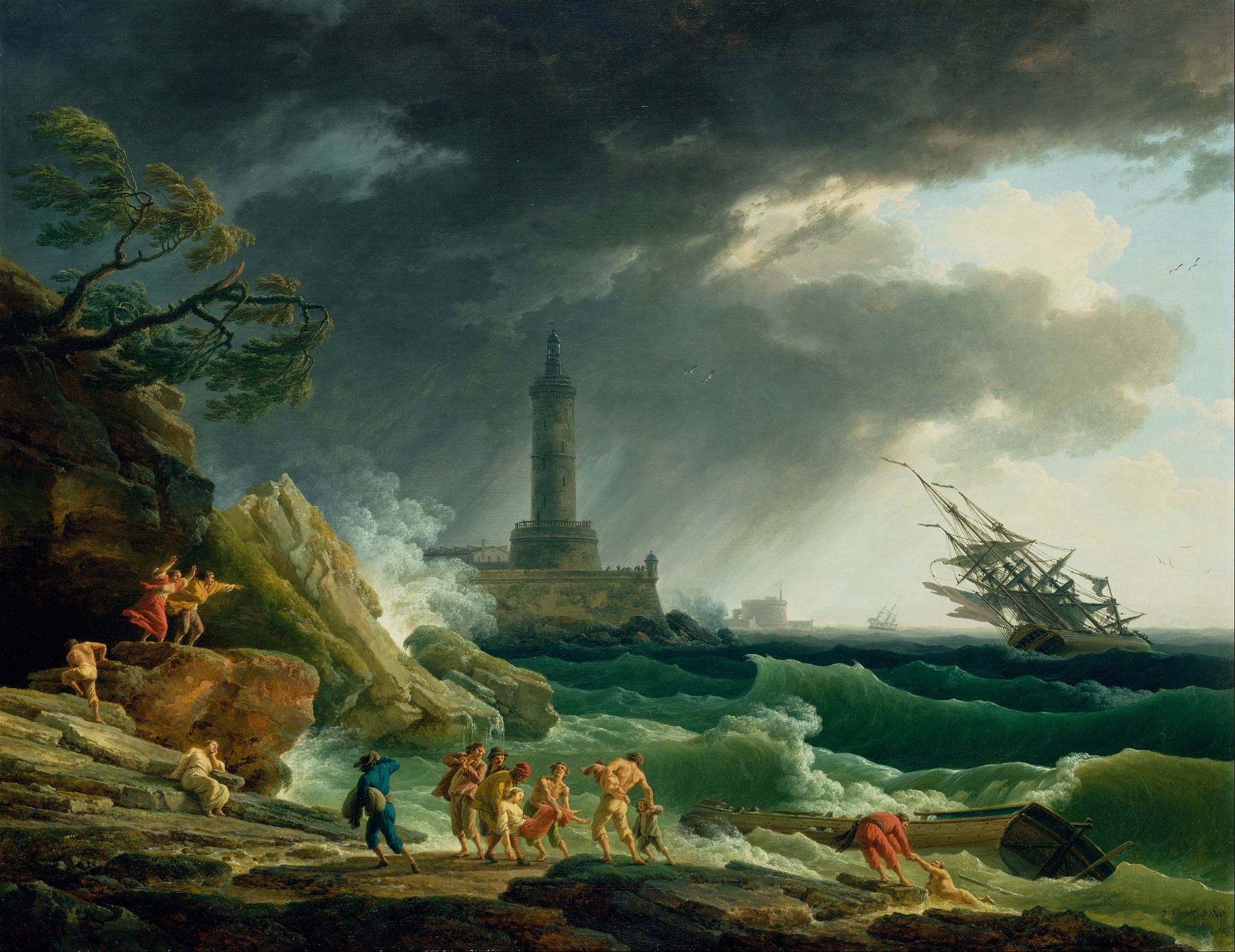
Zeus destroys Odysseus' ship with a thunderbolt
Odysseus Counterback
Another example of vengeance in the Odyssey was Odysseus' revenge on the suitors of his wife Penelope while he was away. Thus, his vengeance was considered one of the best examples of revenge in The Odyssey, which finally took place after several years of his absence. Let us look at Odysseus' Revenge Summary and know how he took matters into his own hands and claimed justice in the Odyssey.
While Odysseus was struggling on his journey home, his wife Penelope and his son Telemachus were averting the suitors competing for Penelope's hand and Ithaca's throne. During his absence, these suitors wasted a lot of his wealth at his expense. They took advantage of him and his wealth and created damaged his reputation as a king, noting that as a king this was a disgrace to his honor.
These reasons enraged Odysseus, and he was ready to disguise himself as a beggar and carefully planned to take revenge on the suitors, as well as on his disloyal servants. He came back to the island in disguise. He introduced himself to Penelope as a beggar who had met Odysseus and eventually came to Ithaca. Penelope tested his honesty by asking him to describe her husband Odysseus.
Odysseus described himself accurately—capturing every detail of how he met Odysseus and that Odysseus was facing a difficult ordeal but was alive traveling the seas. He also mentioned that Odysseus will be back before the month is over.
While in disguise, Odysseus carefully planned his attack on the suitors with the help of the goddess Athena, his son Telemachus, and some of his remaining kind and loyal herdsmen. He endured the arrogance and wickedness of the suitors and the insults they have thrown at him. He waited for the right moment to finally execute his plans.
Odysseus took justice into his own hands, and as he revealed himself, he massacred every single suitor with the help of his son Telemachus. He caught them off guard by surprising them with his attack in an archery contest.
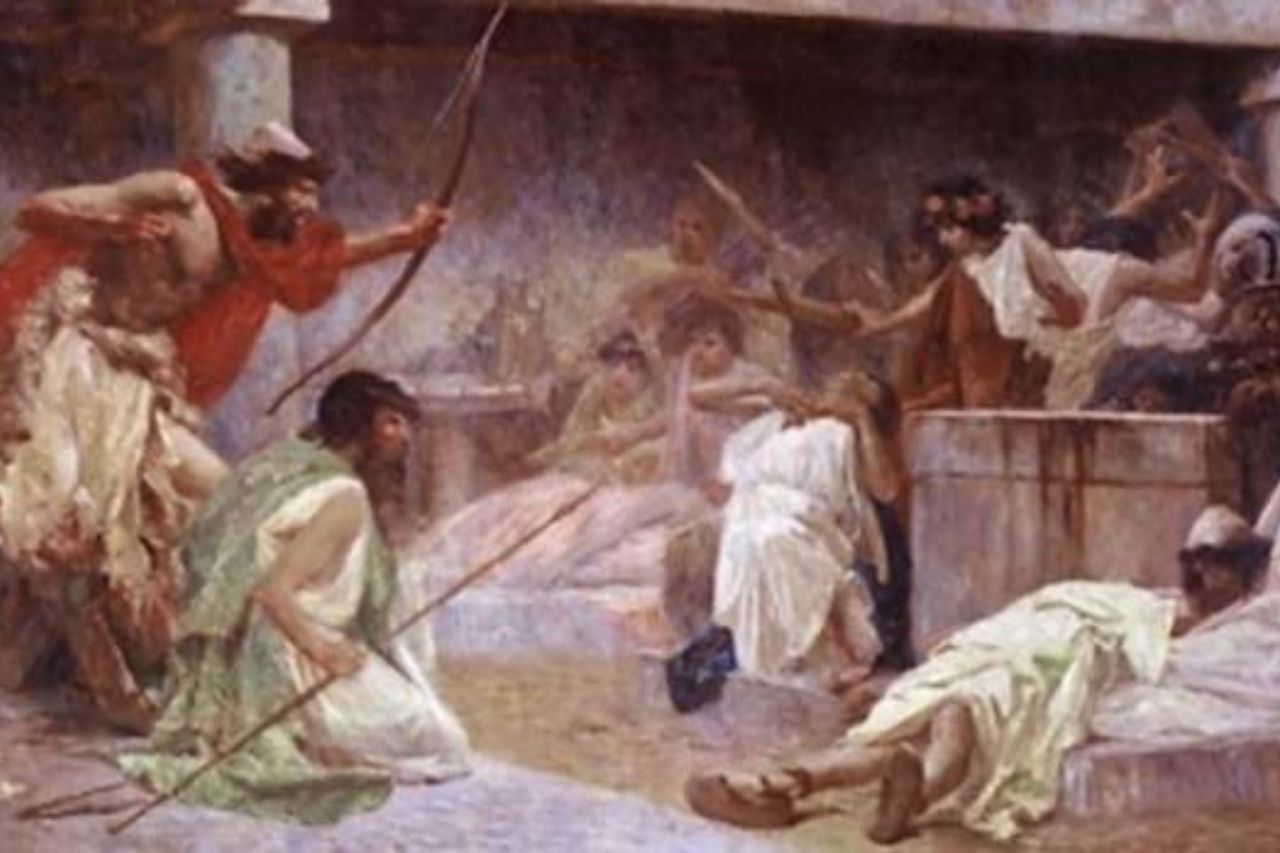
Odysseus killing the suitors in his palace hall
His retribution was to first kill the suitors' leader Antinous by striking an arrow through his throat. Then, he took his revenge further and he killed the other suitors with an arrow while the others were tortured and killed, in conclusion, each suitor died a gruesome death.
Conclusion
Vengeance in the Odyssey was one of the important parts of the epic poem that led from one fragment of the story to another. The characters took revenge into their own hands to claim the appropriate justice.
Odysseus faced retribution for what he did to Polyphemus the Cyclops.
Poseidon's revenge on Odysseus was hindering his travel back home.
Zeus punished Odysseus and his men by striking a thunderbolt at them.
Odysseus exercised his vengeance on his wife's suitors, who brought shame to his household.
Vengeance in the Odyssey was presented accurately and fairly. Aside from achieving the justice deserved, vengeance played a big part in the story.
Without this theme, we wouldn't have known what happened if Odysseus did not experience the struggles he had to face from the vengeance of Poseidon and Zeus, which all propelled the story forward in an epic adventure.