Beowulf vs. Grendel: A Hero Slays a Villain, Weapons Not Included
Beowulf vs. Grendel
Beowulf vs. Grendel is likely one of the more famous battles in literature history. It is an epic Scandinavian hero pitted against a dark, bloodthirsty monster who plagues the Danes and feasts upon them.
In Beowulf's battle with Grendel, we can see the juxtaposition of darkness and light, and we can learn all the interesting details of a warrior against a monster. Find out more about Beowulf vs. Grendel and the details of the battle by reading this.
Grendel vs. Beowulf: The Battle With Grendel
Beowulf arrived in Denmark to offer his services because, for many years, Grendel had plagued the Danes by coming at night to kill them. In a translation by Seamus Heaney, the poem says,
"so Grendel waged his lonely war,
Inflicting constant cruelties on the people,
Atrocious hurt."
One night, after merry-making in the Great Hall of the Danes, the men slept and laid in, waiting for the monster to come.
The monster entered, searching for the next victim to eat when he is sprung upon by Beowulf, who catches him in a vice-like grip:
"He (Grendel) was overwhelmed,
Manacled tight by the man who of all men
Was foremost and strongest in the days of this life."
During the Battle
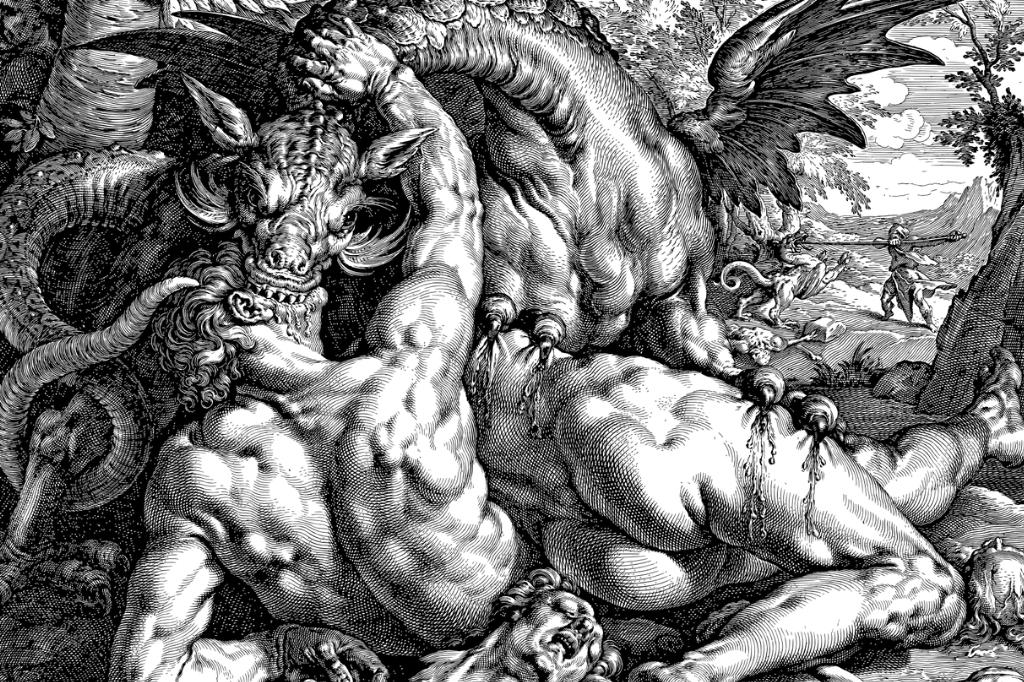
It was a combative clash between the good hero and the evil monster, as they battled fiercely, where Beowulf used no weapon against Grendel, believing that his power was equal to that of the monster's. Beowulf's men rushed to try and help when Beowulf pulled and tore Grendel's arm.
The men brought their weaponry with them to battle against the monster, however, their swords were seen to no use, because eventually, Beowulf had ripped the arm from the monster, hence Grendel fled away into the night, bleeding. In the poem, it says,
"Sinews split
And the bone-lappings burst.
Beowulf was granted
The glory of winning;
Grendel was driven
Under the fen banks, fatally hurt,
To his desolate lair."
After the Battle:
After the battle, Beowulf proved his victory to the Danes by showing them his trophy: Grendel's arm. Grendel's end is explained in the poem:
"His fatal departure
Was regretted by no one who witnessed his trail,
The ignominious marks of his flight
Where he'd sulked away, exhausted in spirit
And beaten in battle, bloodying the path."
Grendel was bleeding to death in his lair, and it didn't take long until his mother arrived for revenge.
Beowulf and Grendel: Good Versus Evil, Dark Versus Light
Beowulf and Grendel
The poem and fight between Beowulf and Grendel are famously known because it illustrates the battle between good and evil, portraying a snippet from the time. during this period in history and in this part of the world, there were tribes of warriors, known as warrior culture. The heroic code or code of chivalry or honor reigned supreme. In the Beowulf loyalty and honor were paramount together with revenge, courage, and physical strength.
In the poem, Beowulf is the ultimate expression of good and "light." He is fighting for those he loves, people he has ties to. Noting that Beowulf killing Grendel is him fighting for the good cause, aiming to remove evil from the world. Representing a perfect hero, he is entirely focused on his goal of doing good, and he is courageous, strong, and skillful in battle.
On the other hand, Grendel is the perfect epitome of evil and darkness. He lives in a dark, desperate lair, seeking pain, death, and destruction. He is jealous of the Danes especially their happiness and merriment, thus he kills to appease his anger. Since he is pure evil, his death in the poem represents the victory of good over evil.
Comparing the Two Powers of the Poem: Beowulf vs. Grendel
Even though we often look at Beowulf vs. Grendel as complete opposites, good and evil, dark and light, they actually have a lot of similarities. Perhaps that is what makes them even more interesting as famous literary foes. These similarities include:
Beowulf and Grendel are both super strong. That is why Beowulf has confidence in his ability to defeat the monster that no one is able to face, hence he doesn't use weapons to do so. The latter is the reason why Grendel was surprised that a human came up against him and stronger than he'd ever seen.
Both of these powerful characters are well-known and legendary because of their skills. Grendel is renowned for his evil and dark deeds, and Beowulf on the other hand, for his power and ability to fight.
Both Beowulf and Grendel view foes in the same way: people or things to be removed, and they both work towards achieving that goal
To go even deeper into the similarities, Grendel and Beowulf were both outsiders to the hall of the Danes. But the difference is that while Beowulf was welcomed with open arms, Grendel was not.
These similarities could show you that perhaps neither one was all good nor all bad. On another token, it could show you that they are well-matched foes. They have enough similarities that their fight is something to remember.
The Background to the Famous Epic Poem
Between the years 975 to 1025 an anonymous author wrote the epic poem of Beowulf, likely originally an oral tale that got transcribed. It was written in Old English, as the story took place in Scandinavia around the 6th century.
It is the tale of an epic hero named Beowulf and his epic battles against monsters throughout his lifetime. The story begins with the Danes being mauled by a bloodthirsty creature who emerged from dark places to find them:
"before morning
He would rip life from limb and devour them,
Feed on their flesh."
The Danes were in fear, and as Beowulf heard about their struggle, he traveled to meet them and offer help. The King of the Danes helped his family in the past, and so Beowulf rushed to fulfill the debt. Beowulf is a skilled warrior, confident in his ability to kill the monster. Beowulf fights Grendel, as the first of his three monsters, and kills him easily without weapons.
Grendel's mother arrives to take her revenge, and Beowulf later finds her lair and kills her in retaliation. Followed by later years, he comes across a dragon and aims to kill it as well, eventually meeting his own death. Beowulf's traits fit exactly into the Germanic code of honor of the time, and Grendel is the perfect villain, hence the fame. He is also the first monster that Beowulf comes across, the first monster to test Beowulf's mettle, and his defeat helps to increase Beowulf's fame.
Conclusion
Beowulf vs. Grendel
Take a look at the main points about Beowulf vs. Grendel covered in the article above:
The battle between Beowulf and Grendel represents good versus evil
Beowulf is the perfect epic hero with all his courage, strength, and desire to rid the world of evil, on the other hand, Grendel is the perfect villain with his desire to kill and hurt others
Beowulf displays Grendel's severed arm while Grendel dies alone in his lair
Beowulf is regarded as a hero, and it is the beginning of his adventures as well as his success against the monsters in his time
Even though Grendel and Beowulf are opposites in that they represent good and evil, they have many similarities
They are both outsiders to the area, but Beowulf is welcomed while Grendel is hated and feared
They also both look at foes the same way: a thing to get defeated and remove from the world
It is written in Old English and is one of the most important works of literature for the western world. taking place in Scandinavia around the 6th century
It covers the tale of Beowulf, an epic hero whose bravery and skills are well-known
Grendel is demon-like with powers unmatched until he meets with Beowulf
Beowulf lies in wait one evening, and he comes upon Grendel and holds onto him so tightly that Grendel's arm is ripped from its socket
At the end of the battle, Beowulf's fame grew, and evil was removed from the land of the Danes
Beowulf vs. Grendel is an epic battle that has continued to be remembered throughout literary history for its excitement and representation. It is a battle between good and evil, and because of that, it can be understood by all cultures and people groups. Even though Beowulf and Grendel are complete opposites, they also have similarities, and that may strangely make us sympathetic to Grendel's cause.