Timeless Myths Logo

Explore myths and legends from cultures around the world

Featured

Classical Mythology
Classical Mythology Greek and Roman myths, gods, heroes, and epic tales
Norse Mythology
Norse Mythology Vikings, Asgard, Ragnarok, and the nine realms
Celtic Mythology
Celtic Mythology Irish, Welsh, and Gaelic legends and folklore
Ancient Literature
Ancient Literature Classical texts, translations, and literary analysis

All Mythologies

Arthurian Legends King Arthur, Camelot, the Round Table, and the Holy Grail Egyptian Mythology Pharaohs, pyramids, and ancient Nile deities Japanese Mythology Shinto gods, spirits, and legendary creatures Chinese Mythology Dragons, immortals, and celestial beings Aztec Mythology Mesoamerican gods, rituals, and creation myths

Discover gods and goddesses from every pantheon

Featured

Greek Gods
Greek Gods The Olympians, Titans, and primordial deities
Norse Gods
Norse Gods Odin, Thor, Loki, and the Aesir and Vanir
Egyptian Gods
Egyptian Gods Ra, Osiris, Isis, Anubis, and more
Japanese Gods
Japanese Gods Amaterasu, Susanoo, and Shinto kami

All Gods & Deities

Roman Gods Jupiter, Mars, Venus, and the Roman pantheon Celtic Gods The Tuatha Dé Danann and Celtic deities Aztec Gods Quetzalcoatl, Tezcatlipoca, and Aztec deities Chinese Gods Jade Emperor, Dragon Kings, and celestial beings View All 150+ Deities Browse the complete collection of mythological deities
View all gods & deities

Tales, legends, and character profiles from mythology

Featured

All Stories
All Stories Browse 800+ mythology and history stories
Characters
Characters Profiles of 67 mythological heroes, gods, and villains

All Stories

Mythology Stories Ancient myths and legends retold History Stories Historical tales from ancient civilizations Religion & Culture Religious traditions and cultural beliefs
View all stories

Tools, references, and site information

Featured

Name Generators
Name Generators Generate fantasy and mythology-inspired names
All Articles
All Articles Browse 1,800+ articles on mythology and history

All Resources

About Timeless Myths Learn about this mythology resource Bibliography Sources and references used on this site FAQ Frequently asked questions Contact Get in touch with us
Search
Classical Mythology Greek and Roman myths, gods, heroes, and epic tales Norse Mythology Vikings, Asgard, Ragnarok, and the nine realms Celtic Mythology Irish, Welsh, and Gaelic legends and folklore Arthurian Legends King Arthur, Camelot, the Round Table, and the Holy Grail Egyptian Mythology Pharaohs, pyramids, and ancient Nile deities Japanese Mythology Shinto gods, spirits, and legendary creatures Chinese Mythology Dragons, immortals, and celestial beings Aztec Mythology Mesoamerican gods, rituals, and creation myths Ancient Literature Classical texts, translations, and literary analysis
Greek Gods The Olympians, Titans, and primordial deities Roman Gods Jupiter, Mars, Venus, and the Roman pantheon Norse Gods Odin, Thor, Loki, and the Aesir and Vanir Egyptian Gods Ra, Osiris, Isis, Anubis, and more Celtic Gods The Tuatha Dé Danann and Celtic deities Aztec Gods Quetzalcoatl, Tezcatlipoca, and Aztec deities Japanese Gods Amaterasu, Susanoo, and Shinto kami Chinese Gods Jade Emperor, Dragon Kings, and celestial beings View All 150+ Deities Browse the complete collection of mythological deities View all gods & deities
All Stories Browse 800+ mythology and history stories Characters Profiles of 67 mythological heroes, gods, and villains Mythology Stories Ancient myths and legends retold History Stories Historical tales from ancient civilizations Religion & Culture Religious traditions and cultural beliefs View all stories
Name Generators Generate fantasy and mythology-inspired names All Articles Browse 1,800+ articles on mythology and history About Timeless Myths Learn about this mythology resource Bibliography Sources and references used on this site FAQ Frequently asked questions Contact Get in touch with us
Search Search the entire mythology archive

Byzas: The Megarian Founder and the King of Byzantium

Characters History

Byzas was a colonist who laid the foundation of the Byzantium empire along with his people. He is most famous for being a true king and the founder of the great Byzantium nation. Although there are many personalities in the literature that are named Byzas, the King of Byzantium stands out because of his personality and administrative prowess. Here we bring you all the information about the king of the Byzantium people, his life, and most importantly the great empire itself.

The Origin of Byzas

Byzas was the son of King Nisou of Megara in Greek mythology. Megara was an important trade port and one of the four cities of Attica in ancient Greece which was later taken into Athens.

King Nisou was an important figure in the mythology as he consulted the oracle of Apollo at Delphi who was the most famous oracle in the history of Greek mythology. The mother of Byzas is unknown but he was the legitimate heir to the throne and the son of King Nisou.

He had a normal childhood among the royals of Megara city. He learned the ways of the warriors but his heart belonged to ruling and administration. He wanted to become an administrator and rule his own city when the time comes.
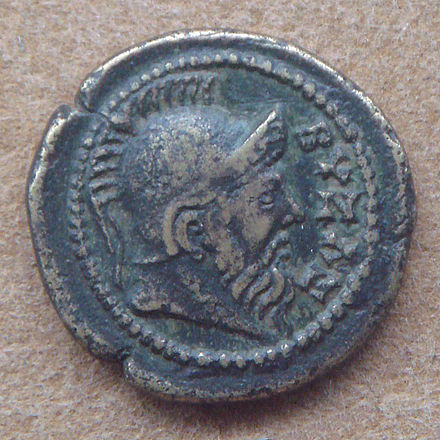
Coin of Byzas

Coin with depiction of Byzas
Wikimedia Commons, CC-BY-SA 3.0

Nonetheless, it was his wish and this wish came true not long after when his father told him about the order of the oracle at Delphi that would change his life forever. The oracle ordered him to find a land and settle a new colony opposite “the land of the blind” which was also called Chalcedon.

This was a great opportunity for him to make his wish come true so he accepted the order and set out to find a land where he and his fellow Megarians would settle and form a colony of the new world. Neither did King Nisou nor Byzas know at the time that he was going to put down the foundation of one of the greatest empires that the world will ever see.

Founding Byzantium

He found a perfect piece of land just opposite the Chalcedon which had a beautiful seaport and dynamic landforms. This land was everything that Byzas had wished for and he was surprised to know that the people of Chalcedon were in complete oblivion and had preferred to settle away from the port.

Nevertheless, he laid the foundation of the great empire of Byzantium opposite Chalcedon as ordered by the oracle and his father, King Nisou. The port is now known as the infamous Bosphorous port and the empire is now under Turkey, its European side.

The Megarian colonists, including Byzas, started planning and building the city from scratch. They built a colony at the mouth of the sea and took full advantage of the port. This port turned out to be the turning point for the empire as in no time it became one of the busiest ports in the world at that time.

Thus in 667 B.C.E, he founded Byzantium on the order of the oracle and rose the empire from dust to its glory, and around a millennium later, Byzantium was renamed Constantinopole.

History of Byzantium

The history of Byzantium is very interesting as this city withstood many wars, hostile takeovers, time, natural disasters, and various ruling parties. The city whose foundation was laid by a Megarian was in the eyes of many predatory rulers because of its position on the world map.

With time the friends of the state turned to foes and many new allies were formed. Byzas stayed the king of the empire until his death and after that many people claimed the empire as it was a newly built state.

Different Byzas’ in History

History has many great personalities named Byzas who have their own epic stories and tales to tell. Here we have talked about the one, the founder of the Byzantium empire in 667 B.C.E. Now we talk about the lesser known Byzus who has an incredible story in Greek mythology:

Son of Poseidon

In Greek mythology, Poseidon was an Olympian god of all water bodies and the brother of the great Olympian god, Zeus. According to Theogony by Hesiod, Poseidon had an estranged son named Byzas. Theogony is famous for iterating and enlisting the genealogy of Greek gods from the start of time. It is still debatable whether the one of Byzantium and one of the son of Poseidon are the same entities or not but both of them surely have a spot in history.

Poseidon and Keroessa bore Byzas. This story is not at all as simple and straightforward but is full of betrayal and deceit. It all started when Zeus fell in love with Io, the daughter of king Inachus who was the God of the River of Argos and the King of the City of Argos.

Zeus was already married to Hera and because Hera was known for committing brutalities against the lovers of Zeus, King Inachus transformed his daughter into a heifer in hopes of her safety from Hera.

Io was with the child then and when she regained her original form back, she gave birth to Keroessa. The latter then bore a son to Poseidon who had very peculiar patronage but nonetheless a very royal one.

FAQ

What Is Byzantium Called Today?

Byzantium is called Istanbul today but it acquired this name after many alterations. After around a Millenium, the infamous and unique name Byzantium was changed to Constantinopole. The land kept this name for a very long time until the rise of Turks who renamed it Istanbul. In the world today, Istanbul is very well known for its Bosphorous and also its beautiful and diverse culture.

Is There Any Town Named After a Nymph in Ancient Greece?

Yes, a small town in Ancient Greece is named after the nymph Semystra. The town was located in ancient Thrace and it thrived during the Greek colonization. But like many small towns and cities, this town also got lost in the geography of the world.

Conclusion

In this article, we took you through the life of Byzas. Here we summarize the article in some of the most important points:

  • He was an Ancient Greek colonist who laid the foundation of the great Byzantium empire in 667 B.C.E which would make a very prominent place on the world map.

  • He was the son of King Nisou of Megara. He spoke with the oracle of Apollo at Delphi and took orders from it. The oracle ordered him to find and settle a colony opposite Chalcedon and so he did.

  • The land he colonized was later named Byzantium and was at the mouth of the Bosphorous river. The city is now under Turkey and is now called Istanbul.

  • He stayed the king of the empire until his death and after that many people claimed the empire.

  • There exists another he in Greek history who was the son of Poseidon and Keroessa, who had the same name as the founder of Byzantium.

He was surely an important ruler in Greek history and mythology. He was the king and the founder of the Byzantium empire on the order of Apollo at Delphi.

By Ancient Literature

Created: February 15th, 2024

Modified: October 21st, 2024

The Beys: Original Rulers of the Ottoman Empire

The Beys: Original Rulers of the Ottoman Empire

The Beys were the first rulers of the Ottoman Empire. The provinces or regions which they controlled had the name beylik or governorate. They equated to duchies in other areas of Europe. Each country gave its beys different scopes of power. The fe...

January 11th, 2022 • Timeless Myths
Cadmus

Cadmus

When Zeus abducted his daughter Europa, Agenor (Ἀγηνωρ) sent his sons to find her, with the order not to come back until Europa was returned to him (see Minoan Crete, for her myth). Agenor's favourite child was Europa. Agenor was quite besotted ov...

May 6th, 1999 • Jimmy Joe
Cyzicus

Cyzicus

Cyzicus was a city in northern Mysia, situated on the coast of Sea of Marmara. It was named after the king of Doliones, who was accidentally killed by the Argonauts.

August 8th, 1999 • Jimmy Joe
Dardanus: The Mythical Founder of Dardania and Ancestor of the Romans

Dardanus: The Mythical Founder of Dardania and Ancestor of the Romans

Dardanus was the son of Zeus who established the city of Dardania in the northwestern Anatolian region of Troad. He was a king in Arcadia but had to relocate after a deluge displaced most of his citizens. According to Greek mythology, the floods w...

February 16th, 2024 • Ancient Literature
Thebes

Thebes

Thebes was a city of south east of Boeotia. It was founded by its first king, Cadmus, descendant of Io and brother of Europa. Thebes was originally called Cadmeia. Later, Cadmeia was the name of the citadel, while the entire city was renamed Thebe...

August 8th, 1999 • Jimmy Joe
Megara

Megara

Megara was a city situated on east side of the Isthmus of Corinth, a seaport to the Saronic Gulf. Its citadel was called Nisa. The city was founded by Car, son of Phoroneus. Later, Lelex, a descendant of Io, established a dynasty that ruled Megara...

August 8th, 1999 • Jimmy Joe
Early Kings of Athens

Early Kings of Athens

Cecrops I ErichthoniusCecrops I There is some confusion over who the earliest rulers of Athens were. Attica was probably originally called Acte or Actaea after its first king, Actaeüs (Actaeus). Cecrops married Actaeus' daughter Agraulus. Without ...

January 13th, 2001 • Jimmy Joe
Aegeus: The Reason Behind the Name of Aegean Sea

Aegeus: The Reason Behind the Name of Aegean Sea

Aegeus is associated with founding Athens and being the father of Theseus. There are a lot of important events to his name in the mythology. The death of Aegeus Greek mythology was surely very tragic and a result of a misunderstanding and forgetfu...

February 15th, 2024 • Ancient Literature
Rome

Rome

Rome (Roma) was a city-state on the banks of River Tiber, located in the region of ancient Latium. Although Rome is now larger than it was back then, Rome in ancient times occupied seven hills: Palatine, Capitoline, Quirinal, Viminal, Esquiline, C...

February 4th, 2008 • Jimmy Joe
House of Troy and Dardania

House of Troy and Dardania

The first ruler of the region around Troad was Teucer, the son of the river god Scamander. It was Dardanus, son of Zeus and the Pleiad Electra, who founded the kingdom and the dynasty of Dardania and Troy (or Ilium). Often, the names of the Dardan...

July 28th, 1999 • Jimmy Joe
Timeless Myths

Exploring mythology and legends from around the world.

Explore Myths

All Stories Characters All Articles Search Site Map

Mythologies

Norse Mythology Classical Mythology Celtic Mythology Arthurian Legends Mythology Gods Ancient Literature

About Us

Introduction About Jimmy Bibliography FAQs Retro Version

Resources

Timeless Myths All Stories All Articles Characters
© 1999-2026 Timeless Myths • Copyright • Privacy Policy • Cookie Policy • Contact
Follow us: