Timeless Myths Logo

Explore myths and legends from cultures around the world

Featured

Classical Mythology
Classical Mythology Greek and Roman myths, gods, heroes, and epic tales
Norse Mythology
Norse Mythology Vikings, Asgard, Ragnarok, and the nine realms
Celtic Mythology
Celtic Mythology Irish, Welsh, and Gaelic legends and folklore
Ancient Literature
Ancient Literature Classical texts, translations, and literary analysis

All Mythologies

Arthurian Legends King Arthur, Camelot, the Round Table, and the Holy Grail Egyptian Mythology Pharaohs, pyramids, and ancient Nile deities Japanese Mythology Shinto gods, spirits, and legendary creatures Chinese Mythology Dragons, immortals, and celestial beings Aztec Mythology Mesoamerican gods, rituals, and creation myths

Discover gods and goddesses from every pantheon

Featured

Greek Gods
Greek Gods The Olympians, Titans, and primordial deities
Norse Gods
Norse Gods Odin, Thor, Loki, and the Aesir and Vanir
Egyptian Gods
Egyptian Gods Ra, Osiris, Isis, Anubis, and more
Japanese Gods
Japanese Gods Amaterasu, Susanoo, and Shinto kami

All Gods & Deities

Roman Gods Jupiter, Mars, Venus, and the Roman pantheon Celtic Gods The Tuatha Dé Danann and Celtic deities Aztec Gods Quetzalcoatl, Tezcatlipoca, and Aztec deities Chinese Gods Jade Emperor, Dragon Kings, and celestial beings View All 150+ Deities Browse the complete collection of mythological deities
View all gods & deities

Tales, legends, and character profiles from mythology

Featured

All Stories
All Stories Browse 800+ mythology and history stories
Characters
Characters Profiles of 67 mythological heroes, gods, and villains

All Stories

Mythology Stories Ancient myths and legends retold History Stories Historical tales from ancient civilizations Religion & Culture Religious traditions and cultural beliefs
View all stories

Tools, references, and site information

Featured

Name Generators
Name Generators Generate fantasy and mythology-inspired names
All Articles
All Articles Browse 1,800+ articles on mythology and history

All Resources

About Timeless Myths Learn about this mythology resource Bibliography Sources and references used on this site FAQ Frequently asked questions Contact Get in touch with us
Search
Classical Mythology Greek and Roman myths, gods, heroes, and epic tales Norse Mythology Vikings, Asgard, Ragnarok, and the nine realms Celtic Mythology Irish, Welsh, and Gaelic legends and folklore Arthurian Legends King Arthur, Camelot, the Round Table, and the Holy Grail Egyptian Mythology Pharaohs, pyramids, and ancient Nile deities Japanese Mythology Shinto gods, spirits, and legendary creatures Chinese Mythology Dragons, immortals, and celestial beings Aztec Mythology Mesoamerican gods, rituals, and creation myths Ancient Literature Classical texts, translations, and literary analysis
Greek Gods The Olympians, Titans, and primordial deities Roman Gods Jupiter, Mars, Venus, and the Roman pantheon Norse Gods Odin, Thor, Loki, and the Aesir and Vanir Egyptian Gods Ra, Osiris, Isis, Anubis, and more Celtic Gods The Tuatha Dé Danann and Celtic deities Aztec Gods Quetzalcoatl, Tezcatlipoca, and Aztec deities Japanese Gods Amaterasu, Susanoo, and Shinto kami Chinese Gods Jade Emperor, Dragon Kings, and celestial beings View All 150+ Deities Browse the complete collection of mythological deities View all gods & deities
All Stories Browse 800+ mythology and history stories Characters Profiles of 67 mythological heroes, gods, and villains Mythology Stories Ancient myths and legends retold History Stories Historical tales from ancient civilizations Religion & Culture Religious traditions and cultural beliefs View all stories
Name Generators Generate fantasy and mythology-inspired names All Articles Browse 1,800+ articles on mythology and history About Timeless Myths Learn about this mythology resource Bibliography Sources and references used on this site FAQ Frequently asked questions Contact Get in touch with us
Search Search the entire mythology archive
  1. Classical Mythology
    Pantheon Heroic Age Royal Houses Geographia Facts & Figures Genealogy Bibliography About Classical Myths
  2. Pantheon
    Creation Primeval Deities Titans Olympians Mother Goddesses House of Hades Thracian Deities Anatolian Deities Nymphs Minor Greek Deities Etruscan Deities Roman Deities The Wrath of Heaven Mysteries
  3. Olympians
    Twelve Gods Zeus (Jupiter) Poseidon (Neptune) Hera (Juno) Demeter Hestia (Vesta) Athena (Minerva) Apollo Artemis (Diana) Hermes (Mercury) Ares (Mars) Aphrodite (Venus) Hephaestus (Vulcan) Dionysus (Bacchus)
  4. Poseidon (Neptune)

Poseidon (Neptune)

Lord of the sea and also god of earthquakes and of horses. A son of the titans Cronus and Rhea, he was known as the Roman god of the sea, Neptune.
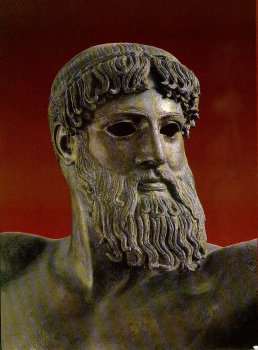
Poseidon of Artemision

Poseidon of Artemision
Bronze statue
Archaeological National
Museum, Athens

After aiding his brother Zeus when they overthrew Cronus and sent the other Titans to Tartarus, he received the sea as his domain. When he was not residing in Olympus, he lived with his Oceanid wife and queen, Amphitrite, in his underwater palace at Aegae. Poseidon was the father of the sea god Triton and two daughters – Rhodes and Benthesicyme.

Poseidon was always depicted as a powerfully muscular, bearded-man, carrying a mighty trident. One blow from his trident could split a rock open. He drove a two-horse chariot over the waves. In Hesiod's Theogony, Poseidon was called the Dark-haired One.

Like many sea deities he had the ability to change shape, but unlike some of them, he didn't have oracular power. Poseidon amorously pursued his sister Demeter. When she changed her shape into a mare to hide from him, Poseidon changed himself into a stallion and mounted her. He became the father of the immortal horse Arion and a daughter, Despoina (goddess of horses). Poseidon was also called a god of horses, known by his epithet as Hippios (or Consus).

His best known epithet was Enosichthon (Ἐνοσέχθων, "Earth-shaker"), which is also found on the Linear B tablets in Knossos: E-NE-SI-DA-O-NE (Enosidas). His other epithet was Gaieochus (Γεήοχος, "earthguarder").

Poseidon was also the father of another famous horse, Pegasus. When Poseidon seduced Medusa at Athena's shrine, the goddess transformed the unfortunate girl into a monster known as the Gorgon. Pegasus and the giant Chrysaor sprung out of the sea from the blood that fell from Medusa's severed head. (See Perseus.)

Like his brother Zeus, he had numerous affairs with nymphs and mortals. He also had many children by them. Some of his sons were gigantic in stature, like Antaeus, Otus and Ephialtes, the Cyclops Polyphemus, and possibly the great hunter Orion.

Poseidon had two important sons who sailed with Jason. One of them was the Miletian pilot Ancaeus, whose mother was Astypalea. Erginus was also his son and brother of Ancaeus, but Erginus played no important role. The other important Argonaut was Euphemus whose mother was Europa, the daughter of Tityus. Euphemus was a great runner who could run on top of the waves without getting his feet wet. Euphemus played an important role in the Clashing Rocks episode and later on when their ship was stranded in Libya. See the Argonauts.

His most famous son was the Athenian hero Theseus, by Aethra, though some say Aegeus was Theseus' father.

There was enmity between Poseidon and the Trojans which dated back to the time of Laomedon, father of Priam. Zeus punished Poseidon and Apollo by making the two gods work as builders of the walls of Troy. Laomedon promised to pay the gods with vines of gold. When the walls were completed, Laomedon refused to pay, breaking their contract. At first, Poseidon sent a sea monster to punish Troy, but the hero Heracles killed the monster. So during the Trojan War, Poseidon sided with the Greeks, though he saved a Trojan hero, Aeneas, son of the goddess Aphrodite and Anchises. He spirited Aeneas away from Achilles because Aeneas had to survive to rule the Trojans one day.

His favourite animals were the horse, the bull, and the dolphin, while pine was his sacred tree. His places of worship were Corinth, Argos, Troezen and Athens where he vied for recognition against the other deities.

In Argos, when he lost to Hera, Poseidon would sometimes dry up the rivers in Argos, while at other times he would flood the city.

In Athens, Poseidon vied against Athena. Poseidon demonstrated his power by striking a rock with his trident, causing sea water to gush from the spring in the Acropolis. Athena caused an olive tree to grow beside the spring. It was decided that the entire citizenship would vote. All the men had voted for the sea god, while all the women voted for the goddess. Since there was one more woman, Athena won the contest by one vote. The angry sea-god flooded the region of Attica. The Athenians, however, wisely continued to worship Poseidon, and Athena decreed that women were not allowed to vote in future elections, thereby appeasing the angry sea god.

Poseidon also contested against Helius, god of the sun, for the city of Corinth. The Corinthians, afraid to offend either god, decided to award the Isthmus to Poseidon while Helius received the heights of the Acrocorinth (the citadel of Corinth). The Isthmian Games were held in his honour.

Clearly, Poseidon was an important god during pre-Hellenic Mycenaean civilisation since his name, PO-SE-DA-O-NE, appeared frequently in the Linear B tablets. Poseidon also has a feminine name in the Linear B tablets, PO-SI-DA-E-JA. The centre of his worship appeared to be at Pylos during the Bronze Age. Poseidon was the father of the twins, Pelias and Neleus, by Tyro. While Pelias ruled in Iolcus, Neleus migrated to Pylos and became father of Nestor.

Related Information

Name

Poseidon, Ποσειδὣν – "Master" or "Drink-giver" (Greek).
PO-SE-DA-O-NE (Mycenaean), PO-SI-DA-E-JA (feminine).

Neptune (Roman).
Nethuns (Etruscan).

E-NE-SI-DA-O-NE – Enosidas "Earthshaker?" (Mycenaean).

Festivals

Isthmian Games.

Sources

The Iliad and the Odyssey were written by Homer.

Theogony and Works and Days were written by Hesiod.

Catalogues of Women was possibly written by Hesiod.

Homeric Hymns.

Library and Epitome were written by Apollodorus.

Metamorphoses was written by Ovid.

Fabulae and Poetica Astronomica were written by Hyginus.

Trojan Women and Hippolytus were written by Euripides.

The Aeneid and Georgics were written by Virgil.

There are too many other references to Poseidon, to be listed here.

Related Articles

See also Neptune.

Cronus, Rhea, Amphitrite, Theseus, Hippolytus.

Creation, Trojan War.

Facts and Figures: Astronomy.

Jimmy Joe Timeless Myths

By Jimmy Joe

Olympians:

  • • Twelve Gods
  • • Zeus (Jupiter)
  • • Poseidon (Neptune)
  • • Hera (Juno)
  • • Demeter
  • • Hestia (Vesta)
  • • Athena (Minerva)
  • • Apollo
  • • Artemis (Diana)
  • • Hermes (Mercury)
  • • Ares (Mars)
  • • Aphrodite (Venus)
  • • Hephaestus (Vulcan)
  • • Dionysus (Bacchus)
Poseidon

Poseidon

Poseidon God: The Legend of the Grumpy, Greedy God of the Sea Poseidon, god of the sea, had a temper. Though the ancient Greeks prized civility, dignity, and morality in their ordered society, the Greek gods were incredibly fallible. They regularl...

April 2nd, 2002 • Timeless Myths
Neptune

Neptune

Neptune | God of the Sea Neptune, god of the sea, was Jupiter’s brother in Roman mythology. He was also the god of fresh waters on earth as well as the patron of horses and horse racing. Neptune was Poseidon’s Roman name, and Poseidon and Neptune ...

April 2nd, 2002 • Timeless Myths
Amphitrite

Amphitrite

A sea-goddess. Amphitrite was a daughter either of Nereus and Doris or that of Oceanus and Tethys. In the Roman myths, Amphitrite was known as Salacia. Poseidon pursued her, but Amphitrite fled to the Titan Atlas for protection. Poseidon only marr...

April 24th, 1999 • Jimmy Joe
Triton

Triton

A minor sea-god. Triton was the son of the Olympian Poseidon and the Oceanid (or Nereïd) Amphitrite. Triton was the brother of Albion, Benthesicyme, Charybdis and Rhodes. Triton was often described as a merman and carried a horn, which he blew. Tr...

April 24th, 1999 • Jimmy Joe
Neptune

Neptune

Neptune was originally the minor god of fresh water and irrigation. It wasn't until the Romans identified him with the Greek Poseidon (399 BC) that he became the great god of the sea. His consort was Salacia (possibly Amphitrite). Neptune was also...

September 10th, 2000 • Jimmy Joe
Oceanus

Oceanus

Oceanus: The Procreating Pacifist Titan God of Water Oceanus ,Titan god of the sea, existed long before Poseidon. During the great war between the new Olympian gods and the Titans, he remained neutral, so he wasn’t punished with imprisonment. Stil...

April 2nd, 2002 • Timeless Myths
Pontus (Sea)

Pontus (Sea)

A personification of the sea. Pontus was born, along with Uranus ("Sky") and Ourea ("Hill"), from Gaea. Pontus literally means the "sea". Pontus lay with his mother Gaea and became the father of Nereus and Phorcys, and also Eurybia, Thaumas (fathe...

April 19th, 1999 • Jimmy Joe
Nereids

Nereids

The Nereïds (Nereids), or Νηρεΐδες, were sea nymphs, and were named after their father, Nereus. Their mother was the sea goddess Doris, who was an Oceanid. Below is the list of Nereids found in Hesiod's Theogony: Ploto, Eucrante, Sao, Amphitrite, ...

August 31st, 2002 • Jimmy Joe
Nethuns

Nethuns

God of fresh water. Nethuns has been identified with Neptune, who was also originally a god of wells and springs, before the Roman god inherited the attribute of the Greek sea god, Poseidon.

August 29th, 2004 • Jimmy Joe
Nereus

Nereus

An ancient sea-god. Nereus was the son of Pontus ("Sea") and Gaea ("Earth"). Nereus was the brother of Phorcys, Eurybia, Thaumas (father of Iris), and the sea monster Ceto. Nereus married an Oceanid named Doris who bore fifty sea-nymphs known as t...

April 19th, 1999 • Jimmy Joe
Timeless Myths

Exploring mythology and legends from around the world.

Explore Myths

All Stories Characters All Articles Search Site Map

Mythologies

Norse Mythology Classical Mythology Celtic Mythology Arthurian Legends Mythology Gods Ancient Literature

About Us

Introduction About Jimmy Bibliography FAQs Retro Version

Resources

Timeless Myths All Stories All Articles Characters
© 1999-2026 Timeless Myths • Copyright • Privacy Policy • Cookie Policy • Contact
Follow us: