Timeless Myths Logo

Explore myths and legends from cultures around the world

Featured

Classical Mythology
Classical Mythology Greek and Roman myths, gods, heroes, and epic tales
Norse Mythology
Norse Mythology Vikings, Asgard, Ragnarok, and the nine realms
Celtic Mythology
Celtic Mythology Irish, Welsh, and Gaelic legends and folklore
Ancient Literature
Ancient Literature Classical texts, translations, and literary analysis

All Mythologies

Arthurian Legends King Arthur, Camelot, the Round Table, and the Holy Grail Egyptian Mythology Pharaohs, pyramids, and ancient Nile deities Japanese Mythology Shinto gods, spirits, and legendary creatures Chinese Mythology Dragons, immortals, and celestial beings Aztec Mythology Mesoamerican gods, rituals, and creation myths

Discover gods and goddesses from every pantheon

Featured

Greek Gods
Greek Gods The Olympians, Titans, and primordial deities
Norse Gods
Norse Gods Odin, Thor, Loki, and the Aesir and Vanir
Egyptian Gods
Egyptian Gods Ra, Osiris, Isis, Anubis, and more
Japanese Gods
Japanese Gods Amaterasu, Susanoo, and Shinto kami

All Gods & Deities

Roman Gods Jupiter, Mars, Venus, and the Roman pantheon Celtic Gods The Tuatha Dé Danann and Celtic deities Aztec Gods Quetzalcoatl, Tezcatlipoca, and Aztec deities Chinese Gods Jade Emperor, Dragon Kings, and celestial beings View All 150+ Deities Browse the complete collection of mythological deities
View all gods & deities

Tales, legends, and character profiles from mythology

Featured

All Stories
All Stories Browse 800+ mythology and history stories
Characters
Characters Profiles of 67 mythological heroes, gods, and villains

All Stories

Mythology Stories Ancient myths and legends retold History Stories Historical tales from ancient civilizations Religion & Culture Religious traditions and cultural beliefs
View all stories

Tools, references, and site information

Featured

Name Generators
Name Generators Generate fantasy and mythology-inspired names
All Articles
All Articles Browse 1,800+ articles on mythology and history

All Resources

About Timeless Myths Learn about this mythology resource Bibliography Sources and references used on this site FAQ Frequently asked questions Contact Get in touch with us
Search
Classical Mythology Greek and Roman myths, gods, heroes, and epic tales Norse Mythology Vikings, Asgard, Ragnarok, and the nine realms Celtic Mythology Irish, Welsh, and Gaelic legends and folklore Arthurian Legends King Arthur, Camelot, the Round Table, and the Holy Grail Egyptian Mythology Pharaohs, pyramids, and ancient Nile deities Japanese Mythology Shinto gods, spirits, and legendary creatures Chinese Mythology Dragons, immortals, and celestial beings Aztec Mythology Mesoamerican gods, rituals, and creation myths Ancient Literature Classical texts, translations, and literary analysis
Greek Gods The Olympians, Titans, and primordial deities Roman Gods Jupiter, Mars, Venus, and the Roman pantheon Norse Gods Odin, Thor, Loki, and the Aesir and Vanir Egyptian Gods Ra, Osiris, Isis, Anubis, and more Celtic Gods The Tuatha Dé Danann and Celtic deities Aztec Gods Quetzalcoatl, Tezcatlipoca, and Aztec deities Japanese Gods Amaterasu, Susanoo, and Shinto kami Chinese Gods Jade Emperor, Dragon Kings, and celestial beings View All 150+ Deities Browse the complete collection of mythological deities View all gods & deities
All Stories Browse 800+ mythology and history stories Characters Profiles of 67 mythological heroes, gods, and villains Mythology Stories Ancient myths and legends retold History Stories Historical tales from ancient civilizations Religion & Culture Religious traditions and cultural beliefs View all stories
Name Generators Generate fantasy and mythology-inspired names All Articles Browse 1,800+ articles on mythology and history About Timeless Myths Learn about this mythology resource Bibliography Sources and references used on this site FAQ Frequently asked questions Contact Get in touch with us
Search Search the entire mythology archive
  1. Arthurian Legends
    Camelot Age of Chivalry Songs of Deeds Facts & Figures Genealogy Bibliography
  2. Genealogy
    House of King Arthur Merlin Houses of the Grail Keeper and the Grail Hero House of Cornwall
  3. Merlin

Merlin

  • Wild Man of the Woods

  • From Boy Prophet to Wizard

Wild Man of the Woods

The two different family trees, shown below, were derived from two different sources:

  • Various Welsh poems attributed to Myrddin, particularly in the Black Book of Carmarthen, c. 1250.

  • Vita Merlini, written by Geoffrey of Monmouth, c. 1150.

The Welsh Myrddin
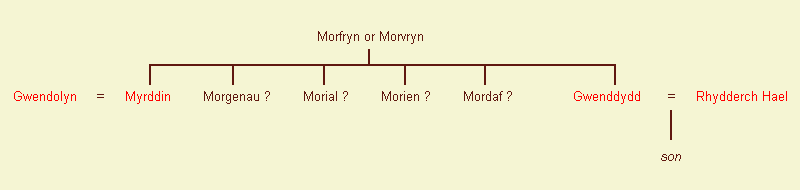
There are number of poems that are attributed to Myrddin found in the Black Book of Carmarthen. From these poems I was able to derive the relationship between him and his sister Gwenddydd. Myrddin may have been responsible for the killing of his nephew, the son of Gwenddydd, in the Battle of Arfderydd.

It is from The Dialogue Between Myrddin and his Sister Gwenddydd preserved in the Red Book of Hergest, where I found the name of Myrddin's father and possibly his four brothers. Myrddin and Gwenddydd were said to be twins.

See the Welsh Legend of Myrddin.

Geoffrey's Caldonius Merlin
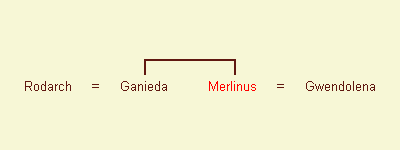
The source for the family tree of Caldonius Merlin came from Geoffrey of Monmouth's Vita Merlini, written in 1150 (see The Wild Man of the Woods). Geoffrey also wrote Historia regum Britanniae in 1137, in which Merlin first appeared as a boy and advised King Vortigern about his crumbling fortress walls. People have speculated that Geoffrey was writing about two different Merlins.

Geoffrey of Monmouth may have gotten his own sources from the Welsh poems attributed to Myrddin, and from the Scottish legend about Lailoken.

From Boy Prophet to Wizard

The three different family trees, shown below, were derived from three different sources:

  • Historia Brittonum, written by Nennius, 9th century.

  • Historia regum Britanniae, written by Geoffrey of Monmouth, 1137.

  • Merlin, written by Robert de Boron, 1200 (there is also a prose version of Merlin, which is part of the Vulgate Cycle, written in c. 1240).

Nennius' Ambrosius
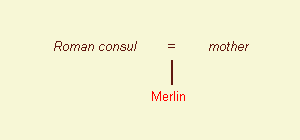
This family tree is based upon the account in Historia Brittonum, which Nennius wrote in the 9th century. Geoffrey of Monmouth based his Historia regum Britanniae (c. 1137) upon Nennius' work, changing and elaborating on the event where Vortigern tried to build a fortress, but its walls kept tumbling down.

In Nennius' account, the "boy born without a father" was named Ambrosius, not Merlin. Ambrosius is actually a Roman name for Emrys. After Ambrosius (Merlin) told the king what was causing the walls to collapse, he claimed that his father was a Roman consul, compared with Geoffrey claiming the boy's father was the devil or an incubus.

See either the Boy Prophet or Vortigern about this event.

Geoffrey's Merlin Ambrosius
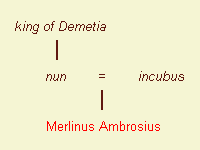
The genealogy above is based upon the Historia regum Britanniae, written by Geoffrey of Monmouth, in 1137. Geoffrey was the first to use the name Merlin (or Merlinus, since he had written the Historia in Latin).

He elaborated the scene, found in Nennius' Historia Brittonum (c. 9th century), about Vortigern trying to build a fortress which kept collapsing. It was in this scene that Vortigern met Merlin. Through his mother, Merlin was the grandson of the King of Demetia (Dyved). Merlin was the son of the devil (or incubus), but because of his baptism at birth, he had great wisdom and the remarkable ability to foretell the future. After Merlin finished explaining why Vortigern's fort kept collapsing, he revealed that his name was also Ambrosius.

See either the Boy Prophet or Vortigern about this event.

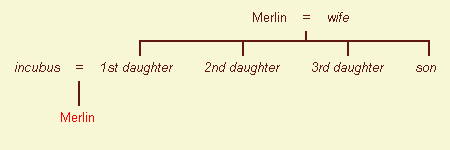
Geoffrey didn't give us much detail about Merlin's extraordinary birth. The next source was written by Robert de Boron, in his trilogy of verse romances about the Grail.

Boron's Merlin
Robert de Boron was a French poet who wrote a trilogy about the Holy Grail (c. 1200): Joseph of Arimathie, Merlin and Perceval.

It was in Merlin that Boron wrote an account about Merlin's birth. This poem also gave an account about the birth and fosterage of Arthur, and Arthur becoming king when he drew a sword out of an anvil or stone, but the account is fragmented. There is a prose version of Merlin, found in one of the five works of the Vulgate Cycle.

In that work, Merlin was indeed the son of the devil, but because his mother was a devout Christian, baptising her son immediately after birth, Merlin was not an evil creature of Satan. He retained his demonic power to know everything that had happened in the past, but he was also given God's gift to see the future.

We discovered that at birth, Merlin was named after his grandfather.

You will find an account about Merlin's birth in Timeless Myths, titled Son of the Devil?

Related Page

Merlin

Jimmy Joe Timeless Myths

By Jimmy Joe

Genealogy:

  • • House of King Arthur
  • • Merlin
  • • Houses of the Grail Keeper and the Grail Hero
  • • House of Cornwall
Merlin

Merlin

One of the most fascinating figures in the Welsh mythology and the Arthurian legend is Merlin, the great wizard, prophet and adviser to several kings, including King Arthur. In this page, we will take a closer look at the role that Merlin played, ...

September 29th, 2001 • Jimmy Joe
Taliesin

Taliesin

Taliesin: Myth of the Beautiful Bard Taliesin, poet, and bard, is the famed Welsh advisor and “entertainer” to the kings of yore. It’s not clear whether Taliesin was a myth, but there was a real Taliesin who lived during the 6th century. He was be...

April 2nd, 2002 • Timeless Myths
Morgan le Fay

Morgan le Fay

Morgan le Fay was the popular sorceress or fairy witch in the Arthurian legends. Morgan le Fay was the daughter of King Gorlois (Hoel) of Cornwall and Igraine. Most of the time, Morgan was identified as the half-sister of Arthur. Chretien de Troye...

April 2nd, 2000 • Jimmy Joe
Gwendoloena (Gwendoleu)

Gwendoloena (Gwendoleu)

Wife of Merlin (Merlinus or Myrddin). In Vita Merlini, Geoffrey of Monmouth wrote that when Merlin went mad during the Battle of Arfderydd and fled into the forest, Gwendoloena stayed with her sister-in-law Ganieda (Gwenddydd) in the court of King...

April 2nd, 2000 • Jimmy Joe
Mordred

Mordred

Before Geoffrey of Monmouth, the earliest mention of his name (as Medraut) was in the Annales Cambriae (10th century). A short passage says that Arthur and Medraut (Mordred) fell in the Battle of Camlann. The short statement was very ambiguous. Di...

April 2nd, 2000 • Jimmy Joe
King Arthur

King Arthur

Arthur is the name that inspired people to think of the Age of Chivalry, where a tall, impregnable castle overlooked a field of combats, a clash between two opposing armies or tournaments between jousting knights, or where we romanticised an armou...

April 2nd, 2000 • Jimmy Joe
Minor Characters

Minor Characters

The following list of characters are those who appear in the Arthurian legends. Some are prominent figures like Uther Pendragon, Ambrosius Aurelianus, Vortigern, Lot and Mordred. Others are minor characters, yet notable for their roles in the lege...

April 2nd, 2000 • Jimmy Joe
Guinevere (Guenevere)

Guinevere (Guenevere)

According to earlier legend, Arthur met Guinevere or Guenevere (she was called Guanhumara (Guenhuuara) by Geoffrey of Monmouth in the Historia regnum Britanniae) in the court of Duke Cador of Cornwall. Guinevere was the ward of Cador. Guinevere ca...

April 2nd, 2000 • Jimmy Joe
House of King Arthur

House of King Arthur

The genealogy of King Arthur and his family changed from one generation to another, during the medieval period. The main difference between one source and another is the number of sisters and half-sisters, or the number of nephews Arthur had. The ...

February 27th, 2001 • Jimmy Joe
House of Arthur & Culhwch

House of Arthur & Culhwch

The genealogy shown below is a Welsh version of King Arthur's family. The names shown here were found in Welsh tales and poems, mainly in the Mabinogion. However, I also used other sources such as the Black Book of Carmarthen, the Book of Taliesin...

January 20th, 2001 • Jimmy Joe
Timeless Myths

Exploring mythology and legends from around the world.

Explore Myths

All Stories Characters All Articles Search Site Map

Mythologies

Norse Mythology Classical Mythology Celtic Mythology Arthurian Legends Mythology Gods Ancient Literature

About Us

Introduction About Jimmy Bibliography FAQs Retro Version

Resources

Timeless Myths All Stories All Articles Characters
© 1999-2026 Timeless Myths • Copyright • Privacy Policy • Cookie Policy • Contact
Follow us: