Timeless Myths Logo

Explore myths and legends from cultures around the world

Featured

Classical Mythology
Classical Mythology Greek and Roman myths, gods, heroes, and epic tales
Norse Mythology
Norse Mythology Vikings, Asgard, Ragnarok, and the nine realms
Celtic Mythology
Celtic Mythology Irish, Welsh, and Gaelic legends and folklore
Ancient Literature
Ancient Literature Classical texts, translations, and literary analysis

All Mythologies

Arthurian Legends King Arthur, Camelot, the Round Table, and the Holy Grail Egyptian Mythology Pharaohs, pyramids, and ancient Nile deities Japanese Mythology Shinto gods, spirits, and legendary creatures Chinese Mythology Dragons, immortals, and celestial beings Aztec Mythology Mesoamerican gods, rituals, and creation myths

Discover gods and goddesses from every pantheon

Featured

Greek Gods
Greek Gods The Olympians, Titans, and primordial deities
Norse Gods
Norse Gods Odin, Thor, Loki, and the Aesir and Vanir
Egyptian Gods
Egyptian Gods Ra, Osiris, Isis, Anubis, and more
Japanese Gods
Japanese Gods Amaterasu, Susanoo, and Shinto kami

All Gods & Deities

Roman Gods Jupiter, Mars, Venus, and the Roman pantheon Celtic Gods The Tuatha Dé Danann and Celtic deities Aztec Gods Quetzalcoatl, Tezcatlipoca, and Aztec deities Chinese Gods Jade Emperor, Dragon Kings, and celestial beings View All 150+ Deities Browse the complete collection of mythological deities
View all gods & deities

Tales, legends, and character profiles from mythology

Featured

All Stories
All Stories Browse 800+ mythology and history stories
Characters
Characters Profiles of 67 mythological heroes, gods, and villains

All Stories

Mythology Stories Ancient myths and legends retold History Stories Historical tales from ancient civilizations Religion & Culture Religious traditions and cultural beliefs
View all stories

Tools, references, and site information

Featured

Name Generators
Name Generators Generate fantasy and mythology-inspired names
All Articles
All Articles Browse 1,800+ articles on mythology and history

All Resources

About Timeless Myths Learn about this mythology resource Bibliography Sources and references used on this site FAQ Frequently asked questions Contact Get in touch with us
Search
Classical Mythology Greek and Roman myths, gods, heroes, and epic tales Norse Mythology Vikings, Asgard, Ragnarok, and the nine realms Celtic Mythology Irish, Welsh, and Gaelic legends and folklore Arthurian Legends King Arthur, Camelot, the Round Table, and the Holy Grail Egyptian Mythology Pharaohs, pyramids, and ancient Nile deities Japanese Mythology Shinto gods, spirits, and legendary creatures Chinese Mythology Dragons, immortals, and celestial beings Aztec Mythology Mesoamerican gods, rituals, and creation myths Ancient Literature Classical texts, translations, and literary analysis
Greek Gods The Olympians, Titans, and primordial deities Roman Gods Jupiter, Mars, Venus, and the Roman pantheon Norse Gods Odin, Thor, Loki, and the Aesir and Vanir Egyptian Gods Ra, Osiris, Isis, Anubis, and more Celtic Gods The Tuatha Dé Danann and Celtic deities Aztec Gods Quetzalcoatl, Tezcatlipoca, and Aztec deities Japanese Gods Amaterasu, Susanoo, and Shinto kami Chinese Gods Jade Emperor, Dragon Kings, and celestial beings View All 150+ Deities Browse the complete collection of mythological deities View all gods & deities
All Stories Browse 800+ mythology and history stories Characters Profiles of 67 mythological heroes, gods, and villains Mythology Stories Ancient myths and legends retold History Stories Historical tales from ancient civilizations Religion & Culture Religious traditions and cultural beliefs View all stories
Name Generators Generate fantasy and mythology-inspired names All Articles Browse 1,800+ articles on mythology and history About Timeless Myths Learn about this mythology resource Bibliography Sources and references used on this site FAQ Frequently asked questions Contact Get in touch with us
Search Search the entire mythology archive
  1. Classical Mythology
    Pantheon Heroic Age Royal Houses Geographia Facts & Figures Genealogy Bibliography About Classical Myths
  2. Pantheon
    Creation Primeval Deities Titans Olympians Mother Goddesses House of Hades Thracian Deities Anatolian Deities Nymphs Minor Greek Deities Etruscan Deities Roman Deities The Wrath of Heaven Mysteries
  3. Olympians
    Twelve Gods Zeus (Jupiter) Poseidon (Neptune) Hera (Juno) Demeter Hestia (Vesta) Athena (Minerva) Apollo Artemis (Diana) Hermes (Mercury) Ares (Mars) Aphrodite (Venus) Hephaestus (Vulcan) Dionysus (Bacchus)
  4. Hephaestus (Vulcan)

Hephaestus (Vulcan)

A god of fire and metalworking. Hephaestus was known to the Romans as the fire-god Vulcan, as well as Mulciber (Gentle Touch).

Some say that Hephaestus was son of Zeus and Hera, but a more popular myth says that he was the son of Hera alone. When Zeus gave birth to Athena without a mother, Hera was jealous and decided to give birth to a child without a father.
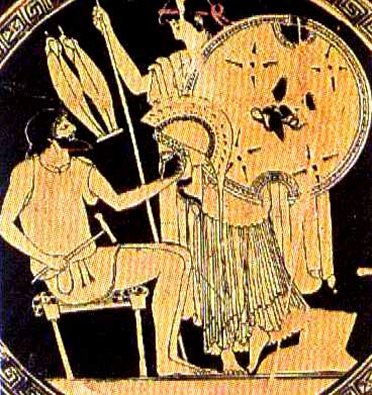
Hephaestus making helmet for Athena

Hephaestus (possibly making
armour for Thetis)
Red-figured pitcher, c. 480 BC
Museum of Berlin

There are several accounts as to how he became lame:

  • One said that Hephaestus was born lame.

  • Another account was that Hephaestus tried to protect his mother when she angered Zeus, by wrecking Heracles' ship in Cos. It was Zeus who threw Hephaestus out of heaven for aiding Hera. Hephaestus became crippled upon impact with the earth. The sea goddess Thetis saved Hephaestus, which was why he was later willing to make new armour for her son during the Trojan War.

  • Another popular version said that Hera, upon giving birth to Hephaestus without a mate, found him so ugly that she threw the infant out of Olympus. Hephaestus in anger created a golden throne and sent it to Olympus as a gift to his mother. Once Hera sat on the throne, she was bound to the chair by a golden fetter. The other gods tried to persuade Hephaestus to release his mother. Hephaestus released her either because Dionysus got him drunk or in return for being promised Aphrodite in marriage.

In the Iliad, he is known as husband of Aglaea, the youngest of the Graces, but in the Odyssey, his wife was Aphrodite (Venus) who had numerous affairs, particularly with the war god Ares.

Homer tells an amusing story about how Hephaestus set a trap for his wife and her lover. During Hephaestus' apparent absence, he captured Aphrodite with the war god in a golden net when they were on the bed, naked. Hephaestus then called upon the other gods to witness their embarrassing affair while they were naked and helpless. Many of the Olympians were amused by the adulterers' embarrassment.

Hephaestus refused to release them until Poseidon persuaded him that he himself would pay for their bond and indemnity. Poseidon had a hidden motive for having Aphrodite released, because the Lord of the Sea found himself attracted to the nude Aphrodite. See Love and War Bound.

Hephaestus had once tried to ravish the virgin goddess Athena. His attempt failed, and his semen fell on the ground (Gaea) at the Acropolis. From the earth, an earth-born creature was born named Erichthonius. Erichthonius was a half-man and half-serpent, who would later become one of the earliest kings of Athens. See Athena or the House of Athens for more detail.

Hephaestus may have had another son named Palaemon of Aetolia, who was one of the Argonauts. Others say that Palaemon was the son of Lernus.

As the metal-smith of the gods, he made many pieces of armour and weapons for the gods as well as building their beautiful palaces in Olympus. He also made armour for mortals such as Heracles, Peleus, husband of Thetis, and Achilles, the son of Peleus and Thetis. He made the armour for Achilles at Thetis' request, because she had rescued him when he fell from heaven. Some say that the Cyclops worked under Hephaestus' supervision.

During the Trojan War, he favoured the Greeks. When the river god Scamander tried to drown Achilles, Hephaestus used his fire to dry the river. Scamander quickly submitted to Hephaestus and never helped the Trojans again.

Related Information

Name

Hephaestus, Hephaistos, Ἥφαιστος – "Shining Day" (Greek).

Vulcan (Roman).
Mulciber – "Gentle Touch" (Roman).
Sethlans (Etruscan).

Sources

Homeric Hymns.

The Iliad and the Odyssey were written by Homer.

Theogony and Works and Days were written by Hesiod.

Catalogues of Women and Great Eoiae were possibly written by Hesiod.

The Cypria was work that comes from the Epic Cycle.

Library and Epitome were written by Apollodorus.

Metamorphoses was written by Ovid.

Fabulae and Poetica Astronomica were written by Hyginus.

Prometheus' Bound was written by Aeschylus.

Argonautica was written by Apollonius.

The Aeneid was written by Virgil.

The Golden Ass was written by Apuleius.

There are too many other references to Hephaestus, to be listed here.

Related Articles

See also Vulcan.

Hera, Zeus, Aphrodite, Ares, Athena, Poseidon.

Love and War Bound.

Jimmy Joe Timeless Myths

By Jimmy Joe

Olympians:

  • • Twelve Gods
  • • Zeus (Jupiter)
  • • Poseidon (Neptune)
  • • Hera (Juno)
  • • Demeter
  • • Hestia (Vesta)
  • • Athena (Minerva)
  • • Apollo
  • • Artemis (Diana)
  • • Hermes (Mercury)
  • • Ares (Mars)
  • • Aphrodite (Venus)
  • • Hephaestus (Vulcan)
  • • Dionysus (Bacchus)
Hephaestus

Hephaestus

Hephaestus: The Greek God of Fire and the Master of Metallurgy Hephaestus, god of the forge and fire in Greek mythology, was the ugliest god in the pantheon. It’s what he’s best known for as well as his skill as a blacksmith and metalworker. Becau...

April 2nd, 2002 • Timeless Myths
Vulcan

Vulcan

Vulcan | The God of Fire and the Forge Vulcan, god of fire and forge, was the ugliest god in Roman mythology. He has rather a sad history, starting with hatred from his mother. However, Vulcan was a skilled blacksmith, and so he was the patron of ...

April 2nd, 2002 • Timeless Myths
Vulcan

Vulcan

Vulcan was the Roman god of fire and the volcano. Vulcan had two epithets – Mulciber and Quietus. Vulcan was identified with the Greek god Hephaestus, inheriting his attributes. His Etruscan counterpart was Sethlans. Vulcan became the metal-smith ...

September 10th, 2000 • Jimmy Joe
Love and War Bound

Love and War Bound

Hephaestus (Vulcan), the smith and craftsman of the gods, was married to Aphrodite (Venus), the goddess of love and beauty. It was not a happy marriage because they had no children and Aphrodite was an unfaithful wife, having children with gods an...

June 22nd, 2000 • Jimmy Joe
Aphrodite (Venus)

Aphrodite (Venus)

The goddess of love and beauty. She was identified with the Roman goddess Venus. There are two versions of her birth. According to Homer, Aphrodite was known as the daughter of Zeus and Dione. Dione was either a Titaness, the daughter of Uranus an...

April 19th, 1999 • Jimmy Joe
Hermes (Mercury)

Hermes (Mercury)

Herald and messenger of the gods. Hermes was son of Zeus and Maia (a Pleiad, see the Pleiades), a daughter of Atlas and Pleïone (Pleione). He was identified as the Roman god Mercury. Hermes was born in a cave within the forest near the mountain of...

April 19th, 1999 • Jimmy Joe
Aphrodite

Aphrodite

Aphrodite: The Most Beautiful and Alluring Greek Sex Goddess Aphrodite, goddess of love and desire in Greek mythology, was the most beautiful and alluring of all the gods. Born from sea foam, she emerged and became the goddess of love, passion, an...

April 2nd, 2002 • Timeless Myths
Thetis

Thetis

A sea-goddess. She was one of the sea-nymphs known as the Nereids. Thetis was the daughter of Nereus and Doris. By far, Thetis was probably the most important sea-goddess because she played a prominent role in several important events in Greek myt...

April 24th, 1999 • Jimmy Joe
Ares (Mars)

Ares (Mars)

God of war. Ares was a son of Zeus and Hera, and was known as the Roman god, Mars. Ares was the brother of Hebe, Eileithyia and possibly of Hephaestus, though most writers say that Hephaestus was son of Hera alone. Ares may possibly appear in the ...

April 19th, 1999 • Jimmy Joe
Hestia

Hestia

Hestia: The Greek Goddess of the Home and Protector of Families Hestia, goddess of the hearth and home, was the patron of all things to do with families and the household. There was always a fire lit for Hestia in her temples. She was one of the e...

April 2nd, 2002 • Timeless Myths
Timeless Myths

Exploring mythology and legends from around the world.

Explore Myths

All Stories Characters All Articles Search Site Map

Mythologies

Norse Mythology Classical Mythology Celtic Mythology Arthurian Legends Mythology Gods Ancient Literature

About Us

Introduction About Jimmy Bibliography FAQs Retro Version

Resources

Timeless Myths All Stories All Articles Characters
© 1999-2026 Timeless Myths • Copyright • Privacy Policy • Cookie Policy • Contact
Follow us: