Ismene in Antigone: The Sister Who Lived

Who is Ismene in Antigone?
Ismene in Antigone is the sister of Antigone and the youngest daughter of Oedipus and Jocasta. She is a loyal but cautious sibling. In contrast to Antigone's headstrong personality, Ismene is reasonable and understands her place. Fearful of Creon, she steps back in the fight between Antigone and Creon, allowing her sister to take the reins and the punishment.
Who Is Ismene in Antigone?
Ismene acts as the voice of reason for her sister, Antigone, as they struggle to accept the terms of Creon's decree. At the start of the play, we can see her trying to talk down Antigone, asking her to fear for her life as well as Ismene's. She pleads with her older sister to concede and not to rebel against the laws of man; to fear the consequences of their already ill-fated family. Her fear mirrors that of the people of Thebes, but to fully understand who she is as a character and her fears, we must go into the details of the play and go over the events that she and her family have gone through.
Antigone
The play opens with Antigone and Ismene arguing over the lack of burial for their brother, Polyneices. Creon had issued a law that would prevent their brother from getting a proper burial, and anyone who does bury the body is stoned to death. Antigone voices out her plans to bury their brother despite the imminent threats of death and asks Ismene for her help. Ismene falters, fearful for her life, and with this, Antigone decides to bury her brother by herself.
Antigone marches to the palace grounds with the intent to bury Polyneices, but in doing so is caught by the palace guards who take her to Creon for her disobedience. Creon sentences her to be entombed alive, going against another law of the gods. Ismene, present in the court, shouts her involvement in the crimes, stating that she too planned to bury her brother. Antigone refutes this and emphasizes that she and only she were caught in the burial's simple act. Ismene marches up to Antigone and says, "No, sister, do not dishonor me, but let me die with you and honor him who died." Antigone shakes her head and tells Ismene that her death was enough. Antigone is then brought to the cave where she is to be entombed, awaiting her death.
Haemon, who is Antigone's fiancé and Creon's son, argues for the release of his lover yet is refused by the king of Thebes. Resolute in his love for his lover, Haemon marches to Antigone to free her. Upon arrival in the tomb, he sees Antigone hanging from her neck and cold as a corpse—she had taken her life. Haemon decides to take his own life, distraught and in pain, to follow his love to the underworld.
At the same time, Tiresias, the blind prophet, warns Creon of angering the Gods. He saw symbols in a vision that equate to garnering the wrath of the Gods. Creon tries to make Tiresias understand his point, and Tiresias refutes him and warns him of the tragedy that awaits his fate. Upon careful reconsideration, Creon immediately rushes to the cave where Antigone is imprisoned. He sees his son's corpse and was frozen in grief. He brings Haemon's body back to the palace only to have his wife kill herself as well.
Antigone and Ismene

Ismene in Antigone
Both Ismene and Antigone represent familial duty in Sophocles' play, but Antigone takes the heroic role further. Unlike Antigone, Ismene seems to have a stable life and psyche. She does not share Antigone's rash nature, who plunges headfirst into the arms of a tiger.
Despite Ismene's devotion to her family, her actions do not equal the sacrifices Antigone has made in the play and, in so doing, are continually in her sister's shadow.
The differences between Antigone and Ismene show from the start of the play; Ismene seems paralyzed by her identity as a woman, while Antigone is rooted in her beliefs, bulldozing her way to her version of justice. Ismene is emotional, contrasting the passionate character of her sister, and yields to authority. From the beginning of the play, Ismene's fear of challenging Creon and his laws prevents her from joining hands with Antigone in her bold plans. This cements the different paths both sisters take and the contrasting nature of their fates. In the play, we witness the sisters' close relationship; Ismene's words and actions portray the love and care she has for Antigone.
Despite their contrasting characters and the differences they share, they love one another significantly, willing to sacrifice all to keep the other safe. This is seen in how Ismene shouts her involvement in the plot despite having none and Antigone refusing to allow Ismene's death for her crimes. Ismene, the only living sibling after the death of Antigone, seems to vanish at the end; this is from her realization that without Antigone, she has nothing left to live for and, in so, disappears into the background.
Antigone and Ismene establish one of the play's central themes, Mortal law vs. Divine law. Ismene, fearful of Creon's decree, points out that the passed law is now the law of the land; this is in contrast to Antigone's unwavering belief in divinity. Antigone feels that the laws of the gods are more important than that of men and rushes headfirst to correct this mistake, barring all consequences.
Ismene's Character Traits
Ismene in the play is written as a blonde, radiant, full-figured woman known as the goody two shoes of the family. She is said to be reasonable, understanding her place in the war and bowing to authoritative figures. For this sole characteristic, she tries to dissuade and voice out reason to Antigone, fearing the death of her beloved sister. She is the exact opposite of Antigone and acts as her foil. Ismene's devotion to her family is seen in her begging to be with her sister in death. Antigone refuses to let Ismene join her in the glory of her death but softens as she considers her sister's weeping. She tells her that it would be pointless to die for something she was not responsible for as she is dragged away to the tomb. Their love for one another is yet again portrayed in the play.
Conclusion
We've talked about Ismene and her involvement in Sophocles' play. Let us go over some key points in this article:
Ismene is the younger daughter of Oedipus and Jocasta, Antigone's younger sister, and the goody two shoes of the family.
Ismene is written as a blonde, radiantly beautiful woman who is devoted to her family.
Ismene is known to be emotional and fearful of authority, conceding to Creon's oppressive laws and understands her place in the chaos.
Ismene seems paralyzed by her identity as a woman; she uses emotions as her driving force, yielding to those in authority; this contrasts the passionate character of her sister, Antigone, who actively seeks justice.
From the beginning of the play, we see Ismene trying to talk the steadfast Antigone down from her plans of rebellion, begging her to fear for her life.
Antigone refuses to as plans to bury their dead brother despite Creon's commands; she is caught in the act and is sentenced to be entombed alive to await her death.
Ismene weeps as she pleads to share the guilt and death with her beloved sister; Antigone refutes this as she did not want Ismene's death to be for something she was not at fault for.
The sisters' devotion to their family was deep as they loved and cared for each other, the only remaining family they had left.
Despite the contrasting characters of Antigone and Ismene, they love one another significantly, willing to sacrifice all to keep the other safe.
In Antigone's death, Ismene realizes that she no longer had anything to live for; she had no family to call her own, for every member of her family had been taken to the underworld, and so she fades into the background.
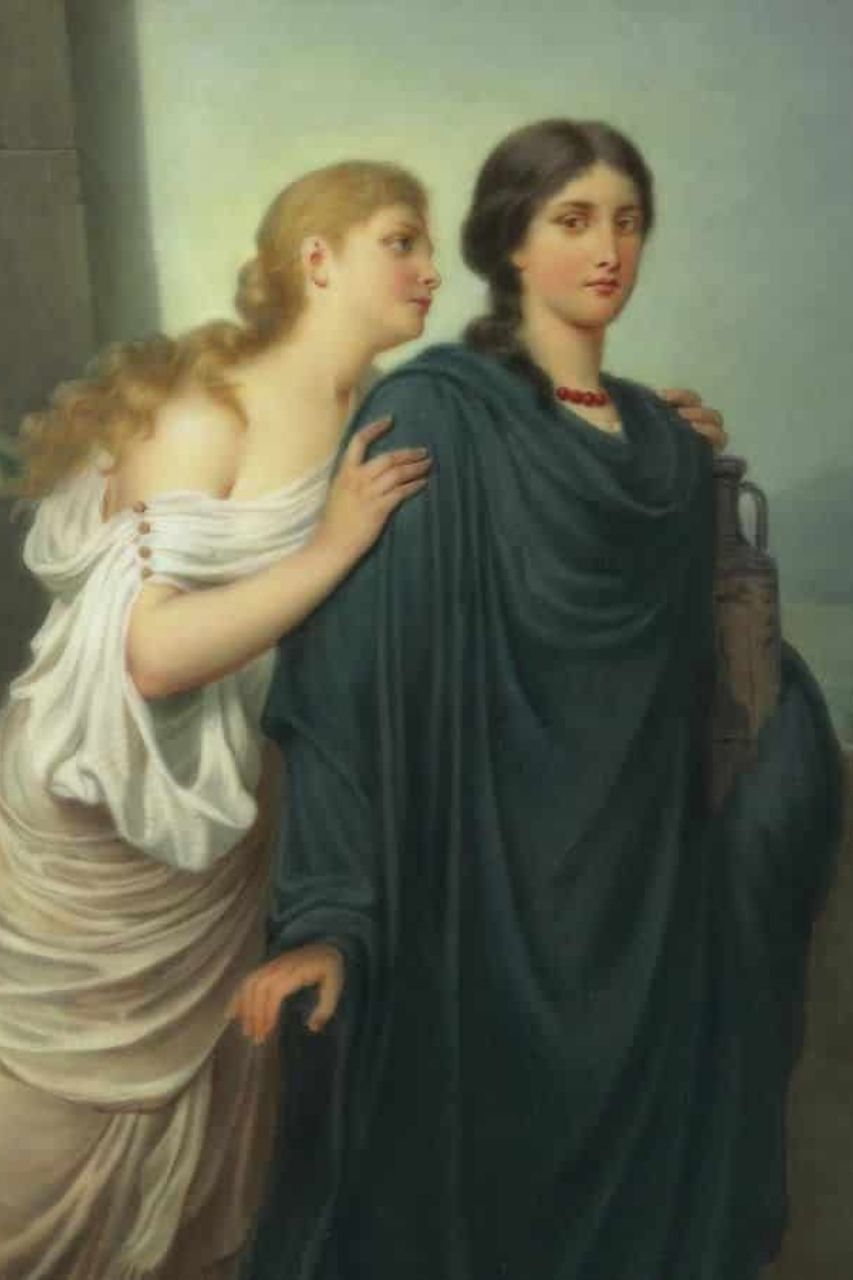
Antigone and Ismene
In conclusion, Ismene in Antigone plays the character with logic and emotions, contrasting Antigone's stubbornness and passion. The contrasting nature of both sisters balances out the play as we see the varying representatives of the play's central theme, Mortal laws vs. Divine laws. The direction of the space would have been altered or deterred without our heroine's contrasting sibling, who brings about fear and reasoning to the audience.
Ismene gives the audience a fresh perspective of what the citizens of Thebes are going through; inner turmoil. The laws passed by their king directly oppose that of the gods, yet if they go against him, their lives are at stake. The chaos and fear shown by Ismene mirror that of the citizens of Thebes. Despite their strong beliefs in divinity and their devotion to family, one cannot simply give up their lives in hopes for justice, and this is what Ismene portrays.