Timeless Myths Logo

Explore myths and legends from cultures around the world

Featured

Classical Mythology
Classical Mythology Greek and Roman myths, gods, heroes, and epic tales
Norse Mythology
Norse Mythology Vikings, Asgard, Ragnarok, and the nine realms
Celtic Mythology
Celtic Mythology Irish, Welsh, and Gaelic legends and folklore
Ancient Literature
Ancient Literature Classical texts, translations, and literary analysis

All Mythologies

Arthurian Legends King Arthur, Camelot, the Round Table, and the Holy Grail Egyptian Mythology Pharaohs, pyramids, and ancient Nile deities Japanese Mythology Shinto gods, spirits, and legendary creatures Chinese Mythology Dragons, immortals, and celestial beings Aztec Mythology Mesoamerican gods, rituals, and creation myths

Discover gods and goddesses from every pantheon

Featured

Greek Gods
Greek Gods The Olympians, Titans, and primordial deities
Norse Gods
Norse Gods Odin, Thor, Loki, and the Aesir and Vanir
Egyptian Gods
Egyptian Gods Ra, Osiris, Isis, Anubis, and more
Japanese Gods
Japanese Gods Amaterasu, Susanoo, and Shinto kami

All Gods & Deities

Roman Gods Jupiter, Mars, Venus, and the Roman pantheon Celtic Gods The Tuatha Dé Danann and Celtic deities Aztec Gods Quetzalcoatl, Tezcatlipoca, and Aztec deities Chinese Gods Jade Emperor, Dragon Kings, and celestial beings View All 150+ Deities Browse the complete collection of mythological deities
View all gods & deities

Tales, legends, and character profiles from mythology

Featured

All Stories
All Stories Browse 800+ mythology and history stories
Characters
Characters Profiles of 67 mythological heroes, gods, and villains

All Stories

Mythology Stories Ancient myths and legends retold History Stories Historical tales from ancient civilizations Religion & Culture Religious traditions and cultural beliefs
View all stories

Tools, references, and site information

Featured

Name Generators
Name Generators Generate fantasy and mythology-inspired names
All Articles
All Articles Browse 1,800+ articles on mythology and history

All Resources

About Timeless Myths Learn about this mythology resource Bibliography Sources and references used on this site FAQ Frequently asked questions Contact Get in touch with us
Search
Classical Mythology Greek and Roman myths, gods, heroes, and epic tales Norse Mythology Vikings, Asgard, Ragnarok, and the nine realms Celtic Mythology Irish, Welsh, and Gaelic legends and folklore Arthurian Legends King Arthur, Camelot, the Round Table, and the Holy Grail Egyptian Mythology Pharaohs, pyramids, and ancient Nile deities Japanese Mythology Shinto gods, spirits, and legendary creatures Chinese Mythology Dragons, immortals, and celestial beings Aztec Mythology Mesoamerican gods, rituals, and creation myths Ancient Literature Classical texts, translations, and literary analysis
Greek Gods The Olympians, Titans, and primordial deities Roman Gods Jupiter, Mars, Venus, and the Roman pantheon Norse Gods Odin, Thor, Loki, and the Aesir and Vanir Egyptian Gods Ra, Osiris, Isis, Anubis, and more Celtic Gods The Tuatha Dé Danann and Celtic deities Aztec Gods Quetzalcoatl, Tezcatlipoca, and Aztec deities Japanese Gods Amaterasu, Susanoo, and Shinto kami Chinese Gods Jade Emperor, Dragon Kings, and celestial beings View All 150+ Deities Browse the complete collection of mythological deities View all gods & deities
All Stories Browse 800+ mythology and history stories Characters Profiles of 67 mythological heroes, gods, and villains Mythology Stories Ancient myths and legends retold History Stories Historical tales from ancient civilizations Religion & Culture Religious traditions and cultural beliefs View all stories
Name Generators Generate fantasy and mythology-inspired names All Articles Browse 1,800+ articles on mythology and history About Timeless Myths Learn about this mythology resource Bibliography Sources and references used on this site FAQ Frequently asked questions Contact Get in touch with us
Search Search the entire mythology archive
  1. Classical Mythology
    Pantheon Heroic Age Royal Houses Geographia Facts & Figures Genealogy Bibliography About Classical Myths
  2. Royal Houses
    Aeolids House of Elis & Calydon Houses of Argolis House of Pelops Minoan Crete House of Thebes House of Sparta House of Athens Heraclids House of Troy Tales of Rome
  3. House of Thebes
    Cadmus Amphion & Zethus Oedipus Eteocles and Polyneices Creon After the War
  4. Oedipus
    Oedipus

Oedipus

Laïus (Laius or Laios; Λάιος) became the king of Thebes after the death of Amphion and Zethus. He married Jocasta (Ἰοκάστη; some authors call her Epicasta), daughter of Menoeceus and sister of Creon.

Laius had at one time visited Pelops, king of Pisa, as a guest. Pelops had an illegitimate son named Chrysippus by a nymph named Astyoche or Axioche. Because of Chrysippus' beauty, Laius fell in love with the youth. When Laius was training Chrysippus in driving a chariot, he abducted the boy and raped him. Feeling shame from his rape, Chrysippus fell on his sword. Of all his sons, Chrysippus was dearest to him. Pelops laid a curse upon the Theban king that would eventually be fulfilled.

When a son named Oedipus (Oidipous; Οἰδίπους) was born to the royal couple, Laïus learned from the oracle that his son would one day kill him and have children by his mother. Horrified of that possible future, he ordered his shepherd to expose the infant child on a mountain. However, the shepherd didn't have the courage to abandon the infant in the wild, and gave Oedipus to Merope or Periboea, wife of Polybus, the king of Corinth. They brought up Oedipus in Corinth as if the child were their own.

However, when Oedipus grew to manhood, he also learned from the oracle in Delphi that he would kill his father and marry his mother. Thinking that Polybus was his real father, Oedipus decided to never return to Corinth, hoping to avoid this horrible fate.

As he travelled, he encountered Laïus in his chariot with his armed escorts on their way to Delphi. For some unknown reason, the king attacked Oedipus. Oedipus unknowingly killed his father and all but one bodyguard. Creon, Laïus' brother-in-law, became king of Thebes upon hearing of Laïus' death.
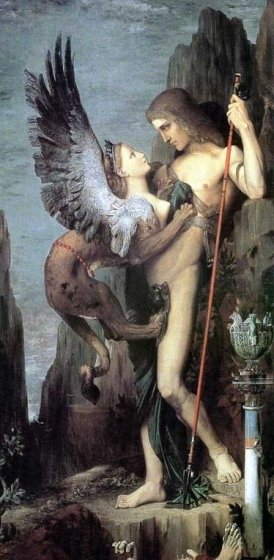
The Sphinx and Oedipus

The Sphinx and Oedipus
Gustave Moreau
Oil on canvas, 1864
Metropolitan Museum, New York

Outside of Thebes, a monster known as the Sphinx (Σφίγξ) had been killing travellers who couldn't answer her riddle. The riddle was "What creature walks on four legs in the morning, two legs at noon, and three in the evening?" The Sphinx had the head and chest of a woman and the body of a lion, and in many Greek paintings she might also have the wings of an eagle. Oedipus arrived and correctly answered the Sphinx' riddle, saying that it was man. Man, because an infant would crawl on its hands and feet; for most of his life, an adult would walk on two legs; but when he was old, he would have to rely on a walking stick. The Sphinx drowned herself.

When the Thebans heard that Oedipus had solved the riddle and gotten rid of the monster that had troubled their land, Creon gave the kingship to the young hero and unwittingly married his sister Jocasta to her own son. Jocasta became the mother of Eteocles, Polyneices, Antigone and Ismene.

They were happily married and over the years Thebes prospered under Oedipus' reign. Oedipus was known as a wise and just king.

After two decades, the land began to suffer from drought and famine or plague. Oedipus was determined to learn the truth of what was causing the woes to his kingdom. He learned that the plague was caused by the murder of Laïus, and his killer had gone unpunished. At the same time, he heard that Polybus had died of natural causes in Corinth.

Oedipus consulted the blind seer Teiresias, and questioned the shepherd and bodyguard. Teiresias was reluctant to tell Oedipus the truth. Gradually, Oedipus found out that Polybus wasn't his real father, nor was Merope his real mother. They had adopted him from the shepherd. From the shepherd, he learned that his father was actually Laius, and he had been left to die in the wild.

Oedipus and Jocasta realised that the fulfilment of the horrible oracle had occurred. To his horror, Oedipus realised that he had killed his own father and married his mother. Unable to deal with it, Jocasta hanged herself, while Oedipus put out his own eyes.

Death of Oedipus

When Oedipus first came to Thebes as a stranger, they welcomed him as their saviour, but with the blood of his father's on his hands, Thebes drove Oedipus out as a murderer. Oedipus went into exile, and Creon, his brother-in-law and uncle, became regent to Oedipus' two sons, Eteocles (Ἐτεοκλἣς) and Polyneices (Πολυνείκης). But the two brothers fought over the rule of Thebes, and war erupted between Thebes and Argos. Eteocles became king, while his brother was exiled. Polyneices sought refuge in Argos.

Oedipus wandered through the land, friendless and sightless; as a suppliant, he sought a place for his final rest. His daughter Antigone (Ἀντιγόνη) acted as his guide during Oedipus' journey. Ismene (Ἰσμήνη) travelled between Thebes and her father, with news about the kingdom.

According to another Athenian tragedy by Sophocles, Oedipus found a place to rest in Colonus, near Athens. Both Eteocles and Polyneices found out that if one of them managed to receive a blessing or support from their father, that son would win the war between the two of them. Instead of a blessing, Oedipus cursed both of his sons for not settling their differences. The curse would later have them kill one another in single combat.

Creon (Κρέων), Oedipus' uncle, had men to kidnap Antigone, hoping to force Oedipus into supporting Eteocles in the war, but Theseus, the Athenian hero and king, rescued her. Theseus allowed the king to die peacefully and had Oedipus buried in Colonus. Theseus returned Oedipus' daughters to Thebes. There are also other versions of Oedipus' exile and death, which I won't go into.

In the battle that followed, Thebes defeated the Argives army, but the war ended with the death of Eteocles and Polyneices. They killed one another, fulfilling their father's curse. (See Seven Against Thebes for details about the war).

Creon ruled again in Thebes, either as king or as regent to Laodamas, the son of Eteocles. Since Polyneices and the seven Argive leaders had attacked their city, no burial was allowed for their enemies. Antigone disobeyed Creon's order and buried her brother Polyneices. The other seven leaders were also given decent funerals, because of the suppliant of Adrastus to Theseus, king of Athens. Theseus and his army forced Creon and the Thebans to give up the bodies of their enemies.

Clearly, the last two works in the Theban cycle told by Sophocles were to bolster the greatness of the Athenian hero Theseus and Athens' place in the Seven Against Thebes myth.

According to the Catalogues of Women (Hesiod?), Oedipus died and was buried in Thebes; there is no mention here of Colonus or Theseus. It mentioned twice in this work that Argea, daughter of Adrastus and wife of Polyneices, came to Thebes and attended Oedipus' funeral, so this contradicts Sophocles' version that he was buried in Colonus.

Related Information

Name

Oedipus, Οἰδίπους – "Swollow Foot"
Oedipus, Oidipous.

Sources

Odyssey was written by Homer.

Oedipodea (lost) and Thebaid were the works of the Epic Cycle.

The following works written by Sophocles:
   Oedipus.
   Oedipus at Colonus.

Seven Against Thebes was written by Aeschylus.

The Phoenician Women was written by Euripides.

Library was written by Apollodorus.

Fabulae was written by Hyginus.

Thebaid was written by Statius.

Related Articles

Polyneices, Antigone, Teiresias, Adrastus, Theseus, Sphinx.

Seven Against Thebes, Epigoni

Genealogy: House of Thebes and the Houses of Seers.

Jimmy Joe Timeless Myths

By Jimmy Joe

House of Thebes:

  • • Cadmus
  • • Amphion & Zethus
  • • Oedipus
  • • Eteocles and Polyneices
  • • Creon
  • • After the War
Oedipus Rex

Oedipus Rex

(Tragedy, Greek, c. 429 BCE, 1,530 lines)Introduction – Oedipus Story “Oedipus the King” (Gr: “Oidipous Tyrannos”; Lat: “Oedipus Rex”) is a tragedy by the ancient Greek playwright Sophocles, first performed in about 429 BCE. It was the second of S...

January 1st, 2025 • Ancient Literature
Why Does Oedipus Leave Corinth? The Reasons Oedipus Abandons His Home

Why Does Oedipus Leave Corinth? The Reasons Oedipus Abandons His Home

Why does Oedipus leave Corinth in Oedipus Rex? He left to escape a prophecy, but the answer doesn’t become clear to the audience until the story is well underway. Oedipus eventually leaves Corinth after he was called a bastard by one of the guests...

January 11th, 2022 • Timeless Myths
Creon

Creon

Ruler and regent of Thebes. Creon (Κρέων) was the son of Menoeceus. Creon was a descendant of the Sparti. He was also the brother of Jocasta or Epicasta, who was first married to Laius, king of Thebes. Creon was married to Eurydice, and became the...

May 6th, 1999 • Jimmy Joe
Oedipus

Oedipus

(Tragedy, Latin/Roman, c. 55 CE, 1,061 lines)Introduction “Oedipus” is a tragedy by the Roman playwright Seneca the Younger, written around 55 CE. It is a retelling of the story of the unlucky King Oedipus, who finds out that he has unknowingly ki...

October 25th, 2024 • Timeless Myths
When did Oedipus Kill his Father – Find it out

When did Oedipus Kill his Father – Find it out

The literal answer is that the event took place in the second play of the trilogy, Oedipus Rex. There are debates, however, over the exact timeline. The murder is never recounted in real-time in the play. It is only referred to by various characte...

January 11th, 2022 • Ancient Literature
Eteocles and Polyneices

Eteocles and Polyneices

Eteocles (Ἐτεοκλἣς) and Polyneices (Πολυνείκης) were the sons of Oedipus and Jocasta. They were brothers of Antigone and Ismene. As brothers, they were bitter rivals and enemies. When Oedipus went into exile as a blind wanderer, Creon, Oedipus' un...

May 6th, 1999 • Jimmy Joe
Why Is Oedipus a Tragic Hero? An Analysis of Oedipus’s Character

Why Is Oedipus a Tragic Hero? An Analysis of Oedipus’s Character

Oedipus’ tragic flaw, his great leadership qualities, and the punishment he suffers are some of the most discussed themes in literature. In this article, you’ll find out who Oedipus is, what his tragic flaw is, and how it leads to his downfall. Bo...

April 3rd, 2022 • Timeless Myths
Antigone

Antigone

A Theban princess. Antigone (Ἀντιγόνη) was the daughter of Oedipus and Jocasta. Antigone was the sister of Eteocles, Polyneices and Ismene. She played an important part in the war between Argos and Thebes, which was called Seven Against Thebes. Sh...

June 22nd, 2003 • Jimmy Joe
Why Is Oedipus a Tragic Hero? Hubris, Hamartia, and Happenstance

Why Is Oedipus a Tragic Hero? Hubris, Hamartia, and Happenstance

Before Oedipus, "tragic hero" meant very little as a literary device. Ever since Aristotle outlined the qualities of tragic drama, scholars continue to debate whether or not there was a true tragic hero in Oedipus Rex. Read this article to learn m...

February 17th, 2024 • Ancient Literature
What Is The Tragic Flaw Of Oedipus

What Is The Tragic Flaw Of Oedipus

An oracle informs Laius of Delphi that he can only save the city of Thebes from certain destruction if he never fathers a child. The prophecy further predicts that if he fathers a son, the boy will murder him and take his wife for his own. Laius t...

February 16th, 2024 • Ancient Literature
Timeless Myths

Exploring mythology and legends from around the world.

Explore Myths

All Stories Characters All Articles Search Site Map

Mythologies

Norse Mythology Classical Mythology Celtic Mythology Arthurian Legends Mythology Gods Ancient Literature

About Us

Introduction About Jimmy Bibliography FAQs Retro Version

Resources

Timeless Myths All Stories All Articles Characters
© 1999-2026 Timeless Myths • Copyright • Privacy Policy • Cookie Policy • Contact
Follow us: