Antigone's Tragic Flaw and the Curse of Her Family
Oedipus Rex
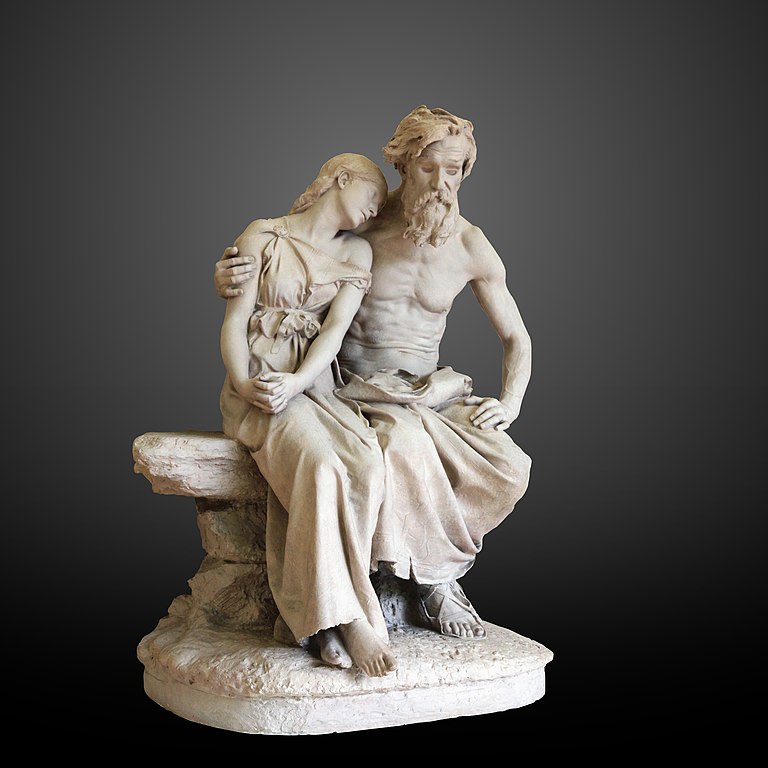
Oedipus at Colonus by Jean-Baptiste Hugues
The tragic life of Oedipus and his family are summarized in the following:
An oracle warns them of a vision where the son will eventually kill his father, King Laius
In fear, the king sends for one of his men to injure the infant's ankles and then be thrown into the river
Instead of throwing the infant's body into the river, the servant decides to leave him on the mountain
A shepherd hailing from Corinth was passing by and discovered the infant
He takes it to the king and queen of Corinth, who struggled to have a child of their own
King Polybus and Queen Merope adopted the child and named him Oedipus
Oedipus decides to trek to Delphi, where Apollo's temple resides
The oracle in the temple reveals his tragic fate: murdering his father
In fear of this, he decides never to go back to Corinth and instead settle in Thebes
On the journey to Thebes, he encounters an older man with which he gets into an argument
Blinded by rage, Oedipus kills the older man and his companions, leaving but one to escape
Upon reaching Thebes, Oedipus defeats the sphinx, regarding him as a hero, and eventually replaces the missing emperor
He marries the current Queen, Jocasta, and fathers four children with her: Ismene, Antigone, Eteocles, and Polynices
Years pass by, and drought arrives in the land of Thebes
He sends his wife's brother, Creon, to Delphi to investigate
The oracle speaks of the death of the previous emperor, asking them to find his murderer before settling the drought
Taking it upon himself to investigate, Oedipus is led to the blind man, Tiresias
Tiresias reveals that Oedipus was the murderer of the previous king
Upset by this, he goes to look for the witness
The witness turned out to be the survivor of the party he murdered
The wife then kills herself upon the realization of her sins
Oedipus thought back to the past: "if it was his fate to kill his father, and his father was the former king of Thebes and the late husband of his wife, then that meant he fathered his mother's children."
In shame, Oedipus blinds himself and leaves Thebes under the rule of both his sons. He exiles himself until the day he was struck by lightning and dies. The story continues to its sequel: Antigone.
How Antigone Was Brought to Death
Antigone's downfall and her fatal flaw is the main theme of this classic literature. But to completely understand how she ended up in her own tragedy, we must first shortly discuss what happens to her family after Oedipus' exile:
Because Oedipus left without a formal heir, the throne was left to both of his sons
Not knowing what to do and not wanting to fight, both brothers agreed to rule the kingdom in alternating years, in which Eteocles would lead first
When it was time for Eteocles to abdicate the throne and give the crown to Polynices, he refused and even went as far as banning his brother from Thebes
This brings about war; the two brothers fighting to the end for the crown
In the end, both Polynices and Eteocles die, leaving Creon to rule
Creon, their uncle, declares Polynices a traitor; refusing him a burial
Antigone voiced out her plans to bury her brother Polynices against Creon's order
Ismene, scared of death, second-guesses whether or not she should help
In the end, Antigone buries her brother alone and gets caught by a palace guard
Haemon, Creon's son and Antigone's fiance, warns his father that Antigone's death would cause another death
Creon orders Antigone to be locked up in a tomb
This angered the people, who believed Antigone is a martyr
Tiresias warns Creon of the consequences of locking up Antigone, who gained favor with the Gods
Creon rushed to the tomb and found both Antigone and Haemon dead
Creon cradled his son's body and brought him back to the palace
Upon hearing the news of her son's death, Eurydice, Creon's wife, kills herself
Creon finally realizes that he has brought all these tragedies upon himself
In the chorus, following the Gods and staying humble is essential not only to curry their favor but also to rule wisely
What Is Antigone's Major Flaw?

Antigone
Now that we've summarized both plays, discussed the family's curse, and explained the Gods' favor towards her, we can begin to analyze her character in depth. Like all characters, Antigone has a flaw, and though this may be subjective to some, we can all agree that this flaw is what unanimously brought her to her demise.
Antigone believes her flaw to be her strength; although her strength may be seen as a flaw, this is not what brought her to her untimely death. Antigone's major flaw was her loyalty, and her commitment was what brought her to the afterlife.
How Did Antigone's Fatal Flaw Lead Her to Her Downfall?
It is loyalty to her family, loyalty to the Gods, loyalty to her convictions that caused hamartia. Let me explain:
Loyalty to her family – Antigone couldn't sit idly by as Creon decreed his unjust law towards her brother. She couldn't stand that her brother wouldn't even be given a proper burial.
Despite the threat of being executed, her loyalty to her brother gave her strength in her conviction to carry out a move that could potentially cause her harm. She thought about the consequences of her decision and chose to push through. In the end, it led to her death.
Loyalty to the Gods – Despite the threat of death, Antigone pursues her plan to bury her brother. This is due to her devotion to the Gods. She claims to honor the dead more than the living.
This can be interpreted as her loyalty to her family and Gods weighing more than her loyalty to the ruler of her city-state. Without her loyalty to the Gods, Antigone could have lived for her remaining sibling, Ismene, and her lover, Haemon. Again, this loyalty to the Gods is what ends her life.
Loyalty to her convictions – Antigone, as seen in the play, is a hard-headed, single-minded woman who pursues what she believes in. Her loyalty to her beliefs gives her the strength to seek an end goal despite the threats she may face from it.
For example, her conviction to her brother's right to a proper burial gave her the strength to carry out such a task despite the threat of her life, which did end her life.
Her stubborn loyalty gave her strength to carry out her beliefs, and in the end, she met her downfall.
Antigone: The Tragic Heroine
Antigone's defiance against Creon for his tyranny is seen as an activist fighting for the divine law. She fought valiantly for her brother's right to be buried as per the will of the gods, and despite sacrificing her life, she still won.
She was able to bury her brother, ending the inner conflict between the citizens of Thebes. She displayed her bravery for all to see and gave hope to those fighting opposition and freedom of thought.
The Family's Curse
Although Antigone tried to take hold of her fate, her tragic end still reflects the curse of her father's mistakes.
Despite the chorus applauding Antigone for attempting to take the reins of her life, it understands that, like her brothers, she will have to ultimately pay for her father's past transgressions as well.
Regardless of the Gods' favors, Antigone could not be spared from the curse her family holds. Instead, it is terminated in her death.
How Did Antigone Garner Favor with the Gods?
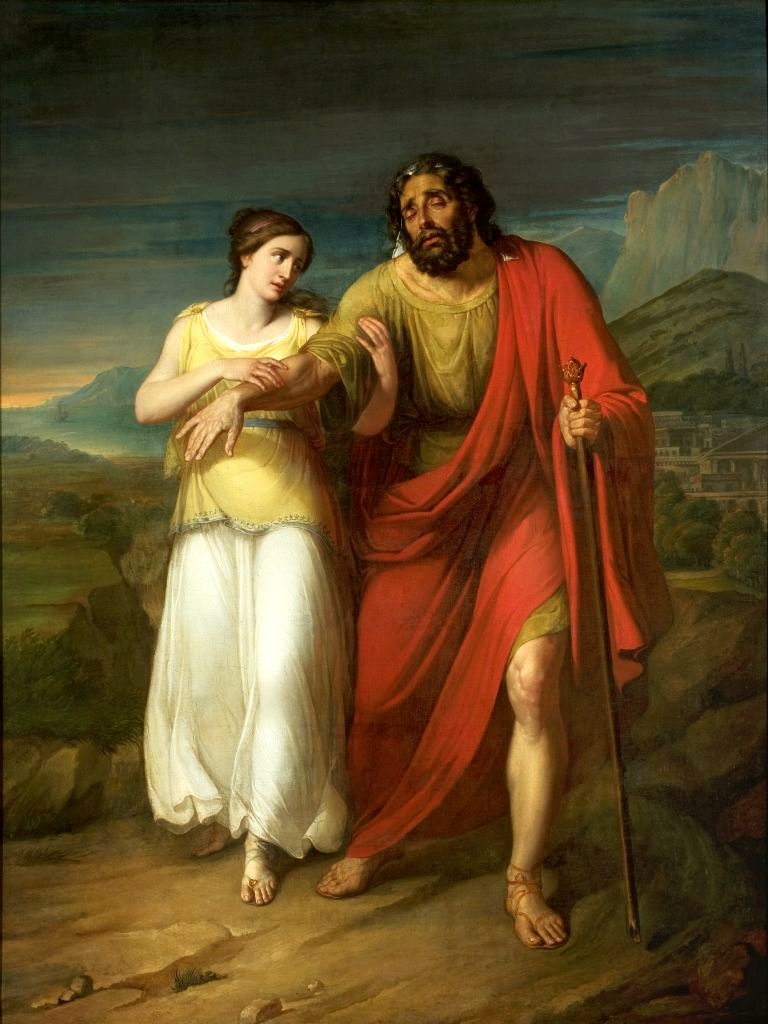
Kokular Painting Oedipus and Antigone from The Phoenician Women
Creon, in his decree, failed to uphold the laws of the Gods. He even went as far as opposing their will. The Gods decreed long ago that all living bodies in death and only death must be buried underground or in a tomb.
Upon leaving Polynices' body on the surface and refusing to give him a proper burial, Creon went against the laws the Gods commanded.
Antigone, on the other hand, went against his rule and even risked death to follow the gods' decrees; this was a show of devotion to the Gods which garnered their favor.
Conclusion
Now that we've talked about Antigone, her flaws, her family, and how she met her death, let's go through the critical points:
Antigone starts after the war in Thebes
Oedipus' sons fight for the throne, which leads to their deaths
Creon takes the throne and gave out an unjust law: refusing to bury Polynices killing anyone who would
Antigone buries Polynices and was sent to the cave to die by the orders of Creon
Upon Antigone's death, her fiance also killed himself
Eurydice (Creon's wife and Haemon's mother) kills herself after Haemon's death
Haemon realizes it's all his fault and lives his entire life miserably
Antigone's loyalty is a significant flaw that brought her to her death
Gods' law and the mortals' law are seen to clash in the second play
Her loyalty to the Gods' law coincided with her devotion to her brother and her loyalty to her convictions
And there we have it! A whole discussion of Antigone, her flaws, her character, her family, and the origins of her family's curse.