Creon's Wife: Eurydice of Thebes
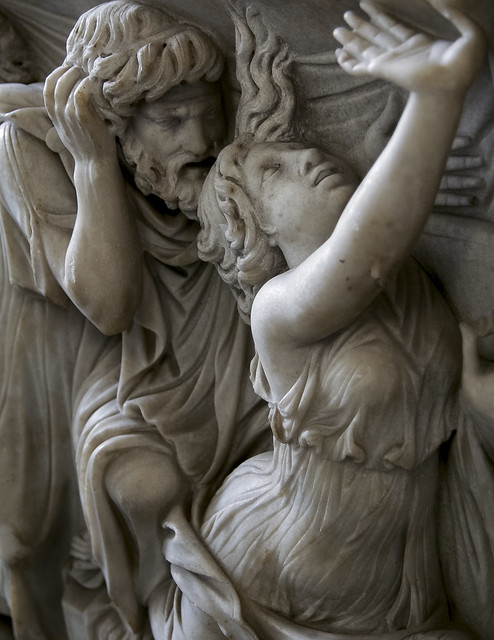
Creon and his dying daughter Creusa
When it comes to Antigone, knowing side characters such as Eurydice, better known as "Creon's wife," is crucial. They add more depth and color to the tale and will allow you to understand the events further. Together, let's explore the story, role, and purpose of Creon's wife, Eurydice.
Who Is Creon's Wife?
Eurydice of Thebes, the wife of Creon, is seen towards the end of the play stabbing a dagger to her heart. Despite playing a minute role, her character embodies strength tragically and realistically. To further understand the complexities of her character and her struggles, we must appreciate who Eurydice is.
Who Is Eurydice?
Eurydice is the wife of Creon, making her the Queen of Thebes. She is described as a loving mother and a kind-hearted woman. Although she was absent for most of the play, she still showed her love and devotion to her sons while in confinement.
Her time in solitude slowly led her to insanity, and upon hearing about her son Haemon's death, she decided to plunge a dagger directly into her heart. But what exactly happened for her to end her life bravely? To fully rationalize this, we must go back to the beginning, the start of her tragedy.
Who Is Creon?
Creon is Eurydice's husband and king of Thebes who refused the burial of Polyneices, leaving the body to the vultures. He was a prideful king that demanded loyalty from his subjects through fear. His unwavering resolve on the matter sowed discord and conflict within his people.
Just as stubborn as Creon, Antigone, who is resolute in her beliefs, goes against the decree and buries her brother. This move angers Creon; his decisions after that, and his refusal to heed any advice and warnings leads to both his beloved son and Eurydice's death.
The Tragedy of Eurydice
The tragedy of Oedipus Rex continues in its second play Antigone. Still, this time it isn't only Oedipus' direct familial kin that faces such a curse but extends to his brother-in-law's family as well. The events that led up to even Eurydice's death are as follows:
In the war to take over Thebes, one of Eurydice's son, Monoeceus participates in the war
In the gruesome battle for Thebes, Polyneices, Eteocles, and even Monoeceus lose their lives
Creon rises to power and prevents the burial of Polyneices
This angered Antigone, who later fought for her brother's right to be buried as divine law states
Antigone is caught burying her brother and is sentenced to death
Haemon, Creon's son and Antigone's fiancé, fights his father for her freedom
Creon refuses and sends him on his way
Haemon, in his plan to free Antigone, goes to the cave where she is entombed
He sees her hanging by her neck, pale and cold
Distraught, he kills himself
Creon rushes to free Antigone upon Tiresias' warnings
He sees both his son and Antigone dead
While all of this is occurring, Eurydice is confined in her room
Her grief for her son, Monoeceus' death, led her to insanity
Her deep lamentation was described as disheartening as she plowed her face with her nails, pulled out her hair from her scalp, and eventually lost her voice in her wails
As she slowly loses her mind in lamentation, news of her second son's death comes bearing upon her
Haemon's death was the tipping point of Eurydice's sanity
She took a dagger and plunged it into her heart while cursing her husband
The Start of the War
Defying Creon
The war begins with Eteocles' refusal to abdicate the throne and the events that happen after. Polyneices, exiled by his brother, treks to Argos, where he is betrothed to a princess. He informs his father-in-law of his desire for the Theban crown.
The king of Argos gives him seven armies to take over the land, so Polyneices and his armies ride off to war. During the battle in Thebes, Tiresias informs Creon of an oracle, the sacrifice of his son, Menoeceus would ensure Etecoles' victory and end the bloodshed. Creon refuses to sacrifice his son and instead sends him off to safety.
Menoeceus, in fear of being called a coward, participates in the war despite the lack of swordsmanship and eventually meets his end in the first clash. The tragic end to his life is what leads Eurydice to spiral and Creon to curse Polyneices.
Eurydice's Spiral
Eurydice of Thebes, upon the loss of her son, caused her tremendous grief and sorrow. Her deep lamentation worries her servants, who eventually decide to lock her in her bedroom for the queen's safety. In solitude, Eurydice slowly loses her sanity and blames Creon for her son's death.
Creon, who couldn't do anything to prevent her son's death despite the oracle. Creon, who could not advise Eteocles to stop the war. Creon, who kept supporting and egging the conflict by enabling Eteocles, left a bitter taste in her mouth.
Menoeceus as Creon's Pride
Menoeceus, the son of Eurydice, was described to have a giant statue and is the physical embodiment of Creon's pride. How was Monoeceus a representation of his father's pride? Allow me to expound; In the events of 'Seven against Thebes,' we see Tiresias' vision of a sacrifice.
The blind prophet states that if Creon sacrifices his son, Monoeceus, to the well then Eteocles would win. Creon sends his son away to protect him, but Monoeceus opts not to, in fear of being called a coward.
Despite having no training, no experience with war, and no talent for the sword, Monoecous joins a gruesome battle where he could lose his life all because he does not want to seem like a coward.
His pride was placed first above his safety, prioritizing it over anything else. His large stature also contributes to the symbolic reason for his demise; his ego, big enough for his reputation, leads him to death just as Creon's pride as a ruler leads his loved ones to death.
The Death of Her Second Son
Haemon, the son of both Creon and Eurydice, was meant to marry Antigone. The same Antigone buried her brother, despite Creon's wishes, and marched up to the consequences bravely. She was entombed alive as punishment and was sentenced to death by her uncle and father-in-law.
Haemon, who loved Antigone dearly, marched up to his father, demanding her pardon and release. When Creon refused his wishes, he foreshadowed his death in Antigone's death.
In Haemon's plan to release Antigone, he discovers her corpse hanging from her neck upon arriving in the cave. Distraught, Haemon kills himself to be with his love, leaving his father and his mother to grieve.
Creon
The Grief of a Mother
Upon hearing of her son's apparent suicide and the story that leads to it, Eurydice curses Creon. She, already grieving the death of Monoeceus, could not handle another source of sorrow. She loved her sons dearly, enough to lose her sanity over their tragic ends.
The chain of despair from the deaths of her beloved sons comes from the harsh reality of her husband's incompetency and mistakes. In Monoeceus' death, Creon was unable to protect his son despite the warning of his impending doom. In Haemon's death, Creon pushed his son to his demise due to his stubborn accord and tryst with a dead body.
Eurydice, Haemon's mother, wonders where it all went wrong and at this point, placed the blame on her husband. In her extreme grief and anguish, Eurydice decides to leave the mortal realm behind and follow her sons to the afterlife. She plunges a small sword into her heart and waits for her to end in tears.
Moral of the Story
The story's moral was to show the consequences of putting oneself on equal footing with the gods. It emphasizes the tragic effects that would occur to those who place their stubbornness and pride above anything else. It also shows that the gods did not forgive but instead, were vengeful and should not be angered.
The original curse from Oedipus's incestuous relationship with his mother and the sin he committed by murdering his father exhibit their vindictive nature. From being struck by lightning to his sons fighting, up to the morbid death and suicide of family members, the gods held no mercy in their punishments.
Conclusion
So we've discussed Eurydice, her sons, her grief, and the events that led up to her death so let us summarize all that has been said so far:
Eurydice is the Queen of Thebes and the wife of Creon
The battle that killed the twin brothers of Oedipus Is the same battle that kills Monoeceus
Her son's death brings Eurydice into great lamentation where she is confined by her servants who fear for her life and in her solitude slowly goes insane
Creon, as the Emperor decrees the rotting of Polyneices body, refusing to give him any form of burial.
Antigone buries her brother anyway, angering Creon
Creon, who committed sinful acts by refusing to bury the dead and entombing a well and alive woman, receives a warning from Tiresias
Antigone kills herself, and in so, Haemon kills himself
Eurydice hears of her son, Hameon's death, and curses Creon; She blames Creon for the death of both of her sons
In her dwindling sanity and added grief, Eurydice plunges a knife to her heart
Menoeceus is a representation of Creon's pride: his refusal to follow his father's orders for his safety in fear of being called a coward shows the size of both his ego and pride
Both Monoeceus and Creon brought tragedy to themselves by placing their feelings of pride above all else, relating to Tiresias' first warning; "An emperor cannot rule wisely if they rule with pride," he states in the argument of his laws
Creon's stubborn refusal to bury the dead and sacrilegious act entombing the living brings tragedy in the form of death to his loved ones
And there you have it! An analysis on Eurydice, who she is, how she is as a mother, how her grief led her astray, and how her husband's actions led her to her demise.