Timeless Myths Logo
Aphrodite Apollo Ares Artemis Athena Atlas Coeus Crius Cronus Demeter Dionysus Gaia Hades Hephaestus Hera Hermes Hestia Hyperion Iapetus Mnemosyne Oceanus Phobos Phoebe Poseidon Prometheus Rhea Tethys Themis Uranus Zeus
Bacchus Ceres Diana Juno Jupiter Mars Mercury Minerva Neptune Pluto Venus Vesta Vulcan
Amun Anubis Aten Atum Babi Bastet Bes Geb Hapi hathor heqet Horus Isis Khepri Khnum Khonsu Maat Nephthys Nut Osiris Ptah Ra Seshat Seth Shu Sobek Thoth
Alfheim Baldur Freya Freyr Frigg Heimdallr Helheim Idun Jotunheim Loki Nerthus Njord Odin Thor Tyr
Aengus Arawn Badb Brigid Cailleach Ceridwen Cernunnos Cu Chulainn Dagda Danu Gwydion Herne the Hunter Lugh Medb Morrigan Neit Nuada Taliesin Taranis
Chalchiuhtlicue Coatlicue Huitzilopochtli Mictlantecuhtli Mixcoatl Ometeotl Quetzalcoatl Tezcatlipoca Tlaloc Tonatiuh Xipe Totec Xochiquetzal Xolotl
Amaterasu Ame no Uzume Benzaiten Bishamonten Daikokuten Ebisu Fujin Fukurokuju Inari Izanagi Kagutsuchi Raijin Susanoo Tsukuyomi
Caishen Cangjie Dragon King Eight Immortals Erlang Shen Fuxi Guanyin Hou Yi Huxian Jade Emperor King Yama Leizi Lu-ban Mazu Nezha Nuwa Pangu Shennong Sun Wukong Xiwangmu Yue Lao Zhong Kui
Norse Classical Celtic Arthurian
Literature Stories Names
Aphrodite Apollo Ares Artemis Athena Atlas Coeus Crius Cronus Demeter Dionysus Gaia Hades Hephaestus Hera Hermes Hestia Hyperion Iapetus Mnemosyne Oceanus Phobos Phoebe Poseidon Prometheus Rhea Tethys Themis Uranus Zeus
Bacchus Ceres Diana Juno Jupiter Mars Mercury Minerva Neptune Pluto Venus Vesta Vulcan
Amun Anubis Aten Atum Babi Bastet Bes Geb Hapi hathor heqet Horus Isis Khepri Khnum Khonsu Maat Nephthys Nut Osiris Ptah Ra Seshat Seth Shu Sobek Thoth
Alfheim Baldur Freya Freyr Frigg Heimdallr Helheim Idun Jotunheim Loki Nerthus Njord Odin Thor Tyr
Aengus Arawn Badb Brigid Cailleach Ceridwen Cernunnos Cu Chulainn Dagda Danu Gwydion Herne the Hunter Lugh Medb Morrigan Neit Nuada Taliesin Taranis
Chalchiuhtlicue Coatlicue Huitzilopochtli Mictlantecuhtli Mixcoatl Ometeotl Quetzalcoatl Tezcatlipoca Tlaloc Tonatiuh Xipe Totec Xochiquetzal Xolotl
Amaterasu Ame no Uzume Benzaiten Bishamonten Daikokuten Ebisu Fujin Fukurokuju Inari Izanagi Kagutsuchi Raijin Susanoo Tsukuyomi
Caishen Cangjie Dragon King Eight Immortals Erlang Shen Fuxi Guanyin Hou Yi Huxian Jade Emperor King Yama Leizi Lu-ban Mazu Nezha Nuwa Pangu Shennong Sun Wukong Xiwangmu Yue Lao Zhong Kui
Norse Classical Celtic Arthurian
Literature Stories Names
  1. Classical Literature
    Greece Rome Other Ancient Civilizations Timeline of Classical Literature Alphabetical List of Authors Index of Individual Works Index of Important Characters Sources About Us
  2. Greece
    Homer Hesiod Aesop Sappho Pindar Aeschylus Sophocles Euripides Aristophanes Menander Apollonius of Rhodes
  3. Euripides
    Alcestis Medea (Euripides) Heracleidae (Euripides) Hippolytus (Euripides) Andromache (Euripides) Hecuba (Euripides) The Suppliants Electra Heracles (Euripides) The Trojan Women Iphigenia in Tauris Ion Helen (Euripides) The Phoenician Women The Bacchae Orestes Iphigenia at Aulis Cyclops

Euripides

(Tragic Playwright, Greek, c. 480 – c. 406 BCE)

Introduction

Euripides was the last of the three great tragedians of classical Greece (the other two being Aeschylus and Sophocles). Largely due to an accident of history, eighteen of Euripides' ninety-five plays have survived in a complete form, along with fragments (some substantial) of many of his other plays.

He is known primarily for having reshaped the formal structure of traditional Greek tragedy by showing strong female characters and intelligent slaves, and by satirizing many heroes of Greek mythology. He is considered to be the most socially critical of all the ancient Greek tragedians, and his plays seem quite modern in comparison with those of his contemporaries.
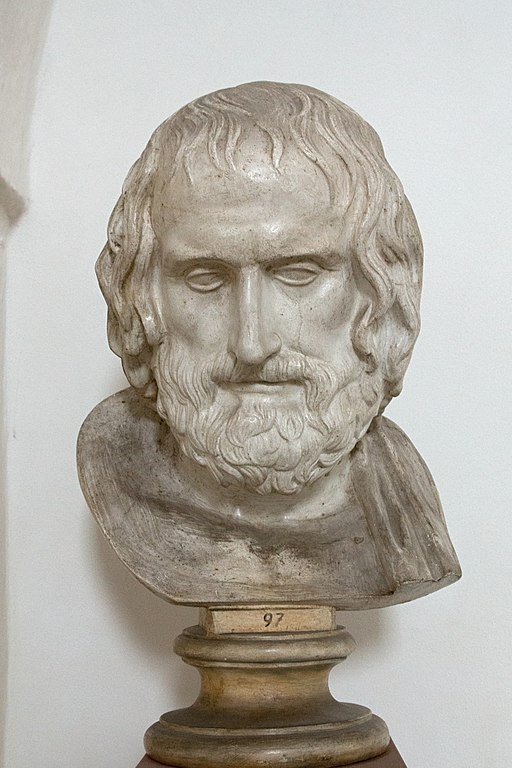
Marble bust of Euripides, ancient Greek tragic playwright

Marble bust of Euripides

Biography – Who is Euripides

According to legend, Euripides was born in Salamis in 480 BCE, at the location and on the day of the Persian War's greatest naval battle (although other sources estimate that he was born as early as 485 or 484 BCE). His family was probably a wealthy and influential one, and as a youth he served as a cup-bearer for Apollo's dancers, although he later grew to question the religion he grew up with, exposed as he was to philosophers and thinkers such as Protagoras, Socrates and Anaxagoras.

He was married twice, to Choerile and Melito, and had three sons and a daughter (who, it was rumoured, was killed after an attack by a rabid dog). We have little or no record of Euripides' public life. It is likely that he engaged in various public or political activities during his lifetime, and that he travelled to Syracuse in Sicily on at least one occasion.

According to tradition, Euripides wrote his tragedies in a sanctuary, known as The Cave of Euripides, on Salamis Island, just off the coast from Piraeus. He first competed in the Dionysia, the famous Athenian dramatic festival honoring Dionysus, in 455 BCE, a year after the death of Aeschylus (he came in third, reportedly because he refused to cater to the fancies of the judges). In fact, it was not until 441 BCE that he won first prize, and over the course of his lifetime, he claimed just four victories (and one posthumous victory for "The Bacchae"), many of his plays being considered too controversial and non-traditional for the Greek audiences of the day.

Embittered over his defeats in the Dionysia playwriting competitions, he left Athens in 408 BCE at the invitation of King Archelaus I of Macedon, and he lived out his remaining days in Macedonia. He is believed to have died there in the winter of 407 or 406 BCE, possibly due to his first exposure to the harsh Macedonian winter (although an improbable variety of other explanations for his death have also been suggested, such as that he was killed by hunting dogs, or torn apart by women).

Writings

The relatively large number of extant plays of Euripides (eighteen, with as many again in fragmentary form) is largely due to a freak accident, with the discovery of the "E-K" volume of a multi-volume alphabetically-arranged collection which had lain in a monastic collection for around eight hundred years. His best known works include "Alcestis", "Medea", "Hecuba", "The Trojan Women" and "The Bacchae", as well as "Cyclops", the only complete satyr play (an ancient Greek form of tragicomedy, similar to the modern-day burlesque style) known to survive.
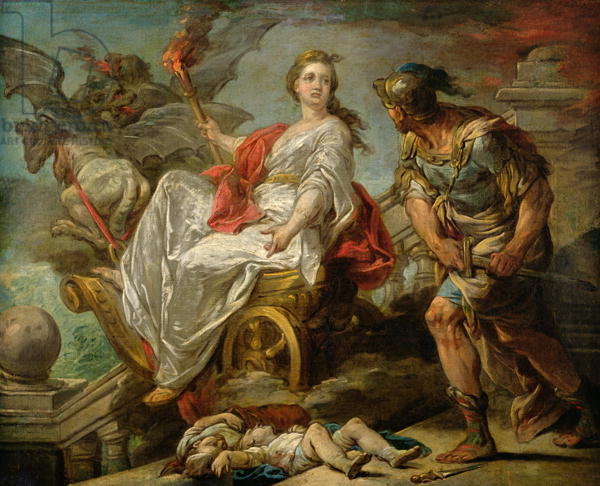
Jason and Medea by Charles André van Loo - depicting a scene from Euripides' famous tragedy

Jason and Medea by Charles André van Loo

To the plot innovations introduced by Aeschylus and Sophocles, Euripides added new levels of intrigue and elements of comedy, and also created the love-drama. It has been suggested by some that Euripides' realistic characterizations sometimes came at the expense of a realistic plot, and it is true that he sometimes relied on the "deus ex machina" (a plot device in which someone or something, often a god or goddess, is introduced suddenly and unexpectedly to provide a contrived solution to an apparently insoluble difficulty) to resolve his plays.

Some commentators have observed that Euripides' focus on the realism of his characters was just too modern for his time, and his use of realistic characters (Medea is a good example) with recognizable emotions and a developed, multi-faceted personality may actually have been one reason why Euripides was less popular in his own time than some of his rivals. He was certainly no stranger to criticism, and was frequently denounced as a blasphemer and misogynist (a rather strange charge given the complexity of his female characters) and condemned as an inferior craftsman, especially in comparison to Sophocles.

By the end of the 4th Century BCE, however, his dramas had become the most popular of all, in part due to the simplicity of the language of his plays. His works strongly influenced later New Comedy and Roman drama, and were later idolized by the 17th Century French classicists such as Corneille and Racine, and his influence on drama reaches modern times.

Major Works

The following are Euripides' surviving plays:

  • Alcestis

  • Medea

  • Heracleidae

  • Hippolytus

  • Andromache

  • Hecuba

  • The Suppliants

  • Electra

  • Heracles

  • The Trojan Women

  • Iphigenia in Tauris

  • Ion

  • Helen

  • The Phoenician Women

  • The Bacchae

  • Orestes

  • Iphigenia at Aulis

  • Cyclops

By Timeless Myths

Greece:

  • • Homer
  • • Hesiod
  • • Aesop
  • • Sappho
  • • Pindar
  • • Aeschylus
  • • Sophocles
  • • Euripides
  • • Aristophanes
  • • Menander
  • • Apollonius of Rhodes
Heracles (Euripides)

Heracles (Euripides)

(Tragedy, Greek, c. 416 BCE, 1,428 lines)Introduction "Heracles" or "The Madness of Heracles" (Gr: "Herakles Mainomenos"; Lat: "Hercules Furens") is a tragedy by the ancient Greek playwright Euripides. It describes the frenzy of divinely induced m...

October 25th, 2024 • Timeless Myths
Helen (Euripides)

Helen (Euripides)

(Tragedy, Greek, 412 BCE, 1,692 lines)Introduction "Helen" (Gr: "Elene"; Lat: "Helena") is a tragedy by the ancient Greek playwright Euripides, first produced in 412 BCE for the annual Dionysia competition in Athens. Although technically a tragedy...

October 25th, 2024 • Timeless Myths
Aeschylus

Aeschylus

(Tragic Playwright, Greek, c. 525 – c. 455 BCE)Introduction Aeschylus (Aiskhylos) is often recognized as the father of tragedy, and is the first of the three early Greek tragedians whose plays survive extant (the other two being Sophocles and Euri...

January 1st, 2025 • Ancient Literature
Aristophanes

Aristophanes

(Comic Playwright, Greek, c. 446 – c. 386 BCE)Introduction Aristophanes was a prolific and much acclaimed comic playwright of ancient Greece, sometimes referred to as the Father of Comedy. Eleven of his forty plays have come down to us virtually c...

October 24th, 2024 • Timeless Myths
Iphigenia in Tauris

Iphigenia in Tauris

"Iphigenia in Tauris" or "Iphigenia among the Taurians" (Gr: "Iphigeneia en Taurois") is a tragedy, although sometimes described as a romance or melodrama, by the ancient Greek playwright Euripides, written sometime between 414 BCE and 412 BCE. It...

October 25th, 2024 • Timeless Myths
The Trachiniae

The Trachiniae

(Tragedy, Greek, c. 440 BCE, 1,278 lines)Introduction “The Trachiniae” (Gr: “Trachiniai”, also known as “The Trachinian Women”, “The Women of Trachis” or “The Maidens of Trachis”) is a tragedy by the ancient Greek playwright Sophocles. It was prob...

January 1st, 2025 • Ancient Literature
Hippolytus (Euripides)

Hippolytus (Euripides)

Hippolytus (Gr: Hippolytos) is a tragedy by the ancient Greek playwright Euripides, first produced at the Athens City Dionysia in 428 BCE, where it won first prize (as part of a trilogy). It is based on the myth of Hippolytus, son of Theseus, and ...

October 25th, 2024 • Timeless Myths
Hesiod

Hesiod

(Didactic Poet, Greek, c. 750 – c. 700 BCE)Introduction Hesiod is often paired with his near contemporary Homer as one of the earliest Greek poets whose work has survived. He is considered the creator of didactic poetry (instructive and moralizing...

January 1st, 2025 • Ancient Literature
The Oresteia

The Oresteia

(Tragedy, Greek, 458 BCE, 3,796 lines over 3 plays)Introduction - Who Wrote Oresteia "The Oresteia" trilogy by the ancient Greek playwright Aeschylus consists of the three linked plays "Agamemnon", "The Libation Bearers" and "The Eumenides". The t...

January 1st, 2025 • Ancient Literature
Troades (The Trojan Women)

Troades (The Trojan Women)

(Tragedy, Latin/Roman, c. 54 CE, 1,179 lines)Introduction "Troades" ("The Trojan Women") is one of the best-known tragedies of the Roman playwright Seneca the Younger, probably written around 54 CE. Largely based on "The Trojan Women" and "Hecuba"...

October 25th, 2024 • Timeless Myths
Timeless Myths

Exploring mythology and legends from around the world.

Explore Myths

All Stories Characters All Articles Search Site Map

Mythologies

Norse Mythology Classical Mythology Celtic Mythology Arthurian Legends Mythology Gods Ancient Literature

About Us

Introduction About Jimmy Bibliography FAQs Retro Version

Resources

Timeless Myths All Stories All Articles Characters
© 1999-2026 Timeless Myths • Copyright • Privacy Policy • Cookie Policy • Contact
Follow us: