Timeless Myths Logo
Aphrodite Apollo Ares Artemis Athena Atlas Coeus Crius Cronus Demeter Dionysus Gaia Hades Hephaestus Hera Hermes Hestia Hyperion Iapetus Mnemosyne Oceanus Phobos Phoebe Poseidon Prometheus Rhea Tethys Themis Uranus Zeus
Bacchus Ceres Diana Juno Jupiter Mars Mercury Minerva Neptune Pluto Venus Vesta Vulcan
Amun Anubis Aten Atum Babi Bastet Bes Geb Hapi hathor heqet Horus Isis Khepri Khnum Khonsu Maat Nephthys Nut Osiris Ptah Ra Seshat Seth Shu Sobek Thoth
Alfheim Baldur Freya Freyr Frigg Heimdallr Helheim Idun Jotunheim Loki Nerthus Njord Odin Thor Tyr
Aengus Arawn Badb Brigid Cailleach Ceridwen Cernunnos Cu Chulainn Dagda Danu Gwydion Herne the Hunter Lugh Medb Morrigan Neit Nuada Taliesin Taranis
Chalchiuhtlicue Coatlicue Huitzilopochtli Mictlantecuhtli Mixcoatl Ometeotl Quetzalcoatl Tezcatlipoca Tlaloc Tonatiuh Xipe Totec Xochiquetzal Xolotl
Amaterasu Ame no Uzume Benzaiten Bishamonten Daikokuten Ebisu Fujin Fukurokuju Inari Izanagi Kagutsuchi Raijin Susanoo Tsukuyomi
Caishen Cangjie Dragon King Eight Immortals Erlang Shen Fuxi Guanyin Hou Yi Huxian Jade Emperor King Yama Leizi Lu-ban Mazu Nezha Nuwa Pangu Shennong Sun Wukong Xiwangmu Yue Lao Zhong Kui
Norse Classical Celtic Arthurian
Literature Stories Names
Aphrodite Apollo Ares Artemis Athena Atlas Coeus Crius Cronus Demeter Dionysus Gaia Hades Hephaestus Hera Hermes Hestia Hyperion Iapetus Mnemosyne Oceanus Phobos Phoebe Poseidon Prometheus Rhea Tethys Themis Uranus Zeus
Bacchus Ceres Diana Juno Jupiter Mars Mercury Minerva Neptune Pluto Venus Vesta Vulcan
Amun Anubis Aten Atum Babi Bastet Bes Geb Hapi hathor heqet Horus Isis Khepri Khnum Khonsu Maat Nephthys Nut Osiris Ptah Ra Seshat Seth Shu Sobek Thoth
Alfheim Baldur Freya Freyr Frigg Heimdallr Helheim Idun Jotunheim Loki Nerthus Njord Odin Thor Tyr
Aengus Arawn Badb Brigid Cailleach Ceridwen Cernunnos Cu Chulainn Dagda Danu Gwydion Herne the Hunter Lugh Medb Morrigan Neit Nuada Taliesin Taranis
Chalchiuhtlicue Coatlicue Huitzilopochtli Mictlantecuhtli Mixcoatl Ometeotl Quetzalcoatl Tezcatlipoca Tlaloc Tonatiuh Xipe Totec Xochiquetzal Xolotl
Amaterasu Ame no Uzume Benzaiten Bishamonten Daikokuten Ebisu Fujin Fukurokuju Inari Izanagi Kagutsuchi Raijin Susanoo Tsukuyomi
Caishen Cangjie Dragon King Eight Immortals Erlang Shen Fuxi Guanyin Hou Yi Huxian Jade Emperor King Yama Leizi Lu-ban Mazu Nezha Nuwa Pangu Shennong Sun Wukong Xiwangmu Yue Lao Zhong Kui
Norse Classical Celtic Arthurian
Literature Stories Names
  1. Classical Literature
    Greece Rome Other Ancient Civilizations Timeline of Classical Literature Alphabetical List of Authors Index of Individual Works Index of Important Characters Sources About Us
  2. Greece
    Homer Hesiod Aesop Sappho Pindar Aeschylus Sophocles Euripides Aristophanes Menander Apollonius of Rhodes
  3. Euripides
    Alcestis Medea (Euripides) Heracleidae (Euripides) Hippolytus (Euripides) Andromache (Euripides) Hecuba (Euripides) The Suppliants Electra Heracles (Euripides) The Trojan Women Iphigenia in Tauris Ion Helen (Euripides) The Phoenician Women The Bacchae Orestes Iphigenia at Aulis Cyclops
  4. The Suppliants
    The Suppliants

The Suppliants

(Tragedy, Greek, 423 BCE, 1,234 lines)

Introduction

"The Suppliants" (also known as "The Suppliant Women"; Gr: "Hiketides"; Lat: "Supplices") is a tragedy by the ancient Greek playwright Euripides, first produced in 423 BCE. Not to be confused with "The Suppliants" of Aeschylus (which describes the founding of the city of Argos by Danaus and the Danaides), Euripides' play deals with the struggle of Adrastus and the Argive mothers against Creon of Thebes to allow of the the bodies of the Argive invaders to receive a proper burial, and the intervention of the Athenian king, Theseus. It is a variant on the story presented in Sophocles' "Antigone".

Synopsis

Dramatis Personae - Characters

AETHRA, mother of Theseus

CHORUS OF ARGIVE MOTHERS

THESEUS, King of Athens

ADRASTUS, King of Argos

HERALD of Creon, King of Thebes

MESSENGER

EVADNE, wife of Capaneus

IPHIS, father of Evadne

CHILDREN OF THE SLAIN CHIEFTAINS

ATHENA

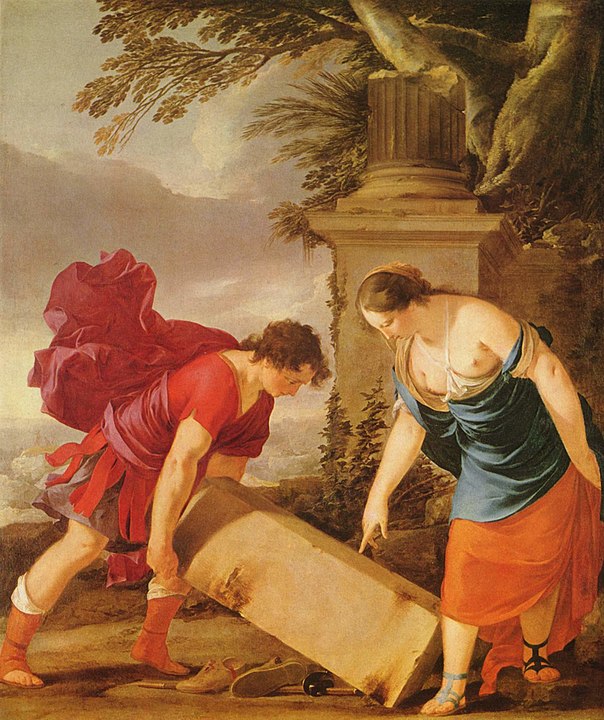
Theseus and Aethra painting

Theseus and Aethra

The background to the play refers back to the time after King Oedipus left Thebes, a broken and disgraced man, and his two sons, Polynices (Polyneices) and Eteocles, fought each other for his crown. Polynices and the Argive "Seven Against Thebes" laid siege to the city after Eteocles broke the terms of their father's agreement, and both brothers killed each other in the struggle, leaving Oedipus' brother-in-law Creon as ruler of Thebes. Creon decreed that Polynices and the invaders from Argos were not to be buried, but left to rot dishonourably on the battlefield.

The play is set at the temple of Demeter at Eleusis near Athens, and it begins with Polynices' father-in-law, Adrastus, and the Chorus, the mothers of the Argive invaders (the "suppliants" of the title), seeking help from Aethra and her son, Theseus, the powerful king of Athens. They beg Theseus to confront Creon and persuade him to deliver the bodies of the dead according to the ancient inviolable Greek law, so that their sons can be buried.
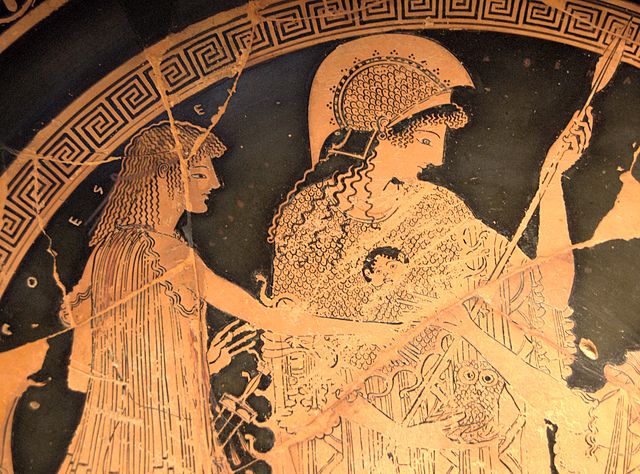
Theseus and Athena on a Greek vase

Theseus and Athena

Persuaded by his mother, Aethra, Theseus takes pity on the Argive mothers and, with the consent of the Athenian people, decides to help. However, it becomes clear that Creon will not easily give up the bodies, and the Athenian army must take them by force of arms. In the end, Theseus is victorious in battle and the bodies are returned and finally laid to rest (the wife of one of the dead generals, Capaneus, insists on being burned along with her husband).

The goddess Athena then appears as the "deus ex machina", and advises Theseus to strike an oath of eternal friendship with Argos, and encourages the sons of the dead Argive generals to take revenge on Thebes for the death of their parents.

Analysis

Funeral rites were very important to the ancient Greeks and the theme of not allowing the bodies of the dead to be buried occurs many times throughout ancient Greek literature (e.g. the fight over the corpses of Patroclus and Hector in Homer's "The Iliad", and the struggle to bury the body of Ajax in Sophocles' play "Ajax"). "The Suppliants" takes this concept even further, portraying a whole city willing to wage war purely to retrieve the bodies of strangers, as Theseus decides to intervene in the argument between Thebes and Argos on this matter of principle.

There are clear pro-Athens political overtones to the play, written as it was during the Peloponnesian War against Sparta. It is very much a public play, focussing on the general or political rather than the particular or personal. Its protagonists, Theseus and Adrastos, are first and foremost rulers representing their respective cities in a diplomatic relationship rather than complex characters with all-too-human foibles.
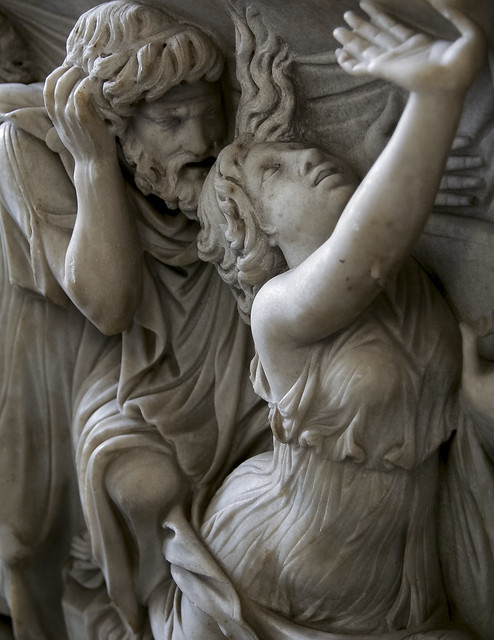
Creon and his dying daughter Creusa

Creon and his dying daughter Creusa

An extended debate between Theseus and the Theban herald discusses the merits and demerits of responsible government, with Theseus lionizing the equality of Athenian democracy, while the herald praises rule by a single man, "not a mob". Theseus champions the virtues of the middle class and the access of the poor to the justice of the law, while the herald complains that farmers know nothing of politics and care even less, and that one should anyway be suspicious of anyone who rises to power through the use of his tongue to control people.

Running parallel throughout the play, though, is the traditional tragic motif of ancient Greek drama, that of hubris or pride, as well as the theme of the contrast between youth (as personified by the protagonist, Theseus, and the subsidiary chorus, the sons of the Seven) and age (Aethra, Iphis and the elderly female chorus).

Rather than merely pointing out the grief and destruction that war brings, the play also indicates some of the more positive boons of peace including economic prosperity, the opportunity to improve education, the flourishing of the arts and the enjoyment of the moment (Adrastus says, at one point: "Life is such a brief moment; we should pass through it as easily as we can, avoiding pain"). Adrastus rues the "stupidity of man" who always tries to solve his problems by war rather than by negotiation, and only seems to learn from ruinous experience, if even then.

Resources

  • English translation by E. P. Coleridge (Internet Classics Archive): http://classics.mit.edu/Euripides/suppliants.html

  • Greek version with word-by-word translation (Perseus Project): http://www.perseus.tufts.edu/hopper/text.jsp?doc=Perseus:text:1999.01.0121

By Timeless Myths

Euripides:

  • • Alcestis
  • • Medea (Euripides)
  • • Heracleidae (Euripides)
  • • Hippolytus (Euripides)
  • • Andromache (Euripides)
  • • Hecuba (Euripides)
  • • The Suppliants
  • • Electra
  • • Heracles (Euripides)
  • • The Trojan Women
  • • Iphigenia in Tauris
  • • Ion
  • • Helen (Euripides)
  • • The Phoenician Women
  • • The Bacchae
  • • Orestes
  • • Iphigenia at Aulis
  • • Cyclops
The Suppliants

The Suppliants

(Tragedy, Greek, c. 469 BCE, 1,073 lines)Introduction "The Suppliants" (Gr: "Hiketides"; Lat: "Supplices") is a tragedy by the ancient Greek playwright Aeschylus. It is sometimes known as "The Suppliant Women" or "The Suppliant Maidens". Along wit...

January 1st, 2025 • Ancient Literature
The Phoenician Women

The Phoenician Women

"The Phoenician Women" (Gr: "Phoinissai"; Lat: "Phoenissae") is a tragedy by the ancient Greek playwright Euripides. It was written between 411 and 409 BCE, and is a variant of the story Aeschylus treated in his play "Seven Against Thebes" in whic...

October 25th, 2024 • Timeless Myths
The Trojan Women

The Trojan Women

(Tragedy, Greek, 415 BCE, 1,332 lines)Introduction "The Trojan Women" (Gr: "Troädes") is a tragedy by the ancient Greek playwright Euripides. It was first presented at the City Dionysia of 415 BCE, along with two other unconnected tragedies, "Alex...

October 25th, 2024 • Timeless Myths
The Eumenides

The Eumenides

(Tragedy, Greek, 458 BCE, 1,047 lines)Introduction "The Eumenides" ("The Kindly Ones" or "The Gracious Ones") is the third of the three linked tragedies which make up "The Oresteia" trilogy by the ancient Greek playwright Aeschylus, preceded by "A...

January 1st, 2025 • Ancient Literature
The Trachiniae

The Trachiniae

(Tragedy, Greek, c. 440 BCE, 1,278 lines)Introduction “The Trachiniae” (Gr: “Trachiniai”, also known as “The Trachinian Women”, “The Women of Trachis” or “The Maidens of Trachis”) is a tragedy by the ancient Greek playwright Sophocles. It was prob...

January 1st, 2025 • Ancient Literature
Troades (The Trojan Women)

Troades (The Trojan Women)

(Tragedy, Latin/Roman, c. 54 CE, 1,179 lines)Introduction "Troades" ("The Trojan Women") is one of the best-known tragedies of the Roman playwright Seneca the Younger, probably written around 54 CE. Largely based on "The Trojan Women" and "Hecuba"...

October 25th, 2024 • Timeless Myths
The Libation Bearers

The Libation Bearers

(Tragedy, Greek, 458 BCE, 1,076 lines)Introduction "The Libation Bearers" (Gr: "Choephoroi") is the second of the three linked tragedies which make up "The Oresteia" trilogy by the ancient Greek playwright Aeschylus, preceded by "Agamemnon" and fo...

January 1st, 2025 • Ancient Literature
Seven Against Thebes

Seven Against Thebes

(Tragedy, Greek, 467 BCE, 1,084 lines)Introduction "Seven Against Thebes" (Gr: "Hepta epi Thebas"; Lat: "Septem contra Thebas") is a tragedy by the ancient Greek playwright Aeschylus, dating from 467 BCE. It is the classic statement of the myth (a...

January 1st, 2025 • Ancient Literature
The Bacchae

The Bacchae

(Tragedy, Greek, c. 410 BCE, 1,392 lines)Introduction "The Bacchae", also known as "The Bacchantes" (Gr: "Bakchai"), is a late tragedy by the ancient Greek playwright Euripides, and it is considered one of his best works and one of the greatest of...

October 25th, 2024 • Timeless Myths
Euripides

Euripides

(Tragic Playwright, Greek, c. 480 – c. 406 BCE)Introduction Euripides was the last of the three great tragedians of classical Greece (the other two being Aeschylus and Sophocles). Largely due to an accident of history, eighteen of Euripides' ninet...

October 24th, 2024 • Timeless Myths
Timeless Myths

Exploring mythology and legends from around the world.

Explore Myths

All Stories Characters All Articles Search Site Map

Mythologies

Norse Mythology Classical Mythology Celtic Mythology Arthurian Legends Mythology Gods Ancient Literature

About Us

Introduction About Jimmy Bibliography FAQs Retro Version

Resources

Timeless Myths All Stories All Articles Characters
© 1999-2026 Timeless Myths • Copyright • Privacy Policy • Cookie Policy • Contact
Follow us: