Timeless Myths Logo

Explore myths and legends from cultures around the world

Featured

Classical Mythology
Classical Mythology Greek and Roman myths, gods, heroes, and epic tales
Norse Mythology
Norse Mythology Vikings, Asgard, Ragnarok, and the nine realms
Celtic Mythology
Celtic Mythology Irish, Welsh, and Gaelic legends and folklore
Ancient Literature
Ancient Literature Classical texts, translations, and literary analysis

All Mythologies

Arthurian Legends King Arthur, Camelot, the Round Table, and the Holy Grail Egyptian Mythology Pharaohs, pyramids, and ancient Nile deities Japanese Mythology Shinto gods, spirits, and legendary creatures Chinese Mythology Dragons, immortals, and celestial beings Aztec Mythology Mesoamerican gods, rituals, and creation myths

Discover gods and goddesses from every pantheon

Featured

Greek Gods
Greek Gods The Olympians, Titans, and primordial deities
Norse Gods
Norse Gods Odin, Thor, Loki, and the Aesir and Vanir
Egyptian Gods
Egyptian Gods Ra, Osiris, Isis, Anubis, and more
Japanese Gods
Japanese Gods Amaterasu, Susanoo, and Shinto kami

All Gods & Deities

Roman Gods Jupiter, Mars, Venus, and the Roman pantheon Celtic Gods The Tuatha Dé Danann and Celtic deities Aztec Gods Quetzalcoatl, Tezcatlipoca, and Aztec deities Chinese Gods Jade Emperor, Dragon Kings, and celestial beings View All 150+ Deities Browse the complete collection of mythological deities
View all gods & deities

Tales, legends, and character profiles from mythology

Featured

All Stories
All Stories Browse 800+ mythology and history stories
Characters
Characters Profiles of 67 mythological heroes, gods, and villains

All Stories

Mythology Stories Ancient myths and legends retold History Stories Historical tales from ancient civilizations Religion & Culture Religious traditions and cultural beliefs
View all stories

Tools, references, and site information

Featured

Name Generators
Name Generators Generate fantasy and mythology-inspired names
All Articles
All Articles Browse 1,800+ articles on mythology and history

All Resources

About Timeless Myths Learn about this mythology resource Bibliography Sources and references used on this site FAQ Frequently asked questions Contact Get in touch with us
Search
Classical Mythology Greek and Roman myths, gods, heroes, and epic tales Norse Mythology Vikings, Asgard, Ragnarok, and the nine realms Celtic Mythology Irish, Welsh, and Gaelic legends and folklore Arthurian Legends King Arthur, Camelot, the Round Table, and the Holy Grail Egyptian Mythology Pharaohs, pyramids, and ancient Nile deities Japanese Mythology Shinto gods, spirits, and legendary creatures Chinese Mythology Dragons, immortals, and celestial beings Aztec Mythology Mesoamerican gods, rituals, and creation myths Ancient Literature Classical texts, translations, and literary analysis
Greek Gods The Olympians, Titans, and primordial deities Roman Gods Jupiter, Mars, Venus, and the Roman pantheon Norse Gods Odin, Thor, Loki, and the Aesir and Vanir Egyptian Gods Ra, Osiris, Isis, Anubis, and more Celtic Gods The Tuatha Dé Danann and Celtic deities Aztec Gods Quetzalcoatl, Tezcatlipoca, and Aztec deities Japanese Gods Amaterasu, Susanoo, and Shinto kami Chinese Gods Jade Emperor, Dragon Kings, and celestial beings View All 150+ Deities Browse the complete collection of mythological deities View all gods & deities
All Stories Browse 800+ mythology and history stories Characters Profiles of 67 mythological heroes, gods, and villains Mythology Stories Ancient myths and legends retold History Stories Historical tales from ancient civilizations Religion & Culture Religious traditions and cultural beliefs View all stories
Name Generators Generate fantasy and mythology-inspired names All Articles Browse 1,800+ articles on mythology and history About Timeless Myths Learn about this mythology resource Bibliography Sources and references used on this site FAQ Frequently asked questions Contact Get in touch with us
Search Search the entire mythology archive
  1. Classical Literature
    Greece Rome Other Ancient Civilizations Timeline of Classical Literature Alphabetical List of Authors Index of Individual Works Index of Important Characters Sources About Us
  2. Greece
    Homer Hesiod Aesop Sappho Pindar Aeschylus Sophocles Euripides Aristophanes Menander Apollonius of Rhodes
  3. Aeschylus
    The Persians The Suppliants Seven Against Thebes Agamemnon The Libation Bearers The Eumenides The Oresteia Prometheus Bound
  4. The Suppliants

The Suppliants

(Tragedy, Greek, c. 469 BCE, 1,073 lines)

Introduction

"The Suppliants" (Gr: "Hiketides"; Lat: "Supplices") is a tragedy by the ancient Greek playwright Aeschylus. It is sometimes known as "The Suppliant Women" or "The Suppliant Maidens". Along with his "The Persians", it is one of the Western world's oldest extant dramas. The myth of Danaus and his fifty daughters, on which the story is based, is essentially a foundation legend (or rather a re-foundation legend) of Argos, one of the foremost Mycenaean cities of the Peloponnesus. It shoud not be confused with Euripides' play, also called "The Suppliants", which deals with the struggle of Adrastus and the Argive mothers against Creon of Thebes to allow the bodies of the Argive invaders to receive a proper burial.

Synopsis

The fifty daughters of Danaus, collectively known as the Danaides (who make up the Chorus of the play), are fleeing with their father in an attempt to escape a forced marriage to their Egyptian cousins, the fifty sons of the usurping King Aegyptus, Danaus' twin brother.
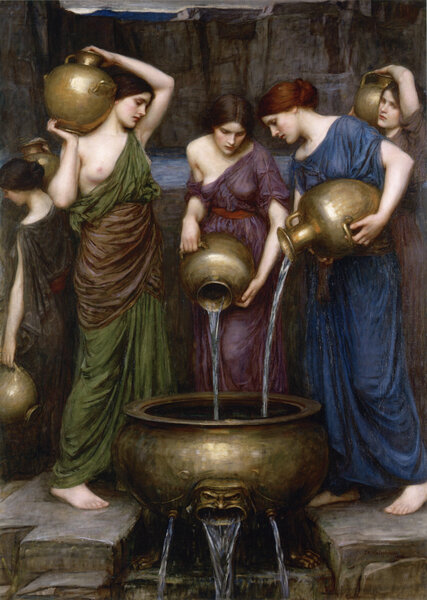
Danaides

Danaides

When they reach Argos, Danaus and his daughters ask the kind but timid King Pelasgus for his protection. At first, he refuses, pending the decision of the Argive people on the matter, but the people of Argos agree to protect the fugitives, to great rejoicing among the Danaides.

Almost immediately, however, the fleet of Egyptian suitors is seen approaching, and a herald blusters and threatens the Danaides and attempts to force them to return to their cousins for marriage, finally resorting to attempts to physically drag them away. King Pelasgus intervenes and threatens the herald, interposing with an armed force to drive off the Egyptians and thereby save the suppliants. He entreats the Danaides to remain within the safety of the walls of the city.

The play ends with the Danaides retreating into the the safety of the Argive walls, as Danaus urges them to prayer and thanksgiving to the Greek gods, and to maidenly modesty.
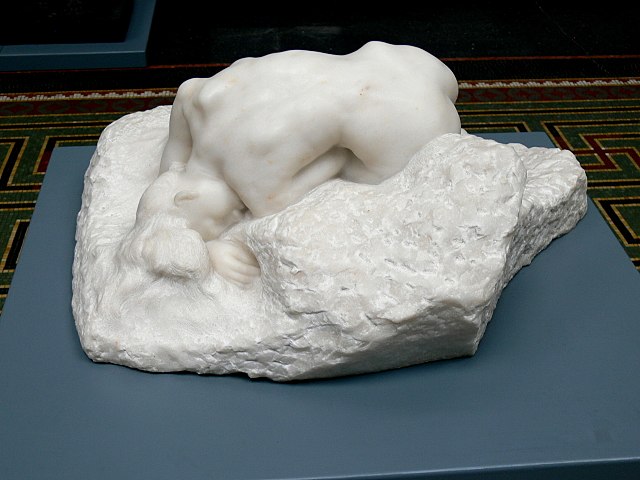
Statue of a Danaide

Statue of a Danaide

Analysis

"The Suppliants" was once thought to be the earliest surviving play by Aeschylus (largely due to the relatively anachronistic function of the Chorus as the protagonist of the drama), but recent evidence places it after "The Persians" as Aeschylus' second extant play. It is still, however, one of the oldest extant dramas from ancient Greece, and in its rudimentary general structure it probably resembles the lost works of Choerilus, Phrynichus, Pratinas and the 6th Century BCE pioneers of drama. Because the suppliant women are essentially both the Chorus and the protagonist, it is perhaps not surprising that choral lyrics occupy more than half the play.

It was probably first performed some time after 470 BCE (possibly as late as 463 BCE) as the first play in a trilogy which included the lost plays "The Sons of Aegyptus" and "The Daughters of Danaus" (both of which continued the story of "The Suppliants" and the re-settlement of Argos), followed by the lost satyr play "Amymone", which comically portrayed one of the Danaides' seduction by Poseidon.

"The Suppliants" does not conform to our expectations of traditional Greek tragic drama in that it has neither hero, nor downfall, nor even tragic conclusion. Instead, the play portrays unresolved conflicts of sexuality, love and emotional maturity. It also pays tribute to the democratic undercurrents running through Athens in advance of the establishment of a democratic government in 461 BCE, and the insistence of King Pelasgus on consulting the people of Argos is a distinct nod in favour of democracy.

It should not to be confused with "The Suppliants" of Euripides (which deals with Theseus' struggle against Creon of Thebes in order to allow of the the bodies of the brothers Polynices and Eteocles to receive a proper burial).

Resources

  • English translation by E. D. A. Morshead (Internet Classics Archive)

  • Greek version with word-by-word translation (Perseus Project)

By Ancient Literature

Aeschylus:

  • • The Persians
  • • The Suppliants
  • • Seven Against Thebes
  • • Agamemnon
  • • The Libation Bearers
  • • The Eumenides
  • • The Oresteia
  • • Prometheus Bound
The Suppliants

The Suppliants

(Tragedy, Greek, 423 BCE, 1,234 lines)Introduction "The Suppliants" (also known as "The Suppliant Women"; Gr: "Hiketides"; Lat: "Supplices") is a tragedy by the ancient Greek playwright Euripides, first produced in 423 BCE. Not to be confused with...

October 25th, 2024 • Timeless Myths
The Phoenician Women

The Phoenician Women

"The Phoenician Women" (Gr: "Phoinissai"; Lat: "Phoenissae") is a tragedy by the ancient Greek playwright Euripides. It was written between 411 and 409 BCE, and is a variant of the story Aeschylus treated in his play "Seven Against Thebes" in whic...

October 25th, 2024 • Timeless Myths
The Trojan Women

The Trojan Women

(Tragedy, Greek, 415 BCE, 1,332 lines)Introduction "The Trojan Women" (Gr: "Troädes") is a tragedy by the ancient Greek playwright Euripides. It was first presented at the City Dionysia of 415 BCE, along with two other unconnected tragedies, "Alex...

October 25th, 2024 • Timeless Myths
The Eumenides

The Eumenides

(Tragedy, Greek, 458 BCE, 1,047 lines)Introduction "The Eumenides" ("The Kindly Ones" or "The Gracious Ones") is the third of the three linked tragedies which make up "The Oresteia" trilogy by the ancient Greek playwright Aeschylus, preceded by "A...

January 1st, 2025 • Ancient Literature
The Trachiniae

The Trachiniae

(Tragedy, Greek, c. 440 BCE, 1,278 lines)Introduction “The Trachiniae” (Gr: “Trachiniai”, also known as “The Trachinian Women”, “The Women of Trachis” or “The Maidens of Trachis”) is a tragedy by the ancient Greek playwright Sophocles. It was prob...

January 1st, 2025 • Ancient Literature
Troades (The Trojan Women)

Troades (The Trojan Women)

(Tragedy, Latin/Roman, c. 54 CE, 1,179 lines)Introduction "Troades" ("The Trojan Women") is one of the best-known tragedies of the Roman playwright Seneca the Younger, probably written around 54 CE. Largely based on "The Trojan Women" and "Hecuba"...

October 25th, 2024 • Timeless Myths
The Libation Bearers

The Libation Bearers

(Tragedy, Greek, 458 BCE, 1,076 lines)Introduction "The Libation Bearers" (Gr: "Choephoroi") is the second of the three linked tragedies which make up "The Oresteia" trilogy by the ancient Greek playwright Aeschylus, preceded by "Agamemnon" and fo...

January 1st, 2025 • Ancient Literature
Seven Against Thebes

Seven Against Thebes

(Tragedy, Greek, 467 BCE, 1,084 lines)Introduction "Seven Against Thebes" (Gr: "Hepta epi Thebas"; Lat: "Septem contra Thebas") is a tragedy by the ancient Greek playwright Aeschylus, dating from 467 BCE. It is the classic statement of the myth (a...

January 1st, 2025 • Ancient Literature
The Bacchae

The Bacchae

(Tragedy, Greek, c. 410 BCE, 1,392 lines)Introduction "The Bacchae", also known as "The Bacchantes" (Gr: "Bakchai"), is a late tragedy by the ancient Greek playwright Euripides, and it is considered one of his best works and one of the greatest of...

October 25th, 2024 • Timeless Myths
Euripides

Euripides

(Tragic Playwright, Greek, c. 480 – c. 406 BCE)Introduction Euripides was the last of the three great tragedians of classical Greece (the other two being Aeschylus and Sophocles). Largely due to an accident of history, eighteen of Euripides' ninet...

October 24th, 2024 • Timeless Myths
Timeless Myths

Exploring mythology and legends from around the world.

Explore Myths

All Stories Characters All Articles Search Site Map

Mythologies

Norse Mythology Classical Mythology Celtic Mythology Arthurian Legends Mythology Gods Ancient Literature

About Us

Introduction About Jimmy Bibliography FAQs Retro Version

Resources

Timeless Myths All Stories All Articles Characters
© 1999-2026 Timeless Myths • Copyright • Privacy Policy • Cookie Policy • Contact
Follow us: