Timeless Myths Logo
Aphrodite Apollo Ares Artemis Athena Atlas Coeus Crius Cronus Demeter Dionysus Gaia Hades Hephaestus Hera Hermes Hestia Hyperion Iapetus Mnemosyne Oceanus Phobos Phoebe Poseidon Prometheus Rhea Tethys Themis Uranus Zeus
Bacchus Ceres Diana Juno Jupiter Mars Mercury Minerva Neptune Pluto Venus Vesta Vulcan
Amun Anubis Aten Atum Babi Bastet Bes Geb Hapi hathor heqet Horus Isis Khepri Khnum Khonsu Maat Nephthys Nut Osiris Ptah Ra Seshat Seth Shu Sobek Thoth
Alfheim Baldur Freya Freyr Frigg Heimdallr Helheim Idun Jotunheim Loki Nerthus Njord Odin Thor Tyr
Aengus Arawn Badb Brigid Cailleach Ceridwen Cernunnos Cu Chulainn Dagda Danu Gwydion Herne the Hunter Lugh Medb Morrigan Neit Nuada Taliesin Taranis
Chalchiuhtlicue Coatlicue Huitzilopochtli Mictlantecuhtli Mixcoatl Ometeotl Quetzalcoatl Tezcatlipoca Tlaloc Tonatiuh Xipe Totec Xochiquetzal Xolotl
Amaterasu Ame no Uzume Benzaiten Bishamonten Daikokuten Ebisu Fujin Fukurokuju Inari Izanagi Kagutsuchi Raijin Susanoo Tsukuyomi
Caishen Cangjie Dragon King Eight Immortals Erlang Shen Fuxi Guanyin Hou Yi Huxian Jade Emperor King Yama Leizi Lu-ban Mazu Nezha Nuwa Pangu Shennong Sun Wukong Xiwangmu Yue Lao Zhong Kui
Norse Classical Celtic Arthurian
Literature Stories Names
Aphrodite Apollo Ares Artemis Athena Atlas Coeus Crius Cronus Demeter Dionysus Gaia Hades Hephaestus Hera Hermes Hestia Hyperion Iapetus Mnemosyne Oceanus Phobos Phoebe Poseidon Prometheus Rhea Tethys Themis Uranus Zeus
Bacchus Ceres Diana Juno Jupiter Mars Mercury Minerva Neptune Pluto Venus Vesta Vulcan
Amun Anubis Aten Atum Babi Bastet Bes Geb Hapi hathor heqet Horus Isis Khepri Khnum Khonsu Maat Nephthys Nut Osiris Ptah Ra Seshat Seth Shu Sobek Thoth
Alfheim Baldur Freya Freyr Frigg Heimdallr Helheim Idun Jotunheim Loki Nerthus Njord Odin Thor Tyr
Aengus Arawn Badb Brigid Cailleach Ceridwen Cernunnos Cu Chulainn Dagda Danu Gwydion Herne the Hunter Lugh Medb Morrigan Neit Nuada Taliesin Taranis
Chalchiuhtlicue Coatlicue Huitzilopochtli Mictlantecuhtli Mixcoatl Ometeotl Quetzalcoatl Tezcatlipoca Tlaloc Tonatiuh Xipe Totec Xochiquetzal Xolotl
Amaterasu Ame no Uzume Benzaiten Bishamonten Daikokuten Ebisu Fujin Fukurokuju Inari Izanagi Kagutsuchi Raijin Susanoo Tsukuyomi
Caishen Cangjie Dragon King Eight Immortals Erlang Shen Fuxi Guanyin Hou Yi Huxian Jade Emperor King Yama Leizi Lu-ban Mazu Nezha Nuwa Pangu Shennong Sun Wukong Xiwangmu Yue Lao Zhong Kui
Norse Classical Celtic Arthurian
Literature Stories Names
  1. Classical Literature
    Greece Rome Other Ancient Civilizations Timeline of Classical Literature Alphabetical List of Authors Index of Individual Works Index of Important Characters Sources About Us
  2. Greece
    Homer Hesiod Aesop Sappho Pindar Aeschylus Sophocles Euripides Aristophanes Menander Apollonius of Rhodes
  3. Aeschylus
    The Persians The Suppliants Seven Against Thebes Agamemnon The Libation Bearers The Eumenides The Oresteia Prometheus Bound
  4. The Persians
    The Persians

The Persians

(Tragedy, Greek, 472 BCE, 1,076 lines)

Introduction

"The Persians" (Gr: "Persai"; Lat: "Persae") is a tragedy by the ancient Greek playwright Aeschylus. First produced in 472 BCE, it is considered the oldest surviving play in the history of theatre, and also the only extant Greek tragedy that is based on contemporary events. It recounts the Persian response to news of their military defeat under Xerxes at the Battle of Salamis in 480 BCE, one of the decisive episodes in the ongoing Greco-Persian Wars.
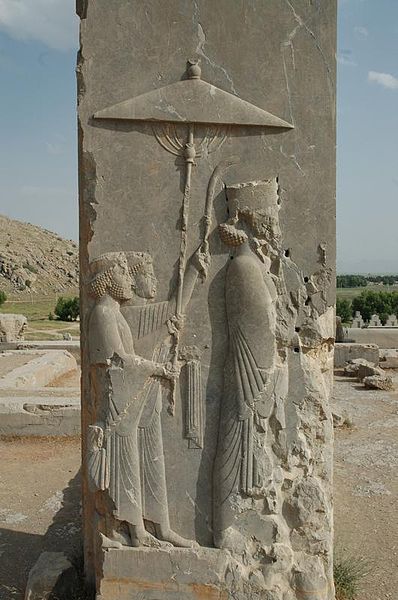
Relief of Xerxes at the doorway of his palace

Relief of Xerxes at the doorway of his palace

Synopsis

"The Persians" takes place in Susa, one of the capitals of the Persian Empire at that time, and opens with a Chorus of old men of Susa as they await news of King Xerxes' expedition against the Greeks. They are soon joined by Xerxes' mother, Atossa, who expresses her anxiety and unease, narrating what is probably the first dream sequence in Western theatre.

An exhausted messenger arrives, offering a graphic description of the Battle of Salamis and its gory outcome. He tells of the Persian defeat, reeling off the names of the Persian generals who have been killed, and giving his rendition of the blood-curdling battle cry of the Greeks as they charged in to battle. Xerxes himself, however, has apparently escaped and is returning.

Atossa then calls on the Chorus to summon the ghost of her dead husband (and Xerxes' father), Darius the Great. When he learns of the Persian defeat, Darius condemns the hubris behind his son's decision to invade Greece and particularly his decision to build a bridge over the Hellespont to expedite the Persian army's advance, which, he argues, merely angered the gods and led to the Persian defeat. Before departing, the ghost of Darius prophesies another Persian defeat at the Battle of Plataea (479 BCE).

Xerxes finally arrives, dressed in torn and tattered robes, reeling from his crushing defeat. The rest of the drama consists of the king alone with the Chorus, as they engage together in an extended lyrical song of lamentation over the enormity of Persia's defeat.

Analysis

Aeschylus' "The Persians" was originally presented as the second part of the trilogy that won the first prize at the dramatic competitions in Athens' City Dionysia festival in 472 BCE. It came between a play called "Phineus" and another called "Glaucus", both of which have since been lost, and was followed, in traditional style, by a satyr play called "Prometheus the Fire-lighter" (also lost). The play was subsequently produced in Sicily in 467 BCE (one of the few times a play was produced twice during the lifetime of the author), and the surviving text is probably based on that later version, which may have been slightly different from the original.
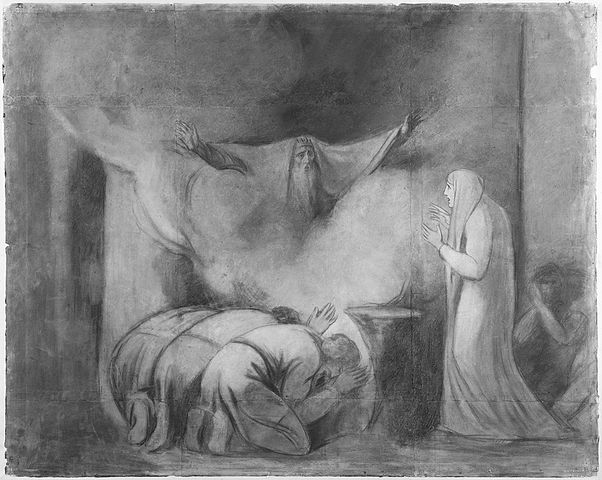
Drawing by George Romney: The Ghost of Darius Appearing to Atossa

Drawing by George Romney: The Ghost of Darius Appearing to Atossa

Some critics (including Aristotle) have interpreted "The Persians" as sympathetic toward the defeated Persians, while others (such as Aristophanes) have seen it as a celebration of Greek victory within the context of an ongoing war. In fact, it can be argued that "The Persians" is not a tragedy at all in the true Greek sense, but that its real aim is the triumphant glorification of Athens and the exultation of the whole nation over the ruin of their foe.

Thus, both as a historic drama and in its real effect, the play was something of an experiment that was not to be repeated either by the author or his successors. It was, however, a popular play in the later Roman and Byzantine Empires (which also fought wars with the Persians) and its popularity has endured in modern Greece and throughout the world.

Resources

  • English translation by Robert Potter (Internet Classics Archive)

  • Greek version with word-by-word translation (Perseus Project)

By Ancient Literature

Aeschylus:

  • • The Persians
  • • The Suppliants
  • • Seven Against Thebes
  • • Agamemnon
  • • The Libation Bearers
  • • The Eumenides
  • • The Oresteia
  • • Prometheus Bound
What Was the Persian Empire Known For: A Beacon of Prosperity

What Was the Persian Empire Known For: A Beacon of Prosperity

The ancient Persian Empire contributed immensely to the growth and development of the world around us, up to the point we are now. The Persian Empire was known for its achievements in all fields, and the development of its culture was able to cont...

January 11th, 2022 • Timeless Myths
Battle of Pelusium: How Persia Defeated Ancient Egypt

Battle of Pelusium: How Persia Defeated Ancient Egypt

Two foremost powers of the ancient Near East, Egypt, and Persia clashed in the Battle of Pelusium, which decided the future of Ancient Egypt. For thousands of years, Pharaonic Egypt had been the foremost power of the ancient world. Its culture spr...

January 11th, 2022 • Timeless Myths
Why Did the Persian Empire Fall: An Ancient Colossus’ Demise

Why Did the Persian Empire Fall: An Ancient Colossus’ Demise

The fall of the Persian Empire happened after a series of tumultuous periods, including an economic crisis, bad governance, power struggles within the empire, revolts by the people, and finally, the conquest by Alexander the Great. In addition, se...

January 11th, 2022 • Timeless Myths
What Were the Effects of the Persian War: Conflicts With Greece

What Were the Effects of the Persian War: Conflicts With Greece

The effects of the Persian war were different for Greeks and Persians and they shaped the fate of both nations for years to come. This series of conflicts occurred between the Achaemenid Empire and Greek city-states from 499 BC to 449 B.C. These c...

January 11th, 2022 • Timeless Myths
How Big Was the Persian Army? Was Its Size A Thousand or A Million?

How Big Was the Persian Army? Was Its Size A Thousand or A Million?

The Persian army numbered over a million, according to ancient sources, and naturally, that worked to their advantage at war. Today, experts believe that the Persian army size was in the hundreds of thousands. So, what was the real size of the Per...

January 11th, 2022 • Timeless Myths
Perses Greek Mythology: An Account of the Story of Perses

Perses Greek Mythology: An Account of the Story of Perses

Perses Greek mythology is an account of two characters with the same name. One of them was a Titan who was famous for fathering more important Greek figures. The other one hails from Colchis who was tasked with protecting the golden fleece. This a...

February 16th, 2024 • Ancient Literature
Ancient Persian Economy: The Secret to Economic Success

Ancient Persian Economy: The Secret to Economic Success

The economy of ancient Persia was a wildly successful system that grew exponentially with time. The Persians were competitive people and brought wealth to their nation by trading, and the Persian economy bloomed because of the Persian empire's lab...

March 8th, 2022 • Timeless Myths
Darius the Great: The Genius Leading the Persian Empire Into Golden Age

Darius the Great: The Genius Leading the Persian Empire Into Golden Age

Darius the Great, King of Persia (522–486 BC), was hailed as a genius administrator in one of the greatest kingdoms of ancient times—the Persian Empire. Read the following to know more about his supremacy.Who Was Darius the Great? Darius the Great...

March 14th, 2022 • Timeless Myths
Perses

Perses

Perses was the son of the Titans Crius and Eurybia. He was the brother of Astraeüs (Astraeus) and Pallas. He married Asteria and became the father of Hecate. Perses was probably imprisoned with the other Titans for participating in the war against...

April 19th, 1999 • Jimmy Joe
Xerxes: The Notorious Persian Ruler and His Greek Invasion

Xerxes: The Notorious Persian Ruler and His Greek Invasion

Xerxes was the fifth ruler of the Persian Dynasty. Also known as Xerxes the First, he was the king of Persia who was made famous not only because of being a boundless ruler of the Persian Empire but also because of his epic failure in his Greek in...

March 4th, 2022 • Timeless Myths
Timeless Myths

Exploring mythology and legends from around the world.

Explore Myths

All Stories Characters All Articles Search Site Map

Mythologies

Norse Mythology Classical Mythology Celtic Mythology Arthurian Legends Mythology Gods Ancient Literature

About Us

Introduction About Jimmy Bibliography FAQs Retro Version

Resources

Timeless Myths All Stories All Articles Characters
© 1999-2026 Timeless Myths • Copyright • Privacy Policy • Cookie Policy • Contact
Follow us: