Timeless Myths Logo
Aphrodite Apollo Ares Artemis Athena Atlas Coeus Crius Cronus Demeter Dionysus Gaia Hades Hephaestus Hera Hermes Hestia Hyperion Iapetus Mnemosyne Oceanus Phobos Phoebe Poseidon Prometheus Rhea Tethys Themis Uranus Zeus
Bacchus Ceres Diana Juno Jupiter Mars Mercury Minerva Neptune Pluto Venus Vesta Vulcan
Amun Anubis Aten Atum Babi Bastet Bes Geb Hapi hathor heqet Horus Isis Khepri Khnum Khonsu Maat Nephthys Nut Osiris Ptah Ra Seshat Seth Shu Sobek Thoth
Alfheim Baldur Freya Freyr Frigg Heimdallr Helheim Idun Jotunheim Loki Nerthus Njord Odin Thor Tyr
Aengus Arawn Badb Brigid Cailleach Ceridwen Cernunnos Cu Chulainn Dagda Danu Gwydion Herne the Hunter Lugh Medb Morrigan Neit Nuada Taliesin Taranis
Chalchiuhtlicue Coatlicue Huitzilopochtli Mictlantecuhtli Mixcoatl Ometeotl Quetzalcoatl Tezcatlipoca Tlaloc Tonatiuh Xipe Totec Xochiquetzal Xolotl
Amaterasu Ame no Uzume Benzaiten Bishamonten Daikokuten Ebisu Fujin Fukurokuju Inari Izanagi Kagutsuchi Raijin Susanoo Tsukuyomi
Caishen Cangjie Dragon King Eight Immortals Erlang Shen Fuxi Guanyin Hou Yi Huxian Jade Emperor King Yama Leizi Lu-ban Mazu Nezha Nuwa Pangu Shennong Sun Wukong Xiwangmu Yue Lao Zhong Kui
Norse Classical Celtic Arthurian
Literature Stories Names
Aphrodite Apollo Ares Artemis Athena Atlas Coeus Crius Cronus Demeter Dionysus Gaia Hades Hephaestus Hera Hermes Hestia Hyperion Iapetus Mnemosyne Oceanus Phobos Phoebe Poseidon Prometheus Rhea Tethys Themis Uranus Zeus
Bacchus Ceres Diana Juno Jupiter Mars Mercury Minerva Neptune Pluto Venus Vesta Vulcan
Amun Anubis Aten Atum Babi Bastet Bes Geb Hapi hathor heqet Horus Isis Khepri Khnum Khonsu Maat Nephthys Nut Osiris Ptah Ra Seshat Seth Shu Sobek Thoth
Alfheim Baldur Freya Freyr Frigg Heimdallr Helheim Idun Jotunheim Loki Nerthus Njord Odin Thor Tyr
Aengus Arawn Badb Brigid Cailleach Ceridwen Cernunnos Cu Chulainn Dagda Danu Gwydion Herne the Hunter Lugh Medb Morrigan Neit Nuada Taliesin Taranis
Chalchiuhtlicue Coatlicue Huitzilopochtli Mictlantecuhtli Mixcoatl Ometeotl Quetzalcoatl Tezcatlipoca Tlaloc Tonatiuh Xipe Totec Xochiquetzal Xolotl
Amaterasu Ame no Uzume Benzaiten Bishamonten Daikokuten Ebisu Fujin Fukurokuju Inari Izanagi Kagutsuchi Raijin Susanoo Tsukuyomi
Caishen Cangjie Dragon King Eight Immortals Erlang Shen Fuxi Guanyin Hou Yi Huxian Jade Emperor King Yama Leizi Lu-ban Mazu Nezha Nuwa Pangu Shennong Sun Wukong Xiwangmu Yue Lao Zhong Kui
Norse Classical Celtic Arthurian
Literature Stories Names
  1. Classical Literature
    Greece Rome Other Ancient Civilizations Timeline of Classical Literature Alphabetical List of Authors Index of Individual Works Index of Important Characters Sources About Us
  2. Greece
    Homer Hesiod Aesop Sappho Pindar Aeschylus Sophocles Euripides Aristophanes Menander Apollonius of Rhodes
  3. Aristophanes

Aristophanes

(Comic Playwright, Greek, c. 446 – c. 386 BCE)

Introduction

Aristophanes was a prolific and much acclaimed comic playwright of ancient Greece, sometimes referred to as the Father of Comedy. Eleven of his forty plays have come down to us virtually complete (along with up to 1,000 brief fragments of other works), and are the only real examples we have of a genre of comic drama known as Old Comedy. Aristophanes' works recreate the life of ancient Athens perhaps more convincingly than those of any other author, although his biting satire and ridicule of his contemporaries often came close to slander.

Biography – Who is Aristophanes
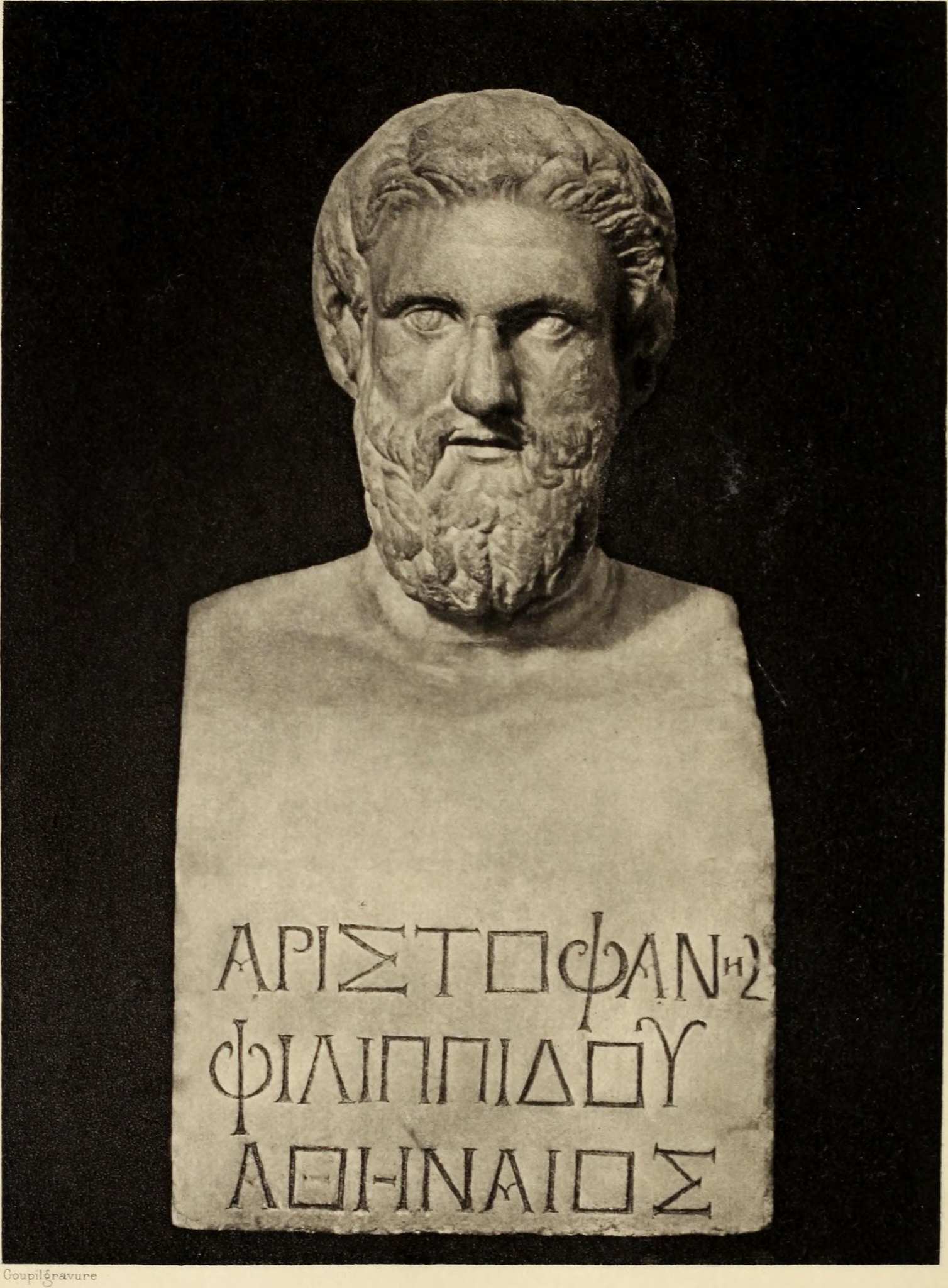
Marble bust statue of Aristophanes, ancient Greek comic playwright

Bust of Aristophanes

Unfortunately, we know less about Aristophanes the man than we do about his plays, and most of what we do know about him is through references in the plays themselves. Oblique references in later plays suggest that he was probably born around 446 or 448 BCE, possibly the son of a man named Philippos from the island of Aegina, although he was almost certainly educated in Athens.

He was writing at a time after the euphoria of Greece's military victories over the Persians, when the Peloponnesian War had largely curtailed Athens' ambitions as an imperial power. However, although Athens' empire had been largely dismantled, it had nevertheless become the intellectual centre of Greece, and Aristophanes was an important figure in this change in intellectual fashions.

From his caricatures of the leading figures in the arts (notably Euripides), in politics (especially the dictator Cleon), and in philosophy and religion (Socrates), he often gives the impression of being something of an old-fashioned conservative, and his plays often espouse opposition to the radical new influences in Athenian society.

He was, however, not afraid to take risks. His first play, "The Banqueters" (now lost), won second prize at the annual City Dionysia drama competition in 427 BCE, and his next play, "The Babylonians" (also now lost), won first prize. His polemical satires in these popular plays caused some embarrassment for the Athenian authorities, and some influential citizens (notably Cleon) subsequently sought to prosecute the young dramatist on a charge of slandering the Athenian polis. It soon became apparent, though, that (unlike impiety) there was no legal redress for slander in a play, and the court case certainly did not stop Aristophanes from repeatedly savaging and caricaturing Cleon in his later plays.
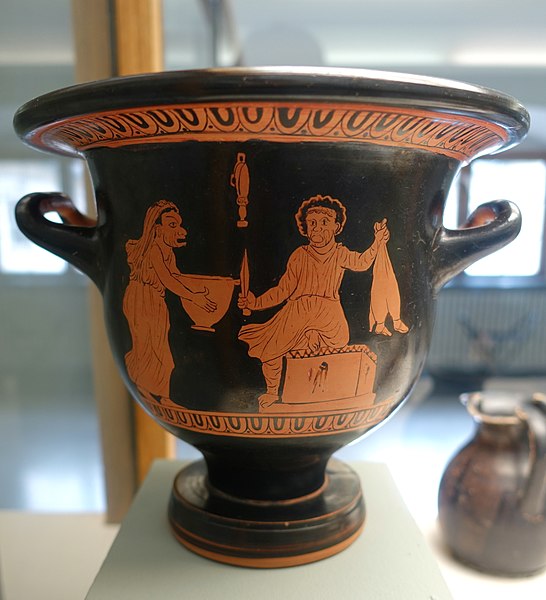
Ancient Greek vase depicting a scene from Thesmophoriazusae by Aristophanes

Scene from Thesmophoriazusae on ancient Greek vase

Despite the highly political stance of his plays, Aristophanes managed to survive The Peloponnesian War, two oligarchic revolutions and two democratic restorations, so it can be assumed that he was not actively involved in politics. He was probably appointed to the Council of Five Hundred for a year at the beginning of the 4th Century BCE, a common appointment in democratic Athens. The genial characterization of Aristophanes in Plato's "The Symposium" has been interpreted as evidence of Plato's own friendship with him, despite Aristophanes' cruel caricature of Plato's teacher Socrates in "The Clouds".

As far as we know, Aristophanes was victorious only once at the City Dionysia, although he also won the less prestigious Lenaia competition at least three times. He apparently lived to a ripe old age, and our best guess as to his date of death is around 386 or 385 BCE, perhaps as late as 380 BCE. At least three of his sons (Araros, Philippus and a third son called either Nicostratus or Philetaerus) were themselves comic poets and later winners of the Lenaia, as well as producers of their father's plays.

Writings – Aristophanes plays
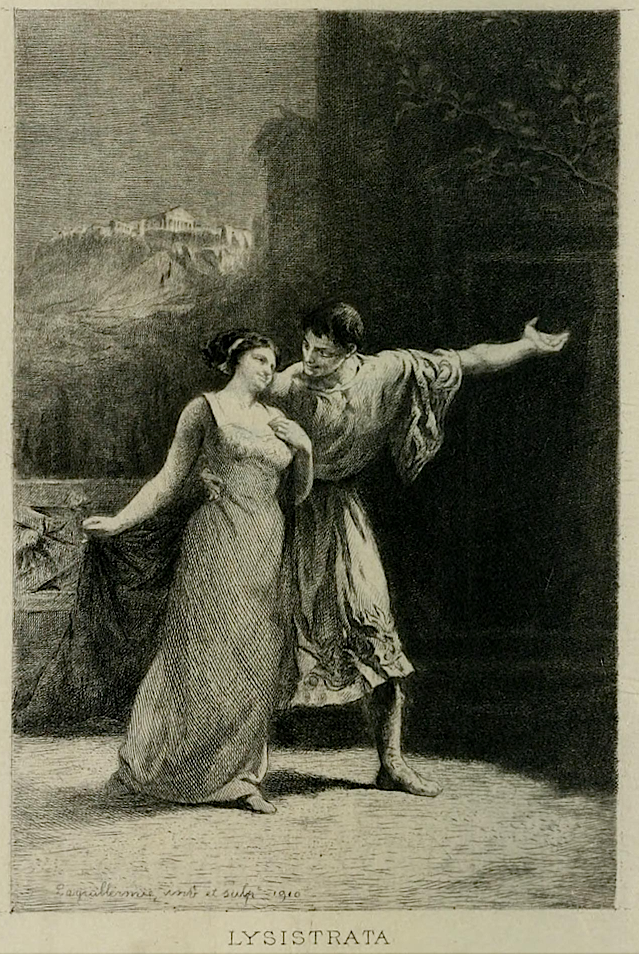
Illustration depicting a scene from Lysistrata by Aristophanes

Scene from Lysistrata

The surviving plays of Aristophanes, in chronological order spanning a period from 425 to 388 BCE, are: "The Acharnians", "The Knights", "The Clouds", "The Wasps", "Peace", "The Birds", "Lysistrata", "Thesmophoriazusae", "The Frogs", "Ecclesiazusae" and "Plutus (Wealth)". Of these, perhaps the best known are "Lysistrata", "The Wasps" and "The Birds".

Comic drama (what is now known as Old Comedy) was already well-established by Aristophanes' time, although the first official comedy was not staged at the City Dionysia until 487 BCE, by which time tragedy had already been long established there. It was under the comic genius of Aristophanes that Old Comedy received its fullest development, and he was able to contrast infinitely graceful poetic language with vulgar and offensive jests, adapting the same versification forms of the tragedians to his own aims.

During Aristophanes' time, though, there was a discernable trend from Old Comedy to New Comedy (perhaps best exemplified by Menander, almost a century later), involving a trend away from the topical emphasis on real individuals and local issues of Old Comedy, towards a more cosmopolitan emphasis on generalized situations and stock characters, increasing levels of complexity and more realistic plots.

Major Works

  • "The Acharnians"

  • "The Knights"

  • "The Clouds"

  • "The Wasps"

  • "Peace"

  • "The Birds"

  • "Lysistrata"

  • "Thesmophoriazusae"

  • "The Frogs"

  • "Ecclesiazusae"

  • "Plutus (Wealth)"

By Timeless Myths

Greece:

  • • Homer
  • • Hesiod
  • • Aesop
  • • Sappho
  • • Pindar
  • • Aeschylus
  • • Sophocles
  • • Euripides
  • • Aristophanes
  • • Menander
  • • Apollonius of Rhodes
The Acharnians

The Acharnians

(Comedy, Greek, 425 BCE, 1,234 lines)Introduction "The Acharnians" (Gr: "Akharneis") is the earliest of the eleven surviving plays of the ancient Greek playwright Aristophanes, and a classic of the highly satirical genre of drama known as Old Come...

October 25th, 2024 • Timeless Myths
Euripides

Euripides

(Tragic Playwright, Greek, c. 480 – c. 406 BCE)Introduction Euripides was the last of the three great tragedians of classical Greece (the other two being Aeschylus and Sophocles). Largely due to an accident of history, eighteen of Euripides' ninet...

October 24th, 2024 • Timeless Myths
Lysistrata

Lysistrata

(Comedy, Greek, 411 BCE, 1,320 lines)Introduction – Is Lysistrata a Tragedy or Comedy "Lysistrata" is a bawdy anti-war comedy by the ancient Greek playwright Aristophanes, first staged in 411 BCE. It is the comic account of one woman's extraordina...

October 25th, 2024 • Timeless Myths
Thesmophoriazusae

Thesmophoriazusae

(Comedy, Greek, 411 BCE, 1,231 lines)Introduction "Thesmophoriazusae" (literally meaning "The Women Celebrating the Festival of the Thesmophoria", sometimes also called "The Poet and the Women"), is a comedy by the ancient Greek playwright Aristop...

October 25th, 2024 • Timeless Myths
Ecclesiazusae

Ecclesiazusae

(Comedy, Greek, 392 BCE, 1,183 lines)Introduction "Ecclesiazusae" (Gr: "Ekklesiazousai"), also known by the titles "The Assembly Women", "The Congress Women" or "Women in Parliament" among others, is a late comedy by the ancient Greek playwright A...

October 25th, 2024 • Timeless Myths
Aeschylus

Aeschylus

(Tragic Playwright, Greek, c. 525 – c. 455 BCE)Introduction Aeschylus (Aiskhylos) is often recognized as the father of tragedy, and is the first of the three early Greek tragedians whose plays survive extant (the other two being Sophocles and Euri...

January 1st, 2025 • Ancient Literature
Menander

Menander

(Comic Playwright, Greek, c. 342 – c. 291 BCE)Introduction Menander (Menandros) was a Hellenistic Greek dramatist. He was the best-known representative of Athenian New Comedy, and one of the favourite writers of antiquity, immensely popular in his...

October 24th, 2024 • Timeless Myths
The Trachiniae

The Trachiniae

(Tragedy, Greek, c. 440 BCE, 1,278 lines)Introduction “The Trachiniae” (Gr: “Trachiniai”, also known as “The Trachinian Women”, “The Women of Trachis” or “The Maidens of Trachis”) is a tragedy by the ancient Greek playwright Sophocles. It was prob...

January 1st, 2025 • Ancient Literature
Aesop

Aesop

(Fabulist, Greek, c. 620 – c. 560 BCE)Introduction Aesop was by tradition a Greek slave, and he is known today exclusively for the genre of fables ascribed to him. "Aesop's Fables" (most of which have anthropomorphic animals as the main characters...

January 1st, 2025 • Ancient Literature
Hesiod

Hesiod

(Didactic Poet, Greek, c. 750 – c. 700 BCE)Introduction Hesiod is often paired with his near contemporary Homer as one of the earliest Greek poets whose work has survived. He is considered the creator of didactic poetry (instructive and moralizing...

January 1st, 2025 • Ancient Literature
Timeless Myths

Exploring mythology and legends from around the world.

Explore Myths

All Stories Characters All Articles Search Site Map

Mythologies

Norse Mythology Classical Mythology Celtic Mythology Arthurian Legends Mythology Gods Ancient Literature

About Us

Introduction About Jimmy Bibliography FAQs Retro Version

Resources

Timeless Myths All Stories All Articles Characters
© 1999-2026 Timeless Myths • Copyright • Privacy Policy • Cookie Policy • Contact
Follow us: