Timeless Myths Logo
Aphrodite Apollo Ares Artemis Athena Atlas Coeus Crius Cronus Demeter Dionysus Gaia Hades Hephaestus Hera Hermes Hestia Hyperion Iapetus Mnemosyne Oceanus Phobos Phoebe Poseidon Prometheus Rhea Tethys Themis Uranus Zeus
Bacchus Ceres Diana Juno Jupiter Mars Mercury Minerva Neptune Pluto Venus Vesta Vulcan
Amun Anubis Aten Atum Babi Bastet Bes Geb Hapi hathor heqet Horus Isis Khepri Khnum Khonsu Maat Nephthys Nut Osiris Ptah Ra Seshat Seth Shu Sobek Thoth
Alfheim Baldur Freya Freyr Frigg Heimdallr Helheim Idun Jotunheim Loki Nerthus Njord Odin Thor Tyr
Aengus Arawn Badb Brigid Cailleach Ceridwen Cernunnos Cu Chulainn Dagda Danu Gwydion Herne the Hunter Lugh Medb Morrigan Neit Nuada Taliesin Taranis
Chalchiuhtlicue Coatlicue Huitzilopochtli Mictlantecuhtli Mixcoatl Ometeotl Quetzalcoatl Tezcatlipoca Tlaloc Tonatiuh Xipe Totec Xochiquetzal Xolotl
Amaterasu Ame no Uzume Benzaiten Bishamonten Daikokuten Ebisu Fujin Fukurokuju Inari Izanagi Kagutsuchi Raijin Susanoo Tsukuyomi
Caishen Cangjie Dragon King Eight Immortals Erlang Shen Fuxi Guanyin Hou Yi Huxian Jade Emperor King Yama Leizi Lu-ban Mazu Nezha Nuwa Pangu Shennong Sun Wukong Xiwangmu Yue Lao Zhong Kui
Norse Classical Celtic Arthurian
Literature Stories Names
Aphrodite Apollo Ares Artemis Athena Atlas Coeus Crius Cronus Demeter Dionysus Gaia Hades Hephaestus Hera Hermes Hestia Hyperion Iapetus Mnemosyne Oceanus Phobos Phoebe Poseidon Prometheus Rhea Tethys Themis Uranus Zeus
Bacchus Ceres Diana Juno Jupiter Mars Mercury Minerva Neptune Pluto Venus Vesta Vulcan
Amun Anubis Aten Atum Babi Bastet Bes Geb Hapi hathor heqet Horus Isis Khepri Khnum Khonsu Maat Nephthys Nut Osiris Ptah Ra Seshat Seth Shu Sobek Thoth
Alfheim Baldur Freya Freyr Frigg Heimdallr Helheim Idun Jotunheim Loki Nerthus Njord Odin Thor Tyr
Aengus Arawn Badb Brigid Cailleach Ceridwen Cernunnos Cu Chulainn Dagda Danu Gwydion Herne the Hunter Lugh Medb Morrigan Neit Nuada Taliesin Taranis
Chalchiuhtlicue Coatlicue Huitzilopochtli Mictlantecuhtli Mixcoatl Ometeotl Quetzalcoatl Tezcatlipoca Tlaloc Tonatiuh Xipe Totec Xochiquetzal Xolotl
Amaterasu Ame no Uzume Benzaiten Bishamonten Daikokuten Ebisu Fujin Fukurokuju Inari Izanagi Kagutsuchi Raijin Susanoo Tsukuyomi
Caishen Cangjie Dragon King Eight Immortals Erlang Shen Fuxi Guanyin Hou Yi Huxian Jade Emperor King Yama Leizi Lu-ban Mazu Nezha Nuwa Pangu Shennong Sun Wukong Xiwangmu Yue Lao Zhong Kui
Norse Classical Celtic Arthurian
Literature Stories Names
  1. Classical Literature
    Greece Rome Other Ancient Civilizations Timeline of Classical Literature Alphabetical List of Authors Index of Individual Works Index of Important Characters Sources About Us
  2. Greece
    Homer Hesiod Aesop Sappho Pindar Aeschylus Sophocles Euripides Aristophanes Menander Apollonius of Rhodes
  3. Menander
    Dyskolos

Menander

(Comic Playwright, Greek, c. 342 – c. 291 BCE)

Introduction

Menander (Menandros) was a Hellenistic Greek dramatist. He was the best-known representative of Athenian New Comedy, and one of the favourite writers of antiquity, immensely popular in his own time and for many centuries afterwards. Unfortunately, very little of his work has survived the ravages of time.

Biography

Marble bust statue of Menander, ancient Greek comic playwright

Bust of Menander

To the best of our knowledge, Menander was born around 342 BCE, the son of well-to-do parents. His father, Diopeithes, may have been an Athenian general and governor of the Thracian Chersonese (the Gallipoli peninsula of modern-day Turkey).

Menander was the friend, associate and perhaps pupil of Theophrastus (Aristotle's successor in the Peripatetic school of philosophy), and he was on intimate terms with the Athenian dictator Demetrius of Phalerum. He enjoyed the patronage of Ptolemy I Soter I (the Macedonian general under Alexander the Great who became ruler of Egypt and founder of the Ptolemaic dynasty), although he preferred the independence of his villa in Piraeus, near Athens, and the company of his mistress, the courtesan Glycera.

According to some reports Menander drowned while bathing in the harbour of the Piraeus, around 291 BCE. He was honoured with a tomb on the road leading to Athens, and numerous supposed busts of him survive.

Writings

Menander was the author of more than a hundred comedies during a career spanning around 30 years, producing the first, "The Self Tormentor" (now lost), at the age of about 20. He took the prize at the Lenaia dramatic festival eight times, rivalled only by his contemporary Philemon. His record at the more prestigious City Dionysia competition is unknown but may well have been similarly spectacular (we know that "Dyskolos" won a prize in the Dionysia in 315 BCE).

His plays held a place in the standard literature of western Europe for over 800 years after his death, but at some point his manuscripts were lost or destroyed, and until the end of the 19th Century, all that was known of Menander were fragments quoted by other authors. However, a series of discoveries in Egypt in the 20th Century have substantially increased the number of extant manuscripts, and we now have one complete play, "Dyskolos" ("The Grouch"), and some long fragments from such plays as "The Arbitration", "The Girl from Samos", "The Shorn Girl" and "The Hero".
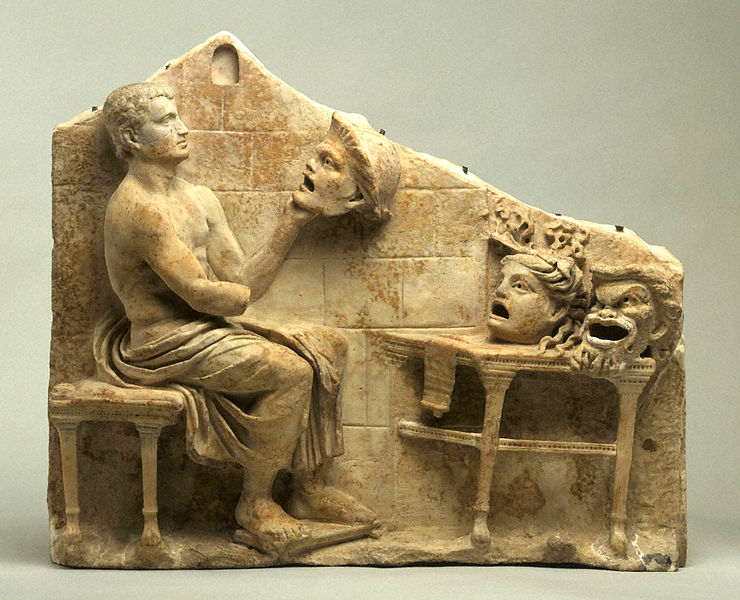
Ancient relief showing Menander with New Comedy theatrical masks

Relief of Menander with New Comedy masks

He was an admirer and imitator of Euripides, whom he resembles in his analysis of the emotions and his keen observation of practical life. In the tense political climate after the Macedonian conquest, Greek comedy had moved away from the daring personal and political satire of Aristophanes towards the safer, more mundane subject matter of so-called New Comedy. Rather than mythical plots or political commentary, Menander used aspects of daily life as topics for his plays (usually with happy endings), and his characters were stern fathers, young lovers, crafty slaves, cooks, farmers, etc, speaking in the contemporary dialect. He dispensed completely with the traditional Greek Chorus.

He also resembled Euripides in his fondness for moral maxims, and many of his maxims (such as "the property of friends is common", "those whom the gods love die young" and "evil communications corrupt good manners") became proverbial and were later collected and published separately. Unlike Euripides, however, Menander was unwilling to resort to artificial plot devices like the "deus ex machina" to settle his plots.

He was known for the delicacy and incisiveness of his characterizations, and he did much to move comedy towards a more realistic representation of human life. However, he was not above adopting the bawdy style of Aristophanes in many of his plays, and some of his subject matter involved young love, unwanted pregnancies, long-lost relatives, and all sorts of sexual misadventures. He has been accused by some commentators of plagiarism, although reworkings and variations on earlier themes were commonplace at the time, and were considered a generally accepted technique of playwriting. Many later Roman dramatists, such as Terence and Plautus, imitated Menander's style.

Major Works

  • "Dyskolos" ("The Grouch")

By Timeless Myths

Greece:

  • • Homer
  • • Hesiod
  • • Aesop
  • • Sappho
  • • Pindar
  • • Aeschylus
  • • Sophocles
  • • Euripides
  • • Aristophanes
  • • Menander
  • • Apollonius of Rhodes
Aristophanes

Aristophanes

(Comic Playwright, Greek, c. 446 – c. 386 BCE)Introduction Aristophanes was a prolific and much acclaimed comic playwright of ancient Greece, sometimes referred to as the Father of Comedy. Eleven of his forty plays have come down to us virtually c...

October 24th, 2024 • Timeless Myths
Euripides

Euripides

(Tragic Playwright, Greek, c. 480 – c. 406 BCE)Introduction Euripides was the last of the three great tragedians of classical Greece (the other two being Aeschylus and Sophocles). Largely due to an accident of history, eighteen of Euripides' ninet...

October 24th, 2024 • Timeless Myths
The Acharnians

The Acharnians

(Comedy, Greek, 425 BCE, 1,234 lines)Introduction "The Acharnians" (Gr: "Akharneis") is the earliest of the eleven surviving plays of the ancient Greek playwright Aristophanes, and a classic of the highly satirical genre of drama known as Old Come...

October 25th, 2024 • Timeless Myths
Thesmophoriazusae

Thesmophoriazusae

(Comedy, Greek, 411 BCE, 1,231 lines)Introduction "Thesmophoriazusae" (literally meaning "The Women Celebrating the Festival of the Thesmophoria", sometimes also called "The Poet and the Women"), is a comedy by the ancient Greek playwright Aristop...

October 25th, 2024 • Timeless Myths
Aeschylus

Aeschylus

(Tragic Playwright, Greek, c. 525 – c. 455 BCE)Introduction Aeschylus (Aiskhylos) is often recognized as the father of tragedy, and is the first of the three early Greek tragedians whose plays survive extant (the other two being Sophocles and Euri...

January 1st, 2025 • Ancient Literature
Pindar

Pindar

(Lyric Poet, Greek, c. 522 – c. 443 BCE)Introduction Pindar was one of the most famous ancient Greek lyric poets, and perhaps the best known of the canonical nine lyric poets of ancient Greece. He was regarded in antiquity as the greatest of Greek...

January 1st, 2025 • Ancient Literature
Medea

Medea

(Tragedy, Latin/Roman, c. 50 CE, 1,027 lines)Introduction "Medea" is one of the best known of the tragedies of Roman playwright Seneca the Younger, completed around 50 CE or possibly earlier. It tells the story of the revenge of the enchantress Me...

October 25th, 2024 • Timeless Myths
Seneca the Younger

Seneca the Younger

(Tragic Playwright, Roman, c. 4 BCE – 65 CE)Introduction Seneca the Younger was a Roman philosopher, statesman and dramatist of the Silver Age of Latin literature. Although generally considered inferior to their corresponding Greek dramas, his tra...

October 24th, 2024 • Timeless Myths
The Trachiniae

The Trachiniae

(Tragedy, Greek, c. 440 BCE, 1,278 lines)Introduction “The Trachiniae” (Gr: “Trachiniai”, also known as “The Trachinian Women”, “The Women of Trachis” or “The Maidens of Trachis”) is a tragedy by the ancient Greek playwright Sophocles. It was prob...

January 1st, 2025 • Ancient Literature
Dyskolos

Dyskolos

(Comedy, Greek, c. 316 BCE, 969 lines)Introduction "Dyskolos", usually translated as "The Grouch" but also "The Misanthrope" or "The Curmudgeon" or "The Bad-Tempered Man", is a comedy by the ancient Greek playwright Menander. It was first presente...

October 25th, 2024 • Timeless Myths
Timeless Myths

Exploring mythology and legends from around the world.

Explore Myths

All Stories Characters All Articles Search Site Map

Mythologies

Norse Mythology Classical Mythology Celtic Mythology Arthurian Legends Mythology Gods Ancient Literature

About Us

Introduction About Jimmy Bibliography FAQs Retro Version

Resources

Timeless Myths All Stories All Articles Characters
© 1999-2026 Timeless Myths • Copyright • Privacy Policy • Cookie Policy • Contact
Follow us: