Timeless Myths Logo
Aphrodite Apollo Ares Artemis Athena Atlas Coeus Crius Cronus Demeter Dionysus Gaia Hades Hephaestus Hera Hermes Hestia Hyperion Iapetus Mnemosyne Oceanus Phobos Phoebe Poseidon Prometheus Rhea Tethys Themis Uranus Zeus
Bacchus Ceres Diana Juno Jupiter Mars Mercury Minerva Neptune Pluto Venus Vesta Vulcan
Amun Anubis Aten Atum Babi Bastet Bes Geb Hapi hathor heqet Horus Isis Khepri Khnum Khonsu Maat Nephthys Nut Osiris Ptah Ra Seshat Seth Shu Sobek Thoth
Alfheim Baldur Freya Freyr Frigg Heimdallr Helheim Idun Jotunheim Loki Nerthus Njord Odin Thor Tyr
Aengus Arawn Badb Brigid Cailleach Ceridwen Cernunnos Cu Chulainn Dagda Danu Gwydion Herne the Hunter Lugh Medb Morrigan Neit Nuada Taliesin Taranis
Chalchiuhtlicue Coatlicue Huitzilopochtli Mictlantecuhtli Mixcoatl Ometeotl Quetzalcoatl Tezcatlipoca Tlaloc Tonatiuh Xipe Totec Xochiquetzal Xolotl
Amaterasu Ame no Uzume Benzaiten Bishamonten Daikokuten Ebisu Fujin Fukurokuju Inari Izanagi Kagutsuchi Raijin Susanoo Tsukuyomi
Caishen Cangjie Dragon King Eight Immortals Erlang Shen Fuxi Guanyin Hou Yi Huxian Jade Emperor King Yama Leizi Lu-ban Mazu Nezha Nuwa Pangu Shennong Sun Wukong Xiwangmu Yue Lao Zhong Kui
Norse Classical Celtic Arthurian
Literature Stories Names
Aphrodite Apollo Ares Artemis Athena Atlas Coeus Crius Cronus Demeter Dionysus Gaia Hades Hephaestus Hera Hermes Hestia Hyperion Iapetus Mnemosyne Oceanus Phobos Phoebe Poseidon Prometheus Rhea Tethys Themis Uranus Zeus
Bacchus Ceres Diana Juno Jupiter Mars Mercury Minerva Neptune Pluto Venus Vesta Vulcan
Amun Anubis Aten Atum Babi Bastet Bes Geb Hapi hathor heqet Horus Isis Khepri Khnum Khonsu Maat Nephthys Nut Osiris Ptah Ra Seshat Seth Shu Sobek Thoth
Alfheim Baldur Freya Freyr Frigg Heimdallr Helheim Idun Jotunheim Loki Nerthus Njord Odin Thor Tyr
Aengus Arawn Badb Brigid Cailleach Ceridwen Cernunnos Cu Chulainn Dagda Danu Gwydion Herne the Hunter Lugh Medb Morrigan Neit Nuada Taliesin Taranis
Chalchiuhtlicue Coatlicue Huitzilopochtli Mictlantecuhtli Mixcoatl Ometeotl Quetzalcoatl Tezcatlipoca Tlaloc Tonatiuh Xipe Totec Xochiquetzal Xolotl
Amaterasu Ame no Uzume Benzaiten Bishamonten Daikokuten Ebisu Fujin Fukurokuju Inari Izanagi Kagutsuchi Raijin Susanoo Tsukuyomi
Caishen Cangjie Dragon King Eight Immortals Erlang Shen Fuxi Guanyin Hou Yi Huxian Jade Emperor King Yama Leizi Lu-ban Mazu Nezha Nuwa Pangu Shennong Sun Wukong Xiwangmu Yue Lao Zhong Kui
Norse Classical Celtic Arthurian
Literature Stories Names
  1. Classical Literature
    Greece Rome Other Ancient Civilizations Timeline of Classical Literature Alphabetical List of Authors Index of Individual Works Index of Important Characters Sources About Us
  2. Greece
    Homer Hesiod Aesop Sappho Pindar Aeschylus Sophocles Euripides Aristophanes Menander Apollonius of Rhodes
  3. Aeschylus
    The Persians The Suppliants Seven Against Thebes Agamemnon The Libation Bearers The Eumenides The Oresteia Prometheus Bound

Aeschylus

(Tragic Playwright, Greek, c. 525 – c. 455 BCE)

Introduction

Aeschylus (Aiskhylos) is often recognized as the father of tragedy, and is the first of the three early Greek tragedians whose plays survive extant (the other two being Sophocles and Euripides). In fact, by expanding the number of characters in plays to allow for conflict among them (previously, only a single character interacted with the Chorus) he was arguably the founder of all serious Greek drama (although some credit that honour to Phrynichus or the even earlier Thespis). Only seven of over seventy plays written by Aeschylus have survived into modern times, the best known being "The Oresteia" trilogy.
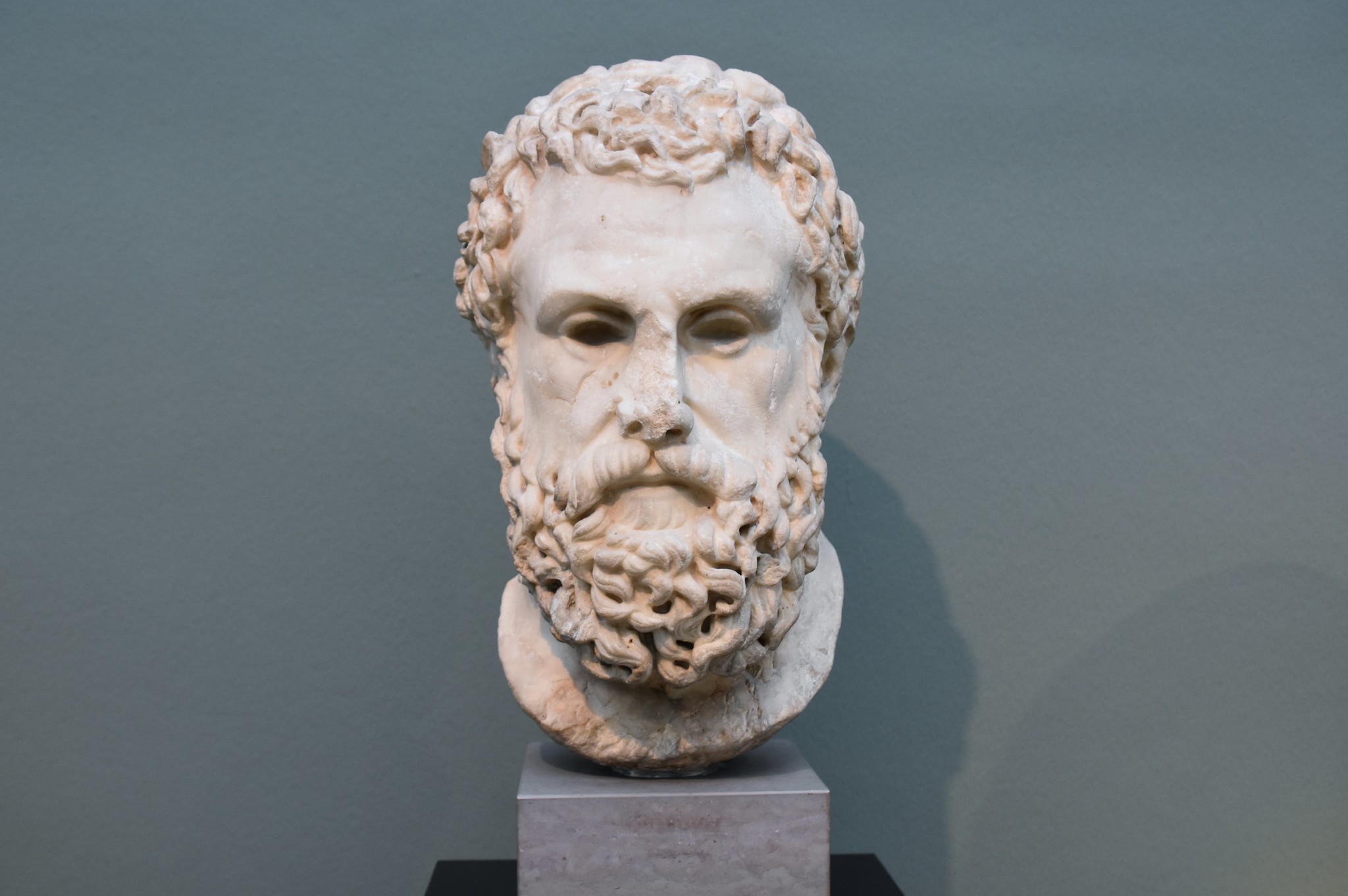
Aeschylus Bust Statue

Aeschylus Bust Statue

Biography - Who Was Aeschylus?

There are few reliable sources for the life of Aeschylus. He was said to have been born in about 525 or 524 BCE in Eleusis, a small town just northwest of Athens. As a youth, he worked at a vineyard until, according to tradition, the god Dionysus visited him in his sleep and commanded him to turn his attention to the nascent art of tragedy. His first play was performed when he was only 26 years old (in 499 BCE), and fifteen years later he won his first prize at Athens' annual Dionysia playwriting competition.

Aeschylus and his brother Cynegeirus fought to defend Athens against Darius's invading Persian army at the Battle of Marathon in 490 BCE and, although the Greeks won a famous victory against apparently overwhelming odds, Cynegeirus died in the battle, which had a profound effect on Aeschylus. He continued to write plays, although he was called into military service against the Persians again in 480 BCE, this time against Xerxes' invading forces at the Battle of Salamis. This naval battle holds a prominent place in "The Persians", his oldest surviving play, which was performed in 472 BCE and won first prize at the Dionysia. In fact, by 473 BCE, after the death of his chief rival Phrynichus, Aeschylus was winning first prize in nearly every competition at the Dionysia.
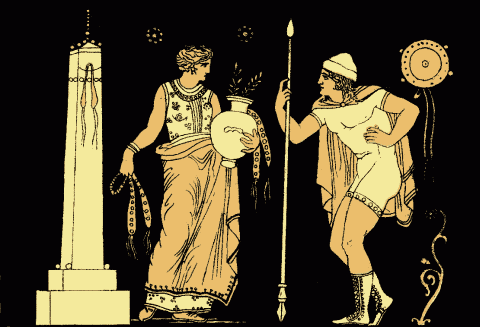
Electra and Orestes

Electra and Orestes

He was an adherent of the Eleusinian Mysteries, a mystical, secretive cult dedicated to the Earth-mother goddess Demeter, which was based in his hometown of Eleusis. According to some reports, an attempt was made on his life while he was acting on stage, possibly because he revealed a secret of the Eleusinian Mysteries.

He made several visits to the important Greek city of Syracuse in Sicily at the invitation of the tyrant Hieron, and it is thought that he also travelled extensively in the region of Thrace. He returned to Sicily for the last time in 458 BCE and it was there that he died, while visiting the city of Gela in 456 or 455 BCE, traditionally (although almost certainly apocryphally) by a tortoise which fell out of the sky after it was dropped by an eagle. Interestingly, the inscription on Aeschylus' gravestone makes no mention of his theatrical renown, commemorating only his military achievements. His sons, Euphorion and Euon, and his nephew, Philocles, followed in his footsteps and became playwrights themselves.

Writings

Only seven of an estimated seventy to ninety tragedies written by Aeschylus have survived intact: "Agamemnon", "The Libation Bearers" and "The Eumenides" (these three forming a trilogy collectively known as "The Oresteia"), "The Persians", "The Suppliants", "Seven Against Thebes" and "Prometheus Bound" (whose authorship is now disputed). All of these plays, with the possible exception of "Prometheus Bound", are known to have taken the first prize at the City Dionysia, which Aeschylus won thirteen times in total. Although "The Oresteia" is the only wholly extant example of a connected trilogy, there is ample evidence that Aeschylus often wrote such trilogies.

At the time that Aeschylus first began writing, the theatre had only just begun to evolve in Greece, usually involving just a single actor and a Chorus. Aeschylus added the innovation of a second actor, allowing for greater dramatic variety, and gave the Chorus a less important role. He is also sometimes credited with introducing scene-decoration (although this distinction is sometimes ascribed to Sophocles) and more elaborate and dramatic costuming. In general, though, he continued to write within the very strict bounds of Greek drama: his plays were written in verse, no violence could be performed on stage, and the works had a strong moral and religious emphasis.

Major Works

  • "The Persians"

  • "The Suppliants"

  • "Seven Against Thebes"

  • "Agamemnon" (Part 1 of "The Oresteia")

  • "The Libation Bearers" (Part 2 of "The Oresteia")

  • "The Eumenides" (Part 3 of "The Oresteia")

  • "Prometheus Bound"

By Ancient Literature

Greece:

  • • Homer
  • • Hesiod
  • • Aesop
  • • Sappho
  • • Pindar
  • • Aeschylus
  • • Sophocles
  • • Euripides
  • • Aristophanes
  • • Menander
  • • Apollonius of Rhodes
Euripides

Euripides

(Tragic Playwright, Greek, c. 480 – c. 406 BCE)Introduction Euripides was the last of the three great tragedians of classical Greece (the other two being Aeschylus and Sophocles). Largely due to an accident of history, eighteen of Euripides' ninet...

October 24th, 2024 • Timeless Myths
Aesop

Aesop

(Fabulist, Greek, c. 620 – c. 560 BCE)Introduction Aesop was by tradition a Greek slave, and he is known today exclusively for the genre of fables ascribed to him. "Aesop's Fables" (most of which have anthropomorphic animals as the main characters...

January 1st, 2025 • Ancient Literature
The Oresteia

The Oresteia

(Tragedy, Greek, 458 BCE, 3,796 lines over 3 plays)Introduction - Who Wrote Oresteia "The Oresteia" trilogy by the ancient Greek playwright Aeschylus consists of the three linked plays "Agamemnon", "The Libation Bearers" and "The Eumenides". The t...

January 1st, 2025 • Ancient Literature
Aristophanes

Aristophanes

(Comic Playwright, Greek, c. 446 – c. 386 BCE)Introduction Aristophanes was a prolific and much acclaimed comic playwright of ancient Greece, sometimes referred to as the Father of Comedy. Eleven of his forty plays have come down to us virtually c...

October 24th, 2024 • Timeless Myths
Hesiod

Hesiod

(Didactic Poet, Greek, c. 750 – c. 700 BCE)Introduction Hesiod is often paired with his near contemporary Homer as one of the earliest Greek poets whose work has survived. He is considered the creator of didactic poetry (instructive and moralizing...

January 1st, 2025 • Ancient Literature
Sophocles

Sophocles

(Tragic Playwright, Greek, c. 496 – c. 406 BCE)Introduction Sophocles (Sophokles) was the second of the three great ancient Greek tragedians (after Aeschylus and before Euripides) whose work has survived. Only seven of his 123 plays have survived ...

January 1st, 2025 • Ancient Literature
The Trachiniae

The Trachiniae

(Tragedy, Greek, c. 440 BCE, 1,278 lines)Introduction “The Trachiniae” (Gr: “Trachiniai”, also known as “The Trachinian Women”, “The Women of Trachis” or “The Maidens of Trachis”) is a tragedy by the ancient Greek playwright Sophocles. It was prob...

January 1st, 2025 • Ancient Literature
The Bacchae

The Bacchae

(Tragedy, Greek, c. 410 BCE, 1,392 lines)Introduction "The Bacchae", also known as "The Bacchantes" (Gr: "Bakchai"), is a late tragedy by the ancient Greek playwright Euripides, and it is considered one of his best works and one of the greatest of...

October 25th, 2024 • Timeless Myths
The Eumenides

The Eumenides

(Tragedy, Greek, 458 BCE, 1,047 lines)Introduction "The Eumenides" ("The Kindly Ones" or "The Gracious Ones") is the third of the three linked tragedies which make up "The Oresteia" trilogy by the ancient Greek playwright Aeschylus, preceded by "A...

January 1st, 2025 • Ancient Literature
Seven Against Thebes

Seven Against Thebes

(Tragedy, Greek, 467 BCE, 1,084 lines)Introduction "Seven Against Thebes" (Gr: "Hepta epi Thebas"; Lat: "Septem contra Thebas") is a tragedy by the ancient Greek playwright Aeschylus, dating from 467 BCE. It is the classic statement of the myth (a...

January 1st, 2025 • Ancient Literature
Timeless Myths

Exploring mythology and legends from around the world.

Explore Myths

All Stories Characters All Articles Search Site Map

Mythologies

Norse Mythology Classical Mythology Celtic Mythology Arthurian Legends Mythology Gods Ancient Literature

About Us

Introduction About Jimmy Bibliography FAQs Retro Version

Resources

Timeless Myths All Stories All Articles Characters
© 1999-2026 Timeless Myths • Copyright • Privacy Policy • Cookie Policy • Contact
Follow us: