Timeless Myths Logo
Aphrodite Apollo Ares Artemis Athena Atlas Coeus Crius Cronus Demeter Dionysus Gaia Hades Hephaestus Hera Hermes Hestia Hyperion Iapetus Mnemosyne Oceanus Phobos Phoebe Poseidon Prometheus Rhea Tethys Themis Uranus Zeus
Bacchus Ceres Diana Juno Jupiter Mars Mercury Minerva Neptune Pluto Venus Vesta Vulcan
Amun Anubis Aten Atum Babi Bastet Bes Geb Hapi hathor heqet Horus Isis Khepri Khnum Khonsu Maat Nephthys Nut Osiris Ptah Ra Seshat Seth Shu Sobek Thoth
Alfheim Baldur Freya Freyr Frigg Heimdallr Helheim Idun Jotunheim Loki Nerthus Njord Odin Thor Tyr
Aengus Arawn Badb Brigid Cailleach Ceridwen Cernunnos Cu Chulainn Dagda Danu Gwydion Herne the Hunter Lugh Medb Morrigan Neit Nuada Taliesin Taranis
Chalchiuhtlicue Coatlicue Huitzilopochtli Mictlantecuhtli Mixcoatl Ometeotl Quetzalcoatl Tezcatlipoca Tlaloc Tonatiuh Xipe Totec Xochiquetzal Xolotl
Amaterasu Ame no Uzume Benzaiten Bishamonten Daikokuten Ebisu Fujin Fukurokuju Inari Izanagi Kagutsuchi Raijin Susanoo Tsukuyomi
Caishen Cangjie Dragon King Eight Immortals Erlang Shen Fuxi Guanyin Hou Yi Huxian Jade Emperor King Yama Leizi Lu-ban Mazu Nezha Nuwa Pangu Shennong Sun Wukong Xiwangmu Yue Lao Zhong Kui
Norse Classical Celtic Arthurian
Literature Stories Names
Aphrodite Apollo Ares Artemis Athena Atlas Coeus Crius Cronus Demeter Dionysus Gaia Hades Hephaestus Hera Hermes Hestia Hyperion Iapetus Mnemosyne Oceanus Phobos Phoebe Poseidon Prometheus Rhea Tethys Themis Uranus Zeus
Bacchus Ceres Diana Juno Jupiter Mars Mercury Minerva Neptune Pluto Venus Vesta Vulcan
Amun Anubis Aten Atum Babi Bastet Bes Geb Hapi hathor heqet Horus Isis Khepri Khnum Khonsu Maat Nephthys Nut Osiris Ptah Ra Seshat Seth Shu Sobek Thoth
Alfheim Baldur Freya Freyr Frigg Heimdallr Helheim Idun Jotunheim Loki Nerthus Njord Odin Thor Tyr
Aengus Arawn Badb Brigid Cailleach Ceridwen Cernunnos Cu Chulainn Dagda Danu Gwydion Herne the Hunter Lugh Medb Morrigan Neit Nuada Taliesin Taranis
Chalchiuhtlicue Coatlicue Huitzilopochtli Mictlantecuhtli Mixcoatl Ometeotl Quetzalcoatl Tezcatlipoca Tlaloc Tonatiuh Xipe Totec Xochiquetzal Xolotl
Amaterasu Ame no Uzume Benzaiten Bishamonten Daikokuten Ebisu Fujin Fukurokuju Inari Izanagi Kagutsuchi Raijin Susanoo Tsukuyomi
Caishen Cangjie Dragon King Eight Immortals Erlang Shen Fuxi Guanyin Hou Yi Huxian Jade Emperor King Yama Leizi Lu-ban Mazu Nezha Nuwa Pangu Shennong Sun Wukong Xiwangmu Yue Lao Zhong Kui
Norse Classical Celtic Arthurian
Literature Stories Names
  1. Classical Literature
    Greece Rome Other Ancient Civilizations Timeline of Classical Literature Alphabetical List of Authors Index of Individual Works Index of Important Characters Sources About Us
  2. Greece
    Homer Hesiod Aesop Sappho Pindar Aeschylus Sophocles Euripides Aristophanes Menander Apollonius of Rhodes
  3. Aeschylus
    The Persians The Suppliants Seven Against Thebes Agamemnon The Libation Bearers The Eumenides The Oresteia Prometheus Bound
  4. Prometheus Bound
    Prometheus Bound

Prometheus Bound

(Tragedy, Greek, c. 415 BCE, 1,093 lines)

Introduction

"Prometheus Bound" (Gr: "Prometheus Desmotes") is a tragedy often attributed to the ancient Greek playwright Aeschylus although it is now usually considered to be almost certainly the work of another (unknown) hand, perhaps as late as 415 BCE. It is based on the myth of Prometheus, the Titan who was punished by the god Zeus for giving fire to mankind.
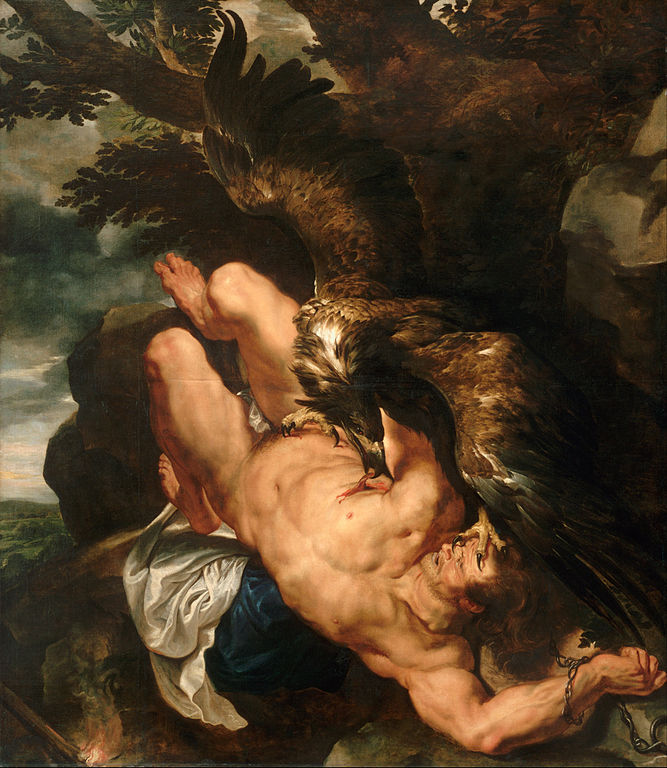
prometheus eagle

Synopsis

At the beginning of the play, Hephaestus, the blacksmith of the gods, accompanied by Kratos and Bia (representing Power and Force), reluctantly chains Prometheus to a mountain in the Caucasus, (considered by the ancient Greeks to be the end of the earth), while Kratos heaps abuse on him and Bia remains mute throughout. Although Hephaestus has some sympathy for Prometheus' plight, especially in that Prometheus was instrumental in Zeus' victory in the great battle against the Titans, Kratos reminds him that this is Zeus' punishment for Prometheus' theft of forbidden fire from the gods.

A Chorus of ocean nymhs (Prometheus' cousins, the Oceanids), attempt to comfort Prometheus. He confides in the Chorus that his gift of fire to mankind was not his only benefaction, and reveals that it was he who thwarted Zeus' plan to obliterate the human race after the battle against the Titans, and then taught men all the civilizing arts, such as writing, medicine, mathematics, astronomy, metallurgy, architecture and agriculture (the so-called "Catalogue of the Arts").

Later, the Titan Oceanus himself enters, announcing his intent to go to Zeus to plead on Prometheus' behalf. But Prometheus discourages him, warning that the plan will only bring Zeus's wrath down on Oceanus himself. However, he appears confident that Zeus will eventually release him anyway, as he will have need of Prometheus' gift of prophecy in order to safeguard his own position (he hints several times at the prophecy about a son who would become greater than his father).
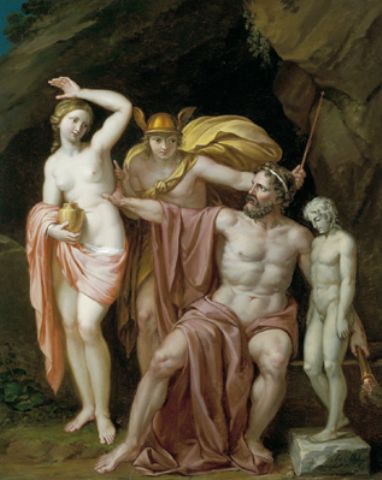
Zeus, Pandora & Hermes

Zeus, Pandora & Hermes

Prometheus is then visited by Io, once a beautiful maiden pursued by the lustful Zeus, but now, thanks to the jealous Hera, transformed into a cow, pursued to the ends of the earth by a biting gadfly. Prometheus again demonstrates his gift of prophecy in revealing to Io that her torments will continue for some time, but will eventually end in Egypt, where she will bear a son named Epaphus, adding that one of her descendants several generations hence (the unnamed Heracles), will be the one who will release Prometheus himself from his own torment.

Towards the end of the play, Zeus sends Hermes the messenger-god down to Prometheus to demand of him who it is that threatens to overthrow him. When Prometheus refuses to comply, the angry Zeus strikes him with a thunderbolt that plunges him down into the abyss of Tartarus, where he is to be tortured forever with fantastic and terrible pains, organ-devouring beasts, lightning and never-ending agony.

Analysis

Aeschylus' treatment of the myth of Prometheus departs radically from the earlier accounts in Hesiod's "Theogony" and "Works and Days", where the Titan is portrayed as a lowly trickster. In "Prometheus Bound", Prometheus becomes more of a wise and proud human benefactor rather than an object of blame for human suffering, and Pandora and her jar of evils (whose arrival was prompted by Prometheus' theft of fire in Hesiod's account) is entirely absent.

"Prometheus Bound" was purportedly the first play in a Prometheus trilogy conventionally called the "Prometheia". However, the other two plays, "Prometheus Unbound" (in which Heracles frees Prometheus from his chains and kills the eagle that had been sent daily to eat the Titan's perpetually regenerating liver) and "Prometheus the Fire-Bringer" (in which Prometheus warns Zeus not to lie with the sea nymph Thetis as she is fated to give birth to a son greater than the father, an act which brings about the grateful Zeus' final reconciliation with Prometheus), survive only in fragments.
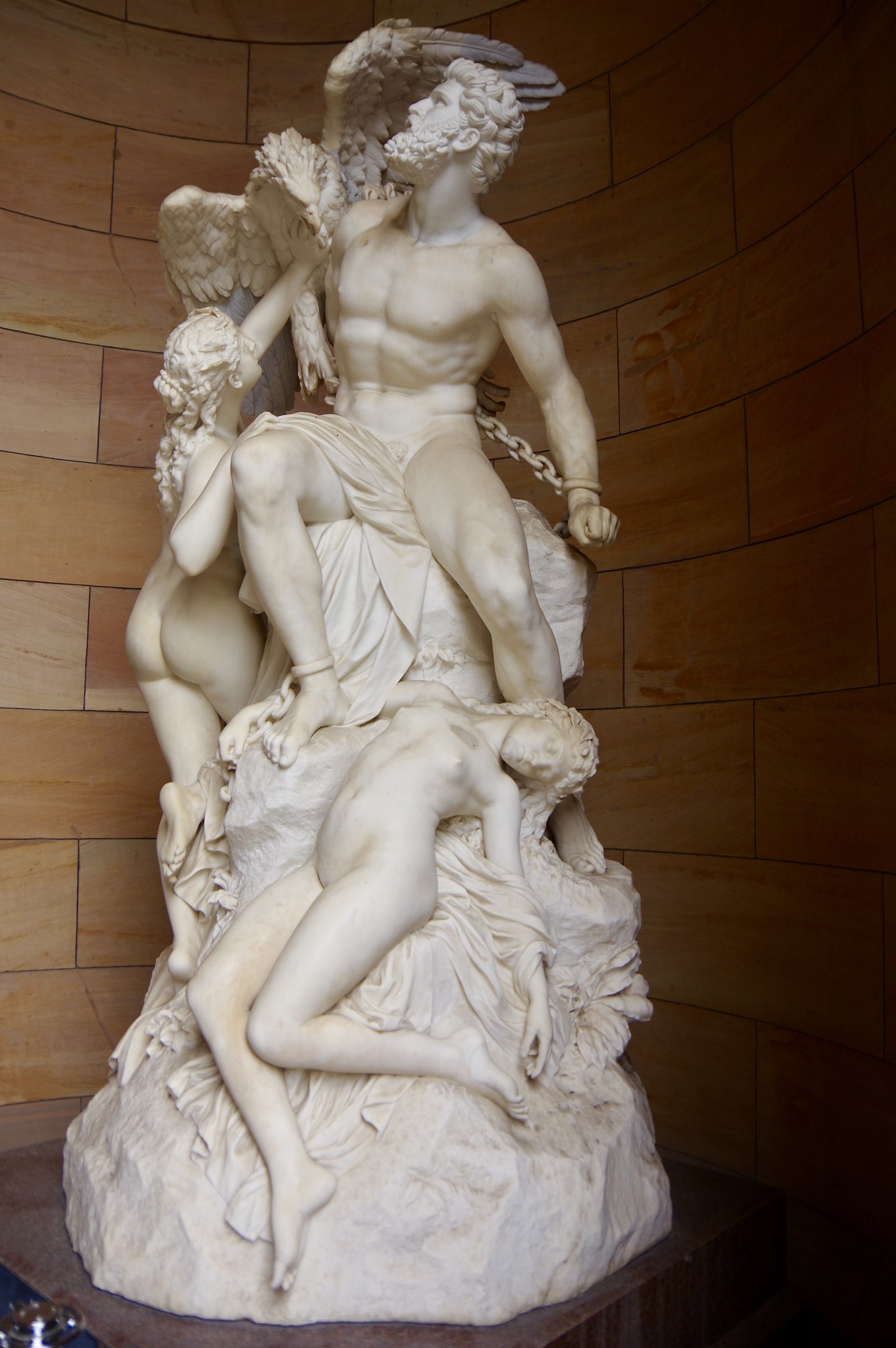
prometheus bound aeschylus

Although there are reports dating back to the Great Library of Alexandria unanimously crediting Aeschylus as the author of "Prometheus Bound", modern scholarship (based on stylisic and metrical grounds, as well as its uncharacteristically unflattering depiction of Zeus, and references to it in the works of other writers) increasingly points to a date of around 415 BCE, long after Aeschylus' death. Some scholars have even suggested that it may be the work of Aeschylus' son, Euphorion, who was also a playwright. The ongoing debate will, however, probably never be resolved definitively.

Much of the play is composed of speeches and contains little action, especially given that its protagonist, Prometheus, is chained and immobile throughout.

A major theme throughout the play is about resisting tyranny and the frustration and helplessness of reason and rightness in the face of sheer power. Prometheus is the personification of reason and wisdom, but he also represents the individual of conscience in a tyrannical totalitarian state (a common theme in Greek plays of the era). He is portrayed as the rebel with a conscience, whose crime - his love of man - brings on him the rage of the gods, but also the immediate sympathy of the human audience. He becomes a representative for those human champions of justice and principle who defy tyranny and pay the ultimate price. In some ways, Prometheus prefigures Christ, as a divine being who suffers horrible tortures for the sake of mankind.

Another big theme in the play is that of fate. As a visionary who can see the future, Prometheus knows full well that he cannot escape his long years of torture, but he also knows that one day he will be set free, and that he possesses a piece of strategic knowledge that could preserve or destroy Zeus's reign.

Resources

  • English translation (Internet Classics Archive)

  • Greek version with word-by-word translation (Perseus Project)

By Ancient Literature

Aeschylus:

  • • The Persians
  • • The Suppliants
  • • Seven Against Thebes
  • • Agamemnon
  • • The Libation Bearers
  • • The Eumenides
  • • The Oresteia
  • • Prometheus Bound
Prometheus

Prometheus

Titan of forethought. Prometheus ("Forethought") was the son of the Titan Iapetus and either Iapetus' sister Themis, or possibly Clymene or Asia, both of which were Oceanids. Prometheus was the brother of Atlas, Menoetius and Epimetheus. He marrie...

April 19th, 1999 • Jimmy Joe
Prometheus

Prometheus

Prometheus: The Quick-Thinking Advocate of Humankind Though Prometheus, titan and trickster, was known as the Titan who gave fire to humans, there is much more to know about this fascinating character. To the Greeks, Prometheus was the “benefactor...

April 2nd, 2002 • Timeless Myths
The Suppliants

The Suppliants

(Tragedy, Greek, 423 BCE, 1,234 lines)Introduction "The Suppliants" (also known as "The Suppliant Women"; Gr: "Hiketides"; Lat: "Supplices") is a tragedy by the ancient Greek playwright Euripides, first produced in 423 BCE. Not to be confused with...

October 25th, 2024 • Timeless Myths
The Suppliants

The Suppliants

(Tragedy, Greek, c. 469 BCE, 1,073 lines)Introduction "The Suppliants" (Gr: "Hiketides"; Lat: "Supplices") is a tragedy by the ancient Greek playwright Aeschylus. It is sometimes known as "The Suppliant Women" or "The Suppliant Maidens". Along wit...

January 1st, 2025 • Ancient Literature
Iphigenia in Tauris

Iphigenia in Tauris

"Iphigenia in Tauris" or "Iphigenia among the Taurians" (Gr: "Iphigeneia en Taurois") is a tragedy, although sometimes described as a romance or melodrama, by the ancient Greek playwright Euripides, written sometime between 414 BCE and 412 BCE. It...

October 25th, 2024 • Timeless Myths
The Phoenician Women

The Phoenician Women

"The Phoenician Women" (Gr: "Phoinissai"; Lat: "Phoenissae") is a tragedy by the ancient Greek playwright Euripides. It was written between 411 and 409 BCE, and is a variant of the story Aeschylus treated in his play "Seven Against Thebes" in whic...

October 25th, 2024 • Timeless Myths
The Trachiniae

The Trachiniae

(Tragedy, Greek, c. 440 BCE, 1,278 lines)Introduction “The Trachiniae” (Gr: “Trachiniai”, also known as “The Trachinian Women”, “The Women of Trachis” or “The Maidens of Trachis”) is a tragedy by the ancient Greek playwright Sophocles. It was prob...

January 1st, 2025 • Ancient Literature
The Eumenides

The Eumenides

(Tragedy, Greek, 458 BCE, 1,047 lines)Introduction "The Eumenides" ("The Kindly Ones" or "The Gracious Ones") is the third of the three linked tragedies which make up "The Oresteia" trilogy by the ancient Greek playwright Aeschylus, preceded by "A...

January 1st, 2025 • Ancient Literature
The Oresteia

The Oresteia

(Tragedy, Greek, 458 BCE, 3,796 lines over 3 plays)Introduction - Who Wrote Oresteia "The Oresteia" trilogy by the ancient Greek playwright Aeschylus consists of the three linked plays "Agamemnon", "The Libation Bearers" and "The Eumenides". The t...

January 1st, 2025 • Ancient Literature
Aeschylus

Aeschylus

(Tragic Playwright, Greek, c. 525 – c. 455 BCE)Introduction Aeschylus (Aiskhylos) is often recognized as the father of tragedy, and is the first of the three early Greek tragedians whose plays survive extant (the other two being Sophocles and Euri...

January 1st, 2025 • Ancient Literature
Timeless Myths

Exploring mythology and legends from around the world.

Explore Myths

All Stories Characters All Articles Search Site Map

Mythologies

Norse Mythology Classical Mythology Celtic Mythology Arthurian Legends Mythology Gods Ancient Literature

About Us

Introduction About Jimmy Bibliography FAQs Retro Version

Resources

Timeless Myths All Stories All Articles Characters
© 1999-2026 Timeless Myths • Copyright • Privacy Policy • Cookie Policy • Contact
Follow us: