Timeless Myths Logo
Aphrodite Apollo Ares Artemis Athena Atlas Coeus Crius Cronus Demeter Dionysus Gaia Hades Hephaestus Hera Hermes Hestia Hyperion Iapetus Mnemosyne Oceanus Phobos Phoebe Poseidon Prometheus Rhea Tethys Themis Uranus Zeus
Bacchus Ceres Diana Juno Jupiter Mars Mercury Minerva Neptune Pluto Venus Vesta Vulcan
Amun Anubis Aten Atum Babi Bastet Bes Geb Hapi hathor heqet Horus Isis Khepri Khnum Khonsu Maat Nephthys Nut Osiris Ptah Ra Seshat Seth Shu Sobek Thoth
Alfheim Baldur Freya Freyr Frigg Heimdallr Helheim Idun Jotunheim Loki Nerthus Njord Odin Thor Tyr
Aengus Arawn Badb Brigid Cailleach Ceridwen Cernunnos Cu Chulainn Dagda Danu Gwydion Herne the Hunter Lugh Medb Morrigan Neit Nuada Taliesin Taranis
Chalchiuhtlicue Coatlicue Huitzilopochtli Mictlantecuhtli Mixcoatl Ometeotl Quetzalcoatl Tezcatlipoca Tlaloc Tonatiuh Xipe Totec Xochiquetzal Xolotl
Amaterasu Ame no Uzume Benzaiten Bishamonten Daikokuten Ebisu Fujin Fukurokuju Inari Izanagi Kagutsuchi Raijin Susanoo Tsukuyomi
Caishen Cangjie Dragon King Eight Immortals Erlang Shen Fuxi Guanyin Hou Yi Huxian Jade Emperor King Yama Leizi Lu-ban Mazu Nezha Nuwa Pangu Shennong Sun Wukong Xiwangmu Yue Lao Zhong Kui
Norse Classical Celtic Arthurian
Literature Stories Names
Aphrodite Apollo Ares Artemis Athena Atlas Coeus Crius Cronus Demeter Dionysus Gaia Hades Hephaestus Hera Hermes Hestia Hyperion Iapetus Mnemosyne Oceanus Phobos Phoebe Poseidon Prometheus Rhea Tethys Themis Uranus Zeus
Bacchus Ceres Diana Juno Jupiter Mars Mercury Minerva Neptune Pluto Venus Vesta Vulcan
Amun Anubis Aten Atum Babi Bastet Bes Geb Hapi hathor heqet Horus Isis Khepri Khnum Khonsu Maat Nephthys Nut Osiris Ptah Ra Seshat Seth Shu Sobek Thoth
Alfheim Baldur Freya Freyr Frigg Heimdallr Helheim Idun Jotunheim Loki Nerthus Njord Odin Thor Tyr
Aengus Arawn Badb Brigid Cailleach Ceridwen Cernunnos Cu Chulainn Dagda Danu Gwydion Herne the Hunter Lugh Medb Morrigan Neit Nuada Taliesin Taranis
Chalchiuhtlicue Coatlicue Huitzilopochtli Mictlantecuhtli Mixcoatl Ometeotl Quetzalcoatl Tezcatlipoca Tlaloc Tonatiuh Xipe Totec Xochiquetzal Xolotl
Amaterasu Ame no Uzume Benzaiten Bishamonten Daikokuten Ebisu Fujin Fukurokuju Inari Izanagi Kagutsuchi Raijin Susanoo Tsukuyomi
Caishen Cangjie Dragon King Eight Immortals Erlang Shen Fuxi Guanyin Hou Yi Huxian Jade Emperor King Yama Leizi Lu-ban Mazu Nezha Nuwa Pangu Shennong Sun Wukong Xiwangmu Yue Lao Zhong Kui
Norse Classical Celtic Arthurian
Literature Stories Names
  1. Classical Literature
    Greece Rome Other Ancient Civilizations Timeline of Classical Literature Alphabetical List of Authors Index of Individual Works Index of Important Characters Sources About Us
  2. Greece
    Homer Hesiod Aesop Sappho Pindar Aeschylus Sophocles Euripides Aristophanes Menander Apollonius of Rhodes
  3. Aeschylus
    The Persians The Suppliants Seven Against Thebes Agamemnon The Libation Bearers The Eumenides The Oresteia Prometheus Bound
  4. The Oresteia
    The Oresteia

The Oresteia

(Tragedy, Greek, 458 BCE, 3,796 lines over 3 plays)

Introduction - Who Wrote Oresteia

"The Oresteia" trilogy by the ancient Greek playwright Aeschylus consists of the three linked plays "Agamemnon", "The Libation Bearers" and "The Eumenides". The trilogy as a whole, originally performed at the annual Dionysia festival in Athens in 458 BCE, where it won first prize, is considered to be Aeschylus' last authenticated, and also his greatest, work. It follows the vicissitudes of the House of Atreus, from the murder of Agamemnon by his wife Clytemnestra, to the subsequent revenge wreaked by his son Orestes and its consequences.
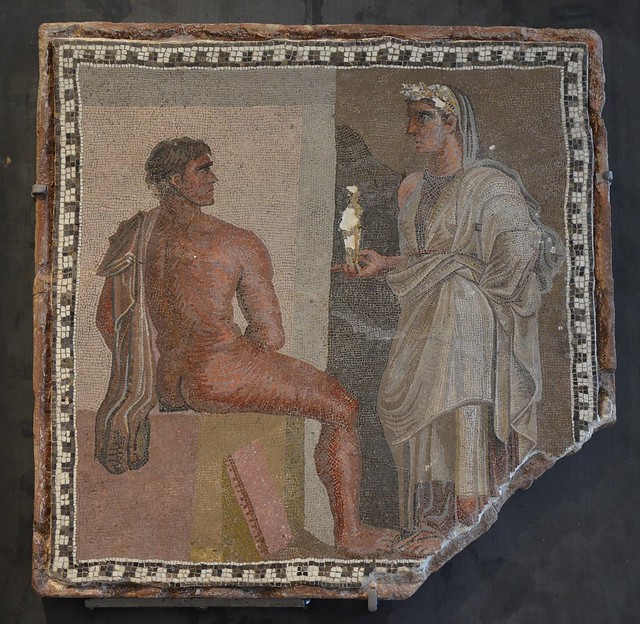
Orestes and Iphigenia - Mosaic

Orestes and Iphigenia - Mosaic

Synopsis - The Oresteia Summary

"Agamemnon" describes the homecoming of King Agamemnon of Argos from the Trojan War, along with his concubine Cassandra. His wife, Clytemnestra, however, had long been planning his murder (in concert with her lover, Aegisthus) as revenge for Agamemnon's earlier sacrifice of their daughter, Iphigenia. For more detail, see the separate page on "Agamemnon".

"The Libation Bearers" deals with the reunion of Agamemnon's children, Electra and Orestes, and their revenge as they kill Clytemnestra and Aegisthus in a new chapter of the curse of the House of Atreus. For more detail, see the separate page on "The Libation Bearers".

"The Eumenides" tells of how Orestes is pursued to Athens by the vengeful Erinyes for the murder of his mother, Clytemnestra, and how he is tried before Athena and a jury of Athenians to decide whether his crime justifies the torment of the Erinyes. For more detail, see the separate page on "The Eumenides".

Analysis

"The Oresteia" (comprising "Agamemnon", "The Libation Bearers" and "The Eumenides") is the only surviving example of a complete trilogy of ancient Greek plays (a fourth play, which would have been performed as a comic finale, a satyr play called "Proteus", has not survived). It was originally performed at the annual Dionysia festival in Athens in 458 BCE, where it won first prize.

Although technically a tragedy, "The Oresteia" as a whole actually ends on a relatively upbeat note, which may surprise modern readers, although in fact the term "tragedy" did not carry its modern meaning in ancient Athens, and many of the extant Greek tragedies do end happily.
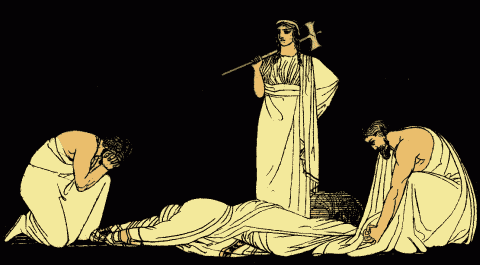
The Murder of Agamemnon

The Murder of Agamemnon

In general, the Choruses of "The Oresteia" are more integral to the action than the Choruses in the works of the other two great Greek tragedians, Sophocles and Euripides (particularly as the elder Aeschylus was only one step removed from the ancient tradition in which the whole play was conducted by the Chorus). In "The Eumenides" in particular, the Chorus is even more essential because it consists of the Erinyes themselves and, after a certain point, their story (and their successful integration into the pantheon of Athens) becomes a major part of the play.

Throughout "The Oresteia", Aeschylus uses a lot of naturalistic metaphors and symbols, such as solar and lunar cycles, night and day, storms, winds, fire, etc, to represent the vacillating nature of human reality (good and evil, birth and death, sorrow and happiness, etc). There is also a significant amount of animal symbolism in the plays, and humans who forget how to govern themselves justly tend to be personified as beasts.

Other important themes covered by the trilogy include: the cyclical nature of blood crimes (the ancient law of the Erinyes mandates that blood must be paid for with blood in an unending cycle of doom, and the bloody past history of the House of Atreus continues to affect events generation after generation in a self-perpetuating cycle of violence begetting violence); the lack of clarity between right and wrong (Agamemnon, Clytemnestra and Orestes are all faced with impossible moral choices, with no clearcut right and wrong); the conflict between the old and the new gods (the Erinyes represent the ancient, primitive laws which demand blood vengeance, while Apollo, and particularly Athena, represent the new order of reason and civilization); and the difficult nature of inheritence (and the responsibilities it carries with it).
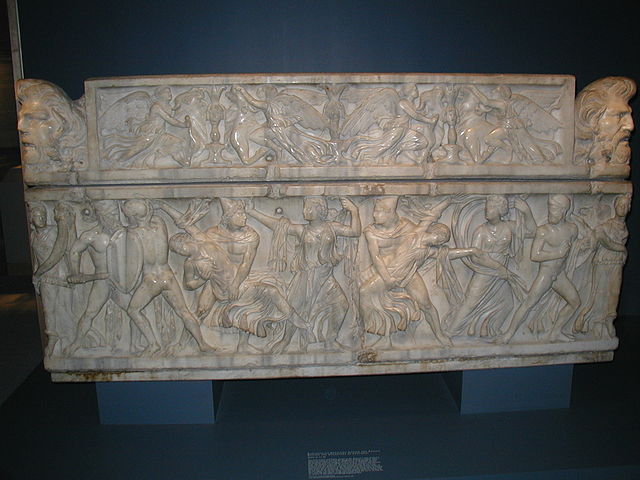
Sarcophagus Carving depicting Oresteia

Sarcophagus Carving depicting Oresteia

There is also an underlying metaphorical aspect to the entire drama: the change from archaic self-help justice by personal revenge or vendetta to the administration of justice by trial (sanctioned by the gods themselves) throughout the series of plays, symbolizes the passage from a primitive Greek society governed by instincts, to a modern democractic society governed by reason.

The tyranny under which Argos finds itself during the rule of Clytemnestra and Aegisthus corresponds in a very broad way to some events in the biographical career of Aeschylus himself. He is known to have made at least two visits to the court of the Sicilian tyrant Hieron (as did several other prominent poets of his day), and he lived through the democratization of Athens. The tension between tyranny and democracy, a common theme in Greek drama, is palpable throughout the three plays.

By the end of the trilogy, Orestes is seen to be the key, not only to ending the curse of the House of Atreus, but also in laying the foundation for a new step in the progress of humanity. Thus, although Aeschylus uses an ancient and well-known myth as the basis for his "The Oresteia", he approaches it in a distinctly different way than other writers who came before him, with his own agenda to convey.

Resources

  • English translation of "Agamemnon" by E. D. A. Morshead (Internet Classics Archive)

  • Greek version of "Agamemnon" with word-by-word translation (Perseus Project)

  • English translation of "The Libation Bearers" by E. D. A. Morshead (Internet Classics Archive)

  • Greek version of "The Libation Bearers" with word-by-word translation (Perseus Project)

  • English translation of "The Eumenides" by E. D. A. Morshead (Internet Classics Archive)

  • Greek version of "The Eumenides" with word-by-word translation (Perseus Project)

By Ancient Literature

Aeschylus:

  • • The Persians
  • • The Suppliants
  • • Seven Against Thebes
  • • Agamemnon
  • • The Libation Bearers
  • • The Eumenides
  • • The Oresteia
  • • Prometheus Bound
Orestes

Orestes

(Tragedy, Greek, c. 407 BCE, 1,629 lines) Introduction | Synopsis | Analysis | ResourcesIntroduction "Orestes" is a late tragedy by the ancient Greek playwright Euripides, first presented in 408 BCE. It continues the story of Orestes after the eve...

October 25th, 2024 • Timeless Myths
The Eumenides

The Eumenides

(Tragedy, Greek, 458 BCE, 1,047 lines)Introduction "The Eumenides" ("The Kindly Ones" or "The Gracious Ones") is the third of the three linked tragedies which make up "The Oresteia" trilogy by the ancient Greek playwright Aeschylus, preceded by "A...

January 1st, 2025 • Ancient Literature
Orestes

Orestes

Revenge and Madness Iphigeneia among the Taurians King of Argos and SpartaRevenge and Madness Orestes was the King of Argos and Sparta, and the son of Agamemnon and Clytemnestra. Orestes (Ὀρέστης) was brother of Iphigeneia, Electra and Chrysothemi...

August 23rd, 2003 • Jimmy Joe
Iphigenia in Tauris

Iphigenia in Tauris

"Iphigenia in Tauris" or "Iphigenia among the Taurians" (Gr: "Iphigeneia en Taurois") is a tragedy, although sometimes described as a romance or melodrama, by the ancient Greek playwright Euripides, written sometime between 414 BCE and 412 BCE. It...

October 25th, 2024 • Timeless Myths
Aeschylus

Aeschylus

(Tragic Playwright, Greek, c. 525 – c. 455 BCE)Introduction Aeschylus (Aiskhylos) is often recognized as the father of tragedy, and is the first of the three early Greek tragedians whose plays survive extant (the other two being Sophocles and Euri...

January 1st, 2025 • Ancient Literature
The Trachiniae

The Trachiniae

(Tragedy, Greek, c. 440 BCE, 1,278 lines)Introduction “The Trachiniae” (Gr: “Trachiniai”, also known as “The Trachinian Women”, “The Women of Trachis” or “The Maidens of Trachis”) is a tragedy by the ancient Greek playwright Sophocles. It was prob...

January 1st, 2025 • Ancient Literature
The Libation Bearers

The Libation Bearers

(Tragedy, Greek, 458 BCE, 1,076 lines)Introduction "The Libation Bearers" (Gr: "Choephoroi") is the second of the three linked tragedies which make up "The Oresteia" trilogy by the ancient Greek playwright Aeschylus, preceded by "Agamemnon" and fo...

January 1st, 2025 • Ancient Literature
Euripides

Euripides

(Tragic Playwright, Greek, c. 480 – c. 406 BCE)Introduction Euripides was the last of the three great tragedians of classical Greece (the other two being Aeschylus and Sophocles). Largely due to an accident of history, eighteen of Euripides' ninet...

October 24th, 2024 • Timeless Myths
The Bacchae

The Bacchae

(Tragedy, Greek, c. 410 BCE, 1,392 lines)Introduction "The Bacchae", also known as "The Bacchantes" (Gr: "Bakchai"), is a late tragedy by the ancient Greek playwright Euripides, and it is considered one of his best works and one of the greatest of...

October 25th, 2024 • Timeless Myths
The Phoenician Women

The Phoenician Women

"The Phoenician Women" (Gr: "Phoinissai"; Lat: "Phoenissae") is a tragedy by the ancient Greek playwright Euripides. It was written between 411 and 409 BCE, and is a variant of the story Aeschylus treated in his play "Seven Against Thebes" in whic...

October 25th, 2024 • Timeless Myths
Timeless Myths

Exploring mythology and legends from around the world.

Explore Myths

All Stories Characters All Articles Search Site Map

Mythologies

Norse Mythology Classical Mythology Celtic Mythology Arthurian Legends Mythology Gods Ancient Literature

About Us

Introduction About Jimmy Bibliography FAQs Retro Version

Resources

Timeless Myths All Stories All Articles Characters
© 1999-2026 Timeless Myths • Copyright • Privacy Policy • Cookie Policy • Contact
Follow us: