Timeless Myths Logo
Aphrodite Apollo Ares Artemis Athena Atlas Coeus Crius Cronus Demeter Dionysus Gaia Hades Hephaestus Hera Hermes Hestia Hyperion Iapetus Mnemosyne Oceanus Phobos Phoebe Poseidon Prometheus Rhea Tethys Themis Uranus Zeus
Bacchus Ceres Diana Juno Jupiter Mars Mercury Minerva Neptune Pluto Venus Vesta Vulcan
Amun Anubis Aten Atum Babi Bastet Bes Geb Hapi hathor heqet Horus Isis Khepri Khnum Khonsu Maat Nephthys Nut Osiris Ptah Ra Seshat Seth Shu Sobek Thoth
Alfheim Baldur Freya Freyr Frigg Heimdallr Helheim Idun Jotunheim Loki Nerthus Njord Odin Thor Tyr
Aengus Arawn Badb Brigid Cailleach Ceridwen Cernunnos Cu Chulainn Dagda Danu Gwydion Herne the Hunter Lugh Medb Morrigan Neit Nuada Taliesin Taranis
Chalchiuhtlicue Coatlicue Huitzilopochtli Mictlantecuhtli Mixcoatl Ometeotl Quetzalcoatl Tezcatlipoca Tlaloc Tonatiuh Xipe Totec Xochiquetzal Xolotl
Amaterasu Ame no Uzume Benzaiten Bishamonten Daikokuten Ebisu Fujin Fukurokuju Inari Izanagi Kagutsuchi Raijin Susanoo Tsukuyomi
Caishen Cangjie Dragon King Eight Immortals Erlang Shen Fuxi Guanyin Hou Yi Huxian Jade Emperor King Yama Leizi Lu-ban Mazu Nezha Nuwa Pangu Shennong Sun Wukong Xiwangmu Yue Lao Zhong Kui
Norse Classical Celtic Arthurian
Literature Stories Names
Aphrodite Apollo Ares Artemis Athena Atlas Coeus Crius Cronus Demeter Dionysus Gaia Hades Hephaestus Hera Hermes Hestia Hyperion Iapetus Mnemosyne Oceanus Phobos Phoebe Poseidon Prometheus Rhea Tethys Themis Uranus Zeus
Bacchus Ceres Diana Juno Jupiter Mars Mercury Minerva Neptune Pluto Venus Vesta Vulcan
Amun Anubis Aten Atum Babi Bastet Bes Geb Hapi hathor heqet Horus Isis Khepri Khnum Khonsu Maat Nephthys Nut Osiris Ptah Ra Seshat Seth Shu Sobek Thoth
Alfheim Baldur Freya Freyr Frigg Heimdallr Helheim Idun Jotunheim Loki Nerthus Njord Odin Thor Tyr
Aengus Arawn Badb Brigid Cailleach Ceridwen Cernunnos Cu Chulainn Dagda Danu Gwydion Herne the Hunter Lugh Medb Morrigan Neit Nuada Taliesin Taranis
Chalchiuhtlicue Coatlicue Huitzilopochtli Mictlantecuhtli Mixcoatl Ometeotl Quetzalcoatl Tezcatlipoca Tlaloc Tonatiuh Xipe Totec Xochiquetzal Xolotl
Amaterasu Ame no Uzume Benzaiten Bishamonten Daikokuten Ebisu Fujin Fukurokuju Inari Izanagi Kagutsuchi Raijin Susanoo Tsukuyomi
Caishen Cangjie Dragon King Eight Immortals Erlang Shen Fuxi Guanyin Hou Yi Huxian Jade Emperor King Yama Leizi Lu-ban Mazu Nezha Nuwa Pangu Shennong Sun Wukong Xiwangmu Yue Lao Zhong Kui
Norse Classical Celtic Arthurian
Literature Stories Names
  1. Classical Literature
    Greece Rome Other Ancient Civilizations Timeline of Classical Literature Alphabetical List of Authors Index of Individual Works Index of Important Characters Sources About Us
  2. Greece
    Homer Hesiod Aesop Sappho Pindar Aeschylus Sophocles Euripides Aristophanes Menander Apollonius of Rhodes
  3. Euripides
    Alcestis Medea (Euripides) Heracleidae (Euripides) Hippolytus (Euripides) Andromache (Euripides) Hecuba (Euripides) The Suppliants Electra Heracles (Euripides) The Trojan Women Iphigenia in Tauris Ion Helen (Euripides) The Phoenician Women The Bacchae Orestes Iphigenia at Aulis Cyclops
  4. The Phoenician Women
    The Phoenician Women

The Phoenician Women

"The Phoenician Women" (Gr: "Phoinissai"; Lat: "Phoenissae") is a tragedy by the ancient Greek playwright Euripides. It was written between 411 and 409 BCE, and is a variant of the story Aeschylus treated in his play "Seven Against Thebes" in which Oedipus' sons Polynices and Eteocles fight for the crown of Thebes, ultimately killing each other. The title refers to the play's Chorus, which is composed of Phoenician women on their way from Tyre to Delphi who are accidentally trapped in Thebes by the war.

Synopsis of The Phoenician Women

Dramatis Personae – Characters

  • JOCASTA, wife of Oedipus

  • OLD SERVANT, an attendant of Antigone

  • ANTIGONE, daughter of Oedipus

  • CHORUS OF PHOENICIAN MAIDENS

  • POLYNEICES, exiled son of Oedipus

  • ETEOCLES, son of Oedipus, now King of Thebes

  • CREON, brother of Jocasta

  • TIRESIAS, a blind prophet

  • MENOECEUS, son of Creon

  • FIRST MESSENGER

  • SECOND MESSENGER

  • OEDIPUS, formerly King of Thebes

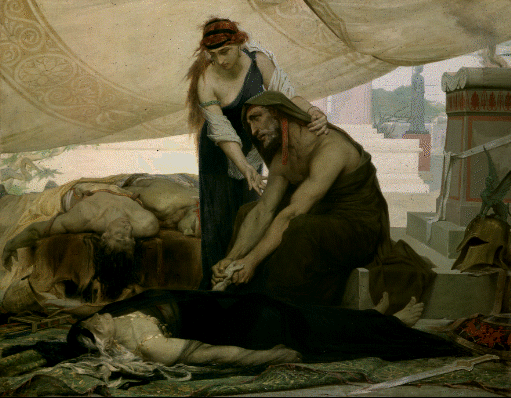
Oedipus and his family - A painting depicting the tragic family of Oedipus

Oedipus and his family - A painting depicting the tragic family of Oedipus, whose curse drives the action of The Phoenician Women

The play opens with a prologue in which Jocasta (who in this version of the myth has not yet committed suicide) summarizes the story of Oedipus and the city of Thebes. She explains that after her husband blinded himself upon discovering that he was also her son, his sons Eteocles and Polynices locked him away in the palace in hopes that the people might forget what had happened. Oedipus however cursed them, proclaiming that neither would rule without killing his brother. In an attempt to avert this prophecy, Polynices and Eteocles agreed to rule for one year each in turn but, after the first year, Eteocles refused to allow his brother to rule for his year, forcing him into exile instead. While exiled, Polynices went to Argos, where he married the daughter of the Argive king Adrastus and persuaded Adrastus to send a force to help him reclaim Thebes.

Jocasta has arranged for a cease-fire so that she can try and mediate between her two sons. She asks Polynices about his life in exile, and then listens to the arguments of both brothers. Polynices explains again that he is the rightful king; Eteocles replies by saying that he desires power above all else and will not surrender it unless forced. Jocasta reprimands them both, warning Eteocles that his ambition may end up destroying the city, and criticizing Polynices for bringing an army to sack the city he loves. They argue at length but are unable to reach any agreement and war is inevitable.

Eteocles then meets with his uncle Creon to plan for the coming battle. Since the Argives are sending one company against each of the seven gates of Thebes, the Thebans also select one company to defend each of the gates. Eteocles asks Creon to petition the old seer Tiresias for advice, and is advised that he must kill his son Menoeceus (being the only pure-blooded descendant from the founding of the city by Cadmus) as a sacrifice to the war god Ares in order to save the city. Although Creon finds himself unable to comply with this and instructs his son to flee to the oracle at Dodona, Menoeceus actually secretly goes to the serpent's lair to sacrifice himself to appease Ares.
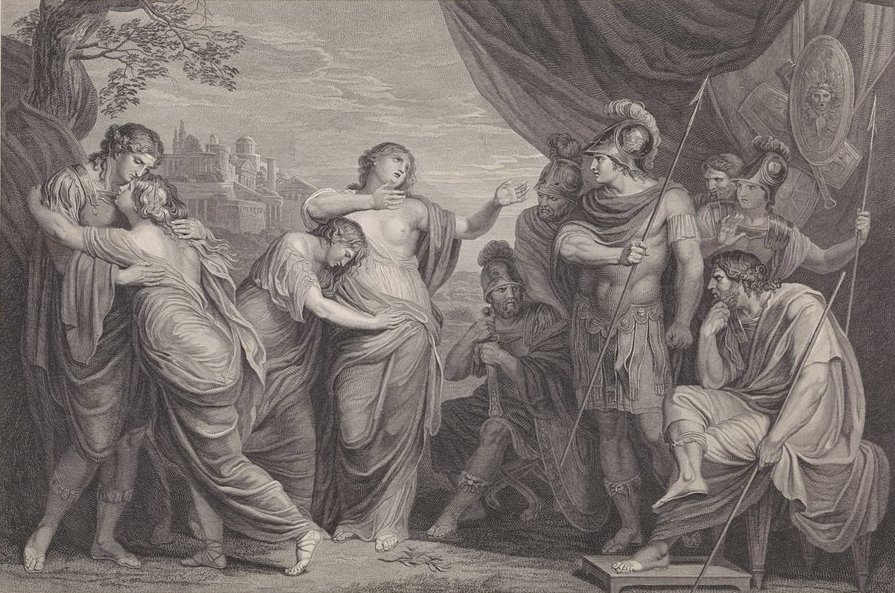
Eteocles, Polynices, and Jocasta - An illustration of the fateful meeting

Eteocles, Polynices, and Jocasta - An illustration of the fateful meeting between the two brothers and their mother Jocasta

A messenger reports the progress of the war to Jocasta and tells her that her sons have agreed to fight in single combat for the throne. She and her daughter Antigone go to try to stop them, but a messenger soon brings the news that the brothers have already fought their duel and have killed each other. Furthermore, Jocasta, overcome with grief on finding out, has also killed herself.

Jocasta's daughter Antigone enters, lamenting the fate of her brothers, followed by the blind old Oedipus who is also told of the tragic events. Creon, who has assumed control of the city in the resulting power vacuum, banishes Oedipus from Thebes, and orders that Eteocles (but not Polynices) be buried honourably in the city. Antigone fights him over this order and breaks off her engagement with his son Haemon over it. She decides to accompany her father into exile, and the play ends with them departing towards Athens.

Analysis of The Phoenician Women

"The Phoenician Women" was probably first presented, along with the two lost tragedies "Oenomaus" and "Chrysippus", at the Dionysia dramatic competition in Athens in 411 BCE (or possibly just after), the same year in which the oligarchic government of the Four Hundred fell and the exiled general Alcibiades was recalled by Athens after his defection to the enemy, Sparta. The dialogue between Jocasta and Polynices in the play, which expounds on the griefs of banishment with a certain emphasis, may well be a tongue-in-cheek allusion to the pardon of the famous Athenian exile.
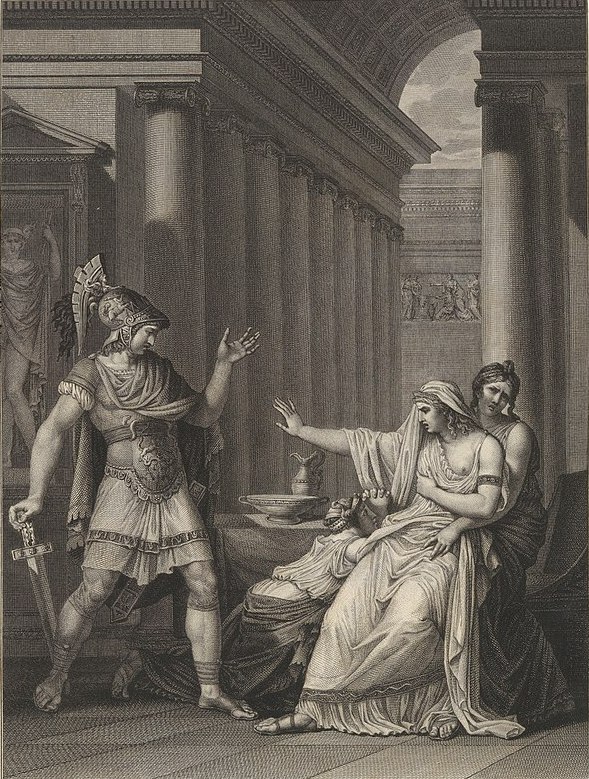
The Phoenician Women - An illustration depicting a scene from the play

The Phoenician Women - An illustration depicting a scene from the tragic play by Euripides

Although containing many brilliant passages, Euripides' rendition of the legend is often considered inferior to that of Aeschylus' "Seven Against Thebes", and it is rarely produced today. Some commentators have complained that the introduction towards the end of the play of the blind old Oedipus is unnecessary and gratuitous, and that the incident of the self-immolation of Creon's son Menoeceus is perhaps glossed over somewhat. It was, however, very popular in the later Greek schools for its varied action and its graphic descriptions (particularly the narratives of the two messengers, first of the general fight between the contending armies, and secondly of the duel between the brothers and the suicide of Jocasta), which give a sustained interest to the piece, which extends to nearly twice the length of Aeschylus' drama.

Unlike the Chorus of Theban elders in Aeschylus' play, Euripides' Chorus is composed of young Phoenician women en route from their home in Syria to Delphi, trapped in Thebes by the war, who discover their ancient kinship with the Thebans (through Cadmus, founder of Thebes, who came originally from Phoenicia). This is consistent with Euripides' tendency to approach familiar stories more from the perspective of women and mothers, and also with his emphasis on the point of view of slaves (the women are on their way to become slaves at Apollo's temple at Delphi).

Resources

  • English translation by E. P Coleridge (Internet Classics Archive): http://classics.mit.edu/Euripides/phoenissae.html

  • Greek version with word-by-word translation (Perseus Project): http://www.perseus.tufts.edu/hopper/text.jsp?doc=Perseus:text:1999.01.0117

By Timeless Myths

Euripides:

  • • Alcestis
  • • Medea (Euripides)
  • • Heracleidae (Euripides)
  • • Hippolytus (Euripides)
  • • Andromache (Euripides)
  • • Hecuba (Euripides)
  • • The Suppliants
  • • Electra
  • • Heracles (Euripides)
  • • The Trojan Women
  • • Iphigenia in Tauris
  • • Ion
  • • Helen (Euripides)
  • • The Phoenician Women
  • • The Bacchae
  • • Orestes
  • • Iphigenia at Aulis
  • • Cyclops
Phoenissae (The Phoenician Women)

Phoenissae (The Phoenician Women)

(Tragedy, Latin/Roman, c. 65 CE, 664 lines)Introduction "Phoenissae" ("The Phoenician Women") is a (possibly incomplete) tragedy by the Roman playwright Seneca the Younger, probably written between about 62 and 65 CE. Based on earlier plays by Eur...

October 25th, 2024 • Timeless Myths
The Trojan Women

The Trojan Women

(Tragedy, Greek, 415 BCE, 1,332 lines)Introduction "The Trojan Women" (Gr: "Troädes") is a tragedy by the ancient Greek playwright Euripides. It was first presented at the City Dionysia of 415 BCE, along with two other unconnected tragedies, "Alex...

October 25th, 2024 • Timeless Myths
Troades (The Trojan Women)

Troades (The Trojan Women)

(Tragedy, Latin/Roman, c. 54 CE, 1,179 lines)Introduction "Troades" ("The Trojan Women") is one of the best-known tragedies of the Roman playwright Seneca the Younger, probably written around 54 CE. Largely based on "The Trojan Women" and "Hecuba"...

October 25th, 2024 • Timeless Myths
The Trachiniae

The Trachiniae

(Tragedy, Greek, c. 440 BCE, 1,278 lines)Introduction “The Trachiniae” (Gr: “Trachiniai”, also known as “The Trachinian Women”, “The Women of Trachis” or “The Maidens of Trachis”) is a tragedy by the ancient Greek playwright Sophocles. It was prob...

January 1st, 2025 • Ancient Literature
The Bacchae

The Bacchae

(Tragedy, Greek, c. 410 BCE, 1,392 lines)Introduction "The Bacchae", also known as "The Bacchantes" (Gr: "Bakchai"), is a late tragedy by the ancient Greek playwright Euripides, and it is considered one of his best works and one of the greatest of...

October 25th, 2024 • Timeless Myths
The Suppliants

The Suppliants

(Tragedy, Greek, 423 BCE, 1,234 lines)Introduction "The Suppliants" (also known as "The Suppliant Women"; Gr: "Hiketides"; Lat: "Supplices") is a tragedy by the ancient Greek playwright Euripides, first produced in 423 BCE. Not to be confused with...

October 25th, 2024 • Timeless Myths
The Suppliants

The Suppliants

(Tragedy, Greek, c. 469 BCE, 1,073 lines)Introduction "The Suppliants" (Gr: "Hiketides"; Lat: "Supplices") is a tragedy by the ancient Greek playwright Aeschylus. It is sometimes known as "The Suppliant Women" or "The Suppliant Maidens". Along wit...

January 1st, 2025 • Ancient Literature
Iphigenia in Tauris

Iphigenia in Tauris

"Iphigenia in Tauris" or "Iphigenia among the Taurians" (Gr: "Iphigeneia en Taurois") is a tragedy, although sometimes described as a romance or melodrama, by the ancient Greek playwright Euripides, written sometime between 414 BCE and 412 BCE. It...

October 25th, 2024 • Timeless Myths
Thesmophoriazusae

Thesmophoriazusae

(Comedy, Greek, 411 BCE, 1,231 lines)Introduction "Thesmophoriazusae" (literally meaning "The Women Celebrating the Festival of the Thesmophoria", sometimes also called "The Poet and the Women"), is a comedy by the ancient Greek playwright Aristop...

October 25th, 2024 • Timeless Myths
Seven Against Thebes

Seven Against Thebes

(Tragedy, Greek, 467 BCE, 1,084 lines)Introduction "Seven Against Thebes" (Gr: "Hepta epi Thebas"; Lat: "Septem contra Thebas") is a tragedy by the ancient Greek playwright Aeschylus, dating from 467 BCE. It is the classic statement of the myth (a...

January 1st, 2025 • Ancient Literature
Timeless Myths

Exploring mythology and legends from around the world.

Explore Myths

All Stories Characters All Articles Search Site Map

Mythologies

Norse Mythology Classical Mythology Celtic Mythology Arthurian Legends Mythology Gods Ancient Literature

About Us

Introduction About Jimmy Bibliography FAQs Retro Version

Resources

Timeless Myths All Stories All Articles Characters
© 1999-2026 Timeless Myths • Copyright • Privacy Policy • Cookie Policy • Contact
Follow us: