Timeless Myths Logo
Aphrodite Apollo Ares Artemis Athena Atlas Coeus Crius Cronus Demeter Dionysus Gaia Hades Hephaestus Hera Hermes Hestia Hyperion Iapetus Mnemosyne Oceanus Phobos Phoebe Poseidon Prometheus Rhea Tethys Themis Uranus Zeus
Bacchus Ceres Diana Juno Jupiter Mars Mercury Minerva Neptune Pluto Venus Vesta Vulcan
Amun Anubis Aten Atum Babi Bastet Bes Geb Hapi hathor heqet Horus Isis Khepri Khnum Khonsu Maat Nephthys Nut Osiris Ptah Ra Seshat Seth Shu Sobek Thoth
Alfheim Baldur Freya Freyr Frigg Heimdallr Helheim Idun Jotunheim Loki Nerthus Njord Odin Thor Tyr
Aengus Arawn Badb Brigid Cailleach Ceridwen Cernunnos Cu Chulainn Dagda Danu Gwydion Herne the Hunter Lugh Medb Morrigan Neit Nuada Taliesin Taranis
Chalchiuhtlicue Coatlicue Huitzilopochtli Mictlantecuhtli Mixcoatl Ometeotl Quetzalcoatl Tezcatlipoca Tlaloc Tonatiuh Xipe Totec Xochiquetzal Xolotl
Amaterasu Ame no Uzume Benzaiten Bishamonten Daikokuten Ebisu Fujin Fukurokuju Inari Izanagi Kagutsuchi Raijin Susanoo Tsukuyomi
Caishen Cangjie Dragon King Eight Immortals Erlang Shen Fuxi Guanyin Hou Yi Huxian Jade Emperor King Yama Leizi Lu-ban Mazu Nezha Nuwa Pangu Shennong Sun Wukong Xiwangmu Yue Lao Zhong Kui
Norse Classical Celtic Arthurian
Literature Stories Names
Aphrodite Apollo Ares Artemis Athena Atlas Coeus Crius Cronus Demeter Dionysus Gaia Hades Hephaestus Hera Hermes Hestia Hyperion Iapetus Mnemosyne Oceanus Phobos Phoebe Poseidon Prometheus Rhea Tethys Themis Uranus Zeus
Bacchus Ceres Diana Juno Jupiter Mars Mercury Minerva Neptune Pluto Venus Vesta Vulcan
Amun Anubis Aten Atum Babi Bastet Bes Geb Hapi hathor heqet Horus Isis Khepri Khnum Khonsu Maat Nephthys Nut Osiris Ptah Ra Seshat Seth Shu Sobek Thoth
Alfheim Baldur Freya Freyr Frigg Heimdallr Helheim Idun Jotunheim Loki Nerthus Njord Odin Thor Tyr
Aengus Arawn Badb Brigid Cailleach Ceridwen Cernunnos Cu Chulainn Dagda Danu Gwydion Herne the Hunter Lugh Medb Morrigan Neit Nuada Taliesin Taranis
Chalchiuhtlicue Coatlicue Huitzilopochtli Mictlantecuhtli Mixcoatl Ometeotl Quetzalcoatl Tezcatlipoca Tlaloc Tonatiuh Xipe Totec Xochiquetzal Xolotl
Amaterasu Ame no Uzume Benzaiten Bishamonten Daikokuten Ebisu Fujin Fukurokuju Inari Izanagi Kagutsuchi Raijin Susanoo Tsukuyomi
Caishen Cangjie Dragon King Eight Immortals Erlang Shen Fuxi Guanyin Hou Yi Huxian Jade Emperor King Yama Leizi Lu-ban Mazu Nezha Nuwa Pangu Shennong Sun Wukong Xiwangmu Yue Lao Zhong Kui
Norse Classical Celtic Arthurian
Literature Stories Names
  1. Classical Literature
    Greece Rome Other Ancient Civilizations Timeline of Classical Literature Alphabetical List of Authors Index of Individual Works Index of Important Characters Sources About Us
  2. Greece
    Homer Hesiod Aesop Sappho Pindar Aeschylus Sophocles Euripides Aristophanes Menander Apollonius of Rhodes
  3. Euripides
    Alcestis Medea (Euripides) Heracleidae (Euripides) Hippolytus (Euripides) Andromache (Euripides) Hecuba (Euripides) The Suppliants Electra Heracles (Euripides) The Trojan Women Iphigenia in Tauris Ion Helen (Euripides) The Phoenician Women The Bacchae Orestes Iphigenia at Aulis Cyclops
  4. Iphigenia at Aulis
    Iphigenia at Aulis

Iphigenia at Aulis

(Tragedy, Greek, c. 407 BCE, 1,629 lines)

"Iphigenia at Aulis" (Gr: "Iphigeneia en Aulidi") is the last extant tragedy by the ancient Greek playwright Euripides. It was written sometime between 408 and 406 BCE (the date of his death) and was first produced in the year following his death, where it won first place at the Athenian City Dionysia contest. The play revolves around Agamemnon, the leader of the Greek forces in the Trojan War, and his decision to sacrifice his own daughter, Iphigenia, in order to allow his troops to set sail and preserve their honour by doing battle against Troy.

Synopsis – Iphigenia at Aulis Summary

Dramatis Personae – Characters

  • AGAMEMNON, King of Argos

  • ATTENDANT, an old man

  • CHORUS OF WOMEN OF CHALCIS

  • MENELAUS, brother of Agamemnon

  • CLYTEMNESTRA, wife of Agamemnon

  • IPHIGENIA, daughter of Agamemnon and Clytemnestra

  • ACHILLES

The Greek fleet, ready to sail for Troy, is becalmed at Aulis. The seer Calchas has advised that the lack of wind is due to the will of the goddess Artemis, whom Agamemnon has slighted, and that in order to placate her, Agamemnon must sacrifice his eldest daughter, Iphigenia (Iphigeneia). He must consider this seriously because his assembled troops may rebel if their honour is not appeased and their bloodlust not satisfied, so he has sent a message to his wife, Clytemnestra, telling her to bring Iphigenia to Aulis, on the pretext that the girl is to be married to the Greek warrior Achilles before he sets off to fight.
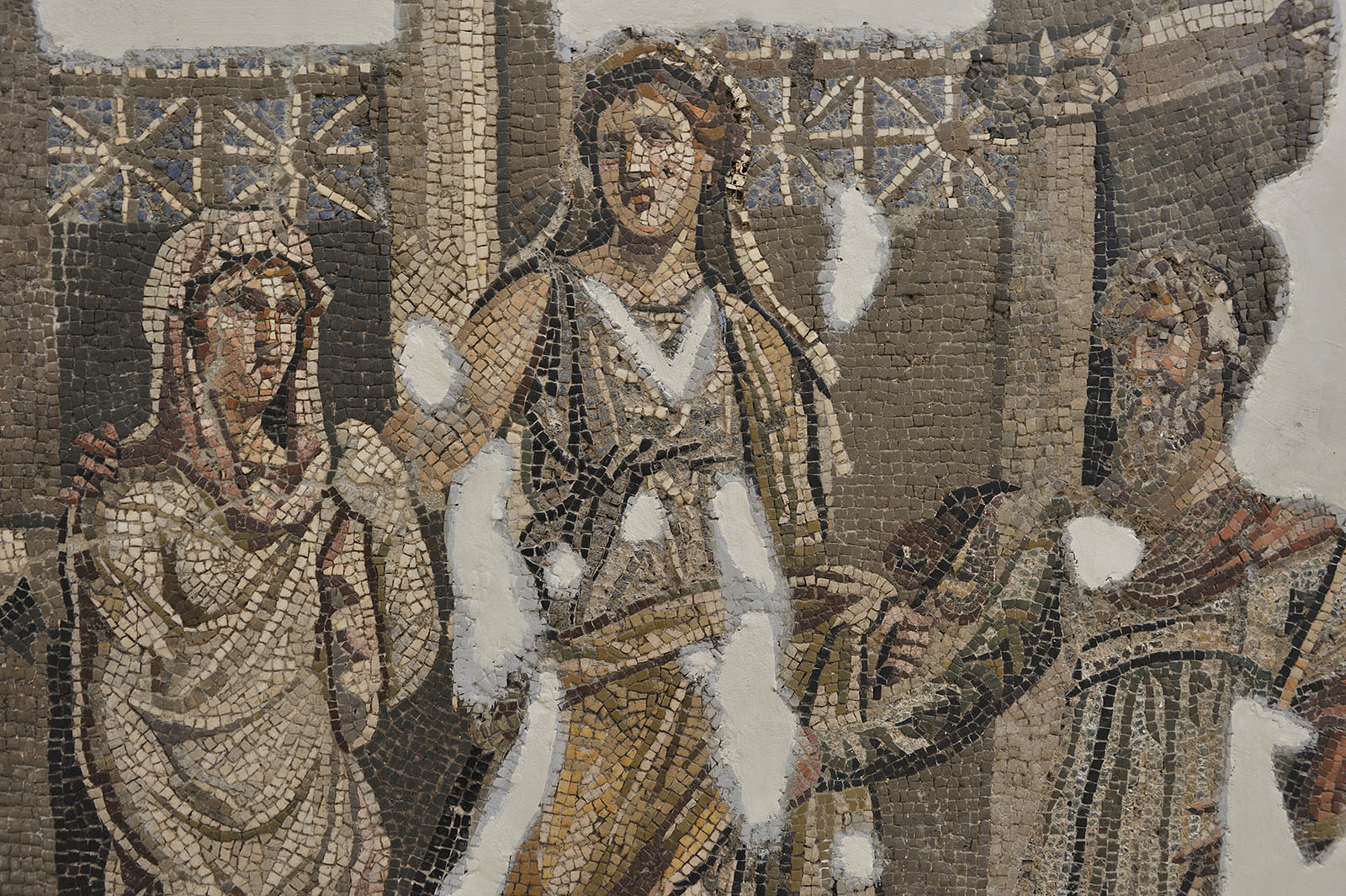
Antakya Archaeological Museum mosaic depicting Iphigenia at Aulis

Antakya Archaeological Museum mosaic depicting Iphigenia at Aulis

At the start of the play, Agamemnon is having second thoughts about going through with the sacrifice and sends a second message to his wife, telling her to ignore the first. However, Clytemnestra never receives it, because it is intercepted by Agamemnon's brother, Menelaus, who is enraged that he should have changed his mind, seeing it as a personal slight (it is the retrieval of Menelaus' wife, Helen, that is the main pretext for the war). He also realizes that it may lead to mutiny and the downfall of the Greek leaders if the troops were to discover the prophecy and realize that their general had put his family above their pride as soldiers.

With Clytemnestra already on her way to Aulis with Iphigenia and her baby brother Orestes, the brothers Agamemnon and Menelaus debate the matter. Eventually, it appears that each has managed to change the other's mind: Agamemnon is now ready to carry out the sacrifice, but Menelaus is apparently convinced that it would be better to disband the Greek army than to have his niece killed.
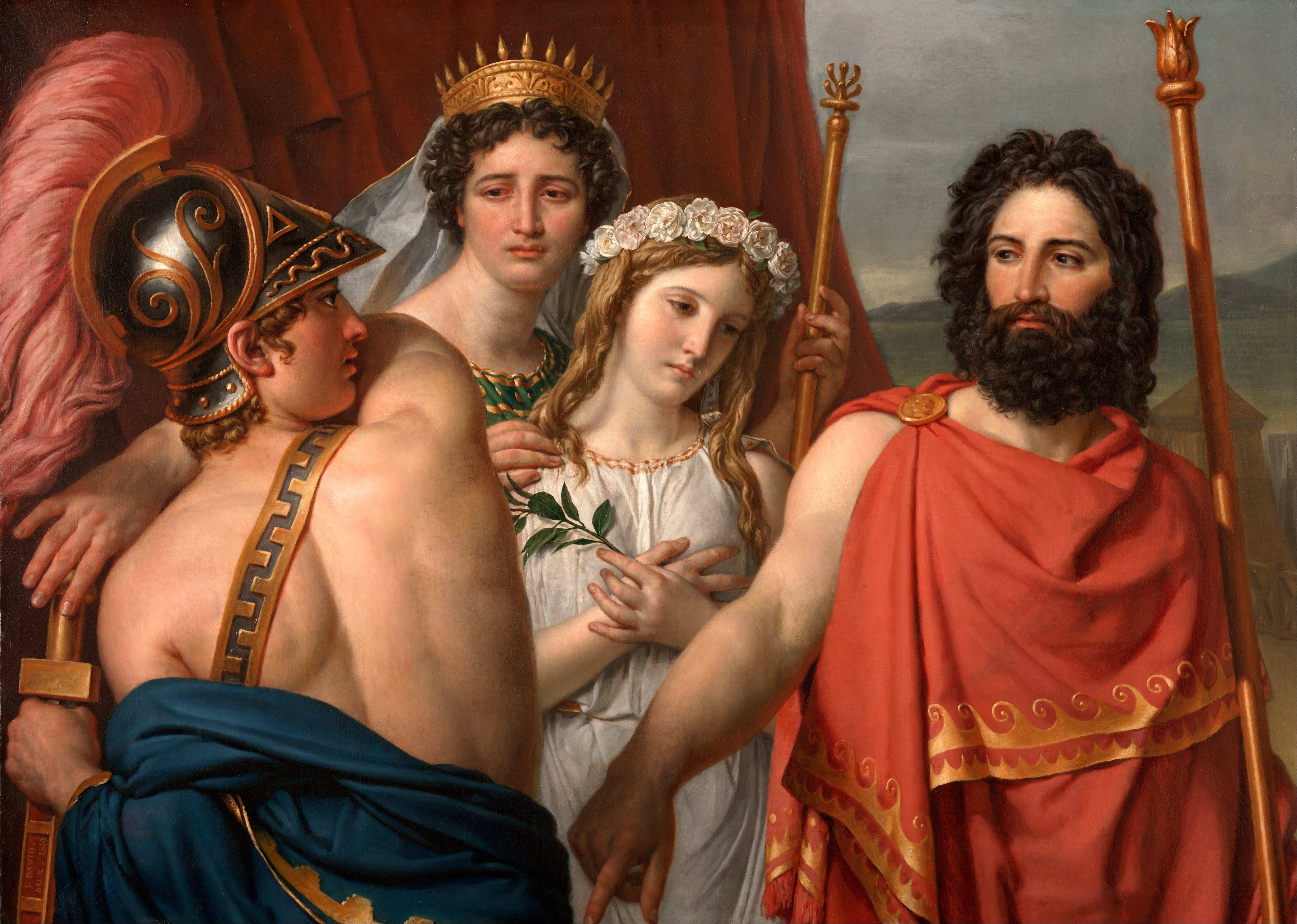
The Anger of Achilles by Jacques-Louis David

The Anger of Achilles by Jacques-Louis David

Innocent of the real reason for her summoning, the young Iphigenia is thrilled at the prospect of marrying one of the great heroes of the Greek army. But, when Achilles discovers the truth, he is furious at having been used as a prop in Agamemnon's plan, and he vows to defend Iphigenia, although more for the purposes of his own honour than to save the innocent girl.

Clytemnestra and Iphigenia try in vain to persuade Agamemnon to change his mind, but the general believes that he has no choice. As Achilles prepares to defend the young woman by force, though, Iphigenia herself has a sudden change of heart, deciding that the heroic thing to do would be to let herself be sacrificed after all. She is led off to die, leaving her mother Clytemnestra distraught. At the end of the play, a messenger comes to tell Clytemnestra that Iphigenia's body inexplicably disappeared just before the fatal blow from the knife.

Analysis

"Iphigenia at Aulis" was Euripides' last play, written just before his death, but it only premiered posthumously as part of a tetralogy that also included his "Bacchae" at the City Dionysia festival of 405 BCE. The play was directed by Euripides' son or nephew, Euripides the Younger, who was also a playwright, and won first prize at the contest (ironically a prize that had eluded Euripides all his life). Some analysts are of the opinion that some of the material in the play is inauthentic and that it may have been worked on by multiple authors.

Compared to Euripides' earlier treatment of the Iphigenia legend in the rather lightweight "Iphigenia in Tauris", this later play is much darker in nature. However, it is one of the few Greek plays which shows Agamemnon in anything other than a negative light. Clytemnestra has many of the best lines in the play, particularly where she doubts that the gods really require this sacrifice.
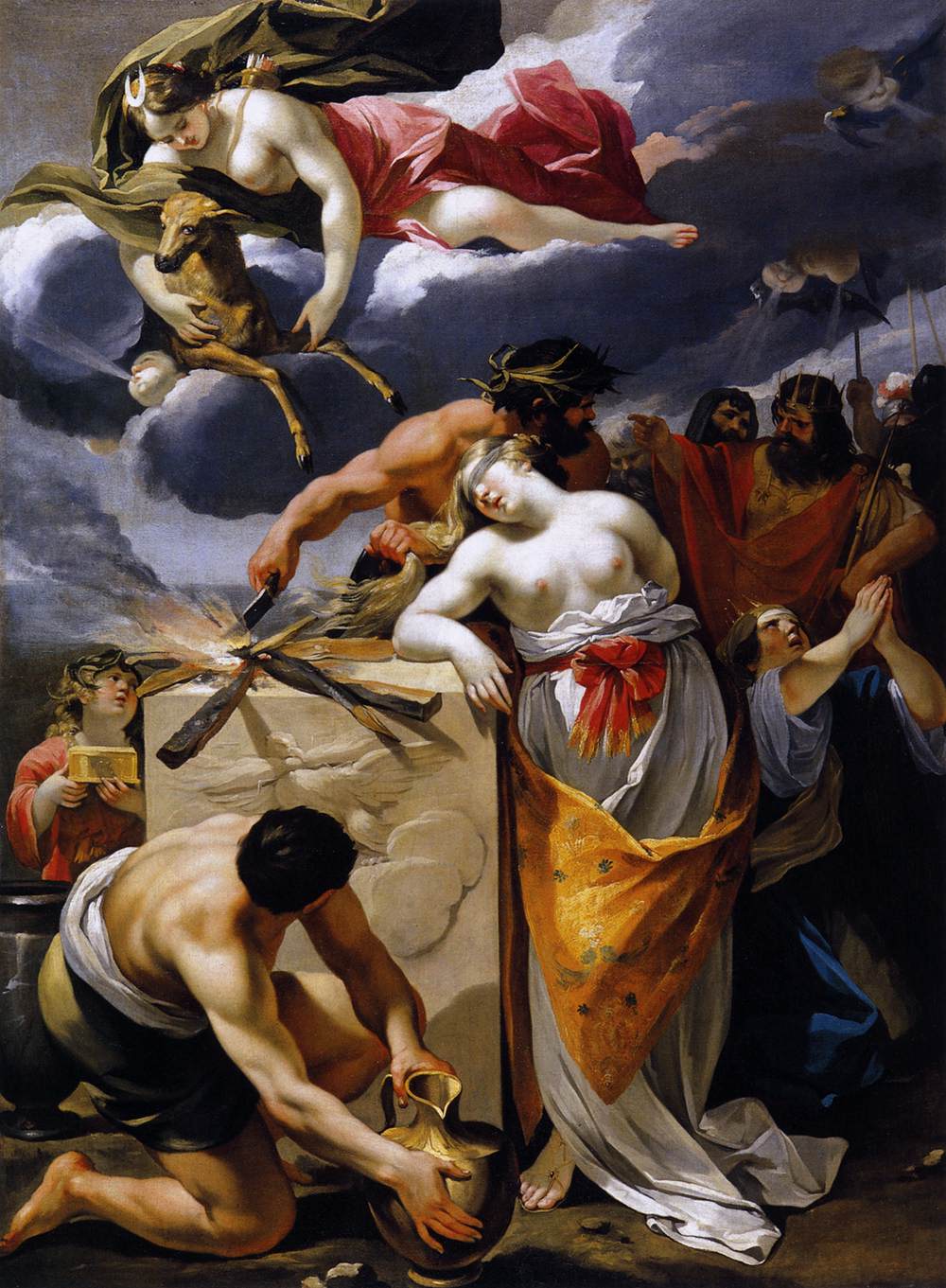
The Sacrifice of Iphigenia painting

The Sacrifice of Iphigenia

A recurring motif in the play is that of the changing of minds. Menelaus first urges Agamemnon to sacrifice his daughter, but then relents and urges the opposite; Agamemnon is resolved to sacrifice his daughter at the beginning of the play, but he changes his mind twice afterwards; Iphigenia herself appears to transform herself quite suddenly from the pleading girl to the resolute woman bent on death and honour (indeed the suddenness of this transformation has led to much criticism of the play, from Aristotle onwards).

At the time of writing, Euripides had recently moved from Athens to the relative safety of Macedon, and it was becoming increasingly clear that Athens would lose the generation-long conflict with Sparta known as the Peloponnesian War. "Iphigenia at Aulis" may be regarded as a subtle attack on two of the principle institutions of ancient Greece, the army and prophecy, and it seems clear that Euripides had grown progressively more pessimistic of the ability of his countrymen to live justly, humanely and compassionately.

Structurally, the play is unusual in that it begins with a dialogue, which is followed by a speech by Agamemnon that reads more like a prologue. The "agon" of the play (the struggle and argument between the main characters which typically supplies the basis of the action) occurs relatively early, when Agamemnon and Menelaus argue over the sacrifice, and there is in fact a second agon when Agamemnon and Clytemnestra trade arguments later in the play.

In this last of Euripides' surviving plays, there is, significantly, no "deus ex machina", as there is in so many of his plays. Thus, although a messenger tells Clytemnestra at the end of the play that Iphigenia's body disappeared just before the fatal blow from the knife, there is no confirmation of this apparent miracle, and neither Clytemnestra nor the audience are sure of the truth of it (the only other witness being Agamemnon himself, an unreliable witness at best).

Resources

  • English translation (Internet Classics Archive): http://classics.mit.edu/Euripides/iphi_aul.html

  • Greek version with word-by-word translation (Perseus Project): http://www.perseus.tufts.edu/hopper/text.jsp?doc=Perseus:text:1999.01.0107

By Timeless Myths

Euripides:

  • • Alcestis
  • • Medea (Euripides)
  • • Heracleidae (Euripides)
  • • Hippolytus (Euripides)
  • • Andromache (Euripides)
  • • Hecuba (Euripides)
  • • The Suppliants
  • • Electra
  • • Heracles (Euripides)
  • • The Trojan Women
  • • Iphigenia in Tauris
  • • Ion
  • • Helen (Euripides)
  • • The Phoenician Women
  • • The Bacchae
  • • Orestes
  • • Iphigenia at Aulis
  • • Cyclops
Iphigenia

Iphigenia

Iphigenia or Iphigeneia (Ἰφιγένεια) was the heroine of a couple of tragedies written by Euripides – Iphigenia at Aulis and Iphigenia among the Taurians. Homer only knew her as Iphianassa. Usually, Iphigeneia was seen as the eldest daughter of Agam...

June 22nd, 2003 • Jimmy Joe
Iphigenia in Tauris

Iphigenia in Tauris

"Iphigenia in Tauris" or "Iphigenia among the Taurians" (Gr: "Iphigeneia en Taurois") is a tragedy, although sometimes described as a romance or melodrama, by the ancient Greek playwright Euripides, written sometime between 414 BCE and 412 BCE. It...

October 25th, 2024 • Timeless Myths
Ion

Ion

(Tragedy, Greek, c. 413 BCE, 1,622 lines) "Ion" is a tragedy by the ancient Greek playwright Euripides, thought to have been written between about 414 and 412 BCE. It describes the tale of the orphan, Ion, eponymous forefather of the Ionian race, ...

October 25th, 2024 • Timeless Myths
Hippolytus (Euripides)

Hippolytus (Euripides)

Hippolytus (Gr: Hippolytos) is a tragedy by the ancient Greek playwright Euripides, first produced at the Athens City Dionysia in 428 BCE, where it won first prize (as part of a trilogy). It is based on the myth of Hippolytus, son of Theseus, and ...

October 25th, 2024 • Timeless Myths
Alcestis

Alcestis

Alcestis (Gr: Alkestis) is a tragedy by the ancient Greek playwright Euripides, first produced at the Athens City Dionysia dramatic festival in 438 BCE (at which it won second prize). It is the oldest surviving work by Euripides, although at the t...

October 25th, 2024 • Timeless Myths
Heracleidae (Euripides)

Heracleidae (Euripides)

Heracleidae or The Children of Heracles (Gr: Herakleidai) is a tragedy by the ancient Greek playwright Euripides, first produced around 430 or 429 BCE. It follows the children of Heracles (collectively known as the Heracleidae) and their protector...

October 25th, 2024 • Timeless Myths
Hecuba (Euripides)

Hecuba (Euripides)

Hecuba (Gr: Hekabe) is a tragedy by the ancient Greek playwright Euripides, written around 424 BCE. The story takes place just after the Trojan War, as the Greeks are heading home, and depicts the grief of Hecuba, queen of the fallen city of Troy,...

October 25th, 2024 • Timeless Myths
Agamemnon

Agamemnon

Agamemnon Iphigeneia in Aulis Murder of AgamemnonAgamemnon According to Homer, Agamemnon (Ἀγαμέμνων) and his brother Menelaüs (Menalaus) were the sons of Atreus and Aerope, the daughter of Catreus of Crete. The two sons of Atreus were known as the...

August 23rd, 2003 • Jimmy Joe
Andromache (Euripides)

Andromache (Euripides)

Andromache is a tragedy by the ancient Greek playwright Euripides, first produced some time between about 428 and 424 BCE. It dramatizes the plight of Andromache, wife of the dead Trojan hero Hector, during her life in the years after the end of t...

October 25th, 2024 • Timeless Myths
Oedipus at Colonus

Oedipus at Colonus

Oedipus at Colonus (Gr: Oidipous epi Kolono or Oedipus epi Kotonoi; Lat: Oedipus Coloneus) is a tragedy by the ancient Greek playwright Sophocles. It is Sophocles' last surviving play, written shortly before his death in 406 BCE, and the last writ...

October 24th, 2024 • Timeless Myths
Timeless Myths

Exploring mythology and legends from around the world.

Explore Myths

All Stories Characters All Articles Search Site Map

Mythologies

Norse Mythology Classical Mythology Celtic Mythology Arthurian Legends Mythology Gods Ancient Literature

About Us

Introduction About Jimmy Bibliography FAQs Retro Version

Resources

Timeless Myths All Stories All Articles Characters
© 1999-2026 Timeless Myths • Copyright • Privacy Policy • Cookie Policy • Contact
Follow us: