Timeless Myths Logo
Aphrodite Apollo Ares Artemis Athena Atlas Coeus Crius Cronus Demeter Dionysus Gaia Hades Hephaestus Hera Hermes Hestia Hyperion Iapetus Mnemosyne Oceanus Phobos Phoebe Poseidon Prometheus Rhea Tethys Themis Uranus Zeus
Bacchus Ceres Diana Juno Jupiter Mars Mercury Minerva Neptune Pluto Venus Vesta Vulcan
Amun Anubis Aten Atum Babi Bastet Bes Geb Hapi hathor heqet Horus Isis Khepri Khnum Khonsu Maat Nephthys Nut Osiris Ptah Ra Seshat Seth Shu Sobek Thoth
Alfheim Baldur Freya Freyr Frigg Heimdallr Helheim Idun Jotunheim Loki Nerthus Njord Odin Thor Tyr
Aengus Arawn Badb Brigid Cailleach Ceridwen Cernunnos Cu Chulainn Dagda Danu Gwydion Herne the Hunter Lugh Medb Morrigan Neit Nuada Taliesin Taranis
Chalchiuhtlicue Coatlicue Huitzilopochtli Mictlantecuhtli Mixcoatl Ometeotl Quetzalcoatl Tezcatlipoca Tlaloc Tonatiuh Xipe Totec Xochiquetzal Xolotl
Amaterasu Ame no Uzume Benzaiten Bishamonten Daikokuten Ebisu Fujin Fukurokuju Inari Izanagi Kagutsuchi Raijin Susanoo Tsukuyomi
Caishen Cangjie Dragon King Eight Immortals Erlang Shen Fuxi Guanyin Hou Yi Huxian Jade Emperor King Yama Leizi Lu-ban Mazu Nezha Nuwa Pangu Shennong Sun Wukong Xiwangmu Yue Lao Zhong Kui
Norse Classical Celtic Arthurian
Literature Stories Names
Aphrodite Apollo Ares Artemis Athena Atlas Coeus Crius Cronus Demeter Dionysus Gaia Hades Hephaestus Hera Hermes Hestia Hyperion Iapetus Mnemosyne Oceanus Phobos Phoebe Poseidon Prometheus Rhea Tethys Themis Uranus Zeus
Bacchus Ceres Diana Juno Jupiter Mars Mercury Minerva Neptune Pluto Venus Vesta Vulcan
Amun Anubis Aten Atum Babi Bastet Bes Geb Hapi hathor heqet Horus Isis Khepri Khnum Khonsu Maat Nephthys Nut Osiris Ptah Ra Seshat Seth Shu Sobek Thoth
Alfheim Baldur Freya Freyr Frigg Heimdallr Helheim Idun Jotunheim Loki Nerthus Njord Odin Thor Tyr
Aengus Arawn Badb Brigid Cailleach Ceridwen Cernunnos Cu Chulainn Dagda Danu Gwydion Herne the Hunter Lugh Medb Morrigan Neit Nuada Taliesin Taranis
Chalchiuhtlicue Coatlicue Huitzilopochtli Mictlantecuhtli Mixcoatl Ometeotl Quetzalcoatl Tezcatlipoca Tlaloc Tonatiuh Xipe Totec Xochiquetzal Xolotl
Amaterasu Ame no Uzume Benzaiten Bishamonten Daikokuten Ebisu Fujin Fukurokuju Inari Izanagi Kagutsuchi Raijin Susanoo Tsukuyomi
Caishen Cangjie Dragon King Eight Immortals Erlang Shen Fuxi Guanyin Hou Yi Huxian Jade Emperor King Yama Leizi Lu-ban Mazu Nezha Nuwa Pangu Shennong Sun Wukong Xiwangmu Yue Lao Zhong Kui
Norse Classical Celtic Arthurian
Literature Stories Names
  1. Classical Literature
    Greece Rome Other Ancient Civilizations Timeline of Classical Literature Alphabetical List of Authors Index of Individual Works Index of Important Characters Sources About Us
  2. Greece
    Homer Hesiod Aesop Sappho Pindar Aeschylus Sophocles Euripides Aristophanes Menander Apollonius of Rhodes
  3. Euripides
    Alcestis Medea (Euripides) Heracleidae (Euripides) Hippolytus (Euripides) Andromache (Euripides) Hecuba (Euripides) The Suppliants Electra Heracles (Euripides) The Trojan Women Iphigenia in Tauris Ion Helen (Euripides) The Phoenician Women The Bacchae Orestes Iphigenia at Aulis Cyclops
  4. Hippolytus (Euripides)

Hippolytus (Euripides)

Hippolytus (Gr: Hippolytos) is a tragedy by the ancient Greek playwright Euripides, first produced at the Athens City Dionysia in 428 BCE, where it won first prize (as part of a trilogy). It is based on the myth of Hippolytus, son of Theseus, and how a series of misunderstandings and the meddling of the gods result in his death and that of his step-mother, Phaedra.

(Tragedy, Greek, 428 BCE, 1,466 lines)
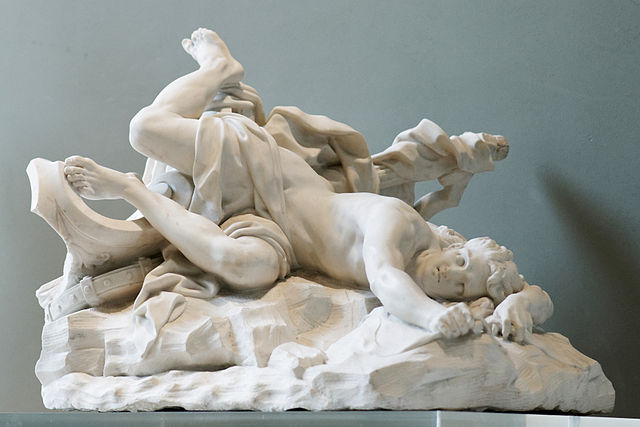
The Death of Hippolytus

Synopsis

Dramatis Personae

  • APHRODITE

  • HIPPOLYTUS, bastard son of Theseus

  • ATTENDANTS OF HIPPOLYTUS

  • CHORUS OF TROEZENIAN WOMEN

  • NURSE OF PHAEDRA

  • PHAEDRA, wife of Theseus

  • THESEUS

  • MESSENGER

The play is set in Troezen, a coastal town in the northeastern Peloponnese, where King Theseus of Athens is serving a year's voluntary exile after having murdered a local king and his sons. Hippolytus, Theseus' illegitimate son with the Amazon Hippolyta, has lived and trained in Troezen since his early childhood, under the protection of Pittheus, the king of Troezen.

At the start of the play, Aphrodite, the goddess of love, explains that Hippolytus has sworn a vow of chastity and now refuses to revere her, instead honouring Artemis, the chaste goddess of the hunt. Hippolytus is warned about his overt disdain for Aphrodite, but he refuses to listen. As an act of vengeance for Hippolytus' snub, Aphrodite has caused Phaedra, Theseus' wife and Hippolytus' stepmother, to fall madly in love with him.

The Chorus of young married women of Troezen describe how Phaedra is not eating or sleeping, and Phaedra finally shocks the Chorus and her nurse by reluctantly admitting that she is sick with love for Hippolytus, and that she plans to starve herself in order to die with her honour intact.
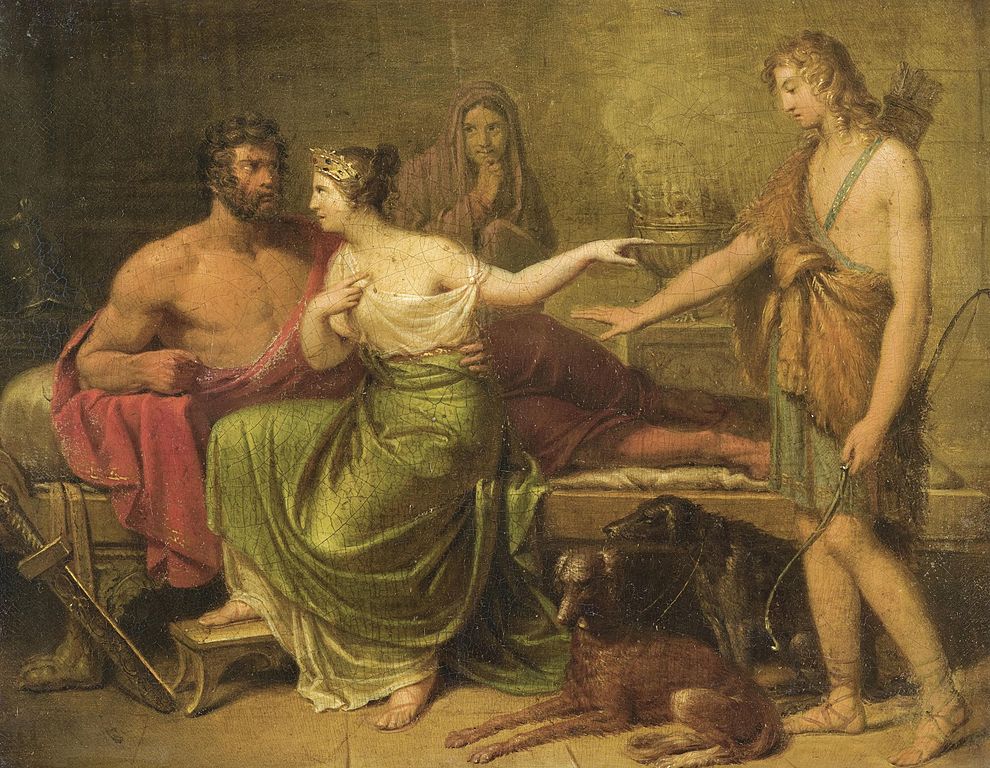
Hippolytus, Phaedra and Theseus

The nurse soon recovers from her shock, though, and urges Phaedra to give in to her love and live, telling Phaedra that she knows of a medicine which will cure her. Instead, however, the nurse runs to tell Hippolytus of Phaedra's desire (against Phaedra's express wishes, even if done out of love for her), making him swear an oath that he will not tell anyone else. He reacts with a furious, misogynistic tirade on the poisonous nature of women.

Since the secret is out, Phaedra believes she is ruined and, after making the Chorus swear secrecy, she goes inside and hangs herself. Theseus then returns and discovers his wife's dead body, along with a letter which seems to clearly place the blame for her death on Hippolytus. Misinterpreting this to mean that Hippolytus had raped Phaedra, the enraged Theseus curses his son to death or at least exile, calling on his father Poseidon to enforce the curse. Hippolytus protests his innocence, but cannot tell the whole truth because of the binding oath he previously swore to the nurse. As the Chorus sings a lament, Hippolytus goes off into exile.

However, a messenger appears shortly to report how, as Hippolytus got into his chariot to leave the kingdom, a sea-monster sent by Poseidon (at Aphrodites' request) frightened his horses and dragged Hippolytus along the rocks. Hippolytus lies dying, but Theseus still refuses to believe the messenger's protests that Hippolytus was innocent, revelling in Hippolytus' suffering.
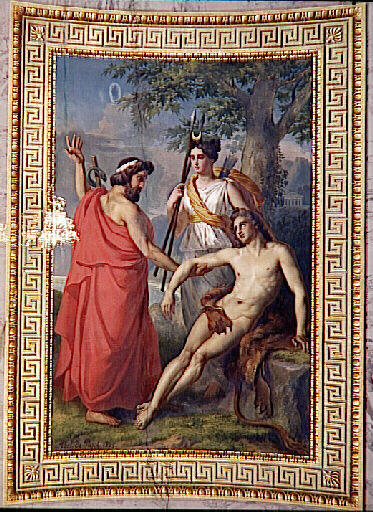
Aesculapius restores Hippolytus to life

Artemis then appears and tells him the truth, explaining that his son was innocent and that it was the dead Phaedra who had lied, although she also explains that the ultimate blame must lie with Aphrodite. As Hippolytus is carried in, barely alive, Artemis vows revenge on Aphrodite, promising to kill any man that Aphrodite holds dearest in the world. With his final breaths, Hippolytus absolves his father of his death, and finally dies.

Analysis

It is believed that Euripides first treated the myth in a play called Hippolytos Kalyptomenos (Hippolytus Veiled), now lost, in which he portrayed a shamelessly lustful Phaedra who directly propositioned Hippolytus on stage, much to the displeasure of the Athenian audience. He then revisited the myth in Hippolytos Stephanophoros (Hippolytus Crowned), also lost, this time with a much more modest Phaedra who fights her sexual appetites. The surviving play, entitled simply Hippolytus, offers a much more even-handed and psychologically complex treatment of the characters than either of these earlier lost plays, and a more sophisticated treatment than is commonly found in traditional retelling of myths.

This even-handededness is demonstrated in the way that neither of the two main characters, Phaedra and Hippolytus, are presented in a wholly favourable light. Euripides has often been accused of misogyny in his presentation of characters such as Medea and Electra, but Phaedra here is initially presented as a generally sympathetic character, honourably struggling against overwhelming odds to do the right thing. Our regard for her is reduced, however, by her indictment of Hippolytus. On the other hand, the character of Hippolytus is unsympathetically portrayed as puritanical and misogynistic, although he is partially redeemed by his refusal to break his oath to the nurse and by his forgiveness of his father.

The gods Aphrodite and Artemis appear at the beginning and end of the play respectively, framing the action, and representing the conflicting emotions of passion and chastity. Euripides pins the blame for the tragedy squarely on Hippolytus' hubris in rejecting Aphrodite (rather than on his lack of sympathy for Phaedra or his misogynism), suggesting that the true malevolent force in the play is uncontrollable desire as personified by the vindictive Aphrodite. The disaffected goddess of chastity, Artemis, however, does not try to protect her favourite, as the gods so often do, but rather abandons him at his very moment of death.

Among the themes of the play are: personal desire vs. the standards of society; uncontrolled emotion vs. excessive control; unrequited love; the sacrosanct nature of oaths; hastiness in judgement; and the distasteful character of the gods (as they to give in to pride, vanity, jealousy and anger).

Resources

  • English translation by E. P. Coleridge (Internet Classics Archive): http://classics.mit.edu/Euripides/hippolytus.html

  • Greek version with word-by-word translation (Perseus Project): http://www.perseus.tufts.edu/hopper/text.jsp?doc=Perseus:text:1999.01.0105

By Timeless Myths

Euripides:

  • • Alcestis
  • • Medea (Euripides)
  • • Heracleidae (Euripides)
  • • Hippolytus (Euripides)
  • • Andromache (Euripides)
  • • Hecuba (Euripides)
  • • The Suppliants
  • • Electra
  • • Heracles (Euripides)
  • • The Trojan Women
  • • Iphigenia in Tauris
  • • Ion
  • • Helen (Euripides)
  • • The Phoenician Women
  • • The Bacchae
  • • Orestes
  • • Iphigenia at Aulis
  • • Cyclops
Heracleidae (Euripides)

Heracleidae (Euripides)

Heracleidae or The Children of Heracles (Gr: Herakleidai) is a tragedy by the ancient Greek playwright Euripides, first produced around 430 or 429 BCE. It follows the children of Heracles (collectively known as the Heracleidae) and their protector...

October 25th, 2024 • Timeless Myths
Hecuba (Euripides)

Hecuba (Euripides)

Hecuba (Gr: Hekabe) is a tragedy by the ancient Greek playwright Euripides, written around 424 BCE. The story takes place just after the Trojan War, as the Greeks are heading home, and depicts the grief of Hecuba, queen of the fallen city of Troy,...

October 25th, 2024 • Timeless Myths
Medea (Euripides)

Medea (Euripides)

Medea (Gr: Medeia) is a tragedy written by the ancient Greek playwright Euripides, based on the myth of Jason and Medea, and particularly Medea's revenge against Jason for betraying her with another woman. Often considered Euripides' best and most...

October 25th, 2024 • Timeless Myths
Andromache (Euripides)

Andromache (Euripides)

Andromache is a tragedy by the ancient Greek playwright Euripides, first produced some time between about 428 and 424 BCE. It dramatizes the plight of Andromache, wife of the dead Trojan hero Hector, during her life in the years after the end of t...

October 25th, 2024 • Timeless Myths
Alcestis

Alcestis

Alcestis (Gr: Alkestis) is a tragedy by the ancient Greek playwright Euripides, first produced at the Athens City Dionysia dramatic festival in 438 BCE (at which it won second prize). It is the oldest surviving work by Euripides, although at the t...

October 25th, 2024 • Timeless Myths
Iphigenia at Aulis

Iphigenia at Aulis

(Tragedy, Greek, c. 407 BCE, 1,629 lines) "Iphigenia at Aulis" (Gr: "Iphigeneia en Aulidi") is the last extant tragedy by the ancient Greek playwright Euripides. It was written sometime between 408 and 406 BCE (the date of his death) and was first...

October 25th, 2024 • Timeless Myths
Euripides

Euripides

(Tragic Playwright, Greek, c. 480 – c. 406 BCE)Introduction Euripides was the last of the three great tragedians of classical Greece (the other two being Aeschylus and Sophocles). Largely due to an accident of history, eighteen of Euripides' ninet...

October 24th, 2024 • Timeless Myths
Heracles (Euripides)

Heracles (Euripides)

(Tragedy, Greek, c. 416 BCE, 1,428 lines)Introduction "Heracles" or "The Madness of Heracles" (Gr: "Herakles Mainomenos"; Lat: "Hercules Furens") is a tragedy by the ancient Greek playwright Euripides. It describes the frenzy of divinely induced m...

October 25th, 2024 • Timeless Myths
Hippolyte (Melanippe or Glauce)

Hippolyte (Melanippe or Glauce)

An Amazon Queen. This Hippolyte was also sometimes called Melanippe or Glauce. She shouldn't be confused with the Queen Hippolyte who the owner of golden girdle, which was one of the labours of Heracles. Hippolyte was possibly the daughter of Otre...

January 1st, 2002 • Jimmy Joe
Hippolyte

Hippolyte

There seemed to be a number of Amazon queens with the name Hippolyte or Hippolyta (Ἱππολύτη). Each one died by a different hand. The Hippolyte that I refer to in this article was the Amazon queen who owned the Girdle of Hippolyte. She was the quee...

January 1st, 2002 • Jimmy Joe
Timeless Myths

Exploring mythology and legends from around the world.

Explore Myths

All Stories Characters All Articles Search Site Map

Mythologies

Norse Mythology Classical Mythology Celtic Mythology Arthurian Legends Mythology Gods Ancient Literature

About Us

Introduction About Jimmy Bibliography FAQs Retro Version

Resources

Timeless Myths All Stories All Articles Characters
© 1999-2026 Timeless Myths • Copyright • Privacy Policy • Cookie Policy • Contact
Follow us: