Timeless Myths Logo
Aphrodite Apollo Ares Artemis Athena Atlas Coeus Crius Cronus Demeter Dionysus Gaia Hades Hephaestus Hera Hermes Hestia Hyperion Iapetus Mnemosyne Oceanus Phobos Phoebe Poseidon Prometheus Rhea Tethys Themis Uranus Zeus
Bacchus Ceres Diana Juno Jupiter Mars Mercury Minerva Neptune Pluto Venus Vesta Vulcan
Amun Anubis Aten Atum Babi Bastet Bes Geb Hapi hathor heqet Horus Isis Khepri Khnum Khonsu Maat Nephthys Nut Osiris Ptah Ra Seshat Seth Shu Sobek Thoth
Alfheim Baldur Freya Freyr Frigg Heimdallr Helheim Idun Jotunheim Loki Nerthus Njord Odin Thor Tyr
Aengus Arawn Badb Brigid Cailleach Ceridwen Cernunnos Cu Chulainn Dagda Danu Gwydion Herne the Hunter Lugh Medb Morrigan Neit Nuada Taliesin Taranis
Chalchiuhtlicue Coatlicue Huitzilopochtli Mictlantecuhtli Mixcoatl Ometeotl Quetzalcoatl Tezcatlipoca Tlaloc Tonatiuh Xipe Totec Xochiquetzal Xolotl
Amaterasu Ame no Uzume Benzaiten Bishamonten Daikokuten Ebisu Fujin Fukurokuju Inari Izanagi Kagutsuchi Raijin Susanoo Tsukuyomi
Caishen Cangjie Dragon King Eight Immortals Erlang Shen Fuxi Guanyin Hou Yi Huxian Jade Emperor King Yama Leizi Lu-ban Mazu Nezha Nuwa Pangu Shennong Sun Wukong Xiwangmu Yue Lao Zhong Kui
Norse Classical Celtic Arthurian
Literature Stories Names
Aphrodite Apollo Ares Artemis Athena Atlas Coeus Crius Cronus Demeter Dionysus Gaia Hades Hephaestus Hera Hermes Hestia Hyperion Iapetus Mnemosyne Oceanus Phobos Phoebe Poseidon Prometheus Rhea Tethys Themis Uranus Zeus
Bacchus Ceres Diana Juno Jupiter Mars Mercury Minerva Neptune Pluto Venus Vesta Vulcan
Amun Anubis Aten Atum Babi Bastet Bes Geb Hapi hathor heqet Horus Isis Khepri Khnum Khonsu Maat Nephthys Nut Osiris Ptah Ra Seshat Seth Shu Sobek Thoth
Alfheim Baldur Freya Freyr Frigg Heimdallr Helheim Idun Jotunheim Loki Nerthus Njord Odin Thor Tyr
Aengus Arawn Badb Brigid Cailleach Ceridwen Cernunnos Cu Chulainn Dagda Danu Gwydion Herne the Hunter Lugh Medb Morrigan Neit Nuada Taliesin Taranis
Chalchiuhtlicue Coatlicue Huitzilopochtli Mictlantecuhtli Mixcoatl Ometeotl Quetzalcoatl Tezcatlipoca Tlaloc Tonatiuh Xipe Totec Xochiquetzal Xolotl
Amaterasu Ame no Uzume Benzaiten Bishamonten Daikokuten Ebisu Fujin Fukurokuju Inari Izanagi Kagutsuchi Raijin Susanoo Tsukuyomi
Caishen Cangjie Dragon King Eight Immortals Erlang Shen Fuxi Guanyin Hou Yi Huxian Jade Emperor King Yama Leizi Lu-ban Mazu Nezha Nuwa Pangu Shennong Sun Wukong Xiwangmu Yue Lao Zhong Kui
Norse Classical Celtic Arthurian
Literature Stories Names
  1. Classical Literature
    Greece Rome Other Ancient Civilizations Timeline of Classical Literature Alphabetical List of Authors Index of Individual Works Index of Important Characters Sources About Us
  2. Greece
    Homer Hesiod Aesop Sappho Pindar Aeschylus Sophocles Euripides Aristophanes Menander Apollonius of Rhodes
  3. Sappho

Sappho

(Lyric Poet, Greek, c. 630 – c. 570 BCE)

Introduction - Who is Sappho

Sappho was the quintessential lyric poet of ancient Greece. Although the bulk of her poetry has been lost, she was well-known and greatly admired throughout antiquity as one of the greatest of lyric poets, and her immense reputation has endured through surviving fragments.
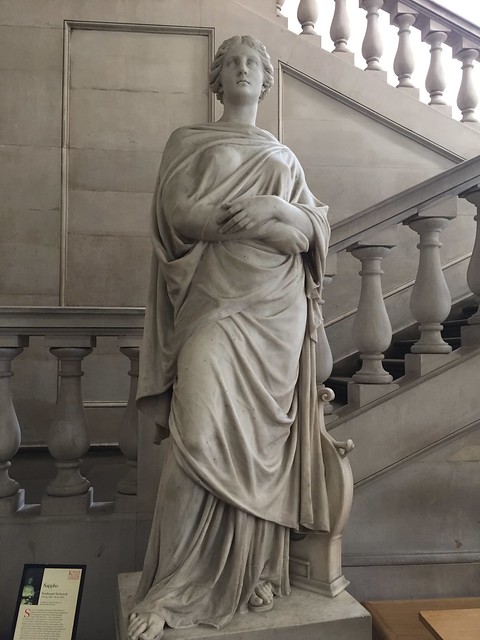
Statue of Sappho

Statue of Sappho

Biography

Sappho was born on the Greek island of Lesbos sometime between 630 and 612 BCE (from the evidence of several different conflicting sources) and it seems that she had already become quite famous by around 600 BCE or just after. Many of the biographical fragments we have been able to piece together are taken from her own poetry and may be unreliable, but she probably came from an aristocratic family. She was described by one contemporary as “violet-haired, pure, honey-smiling”, but by another as “small and dark”.

Sappho lived during a period of political turbulence on Lesbos, and it seems that she was exiled from Lesbos to Sicily sometime between 604 and 594 BCE, for reasons which are not clear (her own poetry makes very few political allusions). She may have been married to a wealthy merchant named Cercylas, and it is likely that she had already had a daughter (possibly called Cleïs, after Sappho’s own mother) by the time of the exile. It is not known for sure, but it is often assumed that she later returned to her beloved Lesbos.

It is believed that she died around 570 BCE, although the suggestion that Sappho killed herself by jumping off the Leucadian cliffs for love of a ferryman named Phaon is now considered spurious.

Writings

Sappho's poetry centres to a large extent on passion, infatuation and love for various personages and genders, although it is not known to what extent her poetry was autobiographical. Descriptions of physical acts between women in her works are few and subject to debate, but the words “lesbian” (from the name of the island of her birth) and “sapphic” nevertheless came to be widely applied to female homosexuality beginning in the 19th Century. Homosexuality during her own period was, however, quite widespread, particularly among the inteligentsia and the aristocracy, and considered unexceptional. It seems clear that she loved some of the women of her community, although whether or not the passion was expressed sexually is far from clear.

She was known as the acknowledged chief writer of “wedding songs” in her time. The Library of Alexandria (which tragically burned down in antiquity) apparently collected Sappho's poetry into nine books, but the surviving proportion is very small with only one poem, the “Hymn to Aphrodite”, surviving in its entirety, along with three other partially complete poems. Sappho organized a group of her young female students into a “thiasos”, a cult that worshipped Aphrodite with songs and poetry, and “Hymn to Aphrodite” was most likely composed for performance within this cult.
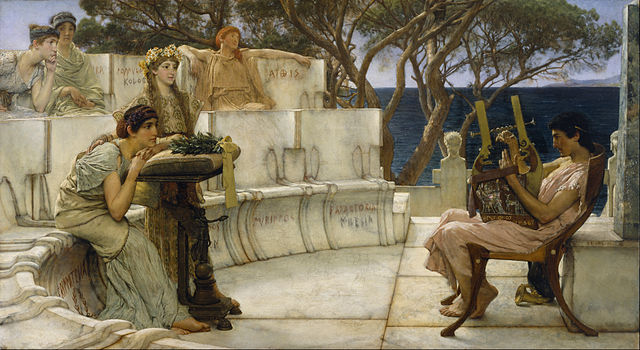
Sappho and Alcaeus

Sappho and Alcaeus

She wrote in a rather difficult and arcane Aeolic Greek dialect (part of the reason why her work was copied less and less as time passed), but her poetry is praised for its clarity of language and simplicity of thought, more than for its wit and rhetoric.

Major Works

  • “Hymn to Aphrodite”

By Ancient Literature

Greece:

  • • Homer
  • • Hesiod
  • • Aesop
  • • Sappho
  • • Pindar
  • • Aeschylus
  • • Sophocles
  • • Euripides
  • • Aristophanes
  • • Menander
  • • Apollonius of Rhodes
Sappho 31 – Interpretation of Her Most Famous Fragment

Sappho 31 – Interpretation of Her Most Famous Fragment

Sappho 31 is an ancient Greek lyrical poem written by a Greek female poet, Sappho of Lesbos. Not only is it one of the most significant pieces of her work to survive, but it is also one of her most famous. Most translators and literary scholars se...

February 16th, 2024 • Ancient Literature
Hymn to Aphrodite

Hymn to Aphrodite

(Lyric Poem, Greek, c. 570 BCE, 28 lines)Introduction “Hymn to Aphrodite” (sometimes referred to as "Ode to Aphrodite" or “Fragment 1”) is the only poem of the ancient Greek lyric poet Sappho to survive in its entirety. Although she is recorded in...

January 1st, 2025 • Ancient Literature
Catullus 51 Translation

Catullus 51 Translation

Introduction This verse is based on a poem fragment from the Poetess, Sappho. It is, logically, written in Sapphic Meter, and is nearly identical to the verse fragment Sappho 31. Catullus has substituted his adored muse, Lesbia, for the central fe...

January 1st, 2025 • Ancient Literature
Heroides

Heroides

"Heroides" ("The Heroines"), also known as "Epistulae Heroidum" ("Letters of Heroines") or simply "Epistulae", is a collection of fifteen epistolary poems (poems in the form of letters) by the Roman lyric poet Ovid, published between 5 BCE and 8 C...

October 25th, 2024 • Timeless Myths
Catullus 5

Catullus 5

(Lyric Poem, Latin/Roman, c. 65 BCE, 13 lines)Introduction "Vivamus, mea Lesbia, atque amemus" ("Let us live, my Lesbia, and let us love") is a passionate love poem by the Roman lyric poet Catullus, often referred to as "Catullus 5" or "Carmina V"...

October 25th, 2024 • Timeless Myths
Lesbos

Lesbos

Lesbos was a large island in the Aegean Sea, off the western coast of Mysia, Asia Minor. The only mythological tale I could find that was associated with Lesbos was that of Myrina, the Amazon queen of Libya, who seized the island with her warriors...

August 8th, 1999 • Jimmy Joe
Catullus 35 Translation

Catullus 35 Translation

Introduction In this poem, Catullus references a poet named Caecilius. Catullus writes an invitation to Caecilius to come to Verona and leave his home in Novum Comum (which we now know as Como, Italy). In this invitation, Catullus wants Caecilius ...

January 1st, 2025 • Ancient Literature
Pythian Ode 1

Pythian Ode 1

(Lyric Poem, Greek, 470 BCE, 100 lines)Introduction "Pythian Ode 1" is one of the better known of the many victory poems (or "epinicia") of the ancient Greek lyric poet Pindar. Like "Olympic Ode 1", it celebrates a victory of the Sicilian tyrant H...

January 1st, 2025 • Ancient Literature
Passer, deliciae meae puellae (Catullus 2)

Passer, deliciae meae puellae (Catullus 2)

(Lyric Poem, Latin/Roman, c. 60 BCE, 10/13 lines)Introduction “Passer, deliciae meae puellae” (“Sparrow, darling of my girl”) is a lyric poem by the Roman poet Catullus, often referred to as “Catullus 2” or “Carmina II” for its position in the gen...

January 1st, 2025 • Ancient Literature
Aristophanes

Aristophanes

(Comic Playwright, Greek, c. 446 – c. 386 BCE)Introduction Aristophanes was a prolific and much acclaimed comic playwright of ancient Greece, sometimes referred to as the Father of Comedy. Eleven of his forty plays have come down to us virtually c...

October 24th, 2024 • Timeless Myths
Timeless Myths

Exploring mythology and legends from around the world.

Explore Myths

All Stories Characters All Articles Search Site Map

Mythologies

Norse Mythology Classical Mythology Celtic Mythology Arthurian Legends Mythology Gods Ancient Literature

About Us

Introduction About Jimmy Bibliography FAQs Retro Version

Resources

Timeless Myths All Stories All Articles Characters
© 1999-2026 Timeless Myths • Copyright • Privacy Policy • Cookie Policy • Contact
Follow us: