Timeless Myths Logo
Aphrodite Apollo Ares Artemis Athena Atlas Coeus Crius Cronus Demeter Dionysus Gaia Hades Hephaestus Hera Hermes Hestia Hyperion Iapetus Mnemosyne Oceanus Phobos Phoebe Poseidon Prometheus Rhea Tethys Themis Uranus Zeus
Bacchus Ceres Diana Juno Jupiter Mars Mercury Minerva Neptune Pluto Venus Vesta Vulcan
Amun Anubis Aten Atum Babi Bastet Bes Geb Hapi hathor heqet Horus Isis Khepri Khnum Khonsu Maat Nephthys Nut Osiris Ptah Ra Seshat Seth Shu Sobek Thoth
Alfheim Baldur Freya Freyr Frigg Heimdallr Helheim Idun Jotunheim Loki Nerthus Njord Odin Thor Tyr
Aengus Arawn Badb Brigid Cailleach Ceridwen Cernunnos Cu Chulainn Dagda Danu Gwydion Herne the Hunter Lugh Medb Morrigan Neit Nuada Taliesin Taranis
Chalchiuhtlicue Coatlicue Huitzilopochtli Mictlantecuhtli Mixcoatl Ometeotl Quetzalcoatl Tezcatlipoca Tlaloc Tonatiuh Xipe Totec Xochiquetzal Xolotl
Amaterasu Ame no Uzume Benzaiten Bishamonten Daikokuten Ebisu Fujin Fukurokuju Inari Izanagi Kagutsuchi Raijin Susanoo Tsukuyomi
Caishen Cangjie Dragon King Eight Immortals Erlang Shen Fuxi Guanyin Hou Yi Huxian Jade Emperor King Yama Leizi Lu-ban Mazu Nezha Nuwa Pangu Shennong Sun Wukong Xiwangmu Yue Lao Zhong Kui
Norse Classical Celtic Arthurian
Literature Stories Names
Aphrodite Apollo Ares Artemis Athena Atlas Coeus Crius Cronus Demeter Dionysus Gaia Hades Hephaestus Hera Hermes Hestia Hyperion Iapetus Mnemosyne Oceanus Phobos Phoebe Poseidon Prometheus Rhea Tethys Themis Uranus Zeus
Bacchus Ceres Diana Juno Jupiter Mars Mercury Minerva Neptune Pluto Venus Vesta Vulcan
Amun Anubis Aten Atum Babi Bastet Bes Geb Hapi hathor heqet Horus Isis Khepri Khnum Khonsu Maat Nephthys Nut Osiris Ptah Ra Seshat Seth Shu Sobek Thoth
Alfheim Baldur Freya Freyr Frigg Heimdallr Helheim Idun Jotunheim Loki Nerthus Njord Odin Thor Tyr
Aengus Arawn Badb Brigid Cailleach Ceridwen Cernunnos Cu Chulainn Dagda Danu Gwydion Herne the Hunter Lugh Medb Morrigan Neit Nuada Taliesin Taranis
Chalchiuhtlicue Coatlicue Huitzilopochtli Mictlantecuhtli Mixcoatl Ometeotl Quetzalcoatl Tezcatlipoca Tlaloc Tonatiuh Xipe Totec Xochiquetzal Xolotl
Amaterasu Ame no Uzume Benzaiten Bishamonten Daikokuten Ebisu Fujin Fukurokuju Inari Izanagi Kagutsuchi Raijin Susanoo Tsukuyomi
Caishen Cangjie Dragon King Eight Immortals Erlang Shen Fuxi Guanyin Hou Yi Huxian Jade Emperor King Yama Leizi Lu-ban Mazu Nezha Nuwa Pangu Shennong Sun Wukong Xiwangmu Yue Lao Zhong Kui
Norse Classical Celtic Arthurian
Literature Stories Names
  1. Classical Literature
    Greece Rome Other Ancient Civilizations Timeline of Classical Literature Alphabetical List of Authors Index of Individual Works Index of Important Characters Sources About Us
  2. Greece
    Homer Hesiod Aesop Sappho Pindar Aeschylus Sophocles Euripides Aristophanes Menander Apollonius of Rhodes
  3. Sappho
    Hymn to Aphrodite
  4. Hymn to Aphrodite
    Hymn to Aphrodite

Hymn to Aphrodite

(Lyric Poem, Greek, c. 570 BCE, 28 lines)

Introduction

“Hymn to Aphrodite” (sometimes referred to as "Ode to Aphrodite" or “Fragment 1”) is the only poem of the ancient Greek lyric poet Sappho to survive in its entirety. Although she is recorded in antiquity as producing many books of poetry, very little of her work has survived intact, and the only reason we have this complete poem is because a Roman orator called Dionysus (who lived in Rome about 30 BCE) quoted it in full in one of his own works.
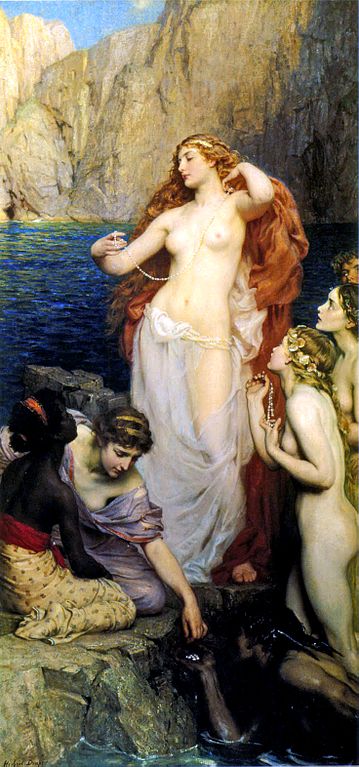
The Pearls of Aphrodite by Herbert James Draper

The Pearls of Aphrodite by Herbert James Draper

Synopsis

“Hymn to Aphrodite” begins with the unidentified speaker calling on the immortal goddess Aphrodite, daughter of the mighty Zeus, the use her unique skills to ensnare a reluctant lover. She entreats the goddess not to ignore her pleadings and so break a heart which is already stricken with grief.

The author reminds Aphrodite of her devotion in the past and of the songs that have been sung in her honour, and of how the goddess has previously heard and answered the speaker’s pleas and made the trip from her father’s golden palace to this mortal’s more humble home.

It is only when Aphrodite replies in the fifth stanza that it becomes clear that it is Sappho herself who is seeking the goddess’ intervention. In the sixth stanza, although it is not clear whether the disinclined lover is in fact a man or a woman, Aphrodite assures Sappho that although he/she maybe reluctant now, he/she will soon come around and return Sappho’s love in equal measure.

The final stanza repeats Sappho’s pleas for Aphrodite to fight on her behalf and to allay her misery.

Analysis

Although we have no specific date for its composition, the poem would have been composed some time in the early 6th Century BCE. Sappho used to organize a group of her young female students into a “thiasos”, a cult that worshipped Aphrodite with songs and poetry, and “Hymn to Aphrodite”was most likely composed for performance within this cult.

The poem consists of a plea, in seven four-line stanzas of her own Sapphic metre, from Sappho to Aphrodite to help secure the ardour of a reluctant lover, and (uniquely among such works) the goddess’s response to the poet’s plea. It points out that the goddess has helped the poet many times in the past, and Aphrodite’s personal response, suggesting almost an intimacy with her devotee, is positive and hopeful.

Resources

  • Modern 1997 translation by Elizabeth Vandiver (Diotima)

  • Original Greek and a variety of different English translations from the 8th and 19th Century (Classic Persuasion)

By Ancient Literature

Sappho:

  • • Hymn to Aphrodite
Pythian Ode 1

Pythian Ode 1

(Lyric Poem, Greek, 470 BCE, 100 lines)Introduction "Pythian Ode 1" is one of the better known of the many victory poems (or "epinicia") of the ancient Greek lyric poet Pindar. Like "Olympic Ode 1", it celebrates a victory of the Sicilian tyrant H...

January 1st, 2025 • Ancient Literature
Aphrodite in The Odyssey: A Tale of Sex, Hubris, and Humiliation

Aphrodite in The Odyssey: A Tale of Sex, Hubris, and Humiliation

Why did Homer mention Aphrodite in The Odyssey? She doesn't even appear in person, but only as a character in a bard's song. Is it just an entertaining story, or did Homer make a specific point? Keep reading to find out!What Is the Role of Aphrodi...

February 15th, 2024 • Ancient Literature
Heroides

Heroides

"Heroides" ("The Heroines"), also known as "Epistulae Heroidum" ("Letters of Heroines") or simply "Epistulae", is a collection of fifteen epistolary poems (poems in the form of letters) by the Roman lyric poet Ovid, published between 5 BCE and 8 C...

October 25th, 2024 • Timeless Myths
Invocation of the Muse Odyssey: The Author's Prayer

Invocation of the Muse Odyssey: The Author's Prayer

Invocation of the muse Odyssey, in Greek mythology, refers to the act of the author, Homer, requesting the muse to give him inspiration and blessing as he begins to write his work of literature, The Odyssey. Read on to discover more details about ...

February 16th, 2024 • Ancient Literature
Sappho

Sappho

(Lyric Poet, Greek, c. 630 – c. 570 BCE)Introduction - Who is Sappho Sappho was the quintessential lyric poet of ancient Greece. Although the bulk of her poetry has been lost, she was well-known and greatly admired throughout antiquity as one of t...

January 1st, 2025 • Ancient Literature
Hymn to Pallas Athena

Hymn to Pallas Athena

Hymn to Pallas Athena from the Book of Timeless Hymns "You are my shadow,Who has comforted meWith your heavenly presence.Your melodious voiceBanishes my fearWhenever I am in grave peril. "You are my light,Who guides my wandering.Your tracks have n...

October 6th, 2002 • Jimmy Joe
Catullus 5

Catullus 5

(Lyric Poem, Latin/Roman, c. 65 BCE, 13 lines)Introduction "Vivamus, mea Lesbia, atque amemus" ("Let us live, my Lesbia, and let us love") is a passionate love poem by the Roman lyric poet Catullus, often referred to as "Catullus 5" or "Carmina V"...

October 25th, 2024 • Timeless Myths
Hesiod

Hesiod

(Didactic Poet, Greek, c. 750 – c. 700 BCE)Introduction Hesiod is often paired with his near contemporary Homer as one of the earliest Greek poets whose work has survived. He is considered the creator of didactic poetry (instructive and moralizing...

January 1st, 2025 • Ancient Literature
Catullus 26 Translation

Catullus 26 Translation

Introduction Catullus addresses Furius in this poem. The exact relationship between Furius and Catullus is uncertain, but some thing that Furius is a rival poet who may have had an affair with Juventius who was one of Catullus’s lovers. Catullus i...

January 1st, 2025 • R.D.M
Olympic Ode 1

Olympic Ode 1

(Lyric Poem, Greek, 476 BCE, 116 lines)Introduction "Olympian Ode 1" is one of the best known of the many victory poems of the ancient Greek lyric poet Pindar. It celebrates the victory of Hieron, the tyrant of Syracuse, in the prestigious single ...

January 1st, 2025 • Ancient Literature
Timeless Myths

Exploring mythology and legends from around the world.

Explore Myths

All Stories Characters All Articles Search Site Map

Mythologies

Norse Mythology Classical Mythology Celtic Mythology Arthurian Legends Mythology Gods Ancient Literature

About Us

Introduction About Jimmy Bibliography FAQs Retro Version

Resources

Timeless Myths All Stories All Articles Characters
© 1999-2026 Timeless Myths • Copyright • Privacy Policy • Cookie Policy • Contact
Follow us: