Timeless Myths Logo
Aphrodite Apollo Ares Artemis Athena Atlas Coeus Crius Cronus Demeter Dionysus Gaia Hades Hephaestus Hera Hermes Hestia Hyperion Iapetus Mnemosyne Oceanus Phobos Phoebe Poseidon Prometheus Rhea Tethys Themis Uranus Zeus
Bacchus Ceres Diana Juno Jupiter Mars Mercury Minerva Neptune Pluto Venus Vesta Vulcan
Amun Anubis Aten Atum Babi Bastet Bes Geb Hapi hathor heqet Horus Isis Khepri Khnum Khonsu Maat Nephthys Nut Osiris Ptah Ra Seshat Seth Shu Sobek Thoth
Alfheim Baldur Freya Freyr Frigg Heimdallr Helheim Idun Jotunheim Loki Nerthus Njord Odin Thor Tyr
Aengus Arawn Badb Brigid Cailleach Ceridwen Cernunnos Cu Chulainn Dagda Danu Gwydion Herne the Hunter Lugh Medb Morrigan Neit Nuada Taliesin Taranis
Chalchiuhtlicue Coatlicue Huitzilopochtli Mictlantecuhtli Mixcoatl Ometeotl Quetzalcoatl Tezcatlipoca Tlaloc Tonatiuh Xipe Totec Xochiquetzal Xolotl
Amaterasu Ame no Uzume Benzaiten Bishamonten Daikokuten Ebisu Fujin Fukurokuju Inari Izanagi Kagutsuchi Raijin Susanoo Tsukuyomi
Caishen Cangjie Dragon King Eight Immortals Erlang Shen Fuxi Guanyin Hou Yi Huxian Jade Emperor King Yama Leizi Lu-ban Mazu Nezha Nuwa Pangu Shennong Sun Wukong Xiwangmu Yue Lao Zhong Kui
Norse Classical Celtic Arthurian
Literature Stories Names
Aphrodite Apollo Ares Artemis Athena Atlas Coeus Crius Cronus Demeter Dionysus Gaia Hades Hephaestus Hera Hermes Hestia Hyperion Iapetus Mnemosyne Oceanus Phobos Phoebe Poseidon Prometheus Rhea Tethys Themis Uranus Zeus
Bacchus Ceres Diana Juno Jupiter Mars Mercury Minerva Neptune Pluto Venus Vesta Vulcan
Amun Anubis Aten Atum Babi Bastet Bes Geb Hapi hathor heqet Horus Isis Khepri Khnum Khonsu Maat Nephthys Nut Osiris Ptah Ra Seshat Seth Shu Sobek Thoth
Alfheim Baldur Freya Freyr Frigg Heimdallr Helheim Idun Jotunheim Loki Nerthus Njord Odin Thor Tyr
Aengus Arawn Badb Brigid Cailleach Ceridwen Cernunnos Cu Chulainn Dagda Danu Gwydion Herne the Hunter Lugh Medb Morrigan Neit Nuada Taliesin Taranis
Chalchiuhtlicue Coatlicue Huitzilopochtli Mictlantecuhtli Mixcoatl Ometeotl Quetzalcoatl Tezcatlipoca Tlaloc Tonatiuh Xipe Totec Xochiquetzal Xolotl
Amaterasu Ame no Uzume Benzaiten Bishamonten Daikokuten Ebisu Fujin Fukurokuju Inari Izanagi Kagutsuchi Raijin Susanoo Tsukuyomi
Caishen Cangjie Dragon King Eight Immortals Erlang Shen Fuxi Guanyin Hou Yi Huxian Jade Emperor King Yama Leizi Lu-ban Mazu Nezha Nuwa Pangu Shennong Sun Wukong Xiwangmu Yue Lao Zhong Kui
Norse Classical Celtic Arthurian
Literature Stories Names
  1. Classical Literature
    Greece Rome Other Ancient Civilizations Timeline of Classical Literature Alphabetical List of Authors Index of Individual Works Index of Important Characters Sources About Us
  2. Greece
    Homer Hesiod Aesop Sappho Pindar Aeschylus Sophocles Euripides Aristophanes Menander Apollonius of Rhodes
  3. Hesiod
    Works and Days Theogony

Hesiod

(Didactic Poet, Greek, c. 750 – c. 700 BCE)

Introduction

Hesiod is often paired with his near contemporary Homer as one of the earliest Greek poets whose work has survived. He is considered the creator of didactic poetry (instructive and moralizing poetry), and his writings serve as a major source on Greek mythology ("Theogony"), farming techniques, archaic Greek astronomy and ancient time-keeping ("Works and Days").
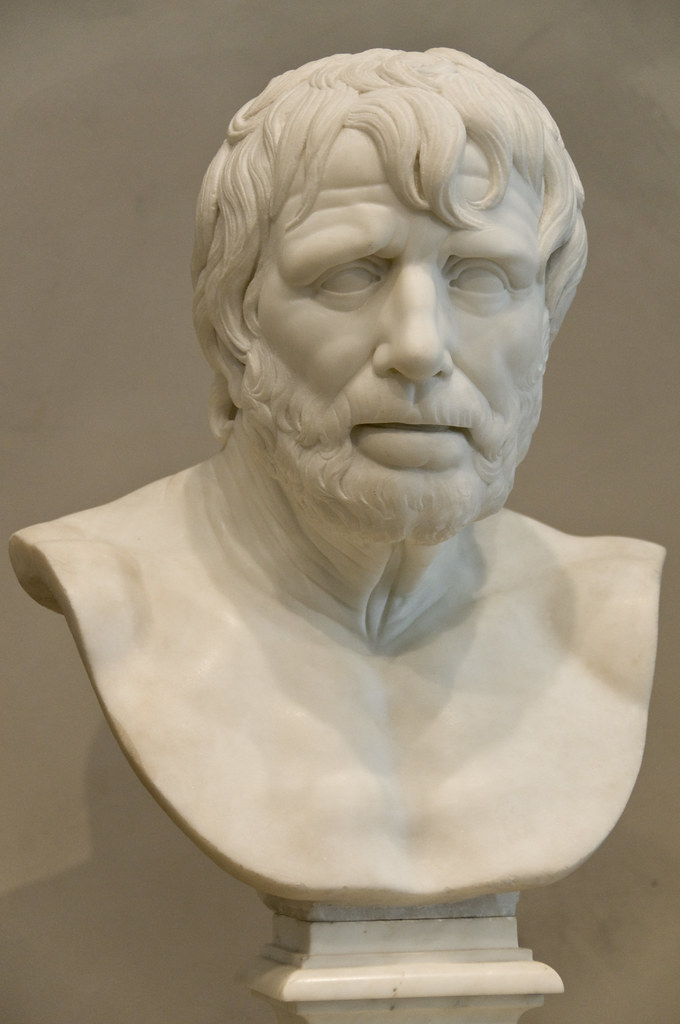
Hesiod Bust Statue

Hesiod Bust Statue

Biography - Who is Hesiod

As with Homer, legendary traditions have accumulated around Hesiod, although we do have at least some biographical details from references in his own works. His father came from Cyme in Aeolis, (modern day western Turkey), but crossed the sea to settle in a small village in Boeotia at the foot of Mount Helicon in Greece.

As a youth, he worked as a shepherd in the mountains, and then, when his father died, as a small farmer working hard land. Hesiod claimed to have been granted the gift of poetic inspiration by the Muses themselves (who traditionally lived on Mount Helicon) while he was out tending sheep one day. After losing a lawsuit to his brother Perses over the distribution of his father's land, he left his homeland and moved to the region of Naupactus in the Gulf of Corinth.

Hesiod's dates are uncertain, but leading scholars generally agree that he lived in the latter half of the 8th Century BCE, probably shortly after Homer. His major works are thought to have been written around 700 BCE. Different traditions regarding Hesiod's death have him dying either in the temple of Nemean Zeus at Locris, murdered by the sons of his host in Oeneon, or at Orchomenus in Boeotia.

Writings

Of the many works attributed in ancient times to Hesiod, three survive in complete form ("Works and Days", "Theogony" and "The Shield of Heracles") and many more in fragmentary state. However, most scholars now consider "The Shield of Heracles" and most of the other poetic fragments attributed to him as later examples of the poetic tradition to which Hesiod belonged, and not as the work of Hesiod himself.

Unlike the epic poetry of Homer, who wrote from the point of view of the rich and the nobility, "Works and Days" is written from the point view of the small independent farmer, probably in the wake of the dispute between Hesiod and his brother Perses over the distribution of his father's land. It is a didactic poem, filled with moral precepts as well as myths and fables, and it is largely this (rather than its literary merit) that made it highly valued by the ancients.
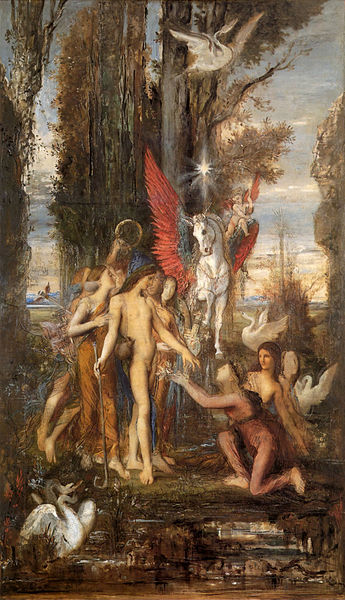
Hesiod and the Muses by Gustave Moreau

Hesiod and the Muses by Gustave Moreau

The 800 verses of "Works and Days" revolve around two general truths: that labour is the universal lot of Man, but he who is willing to work will always get by. It contains advice and wisdom, prescribing a life of honest labour (which is portrayed as the source of all good) and attacking idleness and unjust judges and the practice of usury. It also lays out the "Five Ages of Man", the first extant account of the successive ages of mankind.

"Theogony" uses the same epic verse-form as "Works and Days" and, despite the very different subject matter, most scholars believe that the two works were indeed written by the same man. It is essentially a large-scale synthesis of a vast variety of local Greek traditions concerning the gods, and concerns the origins of the world and of the gods, beginning with Chaos and his progeny, Gaia and Eros.

The better known anthropomorphic deities like Zeus only come to the fore in the third generation, long after the early powers and the Titans, when Zeus wins a struggle against his father and thereby becomes king of the gods. According to the historian Herodotus, Hesiod's retelling of the old stories became, despite the various different historical traditions, the definitive and accepted version that linked all Greeks in ancient times.
Major Works

Works and Days

Works and Days

Theogony

Theogony

By Ancient Literature

Greece:

  • • Homer
  • • Hesiod
  • • Aesop
  • • Sappho
  • • Pindar
  • • Aeschylus
  • • Sophocles
  • • Euripides
  • • Aristophanes
  • • Menander
  • • Apollonius of Rhodes
Works and Days

Works and Days

(Didactic Poem, Greek, c. 700 BCE, 828 lines)Introduction "Works and Days" (Gr:"Erga kaí Hemérai"; Lat: “Opera et Dies”) is a didactic poem written by the very early ancient Greek poet Hesiod. It was probably written around 700 BCE or earlier and ...

January 1st, 2025 • Ancient Literature
Hesiod vs Homer: A Cursory Look At the Two Great Greek Writers

Hesiod vs Homer: A Cursory Look At the Two Great Greek Writers

Hesiod vs Homer compares the two great Greek epic poets of ancient Greek literature. The idea is to establish the similarities and differences between both men and their works. It is no doubt that the works of Homer and Hesiod give an insight into...

February 16th, 2024 • Ancient Literature
Theogony

Theogony

(Didactic Poem, Greek, c. 700 BCE, 1,022 lines)Introduction - What is Theogony and why is it important? The "Theogony" (Gr: "Theogonia") of the ancient Greek poet Hesiod is a didactic or instructional poem describing the origins of the cosmos and ...

January 1st, 2025 • Ancient Literature
Euripides

Euripides

(Tragic Playwright, Greek, c. 480 – c. 406 BCE)Introduction Euripides was the last of the three great tragedians of classical Greece (the other two being Aeschylus and Sophocles). Largely due to an accident of history, eighteen of Euripides' ninet...

October 24th, 2024 • Timeless Myths
Aeschylus

Aeschylus

(Tragic Playwright, Greek, c. 525 – c. 455 BCE)Introduction Aeschylus (Aiskhylos) is often recognized as the father of tragedy, and is the first of the three early Greek tragedians whose plays survive extant (the other two being Sophocles and Euri...

January 1st, 2025 • Ancient Literature
What Do the Muses Do for Hesiod? His Encounter With the Muses

What Do the Muses Do for Hesiod? His Encounter With the Muses

What do the muses do for Hesiod becaus he is regarded as one of the greatest Greek poets that lived as evidenced by his literary works, especially the Theogony. The Theogony is an extensive account of the origins and genealogies of the Greek deiti...

February 16th, 2024 • Ancient Literature
Homer

Homer

(Epic Poet, Greek, c. 750 - c. 700 BCE)Introduction Homer is traditionally held to be the author of the ancient Greek epic poems "The Iliad" and "The Odyssey", widely thought to be the first extant works of Western literature. He is considered by ...

January 1st, 2025 • Ancient Literature
Aesop

Aesop

(Fabulist, Greek, c. 620 – c. 560 BCE)Introduction Aesop was by tradition a Greek slave, and he is known today exclusively for the genre of fables ascribed to him. "Aesop's Fables" (most of which have anthropomorphic animals as the main characters...

January 1st, 2025 • Ancient Literature
Theogony of Hesiod

Theogony of Hesiod

Hesiod was a Boeotian poet of either the 8th or 7th century BC, who is believed by many to have flourished not long after Homer. Hesiod wrote two poems, Works and Days and the Theogony. Both works can actually be combined to form an adequate Creat...

April 9th, 1999 • Jimmy Joe
Ovid

Ovid

(Epic, Elegiac and Didactic Poet, Roman, 43 BCE – c. 17 CE)Introduction Ovid was a prolific Roman poet, straddling the Golden and Silver Ages of Latin literature, who wrote about love, seduction and mythological transformation. He is considered a ...

October 24th, 2024 • Timeless Myths
Timeless Myths

Exploring mythology and legends from around the world.

Explore Myths

All Stories Characters All Articles Search Site Map

Mythologies

Norse Mythology Classical Mythology Celtic Mythology Arthurian Legends Mythology Gods Ancient Literature

About Us

Introduction About Jimmy Bibliography FAQs Retro Version

Resources

Timeless Myths All Stories All Articles Characters
© 1999-2026 Timeless Myths • Copyright • Privacy Policy • Cookie Policy • Contact
Follow us: