Timeless Myths Logo
Aphrodite Apollo Ares Artemis Athena Atlas Coeus Crius Cronus Demeter Dionysus Gaia Hades Hephaestus Hera Hermes Hestia Hyperion Iapetus Mnemosyne Oceanus Phobos Phoebe Poseidon Prometheus Rhea Tethys Themis Uranus Zeus
Bacchus Ceres Diana Juno Jupiter Mars Mercury Minerva Neptune Pluto Venus Vesta Vulcan
Amun Anubis Aten Atum Babi Bastet Bes Geb Hapi hathor heqet Horus Isis Khepri Khnum Khonsu Maat Nephthys Nut Osiris Ptah Ra Seshat Seth Shu Sobek Thoth
Alfheim Baldur Freya Freyr Frigg Heimdallr Helheim Idun Jotunheim Loki Nerthus Njord Odin Thor Tyr
Aengus Arawn Badb Brigid Cailleach Ceridwen Cernunnos Cu Chulainn Dagda Danu Gwydion Herne the Hunter Lugh Medb Morrigan Neit Nuada Taliesin Taranis
Chalchiuhtlicue Coatlicue Huitzilopochtli Mictlantecuhtli Mixcoatl Ometeotl Quetzalcoatl Tezcatlipoca Tlaloc Tonatiuh Xipe Totec Xochiquetzal Xolotl
Amaterasu Ame no Uzume Benzaiten Bishamonten Daikokuten Ebisu Fujin Fukurokuju Inari Izanagi Kagutsuchi Raijin Susanoo Tsukuyomi
Caishen Cangjie Dragon King Eight Immortals Erlang Shen Fuxi Guanyin Hou Yi Huxian Jade Emperor King Yama Leizi Lu-ban Mazu Nezha Nuwa Pangu Shennong Sun Wukong Xiwangmu Yue Lao Zhong Kui
Norse Classical Celtic Arthurian
Literature Stories Names
Aphrodite Apollo Ares Artemis Athena Atlas Coeus Crius Cronus Demeter Dionysus Gaia Hades Hephaestus Hera Hermes Hestia Hyperion Iapetus Mnemosyne Oceanus Phobos Phoebe Poseidon Prometheus Rhea Tethys Themis Uranus Zeus
Bacchus Ceres Diana Juno Jupiter Mars Mercury Minerva Neptune Pluto Venus Vesta Vulcan
Amun Anubis Aten Atum Babi Bastet Bes Geb Hapi hathor heqet Horus Isis Khepri Khnum Khonsu Maat Nephthys Nut Osiris Ptah Ra Seshat Seth Shu Sobek Thoth
Alfheim Baldur Freya Freyr Frigg Heimdallr Helheim Idun Jotunheim Loki Nerthus Njord Odin Thor Tyr
Aengus Arawn Badb Brigid Cailleach Ceridwen Cernunnos Cu Chulainn Dagda Danu Gwydion Herne the Hunter Lugh Medb Morrigan Neit Nuada Taliesin Taranis
Chalchiuhtlicue Coatlicue Huitzilopochtli Mictlantecuhtli Mixcoatl Ometeotl Quetzalcoatl Tezcatlipoca Tlaloc Tonatiuh Xipe Totec Xochiquetzal Xolotl
Amaterasu Ame no Uzume Benzaiten Bishamonten Daikokuten Ebisu Fujin Fukurokuju Inari Izanagi Kagutsuchi Raijin Susanoo Tsukuyomi
Caishen Cangjie Dragon King Eight Immortals Erlang Shen Fuxi Guanyin Hou Yi Huxian Jade Emperor King Yama Leizi Lu-ban Mazu Nezha Nuwa Pangu Shennong Sun Wukong Xiwangmu Yue Lao Zhong Kui
Norse Classical Celtic Arthurian
Literature Stories Names
  1. Classical Literature
    Greece Rome Other Ancient Civilizations Timeline of Classical Literature Alphabetical List of Authors Index of Individual Works Index of Important Characters Sources About Us
  2. Rome
    Catullus Vergil (Virgil) Horace Ovid Seneca the Younger Lucan Juvenal Pliny the Younger
  3. Ovid
    Amores Ars Amatoria Heroides Metamorphoses

Ovid

(Epic, Elegiac and Didactic Poet, Roman, 43 BCE – c. 17 CE)

Introduction

Ovid was a prolific Roman poet, straddling the Golden and Silver Ages of Latin literature, who wrote about love, seduction and mythological transformation. He is considered a master of the elegiac couplet, and is traditionally ranked alongside Vergil and Horace as one of the three canonic poets of Latin literature.

His poetry, especially the epic poem "Metamorphoses", was much imitated during Late Antiquity and the Middle Ages, and is considered to have decisively influenced European art and literature, including Chaucer, Dante, Shakespeare and Milton.

Biography
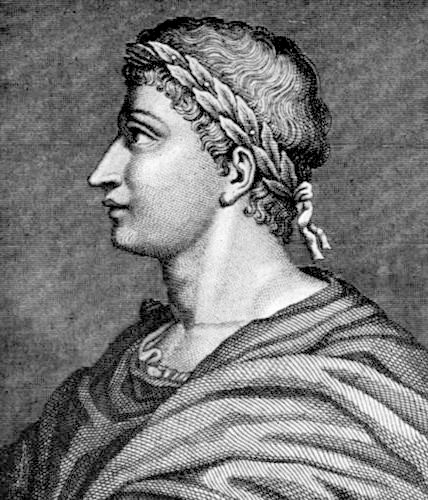
Portrait bust of Ovid, Roman poet

Ovid (Publius Ovidius Naso)

Publius Ovidius Naso was born in 43 BCE in the town of Sulmo (modern-day Sulmona) in the Apennines to the east of Rome. He came from a well-to-do equestrian family, and he and his brother were educated in Rome, with the intention of their pursuing careers in public life.

After the death of his brother, though, Ovid renounced the study of law and politics and began a period of travel in Athens, Asia Minor and Sicily. He held some minor public posts, but eventually resigned even these in order to pursue poetry in earnest. He attracted the patronage of the Roman general and important patron of the arts, Marcus Valerius Messalla Corvinus, and became a friend of Horace. He was described by Seneca the Elder as emotional and impulsive by nature. He married three times (and divorced twice) by the time he was thirty years old, with just one marriage yielding a daughter.

By about 8 CE, Ovid had already published his major works: the early, somewhat irreverent (not to say lewd) "Amores" and "Ars Amatoria", the collection of epistolary poems known as the "Heroides", and his magnum opus, the epic poem "Metamorphoses".

In 8 CE, however, the Emperor Augustus banished Ovid to the city of Tomis, on the Black Sea, in modern-day Romania, for unknown political reasons. The banishment was probably not, as is often assumed, due to his popular but rather lewd early poems, but may have been connected to his part in the lively social circle which had grown up around Augustus' promiscuous daughter, Julia, who was also banished around that time (Ovid himself described the cause rather mysteriously as "carmen et error": "a poem and a mistake").
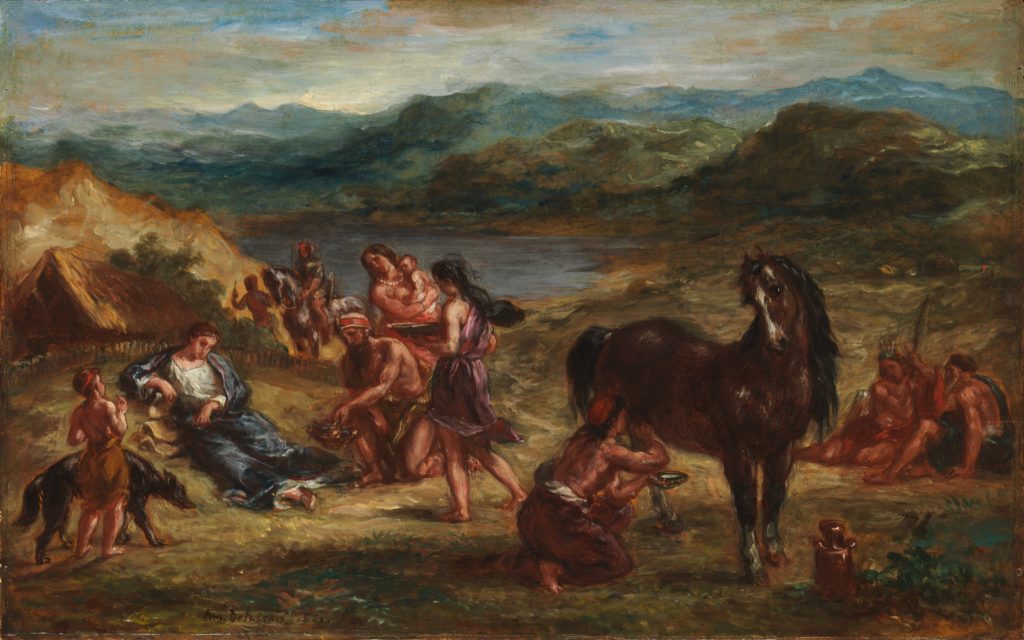
Painting depicting Ovid among the Scythians in exile

Ovid among the Scythians

While in exile, he wrote two multi-book collections of poetry, entitled "Tristia" and "Epistulae ex Ponto", expressing his sadness and desolation and his longing to return to Rome and to his third wife. He was forced to abandon another ambitious work "Fasti", his work on the days of the Roman calendar, probably due to lack of library resources. Even after Augustus's death in 14 CE, the new emperor, Tiberius, still did not recall Ovid, and he eventually died at Tomis some ten years after his banishment in about 17 or 18 CE.

Writings
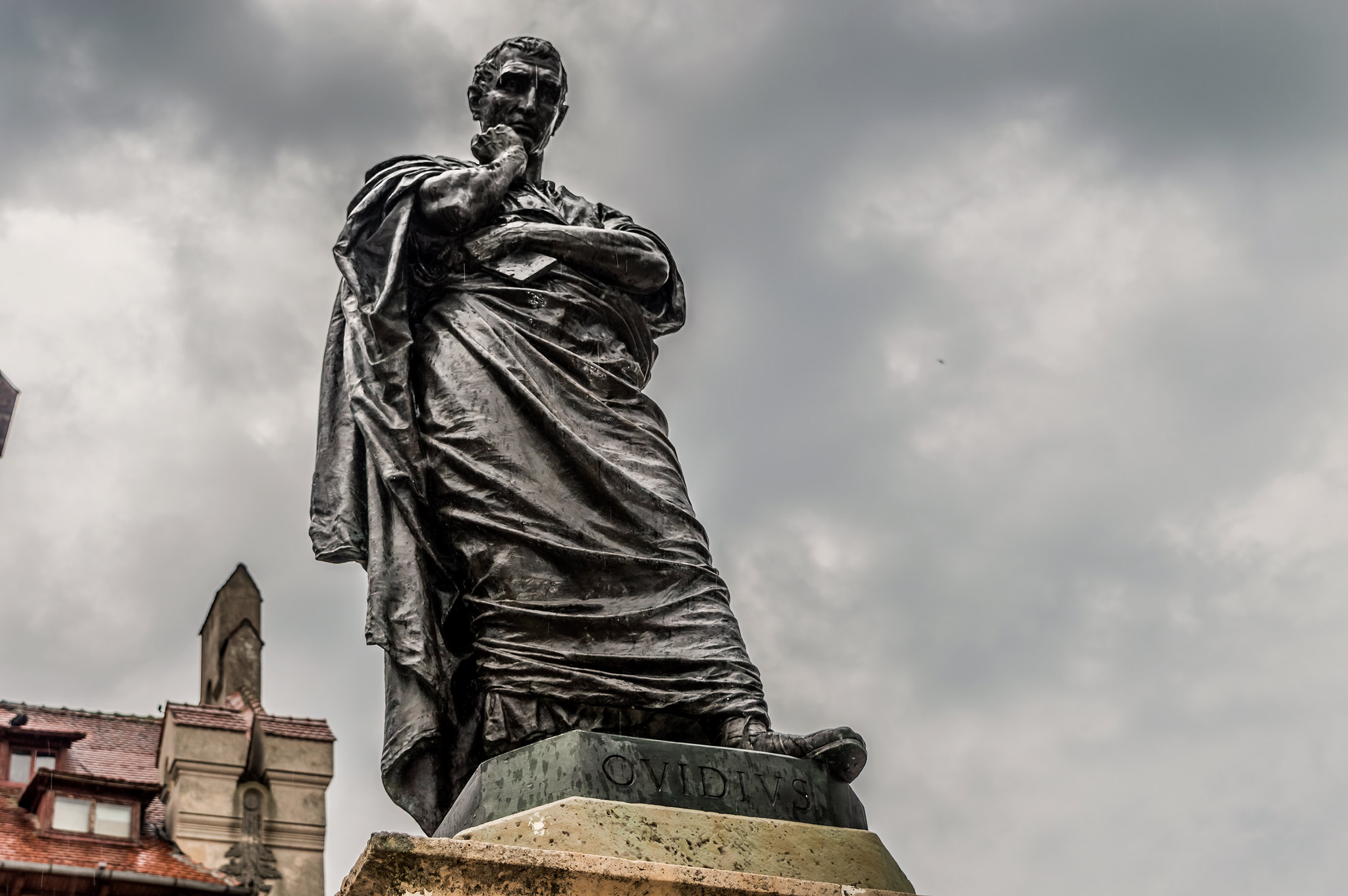
Statue of Ovid, the Roman poet

Statue of Ovid

Ovid's first major work was the "Amores", originally published between 20 and 16 BCE as a five-book collection, although it was later reduced to three books. It is a collection of love poems written in the elegiac distich, generally adhering to standard elegiac themes about various aspects of love, such as the locked-out lover. However, the poems are often humorous, tongue-in-cheek and somewhat cynical, and at times talk about adultery, a brave move in the wake of Augustus' marriage law reforms of 18 BCE.

The "Amores" were followed by the "Ars Amatoria" ("The Art of Love"), published in three books between 1 BCE and 1 CE. It is, on some levels, a burlesque satire on didactic poetry, composed in elegiac couplets rather than the dactylic hexameters more usually associated with the didactic poem. It purports to offer erotic advice on the art of seduction (the first two books aimed at men, the third giving similar advice to women). Some have assumed that the supposed licentiousness of the "Ars Amatoria" was responsible in part for Ovid's banishment by Augustus in 8 CE, but that is now considered unlikely. The work was such a popular success that he wrote a sequel, "Remedia Amoris" ("Remedies for Love").

The "Heroides" ("Epistulae Heroidum") were a collection of fifteen epistolary poems published between about 5 BCE and 8 CE, composed in elegiac couplets and presented as though written by a selection of aggrieved heroines of Greek and Roman mythology (which Ovid claimed to be an entirely new literary genre).

By 8 CE, he had completed his masterpiece, "Metamorphoses", an epic poem in fifteen books derived from Greek mythology about mythical figures who have undergone transformations (from the emergence of the cosmos from formless mass to the organized, material world, to famous myths such as Apollo and Daphne, Daedalus and Icarus, Orpheus and Eurydice, and Pygmalion, to the deification of Julius Caesar). It is written in dactylic hexameter, the epic metre of Homer's "Odyssey" and "Iliad" and Vergil's "Aeneid". It remains an invaluable source on Roman religion, and explains many myths alluded to in other works.

Major Works

  • "Amores"

  • "Ars Amatoria"

  • "Heroides"

  • "Metamorphoses"

By Timeless Myths

Rome:

  • • Catullus
  • • Vergil (Virgil)
  • • Horace
  • • Ovid
  • • Seneca the Younger
  • • Lucan
  • • Juvenal
  • • Pliny the Younger
Metamorphoses

Metamorphoses

(Epic Poem, Latin/Roman, 8 CE, 11,996 lines)Introduction "Metamorphoses" ("Transformations") is a narrative poem in fifteen books by the Roman poet Ovid, completed in 8 CE. It is an epic (or "mock-epic") poem describing the creation and history of...

October 25th, 2024 • Timeless Myths
Hesiod

Hesiod

(Didactic Poet, Greek, c. 750 – c. 700 BCE)Introduction Hesiod is often paired with his near contemporary Homer as one of the earliest Greek poets whose work has survived. He is considered the creator of didactic poetry (instructive and moralizing...

January 1st, 2025 • Ancient Literature
Horace

Horace

(Lyric Poet and Satirist, Roman, 65 – 8 BCE)Introduction Horace was, along with Vergil, the leading Roman poet in the time of Emperor Augustus. He is considered by classicists to be one of the greatest and most original of Latin lyric poets, appre...

October 24th, 2024 • Timeless Myths
Nunc est bibendum (Odes, Book 1, Poem 37)

Nunc est bibendum (Odes, Book 1, Poem 37)

(Lyric Poem, Latin/Roman, c. 30 BCE, 32 lines)Introduction "Nunc est bibendum" ("Now is the time for drinking"), sometimes known as the "Cleopatra Ode", is one of the most famous of the odes of the Roman lyric poet Horace, published in 23 BCE as P...

October 25th, 2024 • Timeless Myths
Euripides

Euripides

(Tragic Playwright, Greek, c. 480 – c. 406 BCE)Introduction Euripides was the last of the three great tragedians of classical Greece (the other two being Aeschylus and Sophocles). Largely due to an accident of history, eighteen of Euripides' ninet...

October 24th, 2024 • Timeless Myths
Tales of Lovers

Tales of Lovers

Tales of Lovers are concerned with myths about love and tragedy. Most of the stories found here come from a work called Metamorphoses by the Roman writer named Ovid, except for the tale of Cupid and Psyche which was only known through Lucius Apule...

June 22nd, 2000 • Jimmy Joe
Heroides

Heroides

"Heroides" ("The Heroines"), also known as "Epistulae Heroidum" ("Letters of Heroines") or simply "Epistulae", is a collection of fifteen epistolary poems (poems in the form of letters) by the Roman lyric poet Ovid, published between 5 BCE and 8 C...

October 25th, 2024 • Timeless Myths
Ars Amatoria

Ars Amatoria

(Didactic/Elegiac Poem, Latin/Roman, 1 CE, 2,330 lines)Introduction "Ars Amatoria" ("The Art of Love") is a collection of 57 didactic poems (or, perhaps more accurately, a burlesque satire on didactic poetry) in three books by the Roman lyric poet...

October 25th, 2024 • Timeless Myths
Odi et amo (Catullus 85)

Odi et amo (Catullus 85)

(Epigram/Elegiac Couplet, Latin/Roman, c. 65 BCE, 2 lines)Introduction "Odi et amo" ("I hate and I love") is a short poem or epigram by the Roman lyric poet Catullus, written in elegiac couplet form sometime around 65 BCE. It is often referred to ...

October 25th, 2024 • Timeless Myths
Tu ne quaesieris (Odes, Book 1, Poem 11)

Tu ne quaesieris (Odes, Book 1, Poem 11)

(Lyric Poem, Latin/Roman, c. 23 BCE, 8 lines)Introduction "Tu ne quaesieris" ("Do not ask") is the most famous of the odes of the Roman lyric poet Horace, published in 23 BCE as Poem 11 in the first book of Horace's collected "Odes" or "Carmina". ...

October 25th, 2024 • Timeless Myths
Timeless Myths

Exploring mythology and legends from around the world.

Explore Myths

All Stories Characters All Articles Search Site Map

Mythologies

Norse Mythology Classical Mythology Celtic Mythology Arthurian Legends Mythology Gods Ancient Literature

About Us

Introduction About Jimmy Bibliography FAQs Retro Version

Resources

Timeless Myths All Stories All Articles Characters
© 1999-2026 Timeless Myths • Copyright • Privacy Policy • Cookie Policy • Contact
Follow us: