Timeless Myths Logo
Aphrodite Apollo Ares Artemis Athena Atlas Coeus Crius Cronus Demeter Dionysus Gaia Hades Hephaestus Hera Hermes Hestia Hyperion Iapetus Mnemosyne Oceanus Phobos Phoebe Poseidon Prometheus Rhea Tethys Themis Uranus Zeus
Bacchus Ceres Diana Juno Jupiter Mars Mercury Minerva Neptune Pluto Venus Vesta Vulcan
Amun Anubis Aten Atum Babi Bastet Bes Geb Hapi hathor heqet Horus Isis Khepri Khnum Khonsu Maat Nephthys Nut Osiris Ptah Ra Seshat Seth Shu Sobek Thoth
Alfheim Baldur Freya Freyr Frigg Heimdallr Helheim Idun Jotunheim Loki Nerthus Njord Odin Thor Tyr
Aengus Arawn Badb Brigid Cailleach Ceridwen Cernunnos Cu Chulainn Dagda Danu Gwydion Herne the Hunter Lugh Medb Morrigan Neit Nuada Taliesin Taranis
Chalchiuhtlicue Coatlicue Huitzilopochtli Mictlantecuhtli Mixcoatl Ometeotl Quetzalcoatl Tezcatlipoca Tlaloc Tonatiuh Xipe Totec Xochiquetzal Xolotl
Amaterasu Ame no Uzume Benzaiten Bishamonten Daikokuten Ebisu Fujin Fukurokuju Inari Izanagi Kagutsuchi Raijin Susanoo Tsukuyomi
Caishen Cangjie Dragon King Eight Immortals Erlang Shen Fuxi Guanyin Hou Yi Huxian Jade Emperor King Yama Leizi Lu-ban Mazu Nezha Nuwa Pangu Shennong Sun Wukong Xiwangmu Yue Lao Zhong Kui
Norse Classical Celtic Arthurian
Literature Stories Names
Aphrodite Apollo Ares Artemis Athena Atlas Coeus Crius Cronus Demeter Dionysus Gaia Hades Hephaestus Hera Hermes Hestia Hyperion Iapetus Mnemosyne Oceanus Phobos Phoebe Poseidon Prometheus Rhea Tethys Themis Uranus Zeus
Bacchus Ceres Diana Juno Jupiter Mars Mercury Minerva Neptune Pluto Venus Vesta Vulcan
Amun Anubis Aten Atum Babi Bastet Bes Geb Hapi hathor heqet Horus Isis Khepri Khnum Khonsu Maat Nephthys Nut Osiris Ptah Ra Seshat Seth Shu Sobek Thoth
Alfheim Baldur Freya Freyr Frigg Heimdallr Helheim Idun Jotunheim Loki Nerthus Njord Odin Thor Tyr
Aengus Arawn Badb Brigid Cailleach Ceridwen Cernunnos Cu Chulainn Dagda Danu Gwydion Herne the Hunter Lugh Medb Morrigan Neit Nuada Taliesin Taranis
Chalchiuhtlicue Coatlicue Huitzilopochtli Mictlantecuhtli Mixcoatl Ometeotl Quetzalcoatl Tezcatlipoca Tlaloc Tonatiuh Xipe Totec Xochiquetzal Xolotl
Amaterasu Ame no Uzume Benzaiten Bishamonten Daikokuten Ebisu Fujin Fukurokuju Inari Izanagi Kagutsuchi Raijin Susanoo Tsukuyomi
Caishen Cangjie Dragon King Eight Immortals Erlang Shen Fuxi Guanyin Hou Yi Huxian Jade Emperor King Yama Leizi Lu-ban Mazu Nezha Nuwa Pangu Shennong Sun Wukong Xiwangmu Yue Lao Zhong Kui
Norse Classical Celtic Arthurian
Literature Stories Names
  1. Classical Literature
    Greece Rome Other Ancient Civilizations Timeline of Classical Literature Alphabetical List of Authors Index of Individual Works Index of Important Characters Sources About Us
  2. Rome
    Catullus Vergil (Virgil) Horace Ovid Seneca the Younger Lucan Juvenal Pliny the Younger
  3. Ovid
    Amores Ars Amatoria Heroides Metamorphoses
  4. Ars Amatoria
    Ars Amatoria

Ars Amatoria

(Didactic/Elegiac Poem, Latin/Roman, 1 CE, 2,330 lines)
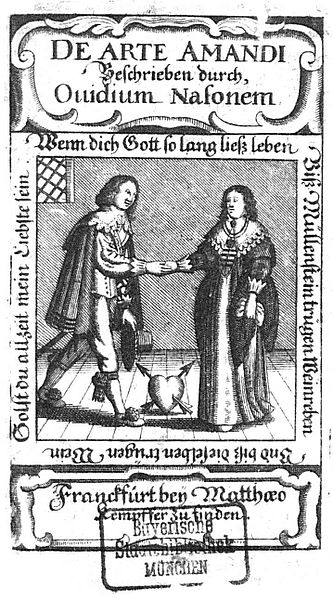
Historical illustration from 1644 edition of Ars Amatoria

Historical illustration from 1644 edition of Ars Amatoria

Introduction

"Ars Amatoria" ("The Art of Love") is a collection of 57 didactic poems (or, perhaps more accurately, a burlesque satire on didactic poetry) in three books by the Roman lyric poet Ovid, written in elegiac couplets and completed and published in 1 CE. The poem provides teaching in the areas of how and where to find women (and husbands) in Rome, how to seduce them and how to prevent others from stealing them.

Synopsis

A very brief general summary of the three books of the "Ars Amatoria" may be listed as follows:

Book 1
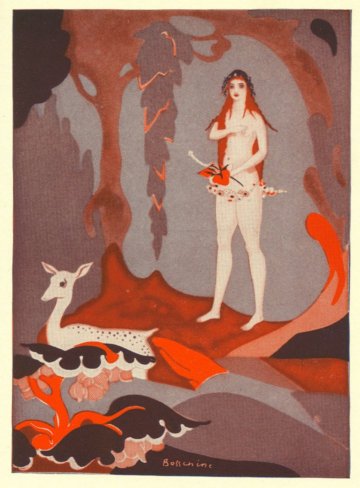
Illustration for Book 1 of Ars Amatoria

Illustration for Book 1 of Ars Amatoria

  • Part I: His task.

  • Part II: How to find her.

  • Part III: Search while you are out walking.

  • Part IV: At the theatre.

  • Part V: At the races or the circus.

  • Part VI: Triumphs are good too.

  • Part VII: At the dinner table.

  • Part VIII: At the beach.

  • Part IX: How to win her.

  • Part X: First secure the maid.

  • Part XI: Do not forget her birthday.

  • Part XII: Write and make promises.

  • Part XIII: Be whereever she is.

  • Part XIV: Look presentable.

  • Part XV: At dinner be bold.

  • Part XVI: Promise and deceive.

  • Part XVII: Tears, kisses and taking the lead.

  • Part XVIII: Be pale and be wary of your friends.

  • Part XIX: Be flexible.

Book 2

  • Part I: His task.

  • Part II: You need gifts of mind.

  • Part III: Be gentle and good tempered.

  • Part IV: Be patient and comply.

  • Part V: Do not be faint-hearted.

  • Part VI: Win over the servants.

  • Part VII: Give her little tasteful gifts.

  • Part VIII: Favour her and compliment her.

  • Part IX: Comfort her in sickness.

  • Part X: Let her miss you (but not for too long).

  • Part XI: Have other friends (but be careful).

  • Part XII: On the use of aphrodisiacs.

  • Part XIII: Stir her jealousy.

  • Part XIV: Be wise and suffer.

  • Part XV: Respect her freedom.

  • Part XVI: Keep it secret.

  • Part XVII: Do not mention her faults.

  • Part XVIII: Never ask about her age.

  • Part XIX: Do not rush.

  • Part XX: The task is complete (for now...).

Book 3
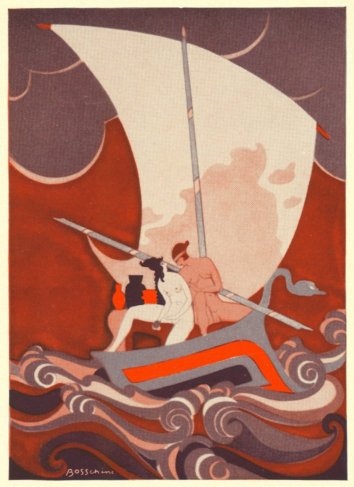
Illustration for Book 3 of Ars Amatoria

Illustration for Book 3 of Ars Amatoria

  • Part I: Now it is time to teach the girls.

  • Part II: Take care with how you look.

  • Part III: Taste and elegance in hair and dress.

  • Part IV: Make-up, but in private.

  • Part V: Conceal your defects.

  • Part VI: Be modest in laughter and movement.

  • Part VII: Learn music and read the poets.

  • Part VIII: Learn dancing and games.

  • Part IX: Be seen around.

  • Part X: Beware of false lovers.

  • Part XI: Take care with letters.

  • Part XII: Avoid the vices, favour the poets.

  • Part XIII: Try young and older lovers.

  • Part XIV: Use jealousy and fear.

  • Part XV: Play cloak and dagger.

  • Part XVI: Make him believe he is loved.

  • Part XVII: Watch how you eat and drink.

  • Part XVIII: And so to bed....

Analysis

The first two books of Ovid's "Ars Amatoria" were published around 1 BCE, with the third (dealing with the same themes from the female perspective) added the next year in 1 CE. The work was a great popular success, so much so that the poet wrote an equally popular sequel, "Remedia Amoris" ("Remedies for Love"), soon after, which offered stoic advice and strategies on how to avoid being hurt by love feelings and how to fall out of love.

The Art of Love - historical illustration

The Art of Love - historical illustration

It was not, however, universally acclaimed, and there are accounts of some listeners walking out of early readings in disgust. Many have assumed that the bawdiness and licentiousness of the "Ars Amatoria", with its celebration of extramarital sex, was largely responsible for Ovid's banishment from Rome in 8 CE by the Emperor Augustus, who was attempting to promote a more austere morality at that time. However, it is more probable that Ovid was somehow caught up in factional politics connected with the succession and/or other scandals (Augustus' adopted son, Postumus Agrippa, and his granddaughter, Julia, were both banished at around the same time). It is possible, however, that the "Ars Amatoria" may well have been used as the official excuse for the relegation.

Although the work does not generally give any immediately usable practical advice, rather employing cryptic allusions and treating the subject matter with the range and intelligence of urbane conversation, the superficial brilliance of the poetry is nevertheless dazzling. The standard situations and clichés of the subject are treated in a highly entertaining way, spiced with colourful details from Greek mythology, everyday Roman life and general human experience.

Through all his ironic discourse, though, Ovid avoids becoming outright ribald or obscene, and sexual matters per se are only dealt with in abbreviated form towards the end of each book, although even here Ovid retains his style and his discretion, avoiding any pornographic tinge. For example, the end of the second book deals with the pleasures of simultaneous orgasm, and the end of the third part discusses various sexual positions, although in a rather flippant and tongue-in-cheek manner.

Appropriately for its subject, the poem is composed in the elegiac couplets of love poetry, rather than the dactyllic hexameters more usually associated with didactic poetry. Elegiac couplets consist of alternating lines of dactylic hexameter and dactylic pentameter: two dactyls followed by a long syllable, a caesura, then two more dactyls followed by a long syllable.

The literary brilliance and popular accessibility of the work has ensured that it has remained a widely-read source of inspiration, and it was included in the syllabuses of medieval European schools in the 11th and 12th Centuries. However, it has also subsequently fallen victim to outbursts of moral opprobrium: all of Ovid's works were burned by Savonarola in Florence, Italy in 1497; Christopher Marlowe's translation of "Ars Amatoria" was banned in 1599; and another English translation was seized by US Customs as late as 1930.

Resources

  • English translation (Perseus Project): http://www.perseus.tufts.edu/hopper/text.jsp?doc=Perseus:text:1999.02.0069:text=Ars:book=1

  • Latin version with word-by-word translation (Perseus Project): http://www.perseus.tufts.edu/hopper/text?doc=Perseus:text:1999.02.0068:text=Ars

By Timeless Myths

Ovid:

  • • Amores
  • • Ars Amatoria
  • • Heroides
  • • Metamorphoses
Ars Poetica

Ars Poetica

(Didactic Poem, Latin/Roman, c. 18 BCE, 476 lines)Introduction "Ars Poetica" ("The Art of Poetry" or "On the Nature of Poetry"), sometimes known under its original title, "Epistula Ad Pisones" ("Letters to the Pisos"), is a treatise or literary es...

October 25th, 2024 • Timeless Myths
Heroides

Heroides

"Heroides" ("The Heroines"), also known as "Epistulae Heroidum" ("Letters of Heroines") or simply "Epistulae", is a collection of fifteen epistolary poems (poems in the form of letters) by the Roman lyric poet Ovid, published between 5 BCE and 8 C...

October 25th, 2024 • Timeless Myths
Odi et amo (Catullus 85)

Odi et amo (Catullus 85)

(Epigram/Elegiac Couplet, Latin/Roman, c. 65 BCE, 2 lines)Introduction "Odi et amo" ("I hate and I love") is a short poem or epigram by the Roman lyric poet Catullus, written in elegiac couplet form sometime around 65 BCE. It is often referred to ...

October 25th, 2024 • Timeless Myths
Tales of Lovers

Tales of Lovers

Tales of Lovers are concerned with myths about love and tragedy. Most of the stories found here come from a work called Metamorphoses by the Roman writer named Ovid, except for the tale of Cupid and Psyche which was only known through Lucius Apule...

June 22nd, 2000 • Jimmy Joe
Catullus 5

Catullus 5

(Lyric Poem, Latin/Roman, c. 65 BCE, 13 lines)Introduction "Vivamus, mea Lesbia, atque amemus" ("Let us live, my Lesbia, and let us love") is a passionate love poem by the Roman lyric poet Catullus, often referred to as "Catullus 5" or "Carmina V"...

October 25th, 2024 • Timeless Myths
Ovid

Ovid

(Epic, Elegiac and Didactic Poet, Roman, 43 BCE – c. 17 CE)Introduction Ovid was a prolific Roman poet, straddling the Golden and Silver Ages of Latin literature, who wrote about love, seduction and mythological transformation. He is considered a ...

October 24th, 2024 • Timeless Myths
Hymn to Aphrodite

Hymn to Aphrodite

(Lyric Poem, Greek, c. 570 BCE, 28 lines)Introduction “Hymn to Aphrodite” (sometimes referred to as "Ode to Aphrodite" or “Fragment 1”) is the only poem of the ancient Greek lyric poet Sappho to survive in its entirety. Although she is recorded in...

January 1st, 2025 • Ancient Literature
Catullus 75 Translation

Catullus 75 Translation

Introduction In this poem, Catullus writes to Lesbia, whom he calls “my Lesbia.” In line one, he shares how his mind is reduced by her fault. This means he is hurt and confused. In the second line, he continues his sad elegiac poem to her by writi...

January 1st, 2025 • Ancient Literature
Catullus 72 Translation

Catullus 72 Translation

Introduction Catullus 72 is addressed to his lover, Lesbia. In the poem, he writes about how strong their friendship was in the past. But, now, she is less of a friend, but more of a lover, and Catullus does not seem happy about it. He begins the ...

January 1st, 2025 • Ancient Literature
Catullus 37 Translation

Catullus 37 Translation

Introduction This poem is about men who visit brothels. In the first line, Catullus talks about people who visit them, and some of them are men who are in the service of the gods. They work in the temples. They think they are the only ones who hav...

January 1st, 2025 • Ancient Literature
Timeless Myths

Exploring mythology and legends from around the world.

Explore Myths

All Stories Characters All Articles Search Site Map

Mythologies

Norse Mythology Classical Mythology Celtic Mythology Arthurian Legends Mythology Gods Ancient Literature

About Us

Introduction About Jimmy Bibliography FAQs Retro Version

Resources

Timeless Myths All Stories All Articles Characters
© 1999-2026 Timeless Myths • Copyright • Privacy Policy • Cookie Policy • Contact
Follow us: