Timeless Myths Logo
Aphrodite Apollo Ares Artemis Athena Atlas Coeus Crius Cronus Demeter Dionysus Gaia Hades Hephaestus Hera Hermes Hestia Hyperion Iapetus Mnemosyne Oceanus Phobos Phoebe Poseidon Prometheus Rhea Tethys Themis Uranus Zeus
Bacchus Ceres Diana Juno Jupiter Mars Mercury Minerva Neptune Pluto Venus Vesta Vulcan
Amun Anubis Aten Atum Babi Bastet Bes Geb Hapi hathor heqet Horus Isis Khepri Khnum Khonsu Maat Nephthys Nut Osiris Ptah Ra Seshat Seth Shu Sobek Thoth
Alfheim Baldur Freya Freyr Frigg Heimdallr Helheim Idun Jotunheim Loki Nerthus Njord Odin Thor Tyr
Aengus Arawn Badb Brigid Cailleach Ceridwen Cernunnos Cu Chulainn Dagda Danu Gwydion Herne the Hunter Lugh Medb Morrigan Neit Nuada Taliesin Taranis
Chalchiuhtlicue Coatlicue Huitzilopochtli Mictlantecuhtli Mixcoatl Ometeotl Quetzalcoatl Tezcatlipoca Tlaloc Tonatiuh Xipe Totec Xochiquetzal Xolotl
Amaterasu Ame no Uzume Benzaiten Bishamonten Daikokuten Ebisu Fujin Fukurokuju Inari Izanagi Kagutsuchi Raijin Susanoo Tsukuyomi
Caishen Cangjie Dragon King Eight Immortals Erlang Shen Fuxi Guanyin Hou Yi Huxian Jade Emperor King Yama Leizi Lu-ban Mazu Nezha Nuwa Pangu Shennong Sun Wukong Xiwangmu Yue Lao Zhong Kui
Norse Classical Celtic Arthurian
Literature Stories Names
Aphrodite Apollo Ares Artemis Athena Atlas Coeus Crius Cronus Demeter Dionysus Gaia Hades Hephaestus Hera Hermes Hestia Hyperion Iapetus Mnemosyne Oceanus Phobos Phoebe Poseidon Prometheus Rhea Tethys Themis Uranus Zeus
Bacchus Ceres Diana Juno Jupiter Mars Mercury Minerva Neptune Pluto Venus Vesta Vulcan
Amun Anubis Aten Atum Babi Bastet Bes Geb Hapi hathor heqet Horus Isis Khepri Khnum Khonsu Maat Nephthys Nut Osiris Ptah Ra Seshat Seth Shu Sobek Thoth
Alfheim Baldur Freya Freyr Frigg Heimdallr Helheim Idun Jotunheim Loki Nerthus Njord Odin Thor Tyr
Aengus Arawn Badb Brigid Cailleach Ceridwen Cernunnos Cu Chulainn Dagda Danu Gwydion Herne the Hunter Lugh Medb Morrigan Neit Nuada Taliesin Taranis
Chalchiuhtlicue Coatlicue Huitzilopochtli Mictlantecuhtli Mixcoatl Ometeotl Quetzalcoatl Tezcatlipoca Tlaloc Tonatiuh Xipe Totec Xochiquetzal Xolotl
Amaterasu Ame no Uzume Benzaiten Bishamonten Daikokuten Ebisu Fujin Fukurokuju Inari Izanagi Kagutsuchi Raijin Susanoo Tsukuyomi
Caishen Cangjie Dragon King Eight Immortals Erlang Shen Fuxi Guanyin Hou Yi Huxian Jade Emperor King Yama Leizi Lu-ban Mazu Nezha Nuwa Pangu Shennong Sun Wukong Xiwangmu Yue Lao Zhong Kui
Norse Classical Celtic Arthurian
Literature Stories Names
  1. Classical Literature
    Greece Rome Other Ancient Civilizations Timeline of Classical Literature Alphabetical List of Authors Index of Individual Works Index of Important Characters Sources About Us
  2. Rome
    Catullus Vergil (Virgil) Horace Ovid Seneca the Younger Lucan Juvenal Pliny the Younger
  3. Catullus
    Passer, deliciae meae puellae (Catullus 2) Catullus 5 Miser Catulle, desinas ineptire (Catullus 8) Odi et amo (Catullus 85) Catullus Translations
  4. Odi et amo (Catullus 85)
    Odi et amo (Catullus 85)

Odi et amo (Catullus 85)

(Epigram/Elegiac Couplet, Latin/Roman, c. 65 BCE, 2 lines)

Introduction
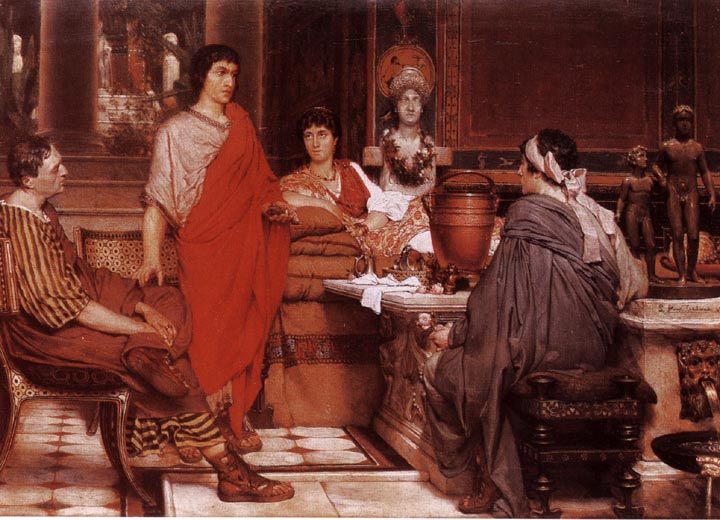
Catullus at Lesbia's by Sir Laurence Alma-Tadema

Catullus at Lesbia's by Sir Laurence Alma-Tadema

"Odi et amo" ("I hate and I love") is a short poem or epigram by the Roman lyric poet Catullus, written in elegiac couplet form sometime around 65 BCE. It is often referred to as "Catullus 85" or "Carmina LXXXV" for its position in the generally accepted catalogue of Catullus works. Despite its brevity, it is one of Catullus's most famous and emotional poems, and its declaration of conflicting feelings for his mistress, Lesbia, is renowned for its force and brevity.

Synopsis

After the bald statement that he both hates and loves, the poet asks why that should be so. He has no answer to the question, but knows only that it is true and that this conflict is the cause of much suffering.

Analysis

Although her name is not actually mentioned anywhere in the poem, the poem is assumed to refer, like so many of Catullus's other poems, to Lesbia, widely regarded to be an alias for Clodia (the wife of the eminent Roman statesman, Clodius), with whom Catullus carried on an affair for some time. Clearly, at this point the relationship was starting to fall apart, and it has been described as the paradox of the disillusioned lover.

The poem is constructed as an elegiac couplet, a short two-line poetic form commonly used by Greek lyric poets for a variety of smaller scale themes. It consists of alternating lines of dactylic hexameter and dactylic pentameter: two dactyls followed by a long syllable, a caesura, then two more dactyls followed by a long syllable.
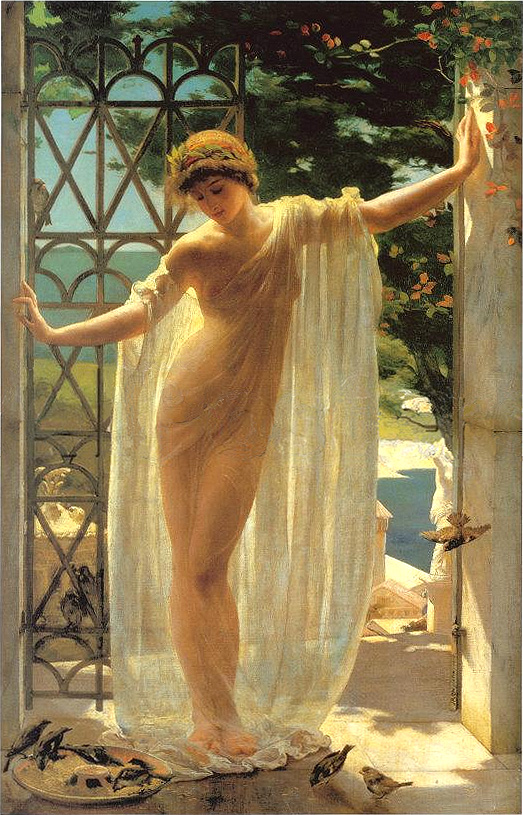
Lesbia by John Reinhard Weguelin

Lesbia by John Reinhard Weguelin

The poem contains eight verbs, no adjectives and no nouns. This reversal of the normal poetic structure (which is generally mostly nouns and adjectives) can be seen as emphasizing the drama and the conflicting emotions Catullus feels. It gets its point across by violent shifts of mood, starting with a simple statement, then a curious psychological inquiry as to motive, next a bland admission of incomprehension, leading to a statement of fact, and ending with the explosion of the final word, "excrucior" (literally, "to be crucified"). The final word gets an extra thrust from its four syllables, in comparison to the two or three syllables of the other words in the poem.

The contrasting and inconsistent feelings that love provokes, and the idea of a love-hate relationship, is one of the most common subjects in world literature, and Catullus was by no means the first poet to touch on it. However, the drama in Catullus's short poem is exacerbated by the sad realization that this trouble arises independently of the human will (particularly brought home by the use of the passive verb "fieri"), and that the poet can do nothing but take note of the situation and suffer terribly.

Despite its shortness, the poem has been translated probably more than any other of Catullus's poems, and it is interesting how a single couplet can offer so many subtly differing possibilities for translation.

Resources

  • Latin original and literal English translation (WikiSource): https://en.wikisource.org/wiki/Catullus_85

  • Audio reading of the original Latin (Classical Latin): http://jcmckeown.com/audio/la5103d1t11.php

By Timeless Myths

Catullus:

  • • Passer, deliciae meae puellae (Catullus 2)
  • • Catullus 5
  • • Miser Catulle, desinas ineptire (Catullus 8)
  • • Odi et amo (Catullus 85)
  • • Catullus Translations
Catullus 85 Translation

Catullus 85 Translation

Introduction Catullus wrote several of his poems about his love, Lesbia. She was married to Metellus, but she had an affair with Catullus. After he died, she had an affair with Caelius and the affair was rumored to have happened when Catullus was ...

January 1st, 2025 • Ancient Literature
Catullus 5

Catullus 5

(Lyric Poem, Latin/Roman, c. 65 BCE, 13 lines)Introduction "Vivamus, mea Lesbia, atque amemus" ("Let us live, my Lesbia, and let us love") is a passionate love poem by the Roman lyric poet Catullus, often referred to as "Catullus 5" or "Carmina V"...

October 25th, 2024 • Timeless Myths
Catullus 95 Translation

Catullus 95 Translation

Introduction Catullus is friends with interesting people, like the poet Cinna. In this poem, Cinna spent nine harvests-tides and winters writing a book titled Smyrna. Another man, Hortensius, who is an orator who occasionally wrote poetry publishe...

January 1st, 2025 • R.D.M
Catullus 81 Translation

Catullus 81 Translation

Introduction In 81, the poet wrote about Juventius, another one of his homosexual lovers. Juventius had several other male lovers besides Catullus. In this poem, Catullus writes about one of his male lovers, who is from the “sickly region of Pisau...

January 1st, 2025 • Ancient Literature
Catullus 55 Translation

Catullus 55 Translation

Introduction In Catullus 55, the poet is busy searching for his friend Camerius. In the first two lines, he asks his friend to show him what dark corner he is hiding in. In lines three through five, he tells where he has already looked, including ...

January 1st, 2025 • Ancient Literature
Catullus 65 Translation

Catullus 65 Translation

Introduction In this poem, Catullus discusses his brother’s death, but the reader doesn’t learn this until line six. In the first five lines, Catullus writes about his grief and sorrow, and how those emotions get in the way of the Muses giving him...

January 1st, 2025 • Timeless Myths
Catullus 48 Translation

Catullus 48 Translation

Introduction In this poem, Catullus writes to his boyfriend, Juventius. The first line addresses Juventius’s honeyed eyes. In the next line, Catullus mentioned how he would like to kiss them, if someone would let him. With permission, Catullus wou...

January 1st, 2025 • Ancient Literature
Catullus 84 Translation

Catullus 84 Translation

Introduction In Catullus 84, the poet mocks a man named Arrius, who adds an aspirant to his words. During the time that Catullus was alive, it was popular for young men to study in the Greek fashion. When they studied under Greeks, young men would...

January 1st, 2025 • Ancient Literature
Catullus 87 Translation

Catullus 87 Translation

Introduction In Catullus 87, the poet declares his love for Lesbia. He says that no woman was loved like he loved her. He never kept a commitment to any woman other than her and that the commitment was the biggest trust that anyone has ever had fo...

January 1st, 2025 • Ancient Literature
Catullus 58 Translation

Catullus 58 Translation

Introduction Catullus loved Lesbia. Caelius also loved Lesbia. In fact, Caelius was the man that Lesbia turned to after her husband died. In this poem, Catullus writes to Caelius and his relationship with Lesbia. He talks about how he loved her mo...

January 1st, 2025 • Ancient Literature
Timeless Myths

Exploring mythology and legends from around the world.

Explore Myths

All Stories Characters All Articles Search Site Map

Mythologies

Norse Mythology Classical Mythology Celtic Mythology Arthurian Legends Mythology Gods Ancient Literature

About Us

Introduction About Jimmy Bibliography FAQs Retro Version

Resources

Timeless Myths All Stories All Articles Characters
© 1999-2026 Timeless Myths • Copyright • Privacy Policy • Cookie Policy • Contact
Follow us: