Timeless Myths Logo
Aphrodite Apollo Ares Artemis Athena Atlas Coeus Crius Cronus Demeter Dionysus Gaia Hades Hephaestus Hera Hermes Hestia Hyperion Iapetus Mnemosyne Oceanus Phobos Phoebe Poseidon Prometheus Rhea Tethys Themis Uranus Zeus
Bacchus Ceres Diana Juno Jupiter Mars Mercury Minerva Neptune Pluto Venus Vesta Vulcan
Amun Anubis Aten Atum Babi Bastet Bes Geb Hapi hathor heqet Horus Isis Khepri Khnum Khonsu Maat Nephthys Nut Osiris Ptah Ra Seshat Seth Shu Sobek Thoth
Alfheim Baldur Freya Freyr Frigg Heimdallr Helheim Idun Jotunheim Loki Nerthus Njord Odin Thor Tyr
Aengus Arawn Badb Brigid Cailleach Ceridwen Cernunnos Cu Chulainn Dagda Danu Gwydion Herne the Hunter Lugh Medb Morrigan Neit Nuada Taliesin Taranis
Chalchiuhtlicue Coatlicue Huitzilopochtli Mictlantecuhtli Mixcoatl Ometeotl Quetzalcoatl Tezcatlipoca Tlaloc Tonatiuh Xipe Totec Xochiquetzal Xolotl
Amaterasu Ame no Uzume Benzaiten Bishamonten Daikokuten Ebisu Fujin Fukurokuju Inari Izanagi Kagutsuchi Raijin Susanoo Tsukuyomi
Caishen Cangjie Dragon King Eight Immortals Erlang Shen Fuxi Guanyin Hou Yi Huxian Jade Emperor King Yama Leizi Lu-ban Mazu Nezha Nuwa Pangu Shennong Sun Wukong Xiwangmu Yue Lao Zhong Kui
Norse Classical Celtic Arthurian
Literature Stories Names
Aphrodite Apollo Ares Artemis Athena Atlas Coeus Crius Cronus Demeter Dionysus Gaia Hades Hephaestus Hera Hermes Hestia Hyperion Iapetus Mnemosyne Oceanus Phobos Phoebe Poseidon Prometheus Rhea Tethys Themis Uranus Zeus
Bacchus Ceres Diana Juno Jupiter Mars Mercury Minerva Neptune Pluto Venus Vesta Vulcan
Amun Anubis Aten Atum Babi Bastet Bes Geb Hapi hathor heqet Horus Isis Khepri Khnum Khonsu Maat Nephthys Nut Osiris Ptah Ra Seshat Seth Shu Sobek Thoth
Alfheim Baldur Freya Freyr Frigg Heimdallr Helheim Idun Jotunheim Loki Nerthus Njord Odin Thor Tyr
Aengus Arawn Badb Brigid Cailleach Ceridwen Cernunnos Cu Chulainn Dagda Danu Gwydion Herne the Hunter Lugh Medb Morrigan Neit Nuada Taliesin Taranis
Chalchiuhtlicue Coatlicue Huitzilopochtli Mictlantecuhtli Mixcoatl Ometeotl Quetzalcoatl Tezcatlipoca Tlaloc Tonatiuh Xipe Totec Xochiquetzal Xolotl
Amaterasu Ame no Uzume Benzaiten Bishamonten Daikokuten Ebisu Fujin Fukurokuju Inari Izanagi Kagutsuchi Raijin Susanoo Tsukuyomi
Caishen Cangjie Dragon King Eight Immortals Erlang Shen Fuxi Guanyin Hou Yi Huxian Jade Emperor King Yama Leizi Lu-ban Mazu Nezha Nuwa Pangu Shennong Sun Wukong Xiwangmu Yue Lao Zhong Kui
Norse Classical Celtic Arthurian
Literature Stories Names
  1. Classical Literature
    Greece Rome Other Ancient Civilizations Timeline of Classical Literature Alphabetical List of Authors Index of Individual Works Index of Important Characters Sources About Us
  2. Rome
    Catullus Vergil (Virgil) Horace Ovid Seneca the Younger Lucan Juvenal Pliny the Younger
  3. Catullus
    Passer, deliciae meae puellae (Catullus 2) Catullus 5 Miser Catulle, desinas ineptire (Catullus 8) Odi et amo (Catullus 85) Catullus Translations

Catullus

(Lyric and Elegiac Poet, Roman, c. 87 – c. 57 BCE)

Introduction

Catullus was a short-lived but very influential Roman lyric poet whose surviving works are still read widely, being among the most accessible Latin poems for the modern reader. Although never considered one of the canonical school authors, Catullus' poems were widely appreciated by other poets, and he greatly influenced other Roman poets such as Ovid, Horace and Vergil, as well as later Renaissance poets. His passionate and sometimes explicit writing style has shocked many readers, both ancient and modern.
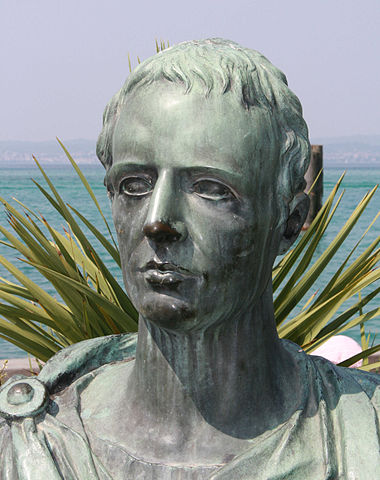
Catullus Statue

Catullus Statue

Biography

Gaius Valerius Catullus was born around 87 or 84 BCE into a leading equestrian family of Verona (the equestrian order was the lower of the two aristocratic classes of ancient Rome). The family villa was at Sirmio near Verona, and the poet also owned a villa near the fashionable resort of Tibur (modern-day Tivoli), so, despite Catullus’ occasional complaints about his poverty, he was clearly independently wealthy and a member of the Roman elite.

There is no ancient biography of Catullus, and his life has been pieced together from scattered references to him in other ancient authors and from his own poems. He spent most of his years as a young adult in Rome, where he numbered among his friends several prominent poets and other literary personalities. It is also quite possible that he was personally acquainted with some of the prominent politicians of the day, including Cicero, Caesar and Pompey (although Cicero apparently despised his poems for their supposed amorality).

It was probably in Rome that Catullus fell deeply in love with the "Lesbia" of his poems (usually identified with Clodia Metelli, a sophisticated woman from an aristocratic house), and he describes several stages of their relationship in his poems with striking depth and psychological insight. He also appears to have had a male lover called Juventius.

As adherents of Epicureanism, Catullus and his friends (who became known as the “Novi Poetae” or the “New Poets”) lived their lives largely withdrawn from politics, cultivating their interest in poetry and love. That said, he did spend a short time in 57 BCE in a political post in Bithynia, near the Black Sea, and also visited his brother's tomb at Troad, in modern-day Turkey. According to St. Jerome, Catullus died at the young age of thirty, which suggests a date of death of 57 or 54 BCE.

Writings
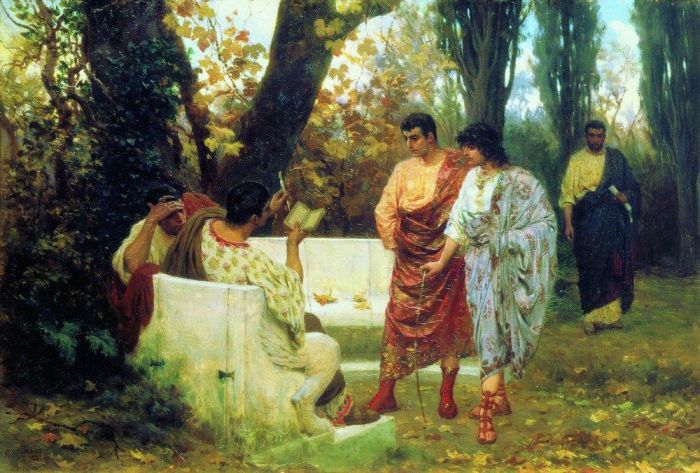
catullus writing a poem painting

Painting of Catullus writing a poem

Nearly lost forever in the Middle Ages, his work has survived thanks to a single manuscript, an anthology that may or may not have been arranged by Catullus himself. Catullus' poems have been preserved in an anthology of 116 “carmina” (verses), although three of these (numbers 18, 19 and 20) are now considered spurious. The poems are often divided into three formal parts: sixty short poems in varying metres (or “polymetra”), eight longer poems (seven hymns and one mini-epic) and forty-eight epigrams.

Catullus' poetry was influenced by the innovative poetry of the Hellenistic Age, especially that of Callimachus and the Alexandrian school, which propagated a new style of poetry, known as "neoteric", which deliberately turned away from the classical epic poetry in the tradition of Homer, focusing instead on small-scale personal themes using very careful and artistically composed language. Catullus was also an admirer of the lyric poetry of Sappho and sometimes used a metre called the Sapphic strophe which she had developed. However, he wrote in many different metres, including hendecasyllabic and elegiac couplets, which were commonly used in love poetry.

Almost all of his poetry shows strong (occasionally wild) emotions, especially in regard to Lesbia, who appears in 26 of his 116 surviving poems, although he could also demonstrate a sense of humour. Some of his poems are rude (sometimes downright obscene), often targeted at friends-turned-traitors, other lovers of Lesbia, rival poets and politicians.

He developed many literary techniques still in common use today, including hyperbaton (where words that naturally belong together are separated from each other for emphasis or effect), anaphora (emphasizing words by repeating them at the beginnings of neighbouring clauses), tricolon (a sentence with three clearly defined parts of equal length and of increasing power) and alliteration (the repeated occurrence of a consonant sound at the beginning of several words in the same phrase).

Major Works

  • “Passer, deliciae meae puellae” (Catullus 2)

  • “Vivamus, mea Lesbia, atque amemus” (Catullus 5)

  • “Miser Catulle, desinas ineptire” (Catullus 8)

  • "Odi et amo" (Catullus 85)

  • Complete Translations (Catullus 1-116)

By Ancient Literature

Rome:

  • • Catullus
  • • Vergil (Virgil)
  • • Horace
  • • Ovid
  • • Seneca the Younger
  • • Lucan
  • • Juvenal
  • • Pliny the Younger
Catullus 56 Translation

Catullus 56 Translation

Introduction In this poem, Catullus talks to his friend Cato about a strange sight. In lines one and two, Catullus speaks directly to Cato to tell him about something funny and absurd that will make him laugh. In line three, he repeats that Cato w...

January 1st, 2025 • Ancient Literature
Catullus 1 Translation

Catullus 1 Translation

Introduction Catullus was a short-lived but very influential Roman lyric poet. Carmen 1 is the introductory poem for 116 Carmina, the collective term for his poetry. This brief verse is a lovely opening for the subsequent Carmina. It asks, as many...

January 1st, 2025 • Ancient Literature
Catullus 109 Translation

Catullus 109 Translation

Introduction Catullus 109 is an honest love poem to an unnamed person. Most likely, that person is Lesbia, the woman that he address in a large percentage of his poems. In 109, the poet talks about how she promised that their love will be happy an...

January 1st, 2025 • Timeless Myths
Catullus 16 Translation

Catullus 16 Translation

Introduction It is not too often that you read a classical work that will rival George Carlin in the need for “bleeped” out words, but Carmen 16 definitely fills the bill. In the very first line, Catullus tells Aurelius and Furius that precisely w...

January 1st, 2025 • Ancient Literature
Catullus 35 Translation

Catullus 35 Translation

Introduction In this poem, Catullus references a poet named Caecilius. Catullus writes an invitation to Caecilius to come to Verona and leave his home in Novum Comum (which we now know as Como, Italy). In this invitation, Catullus wants Caecilius ...

January 1st, 2025 • Ancient Literature
Catullus 51 Translation

Catullus 51 Translation

Introduction This verse is based on a poem fragment from the Poetess, Sappho. It is, logically, written in Sapphic Meter, and is nearly identical to the verse fragment Sappho 31. Catullus has substituted his adored muse, Lesbia, for the central fe...

January 1st, 2025 • Ancient Literature
Catullus 10 Translation

Catullus 10 Translation

Introduction Catullus begins the poem by talking about his friend Varus who took him from the Forum. At this time, Catullus was relaxing, but Varus took him to see his mistress. Catullus noticed that the mistress was a “nice little whore” at first...

January 1st, 2025 • Ancient Literature
Catullus 49 Translation

Catullus 49 Translation

Introduction In this poem, Catullus writes about his advocate, Marcus Tullius. This man is a descendent of Romulus, the first king of Rome. Romulus is the twin brother of Remus, and they are both the descendents of Aeneas who survived the Trojan W...

January 1st, 2025 • Ancient Literature
Catullus 27 Translation

Catullus 27 Translation

Introduction In this poem, Catullus addresses a boy who serves in the area of Falernian, which is an Italian wine country. Catullus tells the boy to fill his cup as the law of Postumia demands. The reference to Postumia could be to an old family w...

January 1st, 2025 • Ancient Literature
Catullus 38 Translation

Catullus 38 Translation

Introduction In this poem, Catullus shares his emotional status with his friend Cornificius and asks for a word of comfort. Cornificius was a friend of Catullus and he was a poet who bought Pompey’s Roman house in an auction. In line one, Catullus...

January 1st, 2025 • Ancient Literature
Timeless Myths

Exploring mythology and legends from around the world.

Explore Myths

All Stories Characters All Articles Search Site Map

Mythologies

Norse Mythology Classical Mythology Celtic Mythology Arthurian Legends Mythology Gods Ancient Literature

About Us

Introduction About Jimmy Bibliography FAQs Retro Version

Resources

Timeless Myths All Stories All Articles Characters
© 1999-2026 Timeless Myths • Copyright • Privacy Policy • Cookie Policy • Contact
Follow us: