Timeless Myths Logo
Aphrodite Apollo Ares Artemis Athena Atlas Coeus Crius Cronus Demeter Dionysus Gaia Hades Hephaestus Hera Hermes Hestia Hyperion Iapetus Mnemosyne Oceanus Phobos Phoebe Poseidon Prometheus Rhea Tethys Themis Uranus Zeus
Bacchus Ceres Diana Juno Jupiter Mars Mercury Minerva Neptune Pluto Venus Vesta Vulcan
Amun Anubis Aten Atum Babi Bastet Bes Geb Hapi hathor heqet Horus Isis Khepri Khnum Khonsu Maat Nephthys Nut Osiris Ptah Ra Seshat Seth Shu Sobek Thoth
Alfheim Baldur Freya Freyr Frigg Heimdallr Helheim Idun Jotunheim Loki Nerthus Njord Odin Thor Tyr
Aengus Arawn Badb Brigid Cailleach Ceridwen Cernunnos Cu Chulainn Dagda Danu Gwydion Herne the Hunter Lugh Medb Morrigan Neit Nuada Taliesin Taranis
Chalchiuhtlicue Coatlicue Huitzilopochtli Mictlantecuhtli Mixcoatl Ometeotl Quetzalcoatl Tezcatlipoca Tlaloc Tonatiuh Xipe Totec Xochiquetzal Xolotl
Amaterasu Ame no Uzume Benzaiten Bishamonten Daikokuten Ebisu Fujin Fukurokuju Inari Izanagi Kagutsuchi Raijin Susanoo Tsukuyomi
Caishen Cangjie Dragon King Eight Immortals Erlang Shen Fuxi Guanyin Hou Yi Huxian Jade Emperor King Yama Leizi Lu-ban Mazu Nezha Nuwa Pangu Shennong Sun Wukong Xiwangmu Yue Lao Zhong Kui
Norse Classical Celtic Arthurian
Literature Stories Names
Aphrodite Apollo Ares Artemis Athena Atlas Coeus Crius Cronus Demeter Dionysus Gaia Hades Hephaestus Hera Hermes Hestia Hyperion Iapetus Mnemosyne Oceanus Phobos Phoebe Poseidon Prometheus Rhea Tethys Themis Uranus Zeus
Bacchus Ceres Diana Juno Jupiter Mars Mercury Minerva Neptune Pluto Venus Vesta Vulcan
Amun Anubis Aten Atum Babi Bastet Bes Geb Hapi hathor heqet Horus Isis Khepri Khnum Khonsu Maat Nephthys Nut Osiris Ptah Ra Seshat Seth Shu Sobek Thoth
Alfheim Baldur Freya Freyr Frigg Heimdallr Helheim Idun Jotunheim Loki Nerthus Njord Odin Thor Tyr
Aengus Arawn Badb Brigid Cailleach Ceridwen Cernunnos Cu Chulainn Dagda Danu Gwydion Herne the Hunter Lugh Medb Morrigan Neit Nuada Taliesin Taranis
Chalchiuhtlicue Coatlicue Huitzilopochtli Mictlantecuhtli Mixcoatl Ometeotl Quetzalcoatl Tezcatlipoca Tlaloc Tonatiuh Xipe Totec Xochiquetzal Xolotl
Amaterasu Ame no Uzume Benzaiten Bishamonten Daikokuten Ebisu Fujin Fukurokuju Inari Izanagi Kagutsuchi Raijin Susanoo Tsukuyomi
Caishen Cangjie Dragon King Eight Immortals Erlang Shen Fuxi Guanyin Hou Yi Huxian Jade Emperor King Yama Leizi Lu-ban Mazu Nezha Nuwa Pangu Shennong Sun Wukong Xiwangmu Yue Lao Zhong Kui
Norse Classical Celtic Arthurian
Literature Stories Names
  1. Classical Literature
    Greece Rome Other Ancient Civilizations Timeline of Classical Literature Alphabetical List of Authors Index of Individual Works Index of Important Characters Sources About Us
  2. Rome
    Catullus Vergil (Virgil) Horace Ovid Seneca the Younger Lucan Juvenal Pliny the Younger
  3. Vergil (Virgil)
    Bucolics (Eclogues) The Georgics The Aeneid

Vergil (Virgil)

(Epic and Didactic Poet, Roman, 70 – c. 19 BCE)

Introduction

Vergil (or Virgil) was one of ancient Rome's greatest poets. His influence on the world's literature has been immeasurable, and his works (along with those of Seneca, Cicero, Ovid, Aristotle and Plato) have been continuously read throughout the Middle Age and up to the present day. His epic "The Aeneid" is considered his magnum opus, as well as Rome's national epic, and has served as a model of literature ever since, but he also wrote much bucolic and didactic poetry.
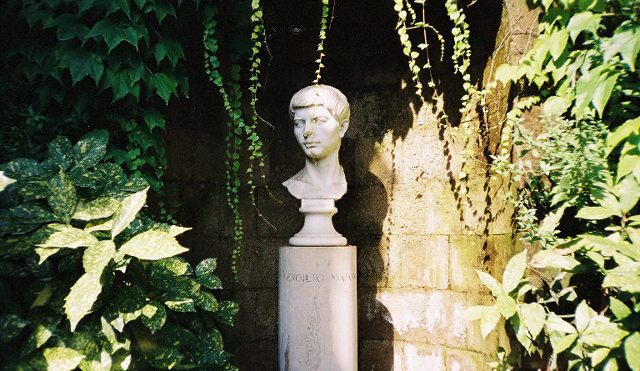
Marble bust statue of Vergil (Virgil), ancient Roman poet

Bust of Vergil

Biography – Who is Virgilio (Publius Vergilius Maro)

Publius Vergilius Maro (known in the English speaking world as Vergil or Virgil) was born in 70 BCE in the village of Andes, near Mantua, in what was then Cisalpine Gaul and is now northern Italy. From the sparse biographical details we have, it appears that his family was of modest means, but wealthy enough to send the young Vergil away for his education in Cremona and Mediolanum. He later moved to Rome to further his studies in rhetoric, medicine and astronomy, although he soon started to focus more on philosophy (particularly Epicureanism, which he studied under Siro the Epicurean) and to begin writing poetry.

After the assassination of Julius Caesar in 44 BCE and the defeat of Brutus and Cassius at the Battle of Philippi in 42 BCE by Mark Antony and Octavian, Vergil's family's estate near Mantua was expropriated (although he was later able to recover it, through the assistance of two influential friends, Asinius Pollio and Cornelius Gallus). Inspired by the promise of the youthful Octavian, he wrote his "The Bucolics" (also known as the "Eclogues"), published in 38 BCE and performed with great success on the Roman stage, and Vergil became an overnight celebrity, legendary in his own lifetime.
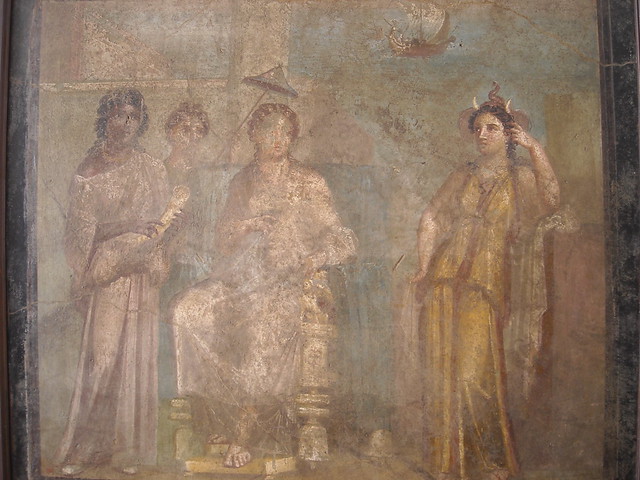
Historical illustration depicting a scene from Vergil's life and poetry

Scene from Vergil's poetry

He soon became part of the circle of Gaius Maecenas, Octavian's capable right hand man and an important patron of the arts, and through him gained many connections with other leading literary figures of the time, including Horace and Lucius Varius Rufus. He spent the ensuing years, from about 37 to 29 BCE, working on a longer didactic poem called "The Georgics", which he dedicated to Maecenas in 29 BCE.

When Octavian assumed the honorific title Augustus and established the Roman Empire in 27 BCE, he commissioned Vergil to write an epic poem to glorify Rome and the Roman people, and he worked on the twelve books of "The Aeneid" throughout the last ten years of his life. In 19 BCE, Vergil travelled to Greece and Asia Minor in order to see at first hand some of the settings of his epic. But he caught a fever (or possibly sunstroke) while in the town of Megara, and died in Brundisium, near Naples, at the age of 51, leaving "The Aeneid" unfinished.

Writings

Vergil's "Bucolics", also known as the "Eclogues", are a series of ten short pastoral poems on rural subjects, which he published in 38 BCE (bucolics as a genre had been pioneered by Theocritus in the 3rd Century BCE). The poems were supposedly inspired by the promise of the youthful Octavian, and they were performed with great success on the Roman stage. Their mix of visionary politics and eroticism made Vergil an overnight celebrity, legendary in his own lifetime.

"The Georgics", a longer didactic poem which he dedicated to his patron Maecenas in 29 BCE, contains 2,188 hexametric verses divided into four books. It is strongly influenced by the didactic poetry of Hesiod, and extolls the wonders of agriculture, portraying an idyllic farmer's life and the creation of a golden age through hard work and sweat. It is the original source of the popular expression "tempus fugit" ("time flies").
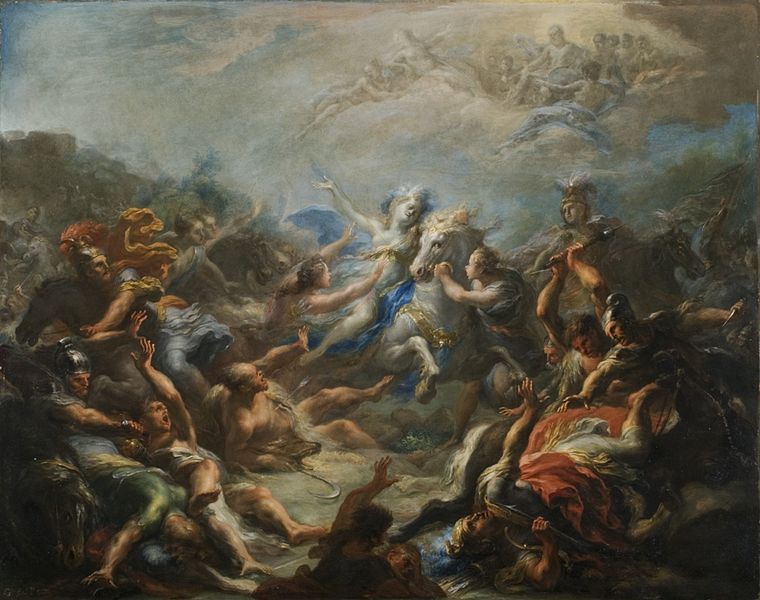
Painting of Camilla at War, a scene from Vergil's Aeneid

Camilla at War from Vergil's Aeneid

Vergil was commissioned by the Emperor Augustus to write an epic poem glorifying Rome and the Roman people. He saw the opportunity to fulfill his lifelong ambition to write a Roman epic to challenge Homer, and also to develop a Caesarist mythology, tracing the Julian line back to the Trojan hero Aeneas. He worked on the twelve books of "The Aeneid" during the last ten years of his life, modelling it on Homer's "Odyssey" and "Iliad". Legend has it that Vergil wrote only three lines of the poem each day, so intent was he on achieving perfection. Written throughout in dactylic hexameter, Vergil fashioned the disconnected tales of Aeneas' wanderings into a compelling founding myth or nationalist epic, which at once tied Rome to the legends and heroes of Troy, glorified traditional Roman virtues and legitimized the Julio-Claudian dynasty.

Despite, Vergil's own wish that the poem be burned, on the grounds that it was still unfinished, Augustus ordered that Vergil's literary executors, Lucius Varius Rufus and Plotius Tucca, publish it with as few editorial changes as possible. This leaves us with the tantalizing possibility that Vergil may well have wished to make radical changes and corrections to the version which has come down to us.

However, incomplete or not, "The Aeneid" was immediately recognized as a literary masterpiece and a testament to the grandeur of the Roman Empire. Already the object of great admiration and veneration before his death, in the following centuries Vergil's name became associated with almost miraculous powers, and his tomb near Naples became the destination of pilgrimages and veneration. It was even suggested by some Medieval Christians that some of his works metaphorically foretold the coming of Christ, hence making him a prophet of sorts.

Major Works

  • "Bucolics" ("Eclogues")

  • "The Georgics"

  • "The Aeneid"

By Timeless Myths

Rome:

  • • Catullus
  • • Vergil (Virgil)
  • • Horace
  • • Ovid
  • • Seneca the Younger
  • • Lucan
  • • Juvenal
  • • Pliny the Younger
Aeneid

Aeneid

The Aeneid was written by a Rome's greatest poet named Virgil or Vergil (full name was Publius Vergilius Maro) and lived in 70-19 BC. Although Virgil wrote a couple of other works, it was the Aeneid which brought him fame after his death, during t...

March 31st, 2004 • Jimmy Joe
The Aeneid

The Aeneid

(Epic Poem, Latin/Roman, 19 BCE, 9,996 lines)Introduction - Who wrote Aeneid "The Aeneid" (Lat: "Aeneis") is an epic poem by Vergil (Virgil), the pre-eminent poet of the Roman Empire. It was his final work and the twelve books of the poem occupied...

October 25th, 2024 • Timeless Myths
The Georgics

The Georgics

(Didactic Poem, Latin/Roman, 29 BCE, 2,188 lines)Introduction "The Georgics" (Gr: "Georgicon") is a didactic poem, in the tradition of Hesiod, by the Roman poet Vergil. It was Vergil's second major work, published in 29 BCE, after The Bucolics (Ec...

October 25th, 2024 • Timeless Myths
Ovid

Ovid

(Epic, Elegiac and Didactic Poet, Roman, 43 BCE – c. 17 CE)Introduction Ovid was a prolific Roman poet, straddling the Golden and Silver Ages of Latin literature, who wrote about love, seduction and mythological transformation. He is considered a ...

October 24th, 2024 • Timeless Myths
Bucolics (Eclogues)

Bucolics (Eclogues)

(Pastoral Poem, Latin/Roman, 37 BCE, 829 lines)Introduction "The Bucolics" (Lat: "Bucolica"), also known as "The Eclogues" (Lat: "Eclogae"), is a collection of ten pastoral poems by the Roman poet Vergil. It was Vergil's first major work, publishe...

October 25th, 2024 • Timeless Myths
Horace

Horace

(Lyric Poet and Satirist, Roman, 65 – 8 BCE)Introduction Horace was, along with Vergil, the leading Roman poet in the time of Emperor Augustus. He is considered by classicists to be one of the greatest and most original of Latin lyric poets, appre...

October 24th, 2024 • Timeless Myths
Pharsalia (De Bello Civili)

Pharsalia (De Bello Civili)

(Epic Poem, Latin/Roman, 65 CE, 8,060 lines)Introduction Pharsalia (also known as De Bello Civili or "On the Civil War") is an epic poem in ten books by the Roman poet Lucan, left unfinished on the poet's death in 65 CE. Although incomplete, it is...

October 25th, 2024 • Timeless Myths
Lucan

Lucan

(Epic Poet, Roman, 39 – 65 CE)Introduction Lucan was a Roman epic poet during the reign of Emperor Nero. Despite his short life, he is regarded as one of the outstanding figures of the Silver Age of Latin literature, and his youth and speed of com...

October 24th, 2024 • Timeless Myths
Hesiod

Hesiod

(Didactic Poet, Greek, c. 750 – c. 700 BCE)Introduction Hesiod is often paired with his near contemporary Homer as one of the earliest Greek poets whose work has survived. He is considered the creator of didactic poetry (instructive and moralizing...

January 1st, 2025 • Ancient Literature
Euripides

Euripides

(Tragic Playwright, Greek, c. 480 – c. 406 BCE)Introduction Euripides was the last of the three great tragedians of classical Greece (the other two being Aeschylus and Sophocles). Largely due to an accident of history, eighteen of Euripides' ninet...

October 24th, 2024 • Timeless Myths
Timeless Myths

Exploring mythology and legends from around the world.

Explore Myths

All Stories Characters All Articles Search Site Map

Mythologies

Norse Mythology Classical Mythology Celtic Mythology Arthurian Legends Mythology Gods Ancient Literature

About Us

Introduction About Jimmy Bibliography FAQs Retro Version

Resources

Timeless Myths All Stories All Articles Characters
© 1999-2026 Timeless Myths • Copyright • Privacy Policy • Cookie Policy • Contact
Follow us: