The Aeneid
(Epic Poem, Latin/Roman, 19 BCE, 9,996 lines)
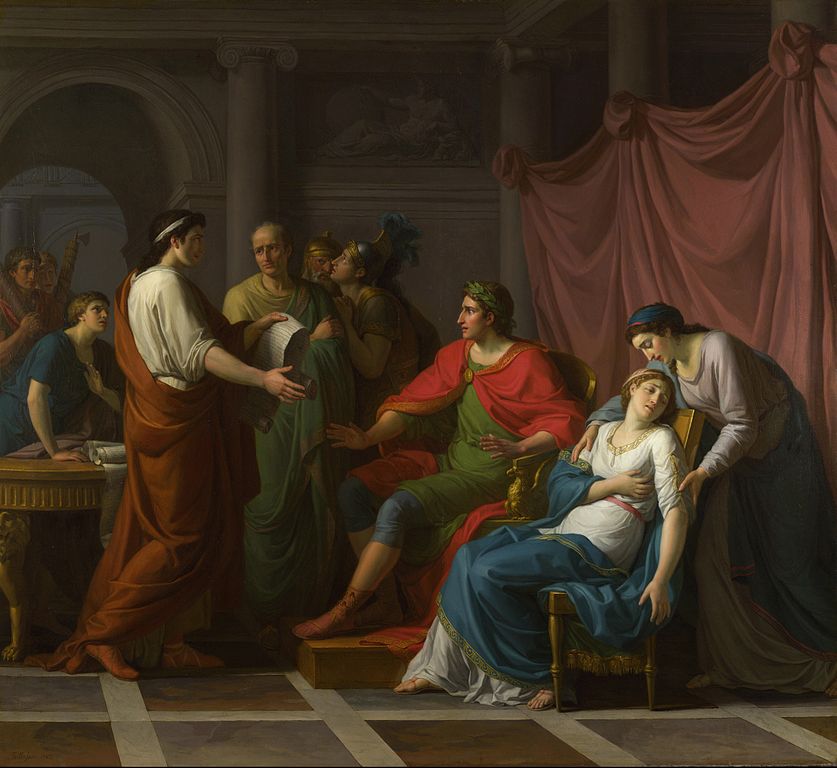
Artwork inspired by Virgil's Aeneid
Introduction - Who wrote Aeneid
"The Aeneid" (Lat: "Aeneis") is an epic poem by Vergil (Virgil), the pre-eminent poet of the Roman Empire. It was his final work and the twelve books of the poem occupied him for about ten years from 29 BCE until his death in 19 BCE.
It tells the legendary story of the Trojan hero Aeneas who, after years of wandering after the fall of Troy, traveled to Italy to battle the Latins, eventually becoming the ancestor of the Roman nation. It is Vergil's best-known work and was considered the masterpiece of Roman literature by the Romans of his day, and the fluidity of its rigorously structured poetry and its vivid portrayals of human emotion have earned it a legacy as one of the greatest poems in the Latin language.
Synopsis - Aeneid Summary
In keeping with the style of the epics of Homer, the poem begins with an invocation to the poet's Muse, and an explanation of the principal conflict of the early part of the plot, which stems from the resentment held by the goddess Juno against the Trojan people.
The action begins with the Trojan fleet, led by Aeneas, in the eastern Mediterranean, heading towards Italy on a voyage to find a second home, in accordance with the prophecy that Aeneas will give rise to a noble and courageous race in Italy, which is destined to become known throughout the world.
The goddess Juno, however, is still wrathful at being overlooked by the judgment of Paris in favour of Aeneas' mother, Venus, and also because her favourite city, Carthage, is destined to be destroyed by Aeneas' descendants, and because the Trojan prince Ganymede was chosen to be the cup-bearer to the gods, replacing Juno's own daughter, Hebe. For all these reasons, Juno bribes Aeolus, god of the winds, with the offer of Deiopea (the loveliest of all the sea nymphs) as a wife, and Aeolus releases the winds to stir up a huge storm, which devastates Aeneas' fleet.
Although himself no friend of the Trojans, Neptune is infuriated by Juno's intrusion into his domain, and stills the winds and calms the waters, allowing the fleet to take shelter on the coast of Africa, near Carthage, a city recently founded by Phoenician refugees from Tyre. Aeneas, after encouragement from his mother, Venus, soon gains the favour of Dido, Queen of Carthage.
At a banquet in honour of the Trojans, Aeneas recounts the events which led up to their arrival, beginning shortly after the events described in "The Iliad". He tells of how the crafty Ulysses (Odysseus) devised a plan for Greek warriors to gain entry into Troy by hiding in a large wooden horse. The Greeks then pretended to sail away, leaving Sinon to tell the Trojans that the horse was an offering and that if it were taken into the city, the Trojans would be able to conquer Greece. The Trojan priest, Laocoon, saw through the Greek plot and urged the horse's destruction, but he and both his sons were attacked and eaten by two giant sea snakes in an apparently divine intervention.
The Trojans brought the wooden horse inside the city walls, and after nightfall the armed Greeks emerged and began to slaughter the city's inhabitants. Aeneas valiantly tried to fight off the enemy, but he soon lost his comrades and was advised by his mother, Venus, to flee with his family. Although his wife, Creusa, was killed in the melee, Aeneas managed to escape with his son, Ascanius, and his father, Anchises. Rallying the other Trojan survivors, he built a fleet of ships, making landfall at various locations in the Mediterranean, notably Aenea in Thrace, Pergamea in Crete, and Buthrotum in Epirus. Twice they attempted to build a new city, only to be driven away by bad omens and plagues. They were cursed by the Harpies (mythical creatures that are part woman and part bird), but they also unexpectedly encountered friendly countrymen.
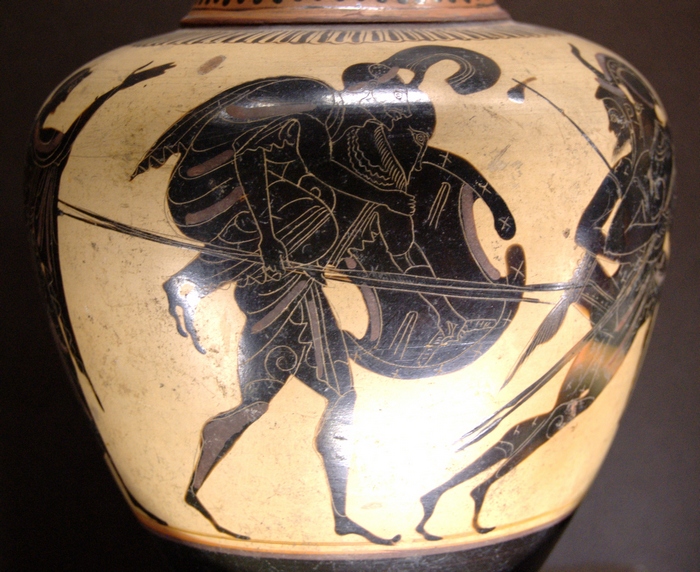
Ancient vase showing Aeneas during the fall of Troy
In Buthrotum, Aeneas met Hector's widow, Andromache, as well as Hector's brother, Helenus, who had the gift of prophecy. Helenus prophesied that Aeneas should seek out the land of Italy (also known as Ausonia or Hesperia), where his descendants would not only prosper, but in time would come to rule the entire known world. Helenus also advised him to visit the Sibyl in Cumae, and Aeneas and his fleet set off towards Italy, making first landfall in Italy at Castrum Minervae. However, on rounding Sicily and making for the mainland, Juno raised up a storm which drove the fleet back across the sea to Carthage in North Africa, thus bringing Aeneas' story up to date.
Through the machinations of Aeneas' mother Venus, and her son, Cupid, Queen Dido of Carthage falls madly in love with Aeneas, even though she had previously sworn fidelity to her late husband, Sychaeus (who had been murdered by her brother Pygmalion). Aeneas is inclined to return Dido's love, and they do become lovers for a time. But, when Jupiter sends Mercury to remind Aeneas of his duty and his destiny, he has no choice but to leave Carthage. Heart-broken, Dido commits suicide by stabbing herself on a funeral pyre with Aeneas' own sword, predicting in her death throes eternal strife between Aeneas' people and hers. Looking back from the deck of his ship, Aeneas sees the smoke of Dido's funeral pyre and knows its meaning only too clearly. However, destiny calls him, and the Trojan fleet sails on towards Italy.
They return to Sicily to hold funeral games in honour of Aeneas' father, Anchises, who had died before Juno's storm blew them off course. Some of the Trojan women, tired of the seemingly endless voyage, begin to burn the ships, but a downpour puts the fires out. Aeneas is sympathetic, though, and some of the travel-weary are allowed to stay behind in Sicily.
Eventually, the fleet lands on the mainland of Italy, and Aeneas, with the guidance of the Sibyl of Cumae, descends into the underworld to speak with the spirit of his father, Anchises. He is given a prophetic vision of the destiny of Rome, which helps him to better understand the importance of his mission. On returning to the land of the living, at the end of Book VI, Aeneas leads the Trojans to settle in the land of Latium, where he is welcomed and begins to court Lavinia, the daughter of King Latinus.
The second half of the poem begins with the break out of war between the Trojans and the Latins. Although Aeneas has tried to avoid war, Juno had stirred up trouble by convincing Queen Amata of the Latins that her daughter Lavinia should be married to a local suitor, Turnus, the king of the Rutuli, and not Aeneas, thus effectively ensuring war. Aeneas goes to seek military support among the neighbouring tribes who are also enemies of Turnus, and Pallas, son of King Evander of Arcadia, agrees to lead troops against the other Italians. However, while the Trojan leader is away, Turnus sees his opportunity to attack, and Aeneas returns to find his countrymen embroiled in battle. A midnight raid leads to the tragic deaths of Nisus and his companion Euryalus, in one of the most emotional passages in the book.
In the battle that follows, many heroes are killed, notably Pallas, who is killed by Turnus; Mezentius (Turnus' friend, who had inadvertently allowed his son to be killed while he himself fled), who is killed by Aeneas in single combat; and Camilla, a sort of Amazon character devoted to the goddess Diana, who fights bravely but is eventually killed, which leads to the man who killed her being struck dead by Diana's sentinel, Opis.
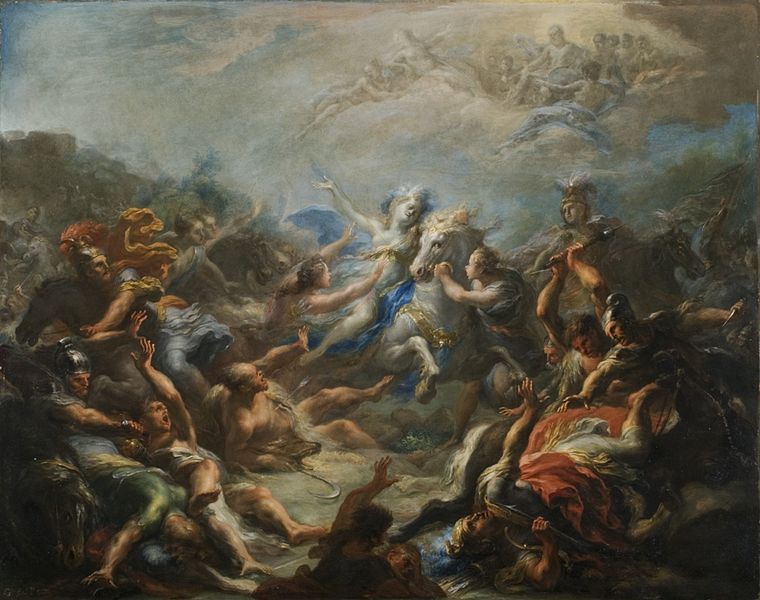
Camilla leading her warriors in battle in the Aeneid
A short-lived truce is called and a hand-to-hand duel is proposed between Aeneas and Turnus in order to spare any further unnecessary carnage. Aeneas would have easily won, but the truce is broken first and full-scale battle resumes. Aeneas is injured in the thigh during the fighting, but he returns to the battle shortly afterwards.
When Aeneas makes a daring attack on the city of Latium itself (causing Queen Amata to hang herself in despair), he forces Turnus into single combat once more. In a dramatic scene, Turnus' strength deserts him as he tries to hurl a rock, and he is struck by Aeneas' spear in the leg. Turnus begs on his knees for his life, and Aeneas is tempted to spare him until he sees that Turnus is wearing the belt of his friend Pallas as a trophy. The poem ends with Aeneas, now in a towering rage, killing Turnus.
Analysis - What is the Aeneid about
The pious hero Aeneas was already well known in Greco-Roman legend and myth, having been a major character in Homer's "The Iliad", in which Poseidon first prophesies that Aeneas will survive the Trojan War and assume leadership over the Trojan people. But Vergil took the disconnected tales of Aeneas'' wanderings and his vague mythical association with the foundation of Rome and fashioned them into a compelling foundation myth or nationalist epic. It is notable that Vergil chooses a Trojan, and not a Greek, to represent the heroic past of Rome, even though Troy lost the war to the Greeks, and this may reflect a Roman uncomfortableness with talking about the glories of Greece''s past, in case they might seem to eclipse the glories of Rome itself. Through his epic tale, then, Vergil at once manages to tie Rome to the heroic legends of Troy, to glorify traditional Roman virtues, and to legitimize the Julio-Claudian dynasty as descendants of the founders, heroes, and gods of Rome and Troy.
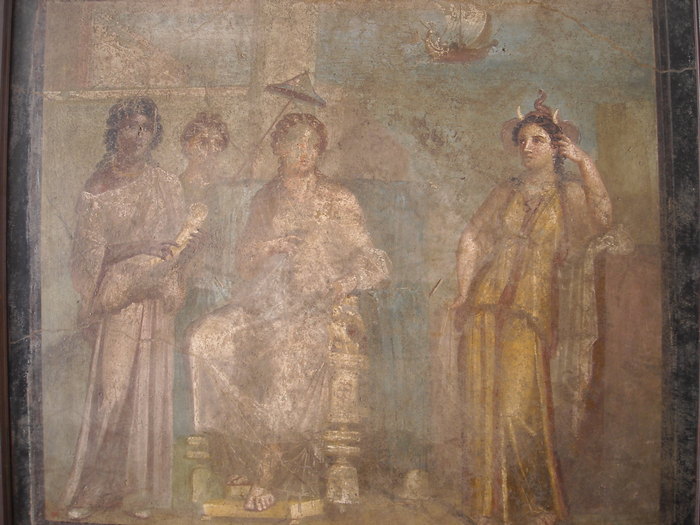
Classical painting illustrating scenes from the Aeneid
Vergil borrowed heavily from Homer, wishing to create an epic worthy of, and even to surpass, the Greek poet. Many contemporary scholars hold that Vergil's poetry pales in comparison to Homer's, and does not possess the same originality of expression. However, most scholars agree that Vergil distinguished himself within the epic tradition of antiquity by representing the broad spectrum of human emotion in his characters as they are subsumed in the historical tides of dislocation and war.
"The Aeneid" can be divided into two halves: Books 1 to 6 describe Aeneas' journey to Italy, and Books 7 to 12 cover the war in Italy. These two halves are commonly regarded as reflecting Vergil's ambition to rival Homer by treating both the wandering theme of "The Odyssey" and the warfare theme of "The Iliad".
It was written in a time of major political and social change in Rome, with the recent fall of the Republic and the Final War of the Roman Republic (in which Octavian decisively defeated the forces of Mark Anthony and Cleopatra) having torn through society, and the faith of many Romans in the greatness of Rome was seen to be severely faltering. The new emperor, Augustus Caesar, however, began to institute a new era of prosperity and peace, specifically through the re-introduction of traditional Roman moral values, and "The Aeneid" can be seen as purposely reflecting this aim. Vergil finally felt some hope for the future of his country, and it was the deep gratitude and admiration he felt for Augustus that inspired him to write his great epic poem.
In addition, it attempts to legitimize the rule of Julius Caesar (and by extension, the rule of his adopted son, Augustus, and his heirs) by renaming Aeneas' son, Ascanius (originally known as Ilus, after Ilium, another name for Troy), as Iulus, and putting him forward as an ancestor of the family of Julius Caesar and his imperial descendants. In the epic, Vergil repeatedly foreshadows the coming of Augustus, perhaps in an attempt to silence critics who claimed that he achieved power through violence and treachery, and there are many parallels between Aeneas' actions and Augustus'. In some respects, Vergil worked backward, connecting the political and social situation of his own day with the inherited tradition of the Greek gods and heroes, in order to show the former as historically derived from the latter.
Like other classical epics, "The Aeneid" is written in dactylic hexameter, with each line having six feet made up of dactyls (one long syllable and two shorts) and spondees (two long syllables). It also incorporates to great effect all the usual poetic devices, such as alliteration, onomatopoeia, synecdoche, and assonance.
Although the writing of "The Aeneid" is generally highly polished and complex in nature (legend has it that Vergil wrote only three lines of the poem each day), there are a number of half-complete lines. That, and its rather abrupt ending, is generally seen as evidence that Vergil died before he could finish the work.

Virgil reading the Aeneid to Augustus and Octavia
Another legend suggests that Vergil, fearing that he would die before he had properly revised the poem, gave instructions to friends (including the Emperor Augustus) that "The Aeneid" should be burned on his death, partly due to its unfinished state and partly because he had apparently come to dislike one of the sequences in Book VIII, in which Venus and Vulcan have sexual intercourse, which he saw as non-conformity to Roman moral virtues. He supposedly planned to spend up to three years editing it, but fell ill while returning from a trip to Greece and, just before his death in September 19 BCE, he ordered that the manuscript of "The Aeneid" be burned as he still considered it unfinished. In the event of his death, though, Augustus himself ordered that these wishes be disregarded, and the poem was published after only very minor modifications.
The main overall theme of "The Aeneid" is that of opposition. The main opposition is that of Aeneas (as guided by Jupiter), representing the ancient virtue of "pietas" (considered the key quality of any honorable Roman, incorporating reasoned judgment, piety, and duty towards the gods, the homeland, and the family), as against Dido and Turnus (who are guided by Juno), representing unbridled "furor" (mindless passion and fury). However, there are several other oppositions within "The Aeneid", including: fate versus action; male versus female; Rome versus Carthage; "Aeneas as Odysseus" (Odysseus in Books 1 to 6) versus "Aeneas as Achilles" (Achilles in Books 7 to 12); calm weather versus storms; etc.
The poem emphasizes the idea of a homeland as one's source of identity, and the Trojans' long wanderings at sea serve as a metaphor for the kind of wandering that is characteristic of life in general. A further theme explores the bonds of family, particularly the strong relationship between fathers and sons: the bonds between Aeneas and Ascanius, Aeneas and Anchises, Evander and Pallas, and between Mezentius and Lausus are all worthy of note. This theme also reflects Augustan moral reforms and was perhaps intended to set an example for Roman youth.
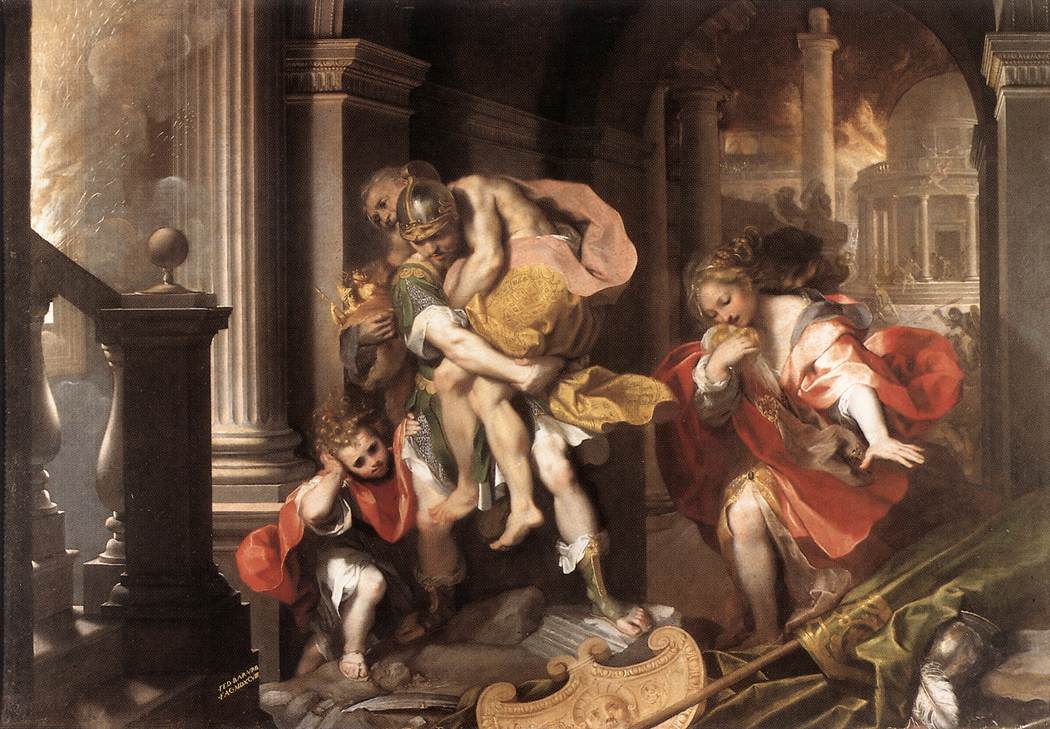
Aeneas carrying Anchises and leading Ascanius out of burning Troy
In the same way, the poem advocates the acceptance of the workings of the gods as fate, particularly stressing that the gods work their ways through humans. The direction and destination of Aeneas' course are preordained, and his various sufferings and glories over the course of the poem merely postpone this unchangeable destiny. Vergil is trying to impress on his Roman audience that, just as the gods used Aeneas to found Rome, they are now using Augustus to lead it, and it is the duty of all good citizens to accept this situation.
Aeneas's character throughout the poem is defined by his piety (he is repeatedly referred to as "pious Aeneas") and the subordination of personal desire to duty, perhaps best exemplified by his abandonment of Dido in the pursuit of his destiny. His behaviour is particularly contrasted with Juno's and Turnus' in this regard, as those characters fight fate every step of the way (but ultimately lose out).
The figure of Dido in the poem is a tragic one. Once the dignified, confident, and competent ruler of Carthage, resolute in her determination to preserve the memory of her dead husband, Cupid's arrow causes her to risk everything by falling for Aeneas, and she finds herself unable to reassume her dignified position when this love fails. As a result, she loses the support of the citizens of Carthage and alienates the local African chieftains who had previously been suitors (and now pose a military threat). She is a figure of passion and volatility, starkly contrasted with the order and control represented by Aeneas (traits that Vergil associated with Rome itself in his own day), and her irrational obsession drives her to a frenzied suicide, which has struck a chord with many subsequent writers, artists, and musicians.
Turnus, another of Juno's proteges who must eventually perish in order for Aeneas to fulfill his destiny, is a counterpart to Dido in the second half of the poem. Like Dido, he represents the forces of irrationality in contrast to Aeneas' pious sense of order and, whereas Dido is undone by her romantic desire, Turnus is doomed by his unrelenting rage and pride. Turnus refuses to accept the destiny Jupiter has decreed for him, stubbornly interpreting all the signs and omens to his own advantage rather than seeking their true meaning. Despite his desperate desire to be a hero, Turnus' character changes in the last few battle scenes, and we see him gradually lose confidence as he comes to understand and accept his tragic fate.
Some have found so-called "hidden messages" or allegories within the poem, although these are largely speculative and highly contested by scholars. One example of these is the passage in Book VI where Aeneas exits the underworld through the "gate of false dreams", which some have interpreted as implying that all of Aeneas' subsequent actions are somehow "false" and, by extension, that the history of the world since the foundation of Rome is but a lie. Another example is the rage and fury Aeneas exhibits when he kills Turnus at the end of Book XII, which some see as his final abandonment of "pietas" in favour of "furor". Some claim that Vergil meant to change these passages before he died, while others believe that their strategic locations (at the very end of each half of the overall poem) are evidence that Vergil placed them there quite purposefully.
"The Aeneid" has long been considered a fundamental member of the Western canon of literature, and it has been highly influential on subsequent works, attracting both imitations as well as parodies and travesties. There have been numerous translations over the years into English and many other languages, including an important English translation by the 17th Century poet John Dryden, as well as 20th Century versions by Ezra Pound, C. Day Lewis, Allen Mandelbaum, Robert Fitzgerald, Stanley Lombardo, and Robert Fagles.
Resources
English translation by John Dryden (Internet Classics Archive): http://classics.mit.edu/Virgil/aeneid.html
Latin version with word-by-word translation (Perseus Project): http://www.perseus.tufts.edu/hopper/text.jsp?doc=Perseus:text:1999.02.0055
Comprehensive online resource list for "The Aeneid" (OnlineClasses.net): http://www.onlineclasses.net/aeneid