Timeless Myths Logo

Explore myths and legends from cultures around the world

Featured

Classical Mythology
Classical Mythology Greek and Roman myths, gods, heroes, and epic tales
Norse Mythology
Norse Mythology Vikings, Asgard, Ragnarok, and the nine realms
Celtic Mythology
Celtic Mythology Irish, Welsh, and Gaelic legends and folklore
Ancient Literature
Ancient Literature Classical texts, translations, and literary analysis

All Mythologies

Arthurian Legends King Arthur, Camelot, the Round Table, and the Holy Grail Egyptian Mythology Pharaohs, pyramids, and ancient Nile deities Japanese Mythology Shinto gods, spirits, and legendary creatures Chinese Mythology Dragons, immortals, and celestial beings Aztec Mythology Mesoamerican gods, rituals, and creation myths

Discover gods and goddesses from every pantheon

Featured

Greek Gods
Greek Gods The Olympians, Titans, and primordial deities
Norse Gods
Norse Gods Odin, Thor, Loki, and the Aesir and Vanir
Egyptian Gods
Egyptian Gods Ra, Osiris, Isis, Anubis, and more
Japanese Gods
Japanese Gods Amaterasu, Susanoo, and Shinto kami

All Gods & Deities

Roman Gods Jupiter, Mars, Venus, and the Roman pantheon Celtic Gods The Tuatha Dé Danann and Celtic deities Aztec Gods Quetzalcoatl, Tezcatlipoca, and Aztec deities Chinese Gods Jade Emperor, Dragon Kings, and celestial beings View All 150+ Deities Browse the complete collection of mythological deities
View all gods & deities

Tales, legends, and character profiles from mythology

Featured

All Stories
All Stories Browse 800+ mythology and history stories
Characters
Characters Profiles of 67 mythological heroes, gods, and villains

All Stories

Mythology Stories Ancient myths and legends retold History Stories Historical tales from ancient civilizations Religion & Culture Religious traditions and cultural beliefs
View all stories

Tools, references, and site information

Featured

Name Generators
Name Generators Generate fantasy and mythology-inspired names
All Articles
All Articles Browse 1,800+ articles on mythology and history

All Resources

About Timeless Myths Learn about this mythology resource Bibliography Sources and references used on this site FAQ Frequently asked questions Contact Get in touch with us
Search
Classical Mythology Greek and Roman myths, gods, heroes, and epic tales Norse Mythology Vikings, Asgard, Ragnarok, and the nine realms Celtic Mythology Irish, Welsh, and Gaelic legends and folklore Arthurian Legends King Arthur, Camelot, the Round Table, and the Holy Grail Egyptian Mythology Pharaohs, pyramids, and ancient Nile deities Japanese Mythology Shinto gods, spirits, and legendary creatures Chinese Mythology Dragons, immortals, and celestial beings Aztec Mythology Mesoamerican gods, rituals, and creation myths Ancient Literature Classical texts, translations, and literary analysis
Greek Gods The Olympians, Titans, and primordial deities Roman Gods Jupiter, Mars, Venus, and the Roman pantheon Norse Gods Odin, Thor, Loki, and the Aesir and Vanir Egyptian Gods Ra, Osiris, Isis, Anubis, and more Celtic Gods The Tuatha Dé Danann and Celtic deities Aztec Gods Quetzalcoatl, Tezcatlipoca, and Aztec deities Japanese Gods Amaterasu, Susanoo, and Shinto kami Chinese Gods Jade Emperor, Dragon Kings, and celestial beings View All 150+ Deities Browse the complete collection of mythological deities View all gods & deities
All Stories Browse 800+ mythology and history stories Characters Profiles of 67 mythological heroes, gods, and villains Mythology Stories Ancient myths and legends retold History Stories Historical tales from ancient civilizations Religion & Culture Religious traditions and cultural beliefs View all stories
Name Generators Generate fantasy and mythology-inspired names All Articles Browse 1,800+ articles on mythology and history About Timeless Myths Learn about this mythology resource Bibliography Sources and references used on this site FAQ Frequently asked questions Contact Get in touch with us
Search Search the entire mythology archive
  1. Classical Literature
    Greece Rome Other Ancient Civilizations Timeline of Classical Literature Alphabetical List of Authors Index of Individual Works Index of Important Characters Sources About Us
  2. Rome
    Catullus Vergil (Virgil) Horace Ovid Seneca the Younger Lucan Juvenal Pliny the Younger
  3. Vergil (Virgil)
    Bucolics (Eclogues) The Georgics The Aeneid
  4. Bucolics (Eclogues)

Bucolics (Eclogues)

(Pastoral Poem, Latin/Roman, 37 BCE, 829 lines)

Introduction
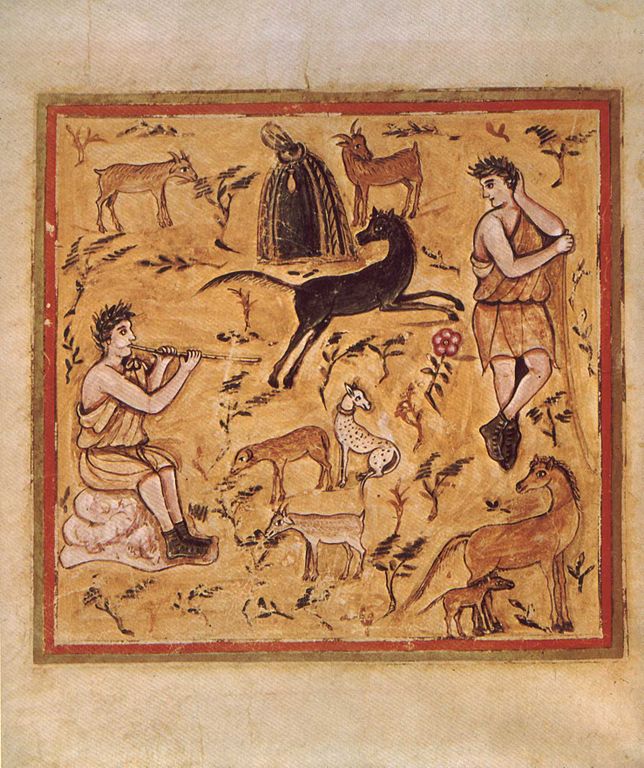
Illustration of Vergil's Eclogues showing pastoral scene

Illustration of Vergil's Eclogues

"The Bucolics" (Lat: "Bucolica"), also known as "The Eclogues" (Lat: "Eclogae"), is a collection of ten pastoral poems by the Roman poet Vergil. It was Vergil's first major work, published in 37 BCE. The haunting and enigmatic verses on rustic subjects provided the inspiration for the whole European tradition of pastoral poetry, but their political element and their commentary on the recent turbulent period of Roman history also made them very popular in their own time.

Synopsis

Eclogue 1: Meliboeus-Tityrus (83 lines).

Eclogue 2: Alexis (73 lines).

Eclogue 3: Menalcas-Damoetas-Palaemon (111 lines).

Eclogue 4: Pollio (63 lines).

Eclogue 5: Menalcas-Mopsus (90 lines).

Eclogue 6: Silenus (86 lines).

Eclogue 7: Meliboeus-Corydon-Thyrsis (70 lines).

Eclogue 8: Damon-Alphesiboeus (109 lines).

Eclogue 9: Lycidas-Moeris (67 lines).

Eclogue 10: Gallus (77 lines).

Analysis

"The Bucolics" were nominally written in imitation of the "Bucolica" by the Greek poet Theocritus, written almost two hundred years earlier, the title of which can be translated as "On the Care of Cattle", so named for the poetry's rustic subjects. The ten pieces which make up Vergil's book, however, are each called "eclogues" (an eclogue is literally a "draft" or "selection" or "reckoning"), rather than the "idylls" of Theocritus, and Vergil's "Bucolics" introduce much more political clamour than Theocritus' simple country vignettes. They add a strong element of Italian realism to the original Greek model, with real or disguised places and people and contemporary events blended with an idealized Arcadia.
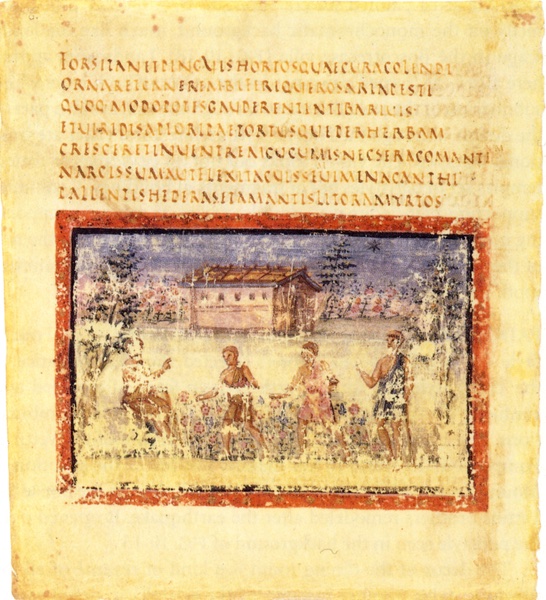
Page from an illustrated edition of Vergil's Eclogues

Page from an illustrated edition of Vergil's Eclogues

Although the poems are populated by and large with herdsmen and their imagined conversations and songs in a largely rural settings, "The Bucolics" also represent a dramatic and mythic interpretation of some of the revolutionary changes that had occurred at Rome during the time of the Second Triumvirate of Lepidus, Anthony and Octavian, the turbulent period between roughly 44 and 38 BCE, during which Vergil wrote the poems. The rural characters are shown suffering or embracing revolutionary change, or experiencing happy or unhappy love. Interestingly, they are the only poems in Vergil's work which refer to slaves as leading characters.

The poems are written in strict dactylic hexameter verse, most of them in the form of conversations between characters with names such as "Tityrus" (supposedly representing Vergil himself), "Meliboeus", "Menalcas" and "Mopsus". They were apparently performed with great success on the Roman stage, and their mix of visionary politics and eroticism made Vergil an immediate celebrity, legendary in his own lifetime.

The fourth eclogue, sub-titled "Pollio", is perhaps the best known of all. It was written in honour of Octavius (soon to become the Emperor Augustus), and it created and augmented a new political mythology, reaching out to imagine a golden age ushered in by the birth of a boy heralded as a "great increase of Jove", which some later readers (including the Roman Emperor Constantine I) treated as a kind of Messianic prophecy, similar to the prophetic themes of Isaiah or the Sybilline Oracles. It was largely this eclogue that garnered for Vergil the reputation of a saint (or even a sorcerer) in the Middle Ages, and it was one reason why Dante chose Vergil as his guide through the underworld of his "Divine Comedy".

Resources

  • English translation (Internet Classics Archive): http://classics.mit.edu/Virgil/eclogue.html

  • Latin version with word-by-word translation (Perseus Project): http://www.perseus.tufts.edu/hopper/text.jsp?doc=Perseus:text:1999.02.0056

  • Latin plain text version (Vergil.org): http://virgil.org/texts/virgil/eclogues.txt

By Timeless Myths

Vergil (Virgil):

  • • Bucolics (Eclogues)
  • • The Georgics
  • • The Aeneid
The Georgics

The Georgics

(Didactic Poem, Latin/Roman, 29 BCE, 2,188 lines)Introduction "The Georgics" (Gr: "Georgicon") is a didactic poem, in the tradition of Hesiod, by the Roman poet Vergil. It was Vergil's second major work, published in 29 BCE, after The Bucolics (Ec...

October 25th, 2024 • Timeless Myths
Pharsalia (De Bello Civili)

Pharsalia (De Bello Civili)

(Epic Poem, Latin/Roman, 65 CE, 8,060 lines)Introduction Pharsalia (also known as De Bello Civili or "On the Civil War") is an epic poem in ten books by the Roman poet Lucan, left unfinished on the poet's death in 65 CE. Although incomplete, it is...

October 25th, 2024 • Timeless Myths
Nunc est bibendum (Odes, Book 1, Poem 37)

Nunc est bibendum (Odes, Book 1, Poem 37)

(Lyric Poem, Latin/Roman, c. 30 BCE, 32 lines)Introduction "Nunc est bibendum" ("Now is the time for drinking"), sometimes known as the "Cleopatra Ode", is one of the most famous of the odes of the Roman lyric poet Horace, published in 23 BCE as P...

October 25th, 2024 • Timeless Myths
Works and Days

Works and Days

(Didactic Poem, Greek, c. 700 BCE, 828 lines)Introduction "Works and Days" (Gr:"Erga kaí Hemérai"; Lat: “Opera et Dies”) is a didactic poem written by the very early ancient Greek poet Hesiod. It was probably written around 700 BCE or earlier and ...

January 1st, 2025 • Ancient Literature
Vergil (Virgil)

Vergil (Virgil)

(Epic and Didactic Poet, Roman, 70 – c. 19 BCE)Introduction Vergil (or Virgil) was one of ancient Rome's greatest poets. His influence on the world's literature has been immeasurable, and his works (along with those of Seneca, Cicero, Ovid, Aristo...

October 24th, 2024 • Timeless Myths
Tu ne quaesieris (Odes, Book 1, Poem 11)

Tu ne quaesieris (Odes, Book 1, Poem 11)

(Lyric Poem, Latin/Roman, c. 23 BCE, 8 lines)Introduction "Tu ne quaesieris" ("Do not ask") is the most famous of the odes of the Roman lyric poet Horace, published in 23 BCE as Poem 11 in the first book of Horace's collected "Odes" or "Carmina". ...

October 25th, 2024 • Timeless Myths
Catullus Translations

Catullus Translations

This page provides access to English translations of all 116 poems (carmina) by the Roman lyric poet Catullus. The poems are traditionally divided into three sections: the polymetra (poems 1-60), longer poems (61-68), and the epigrams (69-116). No...

October 25th, 2024 • Timeless Myths
Horace

Horace

(Lyric Poet and Satirist, Roman, 65 – 8 BCE)Introduction Horace was, along with Vergil, the leading Roman poet in the time of Emperor Augustus. He is considered by classicists to be one of the greatest and most original of Latin lyric poets, appre...

October 24th, 2024 • Timeless Myths
Ars Poetica

Ars Poetica

(Didactic Poem, Latin/Roman, c. 18 BCE, 476 lines)Introduction "Ars Poetica" ("The Art of Poetry" or "On the Nature of Poetry"), sometimes known under its original title, "Epistula Ad Pisones" ("Letters to the Pisos"), is a treatise or literary es...

October 25th, 2024 • Timeless Myths
Euripides

Euripides

(Tragic Playwright, Greek, c. 480 – c. 406 BCE)Introduction Euripides was the last of the three great tragedians of classical Greece (the other two being Aeschylus and Sophocles). Largely due to an accident of history, eighteen of Euripides' ninet...

October 24th, 2024 • Timeless Myths
Timeless Myths

Exploring mythology and legends from around the world.

Explore Myths

All Stories Characters All Articles Search Site Map

Mythologies

Norse Mythology Classical Mythology Celtic Mythology Arthurian Legends Mythology Gods Ancient Literature

About Us

Introduction About Jimmy Bibliography FAQs Retro Version

Resources

Timeless Myths All Stories All Articles Characters
© 1999-2026 Timeless Myths • Copyright • Privacy Policy • Cookie Policy • Contact
Follow us: