Timeless Myths Logo
Aphrodite Apollo Ares Artemis Athena Atlas Coeus Crius Cronus Demeter Dionysus Gaia Hades Hephaestus Hera Hermes Hestia Hyperion Iapetus Mnemosyne Oceanus Phobos Phoebe Poseidon Prometheus Rhea Tethys Themis Uranus Zeus
Bacchus Ceres Diana Juno Jupiter Mars Mercury Minerva Neptune Pluto Venus Vesta Vulcan
Amun Anubis Aten Atum Babi Bastet Bes Geb Hapi hathor heqet Horus Isis Khepri Khnum Khonsu Maat Nephthys Nut Osiris Ptah Ra Seshat Seth Shu Sobek Thoth
Alfheim Baldur Freya Freyr Frigg Heimdallr Helheim Idun Jotunheim Loki Nerthus Njord Odin Thor Tyr
Aengus Arawn Badb Brigid Cailleach Ceridwen Cernunnos Cu Chulainn Dagda Danu Gwydion Herne the Hunter Lugh Medb Morrigan Neit Nuada Taliesin Taranis
Chalchiuhtlicue Coatlicue Huitzilopochtli Mictlantecuhtli Mixcoatl Ometeotl Quetzalcoatl Tezcatlipoca Tlaloc Tonatiuh Xipe Totec Xochiquetzal Xolotl
Amaterasu Ame no Uzume Benzaiten Bishamonten Daikokuten Ebisu Fujin Fukurokuju Inari Izanagi Kagutsuchi Raijin Susanoo Tsukuyomi
Caishen Cangjie Dragon King Eight Immortals Erlang Shen Fuxi Guanyin Hou Yi Huxian Jade Emperor King Yama Leizi Lu-ban Mazu Nezha Nuwa Pangu Shennong Sun Wukong Xiwangmu Yue Lao Zhong Kui
Norse Classical Celtic Arthurian
Literature Stories Names
Aphrodite Apollo Ares Artemis Athena Atlas Coeus Crius Cronus Demeter Dionysus Gaia Hades Hephaestus Hera Hermes Hestia Hyperion Iapetus Mnemosyne Oceanus Phobos Phoebe Poseidon Prometheus Rhea Tethys Themis Uranus Zeus
Bacchus Ceres Diana Juno Jupiter Mars Mercury Minerva Neptune Pluto Venus Vesta Vulcan
Amun Anubis Aten Atum Babi Bastet Bes Geb Hapi hathor heqet Horus Isis Khepri Khnum Khonsu Maat Nephthys Nut Osiris Ptah Ra Seshat Seth Shu Sobek Thoth
Alfheim Baldur Freya Freyr Frigg Heimdallr Helheim Idun Jotunheim Loki Nerthus Njord Odin Thor Tyr
Aengus Arawn Badb Brigid Cailleach Ceridwen Cernunnos Cu Chulainn Dagda Danu Gwydion Herne the Hunter Lugh Medb Morrigan Neit Nuada Taliesin Taranis
Chalchiuhtlicue Coatlicue Huitzilopochtli Mictlantecuhtli Mixcoatl Ometeotl Quetzalcoatl Tezcatlipoca Tlaloc Tonatiuh Xipe Totec Xochiquetzal Xolotl
Amaterasu Ame no Uzume Benzaiten Bishamonten Daikokuten Ebisu Fujin Fukurokuju Inari Izanagi Kagutsuchi Raijin Susanoo Tsukuyomi
Caishen Cangjie Dragon King Eight Immortals Erlang Shen Fuxi Guanyin Hou Yi Huxian Jade Emperor King Yama Leizi Lu-ban Mazu Nezha Nuwa Pangu Shennong Sun Wukong Xiwangmu Yue Lao Zhong Kui
Norse Classical Celtic Arthurian
Literature Stories Names
  1. Classical Literature
    Greece Rome Other Ancient Civilizations Timeline of Classical Literature Alphabetical List of Authors Index of Individual Works Index of Important Characters Sources About Us
  2. Greece
    Homer Hesiod Aesop Sappho Pindar Aeschylus Sophocles Euripides Aristophanes Menander Apollonius of Rhodes
  3. Homer
    The Iliad The Odyssey

Homer

(Epic Poet, Greek, c. 750 - c. 700 BCE)

Introduction

Homer is traditionally held to be the author of the ancient Greek epic poems "The Iliad" and "The Odyssey", widely thought to be the first extant works of Western literature. He is considered by many to be the earliest and most important of all the Greek writers, and the progenitor of the whole Western literary tradition.

He was a poetic pioneer who stood at a pivotal point in the evolution of Greek society from pre-literate to literate, from a centuries old bardic tradition of oral verse to the then new technique of alphabetic writing.
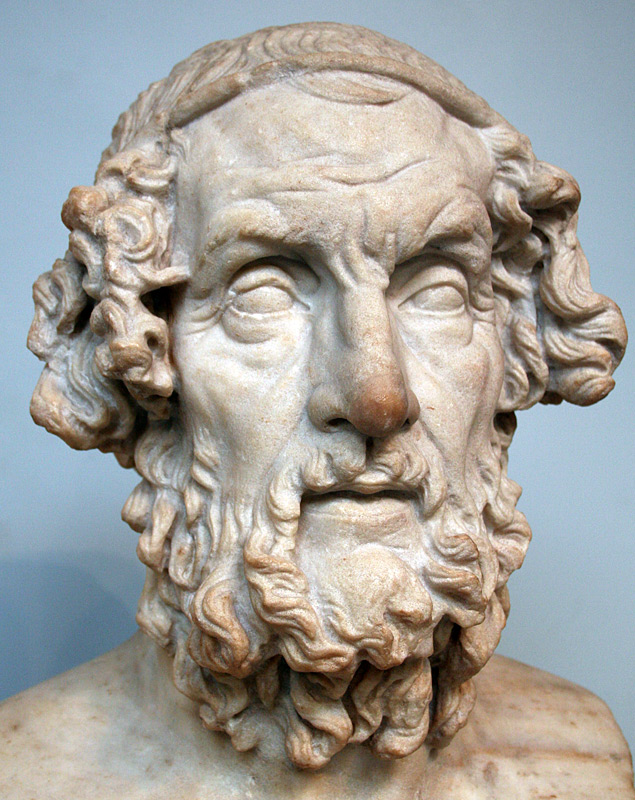
homer busts

Homer Bust from the British Museum

Biography - Who is Homer

Nothing definite is known of Homer the historical man, and indeed we do not know for sure that such a man ever existed. However, of the many conflicting traditions and legends that have grown up around him, the most common and most convincing version suggests that Homer was born at Smyrna in the Ionian region of Asia Minor (or possibly on the island of Chios), and that he died on the Cycladic island of Ios.

Establishing an accurate date for Homer's life also presents significant difficulties as no documentary record of the man's life is known to have existed. Indirect reports from Herodotus and others generally date him approximately between 750 and 700 BCE.

The characterization of Homer as a blind bard by some historians is partly due to translations of the Greek "homêros", meaning "hostage" or "he who is forced to follow", or, in some dialects, "blind". Some ancient accounts depict Homer as a wandering minstrel, and a common portayal is of a blind, begging singer who travelled around the harbour towns of Greece, associating with shoemakers, fisherman, potters, sailors and elderly men in the town gathering places.

Writings - Homer's works

Exactly what Homer was responsible for writing is likewise largely unsubstantiated. The Greeks of the 6th and early 5th Centuries BCE tended to use the label "Homer" for the whole body of early heroic hexameter verse. This included "The Iliad" and "The Odyssey", but also the whole "Epic Cycle" of poems relating the story of the Trojan War (also known as the "Trojan Cycle"), as well as the Theban poems about Oedipus and other works, such as the "Homeric Hymns" and the comic mini-epic "Batrachomyomachia" ("The Frog-Mouse War").

By around 350 BCE, the consensus had arisen that Homer was responsible for just the two outstanding epics, "The Iliad" and "The Odyssey". Stylistically they are similiar, and one view holds that "The Iliad" was composed by Homer in his maturity, while "The Odyssey" was a work of his old age. Other parts of the "Epic Cycle" (e.g. "Kypria", "Aithiopus", "Little Iliad", "The Sack of Ilion", "The Returns" and "Telegony") are now considered to be almost certainly not by Homer. The "Homeric Hymns" and "Epigrams of Homer", despite the names, were likewise almost certainly written significantly later, and therefore not by Homer himself.
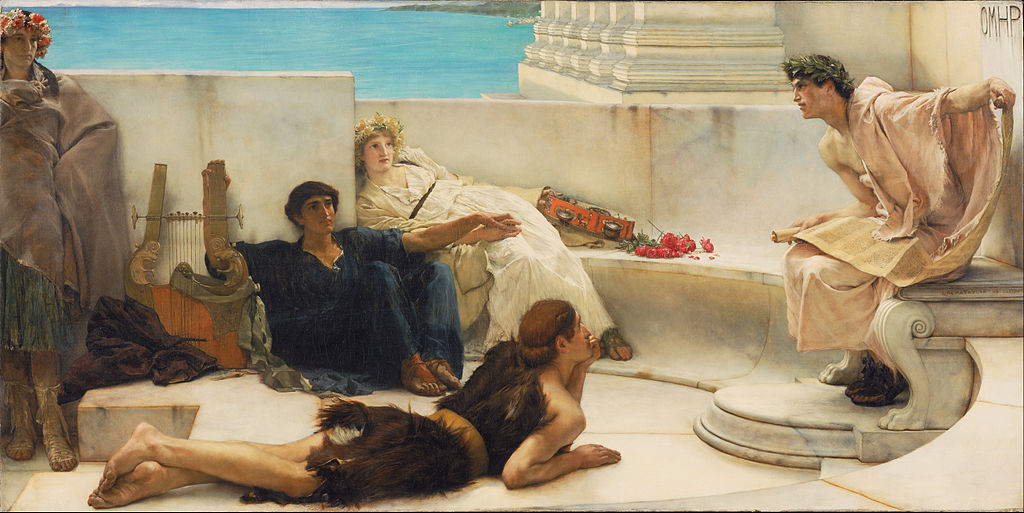
Alma Tadema Reading Homer

Alma Tadema Reading Homer - Sir Lawrence

Some maintain that the Homeric poems are dependent on an oral tradition, a generations-old technique that was the collective inheritance of many singer-poets. The Greek alphabet was introduced (adapted from a Phoenician syllabary) in the early 8th Century BCE, so it is possible that Homer himself (if indeed he was a single, real person) was one of the first generation of authors who were also literate. At any rate, it seems likely that Homer's poems were recorded shortly after the invention of the Greek alphabet, and third-party references to "The Iliad" appear as early as about 740 BCE.

The language used by Homer is an archaic version of Ionic Greek, with admixtures from certain other dialects such as Aeolic Greek. It later served as the basis of Epic Greek, the language of epic poetry, typically written in dactylic hexameter verse.

In the Hellenistic period, Homer appears to have been the subject of a hero cult in several cities, and there is evidence of a shrine devoted to him in Alexandria by Ptolemy IV Philopator in the late 3rd Century BCE.

Major Works

  • "The Iliad"

  • "The Odyssey"

By Ancient Literature

Greece:

  • • Homer
  • • Hesiod
  • • Aesop
  • • Sappho
  • • Pindar
  • • Aeschylus
  • • Sophocles
  • • Euripides
  • • Aristophanes
  • • Menander
  • • Apollonius of Rhodes
The Odyssey

The Odyssey

(Epic Poem, Greek, c. 725 BCE, 12,110 lines)Introduction “The Odyssey” (Gr: “Odysseia”) is the second of the two epic poems attributed to the ancient Greek poet Homer (the first being “The Iliad”), and usually considered the second extant work of ...

January 1st, 2025 • Ancient Literature
The Iliad

The Iliad

(Epic Poem, Greek, c. 750 BCE, 15,693 linesIntroduction - Who wrote the Iliad "The Iliad" (Gr: "Iliás") is an epic poem by the ancient Greek poet Homer, which recounts some of the significant events of the final weeks of the Trojan War and the Gre...

January 1st, 2025 • Ancient Literature
Hesiod

Hesiod

(Didactic Poet, Greek, c. 750 – c. 700 BCE)Introduction Hesiod is often paired with his near contemporary Homer as one of the earliest Greek poets whose work has survived. He is considered the creator of didactic poetry (instructive and moralizing...

January 1st, 2025 • Ancient Literature
Horace

Horace

(Lyric Poet and Satirist, Roman, 65 – 8 BCE)Introduction Horace was, along with Vergil, the leading Roman poet in the time of Emperor Augustus. He is considered by classicists to be one of the greatest and most original of Latin lyric poets, appre...

October 24th, 2024 • Timeless Myths
Hesiod vs Homer: A Cursory Look At the Two Great Greek Writers

Hesiod vs Homer: A Cursory Look At the Two Great Greek Writers

Hesiod vs Homer compares the two great Greek epic poets of ancient Greek literature. The idea is to establish the similarities and differences between both men and their works. It is no doubt that the works of Homer and Hesiod give an insight into...

February 16th, 2024 • Ancient Literature
Odyssey

Odyssey

The Voyage Home Return to IthacaThe Voyage HomeOdyssey Odyssey is an epic poem, written by Homer, about the adventures of the Greek hero Odysseus (Ὀδυσσεύς). Odysseus was the son of Laërtes (Laertes) and Anticleia. Odysseus had married Penelope, a...

May 17th, 1999 • Jimmy Joe
Halitherses in the Odyssey

Halitherses in the Odyssey

Halitherses in the Odyssey is an Ithacan prophet who foresees the homecoming of his dear friend Odysseus. He, together with Athena, fights for Odysseus' place in Ithaca through warnings and subtle nudges. His actions are interpreted in various way...

February 16th, 2024 • Ancient Literature
Why Is Odysseus An Archetype? – Homer's Hero

Why Is Odysseus An Archetype? – Homer's Hero

In the discussion of archetypes (ark-uh-types), it is necessary to begin at the beginning.What is an archetype? The definitions, and types, vary. Psychologist Carl Jung first raised the idea of archetypes in mythology and literature. Building upon...

February 17th, 2024 • Ancient Literature
The Length of Homer's Epic Poem: How Long Is The Odyssey?

The Length of Homer's Epic Poem: How Long Is The Odyssey?

Homer's Odyssey is one of the two most famous ancient Greek epic poems (the first one was The Iliad). This is regarded as one of history's great stories, and it has had a significant impact on European literature. It is divided into 24 books and f...

February 16th, 2024 • Ancient Literature
Euripides

Euripides

(Tragic Playwright, Greek, c. 480 – c. 406 BCE)Introduction Euripides was the last of the three great tragedians of classical Greece (the other two being Aeschylus and Sophocles). Largely due to an accident of history, eighteen of Euripides' ninet...

October 24th, 2024 • Timeless Myths
Timeless Myths

Exploring mythology and legends from around the world.

Explore Myths

All Stories Characters All Articles Search Site Map

Mythologies

Norse Mythology Classical Mythology Celtic Mythology Arthurian Legends Mythology Gods Ancient Literature

About Us

Introduction About Jimmy Bibliography FAQs Retro Version

Resources

Timeless Myths All Stories All Articles Characters
© 1999-2026 Timeless Myths • Copyright • Privacy Policy • Cookie Policy • Contact
Follow us: