Timeless Myths Logo
Aphrodite Apollo Ares Artemis Athena Atlas Coeus Crius Cronus Demeter Dionysus Gaia Hades Hephaestus Hera Hermes Hestia Hyperion Iapetus Mnemosyne Oceanus Phobos Phoebe Poseidon Prometheus Rhea Tethys Themis Uranus Zeus
Bacchus Ceres Diana Juno Jupiter Mars Mercury Minerva Neptune Pluto Venus Vesta Vulcan
Amun Anubis Aten Atum Babi Bastet Bes Geb Hapi hathor heqet Horus Isis Khepri Khnum Khonsu Maat Nephthys Nut Osiris Ptah Ra Seshat Seth Shu Sobek Thoth
Alfheim Baldur Freya Freyr Frigg Heimdallr Helheim Idun Jotunheim Loki Nerthus Njord Odin Thor Tyr
Aengus Arawn Badb Brigid Cailleach Ceridwen Cernunnos Cu Chulainn Dagda Danu Gwydion Herne the Hunter Lugh Medb Morrigan Neit Nuada Taliesin Taranis
Chalchiuhtlicue Coatlicue Huitzilopochtli Mictlantecuhtli Mixcoatl Ometeotl Quetzalcoatl Tezcatlipoca Tlaloc Tonatiuh Xipe Totec Xochiquetzal Xolotl
Amaterasu Ame no Uzume Benzaiten Bishamonten Daikokuten Ebisu Fujin Fukurokuju Inari Izanagi Kagutsuchi Raijin Susanoo Tsukuyomi
Caishen Cangjie Dragon King Eight Immortals Erlang Shen Fuxi Guanyin Hou Yi Huxian Jade Emperor King Yama Leizi Lu-ban Mazu Nezha Nuwa Pangu Shennong Sun Wukong Xiwangmu Yue Lao Zhong Kui
Norse Classical Celtic Arthurian
Literature Stories Names
Aphrodite Apollo Ares Artemis Athena Atlas Coeus Crius Cronus Demeter Dionysus Gaia Hades Hephaestus Hera Hermes Hestia Hyperion Iapetus Mnemosyne Oceanus Phobos Phoebe Poseidon Prometheus Rhea Tethys Themis Uranus Zeus
Bacchus Ceres Diana Juno Jupiter Mars Mercury Minerva Neptune Pluto Venus Vesta Vulcan
Amun Anubis Aten Atum Babi Bastet Bes Geb Hapi hathor heqet Horus Isis Khepri Khnum Khonsu Maat Nephthys Nut Osiris Ptah Ra Seshat Seth Shu Sobek Thoth
Alfheim Baldur Freya Freyr Frigg Heimdallr Helheim Idun Jotunheim Loki Nerthus Njord Odin Thor Tyr
Aengus Arawn Badb Brigid Cailleach Ceridwen Cernunnos Cu Chulainn Dagda Danu Gwydion Herne the Hunter Lugh Medb Morrigan Neit Nuada Taliesin Taranis
Chalchiuhtlicue Coatlicue Huitzilopochtli Mictlantecuhtli Mixcoatl Ometeotl Quetzalcoatl Tezcatlipoca Tlaloc Tonatiuh Xipe Totec Xochiquetzal Xolotl
Amaterasu Ame no Uzume Benzaiten Bishamonten Daikokuten Ebisu Fujin Fukurokuju Inari Izanagi Kagutsuchi Raijin Susanoo Tsukuyomi
Caishen Cangjie Dragon King Eight Immortals Erlang Shen Fuxi Guanyin Hou Yi Huxian Jade Emperor King Yama Leizi Lu-ban Mazu Nezha Nuwa Pangu Shennong Sun Wukong Xiwangmu Yue Lao Zhong Kui
Norse Classical Celtic Arthurian
Literature Stories Names
  1. Classical Literature
    Greece Rome Other Ancient Civilizations Timeline of Classical Literature Alphabetical List of Authors Index of Individual Works Index of Important Characters Sources About Us
  2. Rome
    Catullus Vergil (Virgil) Horace Ovid Seneca the Younger Lucan Juvenal Pliny the Younger
  3. Juvenal

Juvenal

(Satirist, Roman, c. 55 – c. 138 CE)

Introduction

Juvenal was a Roman poet of the Silver Age of Latin literature, the last and most powerful of all the Roman satirical poets. His biting "Satires" could be read as a brutal critique of pagan Rome, although their exaggerated, comedic mode of expression makes such an assumption at best debatable.
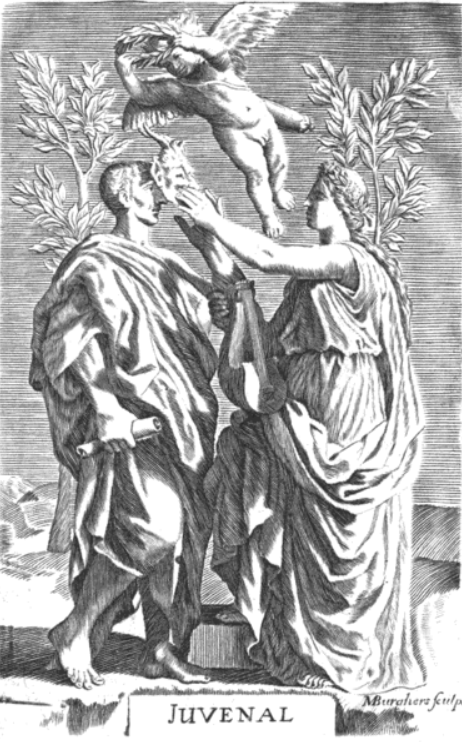
Portrait illustration of Juvenal, Roman satirical poet

Portrait of Juvenal

Biography

Decimus Iunius Iuvenalis (known in English as Juvenal) was born in Aquino, a small town in the Lazio region of Italy, either the son or the adopted son of a rich freedman (freed slave). Trustworthy biographical information is extremely sparse. Some sources place his date of birth at 55 CE, and other traditions have him surviving for some time past the year of Hadrian's death (138 CE), but these dates are at best imprecise. As he did not dedicate his work, it is usually assumed that he did not have a patron and so may have been independently wealthy, although for a time it seems that he was also very poor and dependent on the charity of the rich people of Rome.

He became an officer in the army as a first step to a career in the administrative service of the Emperor Domitian, but grew embittered when he failed to obtain promotion. Most biographers have him living out a period of exile in Egypt, possibly due to a satire he wrote declaring that court favourites had undue influence in the promotion of military officers, or possibly due to an insult to an actor with a high level of court influence. It is not clear whether the banishing emperor was Trajan or Domitian, nor whether he died in exile or was recalled to Rome before his death (the latter seems the most likely).

Writings

Juvenal is credited with sixteen numbered poems, the last unfinished or at least poorly preserved, divided into five books. They are all in the Roman genre of "satura" or satire, wide-ranging discussions of society and social mores in dactylic hexameter. Book One, containing "Satires 1 – 5", which describe in retrospect some of the horrors of Emperor Domitian's tyrannical reign, was probably issued between 100 and 110 CE. The remaining books were published at various intervals up to an estimated date for Book 5 of about 130 CE, although firm dates are not known.
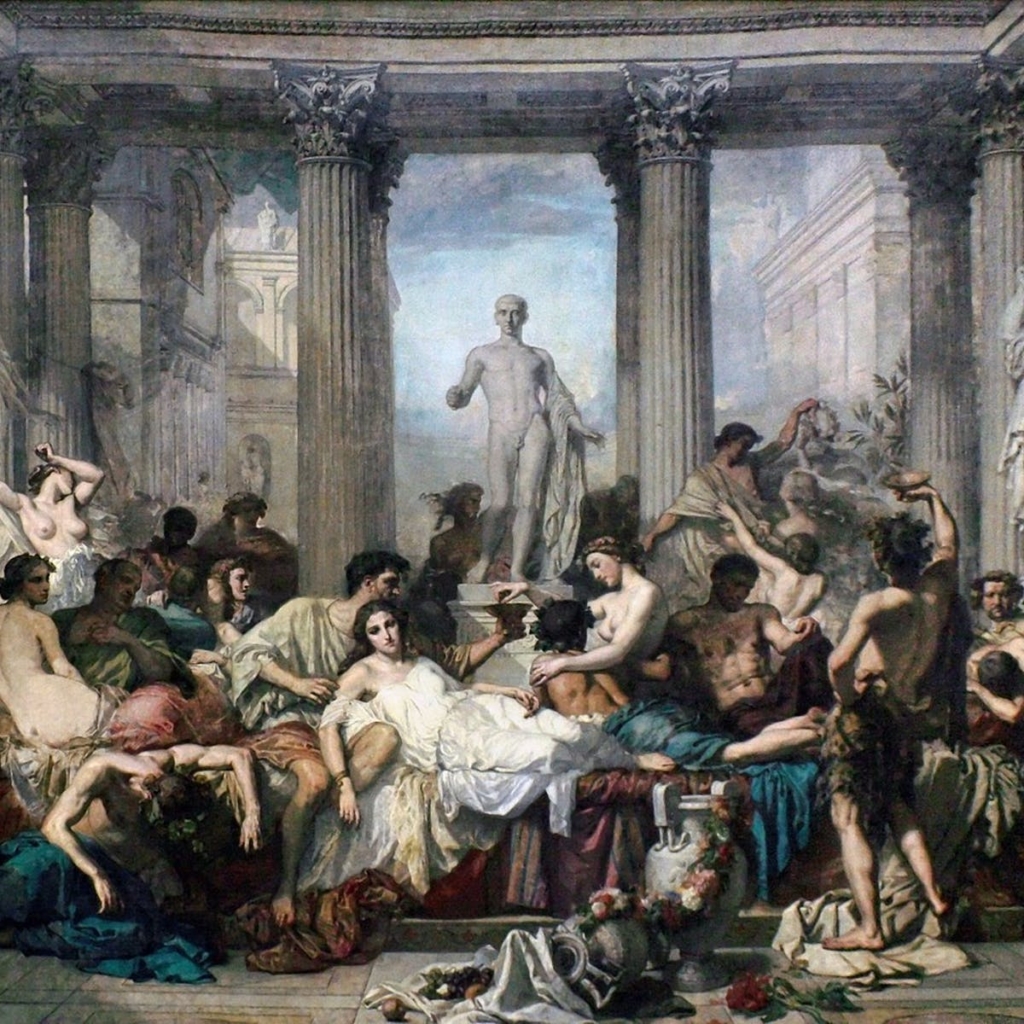
Romans in their Decadence, painting illustrating the themes of Juvenal's satires

Romans in their Decadence

Technically, Juvenal's poetry is very fine, clearly structured and full of expressive effects in which the sound and rhythm mimic and enhance the sense, with many trenchant phrases and memorable epigrams. His poems attack both the corruption of society in the city of Rome and the follies and brutalities of mankind in general, and show a wrathful scorn towards all representatives of what Roman society of the time thought of as social deviance and vice. Satire VI, for example, more than 600 lines long, is a ruthless and vitriolic denunciation of the folly, arrogance, cruelty and sexual depravity of Roman women.

Juvenal's "Satires" are the source of many well-known maxims, including "panem et circenses" ("bread and circuses", with the implication that these are all that the common people are interested in), "mens sana in corpore sano" ("a sound mind in a sound body"), "rara avis" ("rare bird", referring to a perfect wife) and "quis custodiet ipsos custodes?" ("who will guard the guardians themselves?" or "who will watch the watchers?").

The originator of the genre of verse satires is usually deemed to have been Lucilius (who was famed for his vitriolic manner), and Horace and Persius were also well-known proponents of the style, but Juvenal is generally considered to have taken the tradition to its height. However, he was clearly not that well known in Roman literary circles of the period, being all but unmentioned by his contemporary poets (with the exception of Martial) and completely excluded from Quintilian's 1st Century CE history of satire. In fact, it was not until Servius, in the late 4th Century CE, that Juvenal received some belated recognition.

Major Works

  • "Satire III"

  • "Satire VI"

  • "Satire X"

By Timeless Myths

Rome:

  • • Catullus
  • • Vergil (Virgil)
  • • Horace
  • • Ovid
  • • Seneca the Younger
  • • Lucan
  • • Juvenal
  • • Pliny the Younger
Seneca the Younger

Seneca the Younger

(Tragic Playwright, Roman, c. 4 BCE – 65 CE)Introduction Seneca the Younger was a Roman philosopher, statesman and dramatist of the Silver Age of Latin literature. Although generally considered inferior to their corresponding Greek dramas, his tra...

October 24th, 2024 • Timeless Myths
Satire VI

Satire VI

(Satire, Latin/Roman, c. 115 CE, 695 lines)Introduction "Satire VI" ("Satura VI") is a verse satire by the Roman satirical poet Juvenal, written around 115 CE. The poem laments what Juvenal sees as the decay of feminine virtue, and uses a series o...

October 25th, 2024 • Timeless Myths
Ovid

Ovid

(Epic, Elegiac and Didactic Poet, Roman, 43 BCE – c. 17 CE)Introduction Ovid was a prolific Roman poet, straddling the Golden and Silver Ages of Latin literature, who wrote about love, seduction and mythological transformation. He is considered a ...

October 24th, 2024 • Timeless Myths
Pliny the Younger

Pliny the Younger

(Correspondent, Roman, 61 – c. 112 CE)Introduction Pliny the Younger was a successful lawyer, administrator and author of ancient Rome. Through his many detailed letters ("Epistulae") to friends and associates, he has become one of the best-known ...

October 24th, 2024 • Timeless Myths
Horace

Horace

(Lyric Poet and Satirist, Roman, 65 – 8 BCE)Introduction Horace was, along with Vergil, the leading Roman poet in the time of Emperor Augustus. He is considered by classicists to be one of the greatest and most original of Latin lyric poets, appre...

October 24th, 2024 • Timeless Myths
Catullus 24 Translation

Catullus 24 Translation

Introduction In this poem, Catullus speaks to the flower of Juventius or his family. The reader does not know if the flower is a man or a woman, but this person is clearly someone who is being courted by Juventius. However, when the name is spelle...

January 1st, 2025 • Ancient Literature
Satire III

Satire III

(Satire, Latin/Roman, c. 110 CE, 322 lines)Introduction "Satire III" ("Satura III") is a verse satire by the Roman satirical poet Juvenal, written around 110 CE or after. The poem is a monologue by a friend of Juvenal called Umbricius who is leavi...

October 25th, 2024 • Timeless Myths
Catullus 15 Translation

Catullus 15 Translation

Introduction Catullus does not want Aurelius to have an affair with his lover Juventius. In this poem, Catullus asks Aurelius a modest favor: to keep his boyfriend safe. He wants Juventius to be pure and free of stain. In line nine, Catullus share...

January 1st, 2025 • Ancient Literature
Catullus 21 Translation

Catullus 21 Translation

Introduction In this poem, Catullus addresses Aurelius who wants to have an affair with Juventius - his lover. Catullus calls Aurelius the father of all starvations. This reference is not being hungry for food, but to being hungry to fulfill his s...

January 1st, 2025 • Ancient Literature
Satire X

Satire X

(Satire, Latin/Roman, c. 120 CE, 366 lines)Introduction "Satire X" ("Satura X") is a verse satire by the Roman satirical poet Juvenal, written around 120 CE. The poem, sometimes known by the title "The Vanity of Human Wishes", is couched in brilli...

October 25th, 2024 • Timeless Myths
Timeless Myths

Exploring mythology and legends from around the world.

Explore Myths

All Stories Characters All Articles Search Site Map

Mythologies

Norse Mythology Classical Mythology Celtic Mythology Arthurian Legends Mythology Gods Ancient Literature

About Us

Introduction About Jimmy Bibliography FAQs Retro Version

Resources

Timeless Myths All Stories All Articles Characters
© 1999-2026 Timeless Myths • Copyright • Privacy Policy • Cookie Policy • Contact
Follow us: