Timeless Myths Logo
Aphrodite Apollo Ares Artemis Athena Atlas Coeus Crius Cronus Demeter Dionysus Gaia Hades Hephaestus Hera Hermes Hestia Hyperion Iapetus Mnemosyne Oceanus Phobos Phoebe Poseidon Prometheus Rhea Tethys Themis Uranus Zeus
Bacchus Ceres Diana Juno Jupiter Mars Mercury Minerva Neptune Pluto Venus Vesta Vulcan
Amun Anubis Aten Atum Babi Bastet Bes Geb Hapi hathor heqet Horus Isis Khepri Khnum Khonsu Maat Nephthys Nut Osiris Ptah Ra Seshat Seth Shu Sobek Thoth
Alfheim Baldur Freya Freyr Frigg Heimdallr Helheim Idun Jotunheim Loki Nerthus Njord Odin Thor Tyr
Aengus Arawn Badb Brigid Cailleach Ceridwen Cernunnos Cu Chulainn Dagda Danu Gwydion Herne the Hunter Lugh Medb Morrigan Neit Nuada Taliesin Taranis
Chalchiuhtlicue Coatlicue Huitzilopochtli Mictlantecuhtli Mixcoatl Ometeotl Quetzalcoatl Tezcatlipoca Tlaloc Tonatiuh Xipe Totec Xochiquetzal Xolotl
Amaterasu Ame no Uzume Benzaiten Bishamonten Daikokuten Ebisu Fujin Fukurokuju Inari Izanagi Kagutsuchi Raijin Susanoo Tsukuyomi
Caishen Cangjie Dragon King Eight Immortals Erlang Shen Fuxi Guanyin Hou Yi Huxian Jade Emperor King Yama Leizi Lu-ban Mazu Nezha Nuwa Pangu Shennong Sun Wukong Xiwangmu Yue Lao Zhong Kui
Norse Classical Celtic Arthurian
Literature Stories Names
Aphrodite Apollo Ares Artemis Athena Atlas Coeus Crius Cronus Demeter Dionysus Gaia Hades Hephaestus Hera Hermes Hestia Hyperion Iapetus Mnemosyne Oceanus Phobos Phoebe Poseidon Prometheus Rhea Tethys Themis Uranus Zeus
Bacchus Ceres Diana Juno Jupiter Mars Mercury Minerva Neptune Pluto Venus Vesta Vulcan
Amun Anubis Aten Atum Babi Bastet Bes Geb Hapi hathor heqet Horus Isis Khepri Khnum Khonsu Maat Nephthys Nut Osiris Ptah Ra Seshat Seth Shu Sobek Thoth
Alfheim Baldur Freya Freyr Frigg Heimdallr Helheim Idun Jotunheim Loki Nerthus Njord Odin Thor Tyr
Aengus Arawn Badb Brigid Cailleach Ceridwen Cernunnos Cu Chulainn Dagda Danu Gwydion Herne the Hunter Lugh Medb Morrigan Neit Nuada Taliesin Taranis
Chalchiuhtlicue Coatlicue Huitzilopochtli Mictlantecuhtli Mixcoatl Ometeotl Quetzalcoatl Tezcatlipoca Tlaloc Tonatiuh Xipe Totec Xochiquetzal Xolotl
Amaterasu Ame no Uzume Benzaiten Bishamonten Daikokuten Ebisu Fujin Fukurokuju Inari Izanagi Kagutsuchi Raijin Susanoo Tsukuyomi
Caishen Cangjie Dragon King Eight Immortals Erlang Shen Fuxi Guanyin Hou Yi Huxian Jade Emperor King Yama Leizi Lu-ban Mazu Nezha Nuwa Pangu Shennong Sun Wukong Xiwangmu Yue Lao Zhong Kui
Norse Classical Celtic Arthurian
Literature Stories Names
  1. Classical Literature
    Greece Rome Other Ancient Civilizations Timeline of Classical Literature Alphabetical List of Authors Index of Individual Works Index of Important Characters Sources About Us
  2. Rome
    Catullus Vergil (Virgil) Horace Ovid Seneca the Younger Lucan Juvenal Pliny the Younger
  3. Seneca the Younger

Seneca the Younger

(Tragic Playwright, Roman, c. 4 BCE – 65 CE)

Introduction

Seneca the Younger was a Roman philosopher, statesman and dramatist of the Silver Age of Latin literature. Although generally considered inferior to their corresponding Greek dramas, his tragedies (essentially the only surviving specimens of Latin tragic drama) had a profound influence on the development of the tragic form in later times, particularly in the age of Racine and Shakespeare.
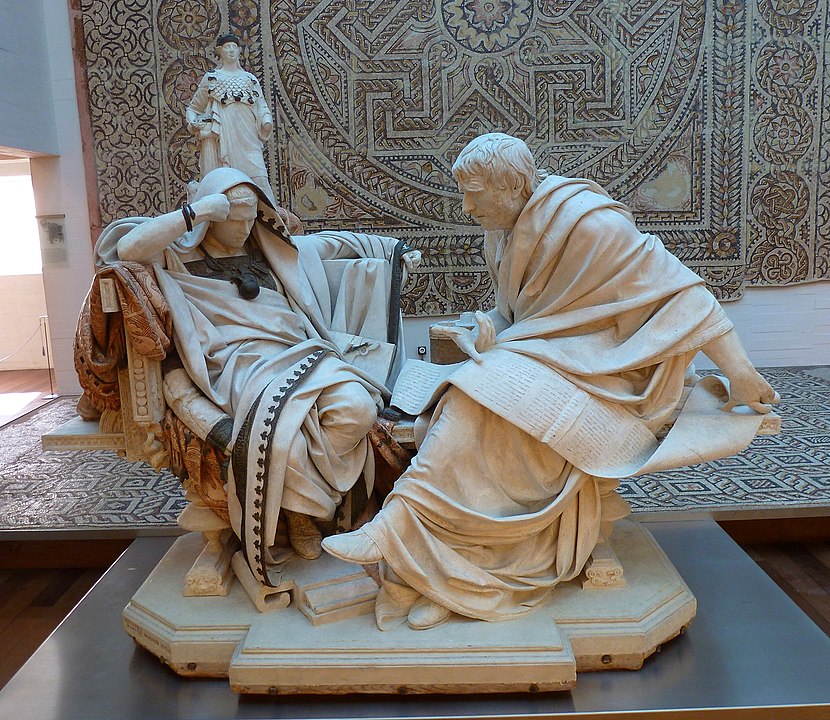
Statue of Seneca and Nero, his former student

Statue of Seneca and Nero

Biography

Lucius Annaeus Seneca (often known simply as Seneca, or as Seneca the Younger to distinguish him from his father, who was also called Lucius Annaeus Seneca) was born in about 4 BCE in Corduba in Hispania (modern-day Córdoba, Spain). As a small boy, he moved to Rome, where he was trained in rhetoric and Stoic and neo-Pythagorean philosophy. His constitution was delicate and his health poor, and he was nursed for some years by his aunt, who also helped him in his campaign for his first magistracy in 31 CE.

When the unstable Caligula became emperor in 38 CE, there was a severe conflict of some kind between him and Seneca, possibly occasioned by jealousy of Seneca's remarkable gift for oratory, and Seneca narrowly avoided execution. He had more problems with the Emperor Claudius, who succeeded Caligula in 41 CE and, at the behest of Claudius' wife Messalina, Seneca was banished to the island of Corsica on a trumped up charge of adultery. Claudius' second wife, Agrippina, however, had Seneca recalled to Rome in 49 CE to tutor her son, Nero, then 12 years old.

On Claudius' death in 54 CE, Nero became emperor, and Seneca (together with the praetorian prefect Sextus Afranius Burrus) acted as Nero's advisor from 54 to 62 CE, exerting a calming influence over the headstrong young emperor, at the same time as amassing great wealth. Over time, however, Seneca and Burrus lost their influence over Nero and, after Burrus' death in 62 CE, Seneca retired and devoted his time to study and writing.

In 65 CE, Seneca was caught up in the aftermath of the conspiracy of Gaius Calpurnius Piso to kill Nero (as was Seneca's nephew, Lucan) and, although it is unlikely that he was actually involved in the plot, he was ordered by Nero to kill himself. Following tradition, he severed several veins in order to bleed to death, although even immersion in a warm bath and additional poison did nothing to hasten a long and painful death. His wife, Pompeia Paulina, tried to commit suicide with him but was prevented.
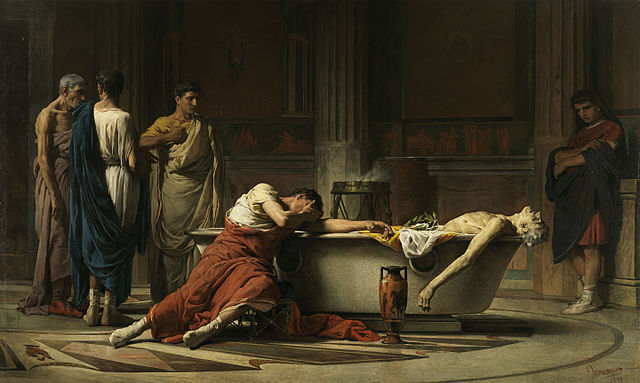
The Death of Seneca, painting depicting his forced suicide

The Death of Seneca

Writings

Seneca's tendency to engage in illicit affairs with married women despite his long-time marriage, and his rather un-Stoic proclivity for hypocrisy and flattery, have sullied his reputation somewhat, but he remains one of the few popular Roman philosophers from the period and, even if his work was not particularly original, he was important in making the Greek philosophers presentable and intelligible.

In addition to his philosophical essays and over a hundred letters dealing with moral issues, Seneca's works include eight tragedies, "Troades" ("The Trojan Women"), "Oedipus", "Medea", "Hercules Furens" ("The Mad Hercules"), "Phoenissae" ("The Phoenician Women"), "Phaedra", "Agamemnon" and "Thyestes", as well as a satire called "Apocolocyntosis" (usually translated as "The Pumpkinification of Claudius"). Two other plays, "Hercules Oetaeus" ("Hercules on Oeta") and "Octavia", closely resemble Seneca's plays in style, but were probably written by a follower.

"Oedipus" is adapted from Sophocles' original, "Agamemnon" is adapted from Aeschylus, and most of the others are adapted from the plays of Euripides. "Thyestes", however, one of the few of Seneca's plays not obviously following a Greek original, is often considered his masterpiece. Despite his appropriation of ancient Greek classics, Seneca never allowed himself to be bound by the original texts, freely discarding and rearranging scenes, and using only the material that he found useful. The poetical influence of Vergil and Ovid is apparent as well as that of the old Greek models.
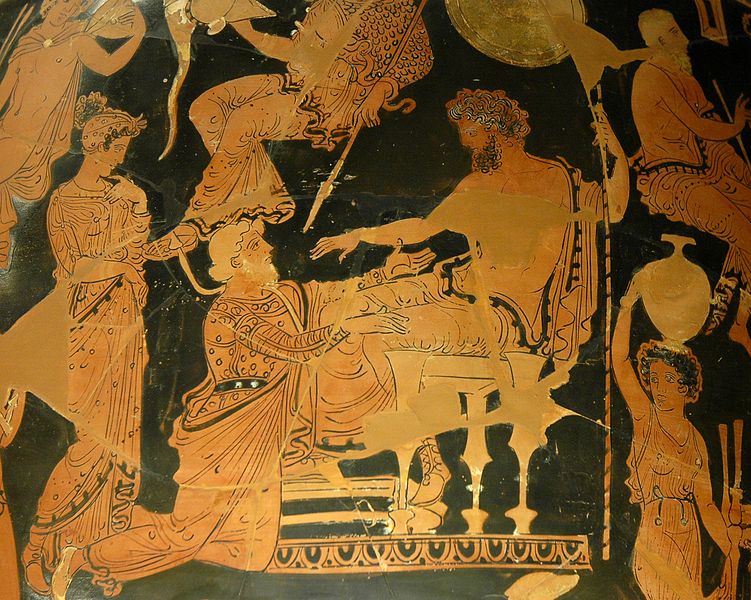
Agamemnon scene on ancient Greek vase

Agamemnon depicted on an ancient vase

His dramatic works generally employ a pointedly (some would say excessively) rhetorical style, and usually contain the traditional themes of Stoic philosophy. It is unclear whether Seneca's tragedies (shorter than the old Attic dramas, but split into five acts not three, and often displaying a distinct lack of concern for the physical requirements of the stage) were written for performance or for private recitation only. The popular plays of his day were generally coarse and indecent, and there was really no public stage open to tragedies, which would anyway have had little chance of success or popularity.

Seneca is well known for his scenes of violence and horror (deliberately avoided in the ancient Greek tradition), such as where Jocasta rips open her womb in "Oedipus" or where the bodies of children are served at a banquet in "Thyestes". His fascination with magic, death and the supernatural would be imitated, many centuries later, by many Elizabethan playwrights. Another of Seneca's innovations is his use of soliloquies and asides, which would also prove integral to the evolution of Renaissance drama.

Major Works

  • "Medea"

  • "Phaedra"

  • "Hercules Furens" ("The Mad Hercules")

  • "Troades" ("The Trojan Women")

  • "Agamemnon"

  • "Oedipus"

  • "Apocolocyntosis"

  • "Thyestes"

  • "Phoenissae" ("The Phoenician Women")

By Timeless Myths

Rome:

  • • Catullus
  • • Vergil (Virgil)
  • • Horace
  • • Ovid
  • • Seneca the Younger
  • • Lucan
  • • Juvenal
  • • Pliny the Younger
Pliny the Younger

Pliny the Younger

(Correspondent, Roman, 61 – c. 112 CE)Introduction Pliny the Younger was a successful lawyer, administrator and author of ancient Rome. Through his many detailed letters ("Epistulae") to friends and associates, he has become one of the best-known ...

October 24th, 2024 • Timeless Myths
Juvenal

Juvenal

(Satirist, Roman, c. 55 – c. 138 CE)Introduction Juvenal was a Roman poet of the Silver Age of Latin literature, the last and most powerful of all the Roman satirical poets. His biting "Satires" could be read as a brutal critique of pagan Rome, al...

October 24th, 2024 • Timeless Myths
Horace

Horace

(Lyric Poet and Satirist, Roman, 65 – 8 BCE)Introduction Horace was, along with Vergil, the leading Roman poet in the time of Emperor Augustus. He is considered by classicists to be one of the greatest and most original of Latin lyric poets, appre...

October 24th, 2024 • Timeless Myths
Lucan

Lucan

(Epic Poet, Roman, 39 – 65 CE)Introduction Lucan was a Roman epic poet during the reign of Emperor Nero. Despite his short life, he is regarded as one of the outstanding figures of the Silver Age of Latin literature, and his youth and speed of com...

October 24th, 2024 • Timeless Myths
Epistulae X.96

Epistulae X.96

(Letters, Latin/Roman, c. 111 CE, 38 lines)Introduction "Epistulae X" ("Letters 10", also known as the "Correspondence with Trajan") is a book of letters by the Roman lawyer and author Pliny the Younger to the Emperor Trajan between 109 and 111 CE...

October 25th, 2024 • Timeless Myths
Epistulae VI.16 & VI.20

Epistulae VI.16 & VI.20

(Letters, Latin/Roman, c. 107 CE, 63 + 60 lines)Introduction "Epistulae VI" ("Letters 6") is the sixth of ten books of letters by the Roman lawyer and author Pliny the Younger, mainly written around 106 to 107 CE. Of these, Letters 16 and 20 are t...

October 25th, 2024 • Timeless Myths
Satire VI

Satire VI

(Satire, Latin/Roman, c. 115 CE, 695 lines)Introduction "Satire VI" ("Satura VI") is a verse satire by the Roman satirical poet Juvenal, written around 115 CE. The poem laments what Juvenal sees as the decay of feminine virtue, and uses a series o...

October 25th, 2024 • Timeless Myths
Ovid

Ovid

(Epic, Elegiac and Didactic Poet, Roman, 43 BCE – c. 17 CE)Introduction Ovid was a prolific Roman poet, straddling the Golden and Silver Ages of Latin literature, who wrote about love, seduction and mythological transformation. He is considered a ...

October 24th, 2024 • Timeless Myths
Ars Poetica

Ars Poetica

(Didactic Poem, Latin/Roman, c. 18 BCE, 476 lines)Introduction "Ars Poetica" ("The Art of Poetry" or "On the Nature of Poetry"), sometimes known under its original title, "Epistula Ad Pisones" ("Letters to the Pisos"), is a treatise or literary es...

October 25th, 2024 • Timeless Myths
Pharsalia (De Bello Civili)

Pharsalia (De Bello Civili)

(Epic Poem, Latin/Roman, 65 CE, 8,060 lines)Introduction Pharsalia (also known as De Bello Civili or "On the Civil War") is an epic poem in ten books by the Roman poet Lucan, left unfinished on the poet's death in 65 CE. Although incomplete, it is...

October 25th, 2024 • Timeless Myths
Timeless Myths

Exploring mythology and legends from around the world.

Explore Myths

All Stories Characters All Articles Search Site Map

Mythologies

Norse Mythology Classical Mythology Celtic Mythology Arthurian Legends Mythology Gods Ancient Literature

About Us

Introduction About Jimmy Bibliography FAQs Retro Version

Resources

Timeless Myths All Stories All Articles Characters
© 1999-2026 Timeless Myths • Copyright • Privacy Policy • Cookie Policy • Contact
Follow us: