Timeless Myths Logo
Aphrodite Apollo Ares Artemis Athena Atlas Coeus Crius Cronus Demeter Dionysus Gaia Hades Hephaestus Hera Hermes Hestia Hyperion Iapetus Mnemosyne Oceanus Phobos Phoebe Poseidon Prometheus Rhea Tethys Themis Uranus Zeus
Bacchus Ceres Diana Juno Jupiter Mars Mercury Minerva Neptune Pluto Venus Vesta Vulcan
Amun Anubis Aten Atum Babi Bastet Bes Geb Hapi hathor heqet Horus Isis Khepri Khnum Khonsu Maat Nephthys Nut Osiris Ptah Ra Seshat Seth Shu Sobek Thoth
Alfheim Baldur Freya Freyr Frigg Heimdallr Helheim Idun Jotunheim Loki Nerthus Njord Odin Thor Tyr
Aengus Arawn Badb Brigid Cailleach Ceridwen Cernunnos Cu Chulainn Dagda Danu Gwydion Herne the Hunter Lugh Medb Morrigan Neit Nuada Taliesin Taranis
Chalchiuhtlicue Coatlicue Huitzilopochtli Mictlantecuhtli Mixcoatl Ometeotl Quetzalcoatl Tezcatlipoca Tlaloc Tonatiuh Xipe Totec Xochiquetzal Xolotl
Amaterasu Ame no Uzume Benzaiten Bishamonten Daikokuten Ebisu Fujin Fukurokuju Inari Izanagi Kagutsuchi Raijin Susanoo Tsukuyomi
Caishen Cangjie Dragon King Eight Immortals Erlang Shen Fuxi Guanyin Hou Yi Huxian Jade Emperor King Yama Leizi Lu-ban Mazu Nezha Nuwa Pangu Shennong Sun Wukong Xiwangmu Yue Lao Zhong Kui
Norse Classical Celtic Arthurian
Literature Stories Names
Aphrodite Apollo Ares Artemis Athena Atlas Coeus Crius Cronus Demeter Dionysus Gaia Hades Hephaestus Hera Hermes Hestia Hyperion Iapetus Mnemosyne Oceanus Phobos Phoebe Poseidon Prometheus Rhea Tethys Themis Uranus Zeus
Bacchus Ceres Diana Juno Jupiter Mars Mercury Minerva Neptune Pluto Venus Vesta Vulcan
Amun Anubis Aten Atum Babi Bastet Bes Geb Hapi hathor heqet Horus Isis Khepri Khnum Khonsu Maat Nephthys Nut Osiris Ptah Ra Seshat Seth Shu Sobek Thoth
Alfheim Baldur Freya Freyr Frigg Heimdallr Helheim Idun Jotunheim Loki Nerthus Njord Odin Thor Tyr
Aengus Arawn Badb Brigid Cailleach Ceridwen Cernunnos Cu Chulainn Dagda Danu Gwydion Herne the Hunter Lugh Medb Morrigan Neit Nuada Taliesin Taranis
Chalchiuhtlicue Coatlicue Huitzilopochtli Mictlantecuhtli Mixcoatl Ometeotl Quetzalcoatl Tezcatlipoca Tlaloc Tonatiuh Xipe Totec Xochiquetzal Xolotl
Amaterasu Ame no Uzume Benzaiten Bishamonten Daikokuten Ebisu Fujin Fukurokuju Inari Izanagi Kagutsuchi Raijin Susanoo Tsukuyomi
Caishen Cangjie Dragon King Eight Immortals Erlang Shen Fuxi Guanyin Hou Yi Huxian Jade Emperor King Yama Leizi Lu-ban Mazu Nezha Nuwa Pangu Shennong Sun Wukong Xiwangmu Yue Lao Zhong Kui
Norse Classical Celtic Arthurian
Literature Stories Names
  1. Classical Literature
    Greece Rome Other Ancient Civilizations Timeline of Classical Literature Alphabetical List of Authors Index of Individual Works Index of Important Characters Sources About Us
  2. Rome
    Catullus Vergil (Virgil) Horace Ovid Seneca the Younger Lucan Juvenal Pliny the Younger
  3. Seneca the Younger
    Medea Phaedra Hercules Furens Troades (The Trojan Women) Agamemnon Oedipus Apocolocyntosis Thyestes Phoenissae (The Phoenician Women)
  4. Agamemnon
    Agamemnon

Agamemnon

(Tragedy, Latin/Roman, c. 55 CE, 1,012 lines)

Introduction

"Agamemnon" is a tragedy by the Roman playwright Seneca the Younger, written around 55 CE. Adapted from the much earlier Greek play "Agamemnon" by Aeschylus, it tells the story of the return of the Greek hero Agamemnon to his home in Argos after the Trojan War, and his death at the hands of his wife Clytemnestra and her lover Aegisthus.
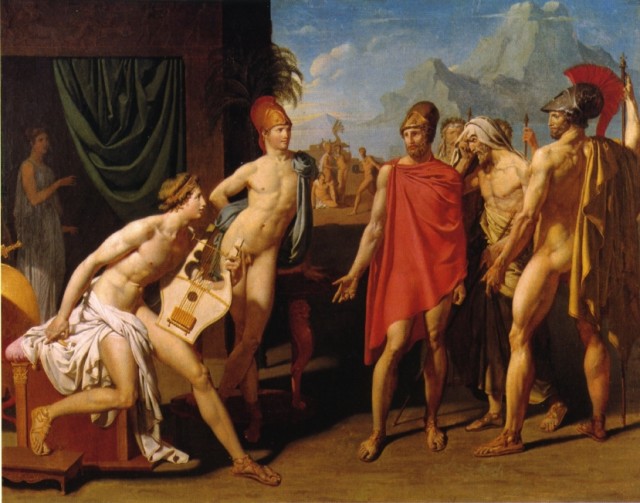
The Envoys of Agamemnon by Jean-Auguste-Dominique Ingres

The Envoys of Agamemnon by Jean-Auguste-Dominique Ingres

Synopsis

Dramatis Personae

  • AGAMEMNON, king of Argos

  • GHOST OF THYESTES

  • AEGISTHUS, son of Thyestes

  • CHORUS OF ARGIVE WOMEN

  • EURYBATES, messenger of Agamemnon

  • CASSANDRA, daughter of Priam, captive of Agamemnon

  • ELECTRA, daughter of Agamemnon

  • STROPHIUS, king of Phocis

  • ORESTES, son of Agamemnon (silent)

  • PYLADES, son of Strophius (silent)

  • BAND OF CAPTIVE TROJAN WOMEN

The background to the play is that Atreus' son, Agamemnon, king of Argos, has been away for ten years leading the Greek forces in the war against Troy, and is shortly due back to reclaim his own throne. In the meantime, though, Agamemnon's wife Clytemnestra has become the lover of his ambitious cousin Aegisthus, and the two have been ruling Argos together. Clytemnestra also bears another grudge against her husband, dating back to when he agreed to sacrifice their own daughter, Iphigenia, to placate the gods before the start of the Trojan War.

The play opens with the ghost of Agamemnon's uncle, Thyestes, foreseeing the death of Agamemnon. As Agamemnon's return to Argos is imminent, Clytemnestra steels herself for revenge by dwelling on her grievances against him (his sacrifice of their daughter Iphigenia, his infidelities and the danger represented by his Trojan mistress Cassandra). Although she feels some revulsion to the guilty path, she feels she must take, she nevertheless resigns herself to colluding with Aegisthus.

After a Chorus of Argive women sing a hymn of thanksgiving to the gods for Agamemnon's victory in Troy, the herald Eurybates reports Agamemnon's imminent arrival as well as the destruction of much of the Greek fleet on the journey back. A secondary Chorus of Trojan women slaves mourn their situation and recall the episode of the wooden horse that led to the fall of Troy.

Agamemnon's mistress, the Trojan seer Cassandra, also mourns for Troy, but has a vision of the coming events, which she sees as just retribution. By clairvoyance, Cassandra "watches" and describes the murder of Agamemnon by Clytemnestra and Aegisthus in the palace.
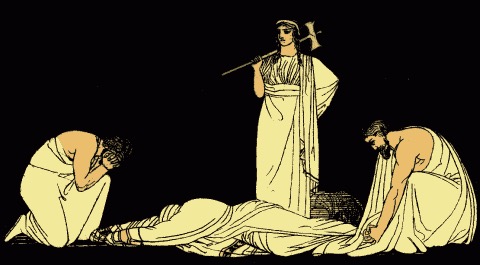
The Murder of Agamemnon - Illustration

The Murder of Agamemnon

Agamemnon's children, Orestes and Electra leave the palace, Electra entrusting her younger brother to the care of a faithful friend, Strophius, before herself being led away to prison by her mother and Aegisthus. Cassandra is also led away to her execution, rejoicing that Troy's fall has been recompensed by the death of Agamemnon.

Analysis

Seneca's "Agamemnon" is a brilliantly rhetorical piece, widely believed to have been written for study rather than the stage, possibly as part of the education of his student, the young Emperor Nero. Although based in general terms on Aeschylus' much earlier play of the same name, it also includes much new material, and Seneca's Acts I and II and Scenes II and III of Act V have no real precedent in Aeschylus' drama. Seneca's description of the destruction of the Greek fleet, for example, contains three distinct episodes, the first known account of which did not appear until the Hellenistic period, long after the time of Aeschylus.

The tragedy encompassed by the play is multiple, involving not only Agamemnon but also many others, both Greeks and Trojans. The perspectives on the tragedies are also multiple, seen through the eyes of Greek participants in the Trojan War, but also through the eyes of Trojan participants and the Trojan princess and seer Cassandra.
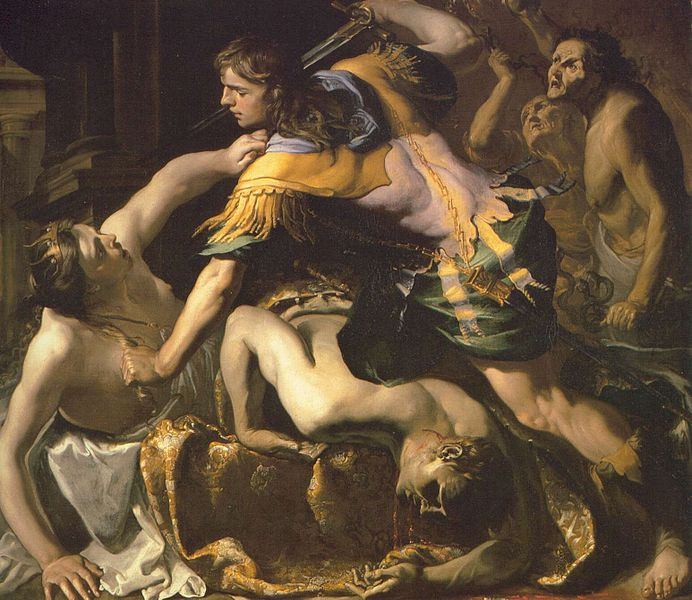
Clytemnestra murdering Agamemnon - Painting

Clytemnestra murdering Agamemnon

The play is also characterized by multiple vision, especially the clairvoyant vision of Cassandra, who sees both into the underworld and the real world, and who watches the killing of Agamemnon as a kind of spectacle, not dissimilar to a gladiatorial fight. Her double image of Argos as Troy (and Agamemnon as Priam) conveys the similarity in the fall of greatness everywhere, and how the vanquishers become the vanquished in turn.

The multiple viewpoints of different characters are used to portray multiple ways of understanding the same events, with none being offered as the definitive version. None of the characters are really central or dominant in the play, least of all Agamemnon himself, who only has 26 lines in the whole play. Even Clytemnestra's motives for her actions are presented as being multiple, with no one motive, event or emotion obviously dominating. She is subject to wild changes of heart, in keeping with Seneca's vision of the workings of human passions, and the resulting characterization of Clytemnestra is actually much more complex than any portrait of her from antiquity.

Aegisthus is presented as essentially just a tool of fate, the whole meaning of his life being to take revenge on the descendants of Atreus. The defiant young women of the play, Electra and Cassandra, both rely on an understanding that death is sometimes preferable to life, and the ghost of Thyestes at the beginning of the play also clearly prefers the world of the dead to that of the living. The Chorus of Trojan women look on death as freedom, both from slavery and from the storms of life.

Resources

  • English translation by Frank Justus Miller (Theoi.com): http://www.theoi.com/Text/SenecaAgamemnon.html

  • Latin version (The Latin Library): http://www.thelatinlibrary.com/sen/sen.agamemnon.shtml

By Timeless Myths

Seneca the Younger:

  • • Medea
  • • Phaedra
  • • Hercules Furens
  • • Troades (The Trojan Women)
  • • Agamemnon
  • • Oedipus
  • • Apocolocyntosis
  • • Thyestes
  • • Phoenissae (The Phoenician Women)
Agamemnon

Agamemnon

(Tragedy, Greek, 458 BCE, 1,673 lines)Introduction - Who wrote Agamemnon "Agamemnon" is the first of the three linked tragedies which make up "The Oresteia" trilogy by the ancient Greek playwright Aeschylus, followed by "The Libation Bearers" and ...

January 1st, 2025 • Ancient Literature
Agamemnon

Agamemnon

Agamemnon Iphigeneia in Aulis Murder of AgamemnonAgamemnon According to Homer, Agamemnon (Ἀγαμέμνων) and his brother Menelaüs (Menalaus) were the sons of Atreus and Aerope, the daughter of Catreus of Crete. The two sons of Atreus were known as the...

August 23rd, 2003 • Jimmy Joe
Agamemnon in The Odyssey: The Death of the Cursed Hero

Agamemnon in The Odyssey: The Death of the Cursed Hero

Agamemnon in The Odyssey is a recurring character in the form of several cameos across Homer's Classic. In its precursor, the Iliad, Agamemnon was known as the King of Mycenae, who waged war on Troy to take his brother Menelaus's wife, Helen.Who I...

February 15th, 2024 • Ancient Literature
Was Agamemnon the King of Mycenae or Argos?

Was Agamemnon the King of Mycenae or Argos?

In Greek mythology, Agamemnon is one of the most prominent characters in the legend of the Trojan War. In fact, he was the leader of the enormous Greek army that fought against Troy. He is famously known as the king of Mycenae. However, was he rea...

November 18th, 2024 • Caleb Howells
The Oresteia

The Oresteia

(Tragedy, Greek, 458 BCE, 3,796 lines over 3 plays)Introduction - Who Wrote Oresteia "The Oresteia" trilogy by the ancient Greek playwright Aeschylus consists of the three linked plays "Agamemnon", "The Libation Bearers" and "The Eumenides". The t...

January 1st, 2025 • Ancient Literature
Antigone

Antigone

(Tragedy, Greek, c. 442 BCE, 1,352 lines)Introduction - Who wrote Antigone “Antigone” is a tragedy by the ancient Greek playwright Sophocles, written around 442 BCE. Although it was written before Sophocles’ other two Theban plays, chronologically...

January 1st, 2025 • Ancient Literature
Orestes

Orestes

(Tragedy, Greek, c. 407 BCE, 1,629 lines) Introduction | Synopsis | Analysis | ResourcesIntroduction "Orestes" is a late tragedy by the ancient Greek playwright Euripides, first presented in 408 BCE. It continues the story of Orestes after the eve...

October 25th, 2024 • Timeless Myths
Memnon

Memnon

An Eithopian prince. Memnon (Μέμνων) was the son of Tithonus and Eos, goddess of Dawn. Memnon was cousin to Hector and Paris, since Tithonus was the brother of Priam. Memnon brought his army as reinforcements for Troy and achieved short successes ...

April 24th, 1999 • Jimmy Joe
Iphigenia in Tauris

Iphigenia in Tauris

"Iphigenia in Tauris" or "Iphigenia among the Taurians" (Gr: "Iphigeneia en Taurois") is a tragedy, although sometimes described as a romance or melodrama, by the ancient Greek playwright Euripides, written sometime between 414 BCE and 412 BCE. It...

October 25th, 2024 • Timeless Myths
The Iliad

The Iliad

(Epic Poem, Greek, c. 750 BCE, 15,693 linesIntroduction - Who wrote the Iliad "The Iliad" (Gr: "Iliás") is an epic poem by the ancient Greek poet Homer, which recounts some of the significant events of the final weeks of the Trojan War and the Gre...

January 1st, 2025 • Ancient Literature
Timeless Myths

Exploring mythology and legends from around the world.

Explore Myths

All Stories Characters All Articles Search Site Map

Mythologies

Norse Mythology Classical Mythology Celtic Mythology Arthurian Legends Mythology Gods Ancient Literature

About Us

Introduction About Jimmy Bibliography FAQs Retro Version

Resources

Timeless Myths All Stories All Articles Characters
© 1999-2026 Timeless Myths • Copyright • Privacy Policy • Cookie Policy • Contact
Follow us: