Timeless Myths Logo

Explore myths and legends from cultures around the world

Featured

Classical Mythology
Classical Mythology Greek and Roman myths, gods, heroes, and epic tales
Norse Mythology
Norse Mythology Vikings, Asgard, Ragnarok, and the nine realms
Celtic Mythology
Celtic Mythology Irish, Welsh, and Gaelic legends and folklore
Ancient Literature
Ancient Literature Classical texts, translations, and literary analysis

All Mythologies

Arthurian Legends King Arthur, Camelot, the Round Table, and the Holy Grail Egyptian Mythology Pharaohs, pyramids, and ancient Nile deities Japanese Mythology Shinto gods, spirits, and legendary creatures Chinese Mythology Dragons, immortals, and celestial beings Aztec Mythology Mesoamerican gods, rituals, and creation myths

Discover gods and goddesses from every pantheon

Featured

Greek Gods
Greek Gods The Olympians, Titans, and primordial deities
Norse Gods
Norse Gods Odin, Thor, Loki, and the Aesir and Vanir
Egyptian Gods
Egyptian Gods Ra, Osiris, Isis, Anubis, and more
Japanese Gods
Japanese Gods Amaterasu, Susanoo, and Shinto kami

All Gods & Deities

Roman Gods Jupiter, Mars, Venus, and the Roman pantheon Celtic Gods The Tuatha Dé Danann and Celtic deities Aztec Gods Quetzalcoatl, Tezcatlipoca, and Aztec deities Chinese Gods Jade Emperor, Dragon Kings, and celestial beings View All 150+ Deities Browse the complete collection of mythological deities
View all gods & deities

Tales, legends, and character profiles from mythology

Featured

All Stories
All Stories Browse 800+ mythology and history stories
Characters
Characters Profiles of 67 mythological heroes, gods, and villains

All Stories

Mythology Stories Ancient myths and legends retold History Stories Historical tales from ancient civilizations Religion & Culture Religious traditions and cultural beliefs
View all stories

Tools, references, and site information

Featured

Name Generators
Name Generators Generate fantasy and mythology-inspired names
All Articles
All Articles Browse 1,800+ articles on mythology and history

All Resources

About Timeless Myths Learn about this mythology resource Bibliography Sources and references used on this site FAQ Frequently asked questions Contact Get in touch with us
Search
Classical Mythology Greek and Roman myths, gods, heroes, and epic tales Norse Mythology Vikings, Asgard, Ragnarok, and the nine realms Celtic Mythology Irish, Welsh, and Gaelic legends and folklore Arthurian Legends King Arthur, Camelot, the Round Table, and the Holy Grail Egyptian Mythology Pharaohs, pyramids, and ancient Nile deities Japanese Mythology Shinto gods, spirits, and legendary creatures Chinese Mythology Dragons, immortals, and celestial beings Aztec Mythology Mesoamerican gods, rituals, and creation myths Ancient Literature Classical texts, translations, and literary analysis
Greek Gods The Olympians, Titans, and primordial deities Roman Gods Jupiter, Mars, Venus, and the Roman pantheon Norse Gods Odin, Thor, Loki, and the Aesir and Vanir Egyptian Gods Ra, Osiris, Isis, Anubis, and more Celtic Gods The Tuatha Dé Danann and Celtic deities Aztec Gods Quetzalcoatl, Tezcatlipoca, and Aztec deities Japanese Gods Amaterasu, Susanoo, and Shinto kami Chinese Gods Jade Emperor, Dragon Kings, and celestial beings View All 150+ Deities Browse the complete collection of mythological deities View all gods & deities
All Stories Browse 800+ mythology and history stories Characters Profiles of 67 mythological heroes, gods, and villains Mythology Stories Ancient myths and legends retold History Stories Historical tales from ancient civilizations Religion & Culture Religious traditions and cultural beliefs View all stories
Name Generators Generate fantasy and mythology-inspired names All Articles Browse 1,800+ articles on mythology and history About Timeless Myths Learn about this mythology resource Bibliography Sources and references used on this site FAQ Frequently asked questions Contact Get in touch with us
Search Search the entire mythology archive
  1. Classical Mythology
    Pantheon Heroic Age Royal Houses Geographia Facts & Figures Genealogy Bibliography About Classical Myths
  2. Heroic Age
    Heroes 1 Heroes 2 Heroines Amazons Perseus Theseus Heracles Argonauts Calydonian Boar Hunt Seven Against Thebes Trojan War Odyssey Aeneid Tales of Lovers Giants Centaurs Mythical Creatures
  3. Heroines
    Io Cyrene Atalanta Medea Antigone Helen Penelope Hecuba Andromache Cassandra Iphigenia Electra Harpalyce Camilla
  4. Electra

Electra

Electra (Ἠλέκτρη) was the long-suffering heroine of a number of Athenian tragedies. She appeared in the 2nd play of Aeschylus' tragedy titled Libation Bearers. Then there are two other plays both bearing her name – one written by Sophocles and the other by Euripides; both dealing the same event as Libation Bearers.

She was a daughter of Agamemnon and Clytemnestra. Electra was also the sister of Iphigeneia and Orestes; she was the middle child. Sometimes Chrysothemis was mentioned as Electra's sister. However, some said that Iphigeneia was the daughter of Theseus and Helen. Helen was too young at the time, so Clytemnestra raised Iphigeneia as if the girl were her own daughter. Homer called her Laodice, while Iphigeneia was called Iphianassa.
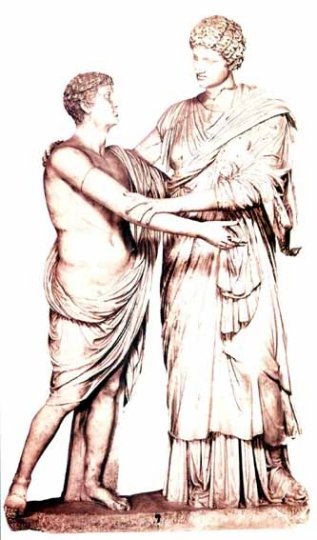
Orestes and Electra

Orestes and Electra
Roman marble statue, AD 100

Her brother Orestes was only an infant when Agamemnon sacrificed her sister Iphigeneia to the goddess Artemis to gain favourable winds, so that the fleet could sail to Troy. It was probably because of Iphigeneia's death that her mother conspired with Aegisthus, Agamemnon's cousin and enemy. Aegisthus became her mother's lover and they plotted to have Agamemnon killed upon his return.

Agamemnon didn't return to Mycenae until ten years later. When Aegisthus and Clytemnestra murdered Agamemnon, fearing for her brother's life, Electra prudently sent Orestes, who was aged ten, to her uncle Strophius in Phocis.

When Orestes reached manhood, he sought the oracle in Delphi where Apollo informed Orestes that he must avenge his father, not only to kill Aegisthus, but his own mother as well.

Orestes secretly returned to Mycenae with Pylades, his foster brother, where he sought his sister. Depending on which versions you may have read, Electra passively urged her brother to avenge their father, which included killing their mother, but in one version, Electra was more aggressive, and even helped her brother to deliver a death blow to Clytemnestra.

See Orestes in the Houses of Argolis.

According to Aeschylus' third play, Eumenides, the Furies (Erinyes) inflicted madness upon Orestes for murdering his mother, and he wandered around Greece until he was tried and acquitted in Athens. Electra played no part in the Eumenides.

According to another play by Euripides, titled Orestes, their grandfather Tyndareus, king of Sparta, arrested Orestes and Electra. Tyndareus wanted justice for his daughter's death, and his grandchildren would have been executed, but they escaped. Orestes and Electra would have killed Helen, but Zeus saved his daughter, and Helen became immortal. Failing this, they captured Hermione, daughter of Menelaus and Helen, holding their cousin as hostage. Apollo, however, intervened. Hermione was released. Apollo ordered Orestes to go into exile for a year, where it was hinted that Orestes would be tried and acquitted in court at Athens like in Aeschylus' Eumenides.

When Orestes returned from the Tauric kingdom, Electra thought that her sister Iphigeneia had sacrificed their brother to the goddess Artemis. Electra would have blinded her sister with a firebrand had Orestes not arrived in time to save Iphigeneia.

Electra married her cousin Pylades, foster brother of Orestes. Electra was the mother of Medon and Strophius.

Related Information

Name

Electra, Elektra, Ἠλέκτρη.
Laodice.

Sources

The Odyssey, written by Homer.

Libation Bearers and the Eumenides were written by Aeschylus.

Electra, written by Sophocles.

The following works were written by Euripides:
   Iphigeneia Among the Taurians.
   Orestes.
   Electra.
   Andromache.

Fabulae was written by Hyginus.

Related Articles

Agamemnon, Clytemnestra, Iphigeneia, Orestes, Aegisthus, Pylades, Tyndareus, Helen, Menelaus.

Jimmy Joe Timeless Myths

By Jimmy Joe

Heroines:

  • • Io
  • • Cyrene
  • • Atalanta
  • • Medea
  • • Antigone
  • • Helen
  • • Penelope
  • • Hecuba
  • • Andromache
  • • Cassandra
  • • Iphigenia
  • • Electra
  • • Harpalyce
  • • Camilla
Orestes

Orestes

Revenge and Madness Iphigeneia among the Taurians King of Argos and SpartaRevenge and Madness Orestes was the King of Argos and Sparta, and the son of Agamemnon and Clytemnestra. Orestes (Ὀρέστης) was brother of Iphigeneia, Electra and Chrysothemi...

August 23rd, 2003 • Jimmy Joe
Electra

Electra

One of the Pleiades; a daughter of Atlas and Pleïone. Zeus lusted after Electra and spirited her to Olympus. Electra tried to prevent Zeus from raping her by running away and hiding behind the Palladium, a wooden image of Pallas, Athena's childhoo...

August 31st, 2002 • Jimmy Joe
Electra

Electra

(Tragedy, Greek, c. 418 BCE, 1,359 lines) Introduction | Synopsis | Analysis | ResourcesIntroduction "Electra" (Gr: "Elektra") is a tragedy by the ancient Greek playwright Euripides. It tells the tale of Electra and her brother, Orestes, as they t...

October 25th, 2024 • Timeless Myths
Electra

Electra

(Tragedy, Greek, c. 410 BCE, 1,510 lines)Introduction Electra (Gr: Elektra) is a tragedy by the ancient Greek playwright Sophocles, probably dating from quite late in his career, around 410 BCE or later. It is based on the story of Electra and her...

October 24th, 2024 • Timeless Myths
Iphigenia

Iphigenia

Iphigenia or Iphigeneia (Ἰφιγένεια) was the heroine of a couple of tragedies written by Euripides – Iphigenia at Aulis and Iphigenia among the Taurians. Homer only knew her as Iphianassa. Usually, Iphigeneia was seen as the eldest daughter of Agam...

June 22nd, 2003 • Jimmy Joe
Agamemnon

Agamemnon

Agamemnon Iphigeneia in Aulis Murder of AgamemnonAgamemnon According to Homer, Agamemnon (Ἀγαμέμνων) and his brother Menelaüs (Menalaus) were the sons of Atreus and Aerope, the daughter of Catreus of Crete. The two sons of Atreus were known as the...

August 23rd, 2003 • Jimmy Joe
Antigone

Antigone

A Theban princess. Antigone (Ἀντιγόνη) was the daughter of Oedipus and Jocasta. Antigone was the sister of Eteocles, Polyneices and Ismene. She played an important part in the war between Argos and Thebes, which was called Seven Against Thebes. Sh...

June 22nd, 2003 • Jimmy Joe
Atreus and Thyestes

Atreus and Thyestes

During Perseus' reign, Pelops was king of Pisa while his wife Hippodaemia bore him many children, including Pittheus (king of Troezen), Atreus (Ἀτρεύς) and Thyestes (Θυέσης). Pelops cleverly married most of his daughters to the sons of Perseus: As...

August 23rd, 2003 • Jimmy Joe
Creusa and Ion

Creusa and Ion

Xuthus was the son of Hellen and Orseïs (Orseis). Xuthus became the king of Iolcus. Xuthus was the father of Diomede, who married Deion, the son of Aeolus and the king of Phocis, and became the mother of Cephalus. Xuthus married Creüsa (Creusa or ...

April 27th, 1999 • Jimmy Joe
Oedipus

Oedipus

Laïus (Laius or Laios; Λάιος) became the king of Thebes after the death of Amphion and Zethus. He married Jocasta (Ἰοκάστη; some authors call her Epicasta), daughter of Menoeceus and sister of Creon. Laius had at one time visited Pelops, king of P...

May 6th, 1999 • Jimmy Joe
Timeless Myths

Exploring mythology and legends from around the world.

Explore Myths

All Stories Characters All Articles Search Site Map

Mythologies

Norse Mythology Classical Mythology Celtic Mythology Arthurian Legends Mythology Gods Ancient Literature

About Us

Introduction About Jimmy Bibliography FAQs Retro Version

Resources

Timeless Myths All Stories All Articles Characters
© 1999-2026 Timeless Myths • Copyright • Privacy Policy • Cookie Policy • Contact
Follow us: