Timeless Myths Logo
Aphrodite Apollo Ares Artemis Athena Atlas Coeus Crius Cronus Demeter Dionysus Gaia Hades Hephaestus Hera Hermes Hestia Hyperion Iapetus Mnemosyne Oceanus Phobos Phoebe Poseidon Prometheus Rhea Tethys Themis Uranus Zeus
Bacchus Ceres Diana Juno Jupiter Mars Mercury Minerva Neptune Pluto Venus Vesta Vulcan
Amun Anubis Aten Atum Babi Bastet Bes Geb Hapi hathor heqet Horus Isis Khepri Khnum Khonsu Maat Nephthys Nut Osiris Ptah Ra Seshat Seth Shu Sobek Thoth
Alfheim Baldur Freya Freyr Frigg Heimdallr Helheim Idun Jotunheim Loki Nerthus Njord Odin Thor Tyr
Aengus Arawn Badb Brigid Cailleach Ceridwen Cernunnos Cu Chulainn Dagda Danu Gwydion Herne the Hunter Lugh Medb Morrigan Neit Nuada Taliesin Taranis
Chalchiuhtlicue Coatlicue Huitzilopochtli Mictlantecuhtli Mixcoatl Ometeotl Quetzalcoatl Tezcatlipoca Tlaloc Tonatiuh Xipe Totec Xochiquetzal Xolotl
Amaterasu Ame no Uzume Benzaiten Bishamonten Daikokuten Ebisu Fujin Fukurokuju Inari Izanagi Kagutsuchi Raijin Susanoo Tsukuyomi
Caishen Cangjie Dragon King Eight Immortals Erlang Shen Fuxi Guanyin Hou Yi Huxian Jade Emperor King Yama Leizi Lu-ban Mazu Nezha Nuwa Pangu Shennong Sun Wukong Xiwangmu Yue Lao Zhong Kui
Norse Classical Celtic Arthurian
Literature Stories Names
Aphrodite Apollo Ares Artemis Athena Atlas Coeus Crius Cronus Demeter Dionysus Gaia Hades Hephaestus Hera Hermes Hestia Hyperion Iapetus Mnemosyne Oceanus Phobos Phoebe Poseidon Prometheus Rhea Tethys Themis Uranus Zeus
Bacchus Ceres Diana Juno Jupiter Mars Mercury Minerva Neptune Pluto Venus Vesta Vulcan
Amun Anubis Aten Atum Babi Bastet Bes Geb Hapi hathor heqet Horus Isis Khepri Khnum Khonsu Maat Nephthys Nut Osiris Ptah Ra Seshat Seth Shu Sobek Thoth
Alfheim Baldur Freya Freyr Frigg Heimdallr Helheim Idun Jotunheim Loki Nerthus Njord Odin Thor Tyr
Aengus Arawn Badb Brigid Cailleach Ceridwen Cernunnos Cu Chulainn Dagda Danu Gwydion Herne the Hunter Lugh Medb Morrigan Neit Nuada Taliesin Taranis
Chalchiuhtlicue Coatlicue Huitzilopochtli Mictlantecuhtli Mixcoatl Ometeotl Quetzalcoatl Tezcatlipoca Tlaloc Tonatiuh Xipe Totec Xochiquetzal Xolotl
Amaterasu Ame no Uzume Benzaiten Bishamonten Daikokuten Ebisu Fujin Fukurokuju Inari Izanagi Kagutsuchi Raijin Susanoo Tsukuyomi
Caishen Cangjie Dragon King Eight Immortals Erlang Shen Fuxi Guanyin Hou Yi Huxian Jade Emperor King Yama Leizi Lu-ban Mazu Nezha Nuwa Pangu Shennong Sun Wukong Xiwangmu Yue Lao Zhong Kui
Norse Classical Celtic Arthurian
Literature Stories Names
  1. Classical Literature
    Greece Rome Other Ancient Civilizations Timeline of Classical Literature Alphabetical List of Authors Index of Individual Works Index of Important Characters Sources About Us
  2. Greece
    Homer Hesiod Aesop Sappho Pindar Aeschylus Sophocles Euripides Aristophanes Menander Apollonius of Rhodes
  3. Sophocles
    Ajax Antigone The Trachiniae Oedipus Rex Electra Philoctetes Oedipus at Colonus
  4. Electra
    Electra

Electra

(Tragedy, Greek, c. 410 BCE, 1,510 lines)

Introduction

Electra (Gr: Elektra) is a tragedy by the ancient Greek playwright Sophocles, probably dating from quite late in his career, around 410 BCE or later. It is based on the story of Electra and her brother Orestes, and the vengeance they take on their mother Clytemnestra and step-father Aegisthus for the murder of their father Agamemnon in the aftermath of the Trojan War. It is considered one of Sophocles' most successful dramas.
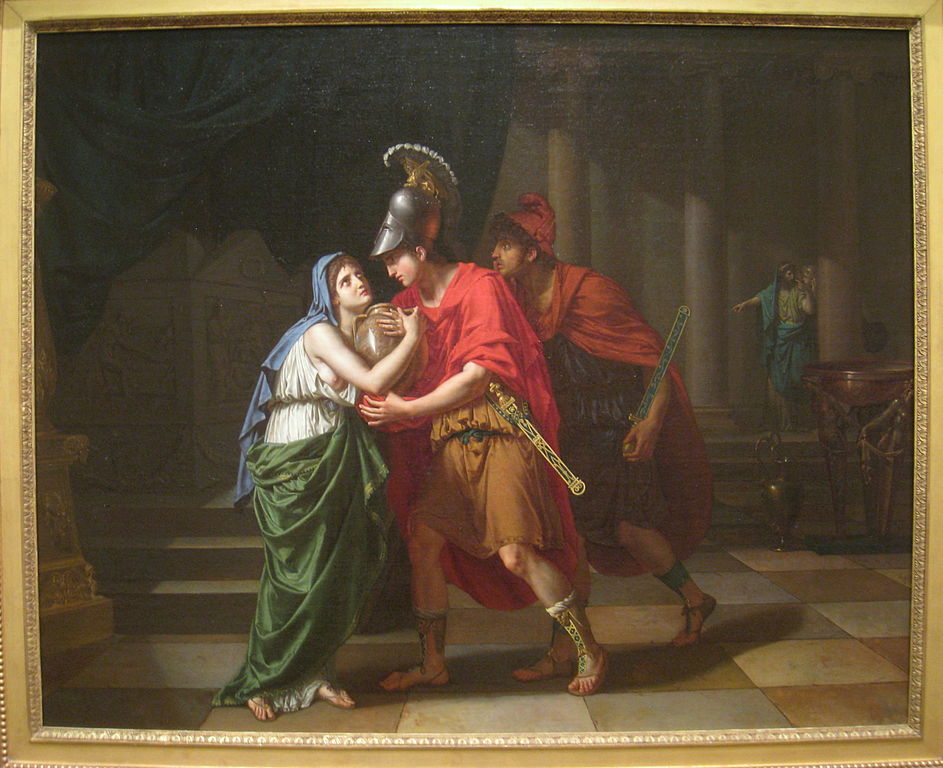
Electra Receiving the Ashes of her Brother Orestes by Jean-Baptiste Joseph Wicar

Electra Receiving the Ashes of her Brother Orestes by Jean-Baptiste Joseph Wicar

Synopsis

Dramatis Personae

  • ORESTES, son of Agamemnon and Clytemnestra

  • ELECTRA, sister of Orestes

  • CHRYSOTHEMIS, sister of Orestes

  • AN OLD MAN, formerly the Paedagogus or Attendant of Orestes

  • CLYTEMNESTRA

  • AEGISTHUS

  • CHORUS OF WOMEN OF MYCENAE

  • PYLADES, son of Strophius, King of Phocis, and friend of Orestes

As background to the play, King Agamemnon of Mycenae had returned from the Trojan War with his new concubine, Cassandra. His wife, Clytemnestra, who had borne a grudge against Agamemnon for many years since he had sacrificed their daughter Iphigenia at the start of the Trojan War in order to placate the gods, and who had in the meantime taken Agamemnon's ambitious cousin Aegisthus as a lover, killed both Agamemnon and Cassandra.

Orestes, Agamemnon and Clytemnestra's infant son, was sent abroad to Phocis for his own safety, while his sister Electra remained in Mycenae (although more or less reduced to the status of servant), as did their younger sister Chrysothemis (who, however, did not protest or look for vengeance against their mother and Aegisthus).
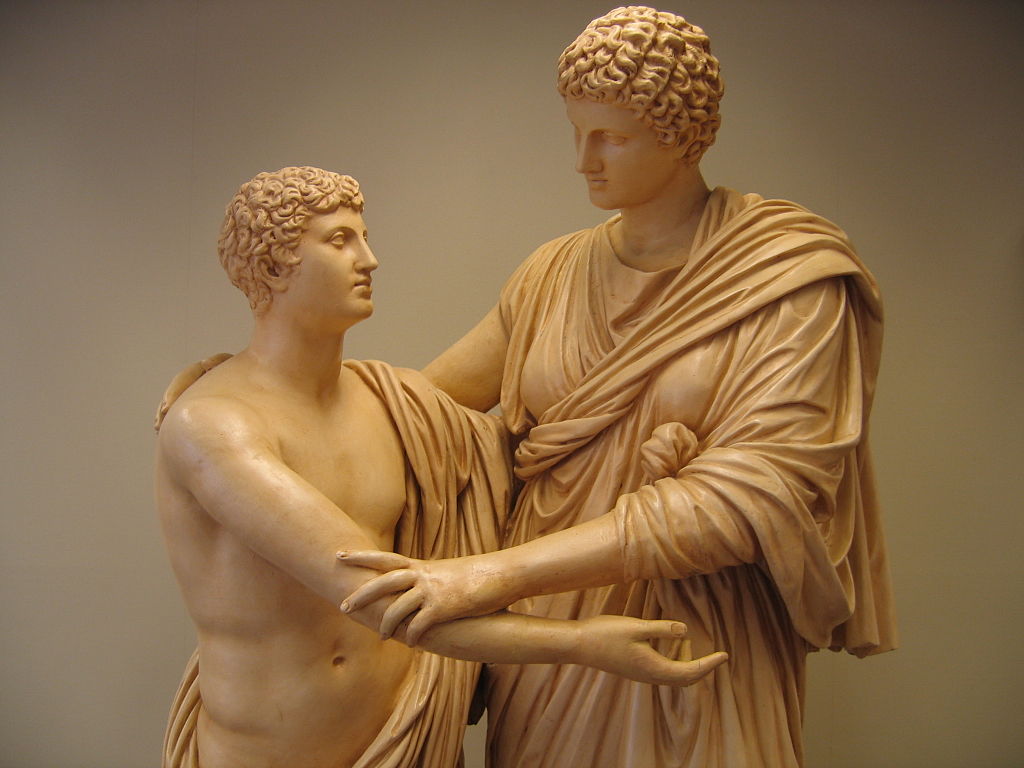
Statue of Orestes and Electra, ancient Greek sculpture

Statue of Orestes and Electra

As the play begins, many years after Agamemnon's death, Orestes, now a grown man, arrives in Mycenae in secret with his friend Pylades of Phocis and an old attendant or tutor. They hatch a plan to gain entrance to Clytemnestra's palace by announcing that Orestes was dead, and that the two men (really Orestes and Pylades) are arriving to deliver an urn with his remains.

Electra has never come to terms with her father Agamemnon's murder, and laments his death to the Chorus of Mycenaean women. She argues bitterly with her sister Chrysothemis over her accommodation with her father's killers, and with her mother, whom she had never forgiven for the murder. Her only hope is that one day her brother Orestes will return to avenge Agamemnon.

When the messenger (the old man of Phocis) arrives with news of the death of Orestes, therefore, Electra is devastated, although Clytemnestra is relieved to hear it. Chrysothemis mentions that she has seen some offerings and a lock of hair at Agamemnon's tomb and concludes that Orestes must have returned, but Electra dismisses her arguments, convinced that Orestes is now dead. Electra proposes to her sister that it is now up to them to kill their hated step-father Aegisthus, but Chrysothemis refuses to help, pointing out the impracticability of the plan.

When Orestes arrives at the palace, carrying the urn supposedly containing his own ashes, he does not recognize Electra at first, nor she him. Belatedly realizing who she is, though, Orestes reveals his identity to his emotional sister, who almost betrays his identity in her excitement and joy that he is alive.

With Electra now involved in their plan, Orestes and Pylades enter the house and slay his mother, Clytemnestra, while Electra keeps watch for Aegisthus. They hide her corpse under a sheet and present it to Aegisthus when he returns home, claiming it to be the body of Orestes. When Aegisthus lifts the veil to discover his dead wife, Orestes reveals himself, and the play ends as Aegisthus is escorted off to be killed at the hearth, the same location Agamemnon was slain.
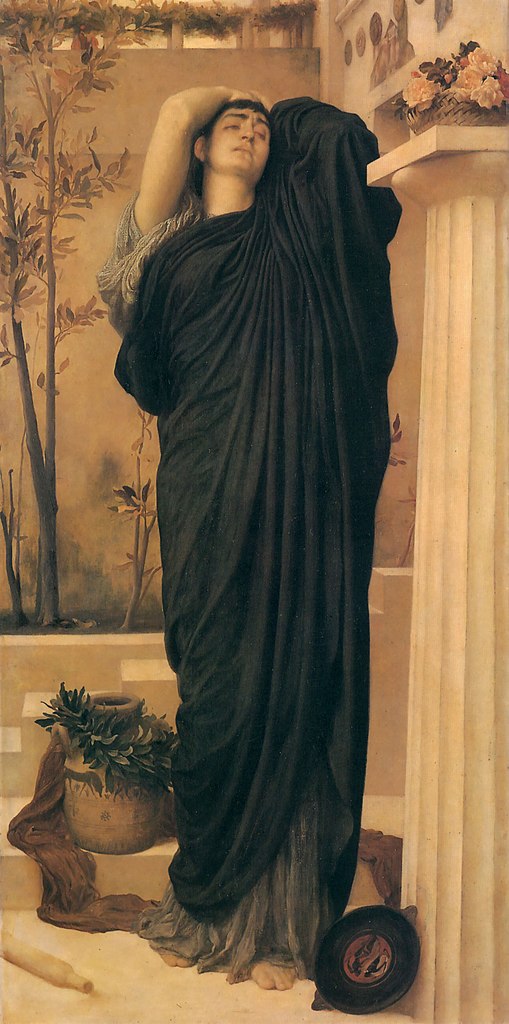
Electra at the Tomb of Agamemnon by Frederic Leighton

Electra at the Tomb of Agamemnon by Frederic Leighton

Analysis

The story is based on "The Nostoi", a lost epic of ancient Greek literature and part of the "Epic Cycle", roughly covering the period between Homer's "The Iliad" and his "The Odyssey". It is a variant on the story told by Aeschylus in "The Libation Bearers" (part of his "Oresteia" trilogy) some forty years earlier. Euripides also wrote an "Electra" play at around the same time as Sophocles, although there are significant differences between the two plots, despite being based on the same basic story.

Electra is widely considered to be Sophocles' best character drama, due to the thoroughness of its examination of the morals and motives of Electra herself. Where Aeschylus told the story with an eye to the ethical issues associated, Sophocles (like Euripides) addresses the problem of character, and asks what kind of woman would want so keenly to kill her mother.

Electra as a person is very emotional and stubbornly devoted to the principles of justice, reverence and honour (even if sometimes her grasp on these principles seems questionable). Orestes, on the other hand, is portrayed as a naive and inexperienced youth, acting more because he has been so instructed by Apollo's oracle than due to any intense or deep emotion. Chrysothemis is less emotional and more detached than Electra, and clings to the principle of expediency in the hopes of maximizing her own comfort and profit.

The Chorus of the play, comprised in this case of the virgins of the Mycenae palace, is traditionally reserved and conservative, although this Chorus abandons its conventional stance to whole-heartedly support both Electra and the play's final act of vengeance.

The main themes explored through the play include the conflict between justice and expediency (as embodied in the characters of Electra and Chrysothemis respectively); the effects of revenge on its perpetrator (as the moment of revenge approaches, Electra grows increasingly irrational, demonstrating a questionable grasp on the very principle of justice by which she claims to be motivated); and the degrading effects of dishonour.

Sophocles acknowledges the "bad" sides of the "heroes" and the "good" sides of the "villains", in effect blurring the distinctions between these two categories and lending the play a morally ambiguous tone. Many scholars are divided over whether Electra's victory over her mother represents the triumph of justice or the downfall (even madness) of Electra.

Resources

  • English translation by F. Storr (Internet Classics Archive): http://classics.mit.edu/Sophocles/electra.html

  • Greek version with word-by-word translation (Perseus Project): Perseus Digital Library

By Timeless Myths

Sophocles:

  • • Ajax
  • • Antigone
  • • The Trachiniae
  • • Oedipus Rex
  • • Electra
  • • Philoctetes
  • • Oedipus at Colonus
Electra

Electra

(Tragedy, Greek, c. 418 BCE, 1,359 lines) Introduction | Synopsis | Analysis | ResourcesIntroduction "Electra" (Gr: "Elektra") is a tragedy by the ancient Greek playwright Euripides. It tells the tale of Electra and her brother, Orestes, as they t...

October 25th, 2024 • Timeless Myths
Electra

Electra

Electra (Ἠλέκτρη) was the long-suffering heroine of a number of Athenian tragedies. She appeared in the 2nd play of Aeschylus' tragedy titled Libation Bearers. Then there are two other plays both bearing her name – one written by Sophocles and the...

June 22nd, 2003 • Jimmy Joe
Electra

Electra

One of the Pleiades; a daughter of Atlas and Pleïone. Zeus lusted after Electra and spirited her to Olympus. Electra tried to prevent Zeus from raping her by running away and hiding behind the Palladium, a wooden image of Pallas, Athena's childhoo...

August 31st, 2002 • Jimmy Joe
Medea

Medea

(Tragedy, Latin/Roman, c. 50 CE, 1,027 lines)Introduction "Medea" is one of the best known of the tragedies of Roman playwright Seneca the Younger, completed around 50 CE or possibly earlier. It tells the story of the revenge of the enchantress Me...

October 25th, 2024 • Timeless Myths
Orestes

Orestes

(Tragedy, Greek, c. 407 BCE, 1,629 lines) Introduction | Synopsis | Analysis | ResourcesIntroduction "Orestes" is a late tragedy by the ancient Greek playwright Euripides, first presented in 408 BCE. It continues the story of Orestes after the eve...

October 25th, 2024 • Timeless Myths
Helen (Euripides)

Helen (Euripides)

(Tragedy, Greek, 412 BCE, 1,692 lines)Introduction "Helen" (Gr: "Elene"; Lat: "Helena") is a tragedy by the ancient Greek playwright Euripides, first produced in 412 BCE for the annual Dionysia competition in Athens. Although technically a tragedy...

October 25th, 2024 • Timeless Myths
Euripides

Euripides

(Tragic Playwright, Greek, c. 480 – c. 406 BCE)Introduction Euripides was the last of the three great tragedians of classical Greece (the other two being Aeschylus and Sophocles). Largely due to an accident of history, eighteen of Euripides' ninet...

October 24th, 2024 • Timeless Myths
Phaedra

Phaedra

(Tragedy, Latin/Roman, c. 50 CE, 1,280 lines)Introduction "Phaedra" (sometimes known as "Hippolytus") is a tragedy by the Roman playwright Seneca the Younger, written around 50 CE. Adapted from "Hippolytus" by Euripides, it tells the story of Phae...

October 25th, 2024 • Timeless Myths
The Oresteia

The Oresteia

(Tragedy, Greek, 458 BCE, 3,796 lines over 3 plays)Introduction - Who Wrote Oresteia "The Oresteia" trilogy by the ancient Greek playwright Aeschylus consists of the three linked plays "Agamemnon", "The Libation Bearers" and "The Eumenides". The t...

January 1st, 2025 • Ancient Literature
The Trachiniae

The Trachiniae

(Tragedy, Greek, c. 440 BCE, 1,278 lines)Introduction “The Trachiniae” (Gr: “Trachiniai”, also known as “The Trachinian Women”, “The Women of Trachis” or “The Maidens of Trachis”) is a tragedy by the ancient Greek playwright Sophocles. It was prob...

January 1st, 2025 • Ancient Literature
Timeless Myths

Exploring mythology and legends from around the world.

Explore Myths

All Stories Characters All Articles Search Site Map

Mythologies

Norse Mythology Classical Mythology Celtic Mythology Arthurian Legends Mythology Gods Ancient Literature

About Us

Introduction About Jimmy Bibliography FAQs Retro Version

Resources

Timeless Myths All Stories All Articles Characters
© 1999-2026 Timeless Myths • Copyright • Privacy Policy • Cookie Policy • Contact
Follow us: