Timeless Myths Logo

Explore myths and legends from cultures around the world

Featured

Classical Mythology
Classical Mythology Greek and Roman myths, gods, heroes, and epic tales
Norse Mythology
Norse Mythology Vikings, Asgard, Ragnarok, and the nine realms
Celtic Mythology
Celtic Mythology Irish, Welsh, and Gaelic legends and folklore
Ancient Literature
Ancient Literature Classical texts, translations, and literary analysis

All Mythologies

Arthurian Legends King Arthur, Camelot, the Round Table, and the Holy Grail Egyptian Mythology Pharaohs, pyramids, and ancient Nile deities Japanese Mythology Shinto gods, spirits, and legendary creatures Chinese Mythology Dragons, immortals, and celestial beings Aztec Mythology Mesoamerican gods, rituals, and creation myths

Discover gods and goddesses from every pantheon

Featured

Greek Gods
Greek Gods The Olympians, Titans, and primordial deities
Norse Gods
Norse Gods Odin, Thor, Loki, and the Aesir and Vanir
Egyptian Gods
Egyptian Gods Ra, Osiris, Isis, Anubis, and more
Japanese Gods
Japanese Gods Amaterasu, Susanoo, and Shinto kami

All Gods & Deities

Roman Gods Jupiter, Mars, Venus, and the Roman pantheon Celtic Gods The Tuatha Dé Danann and Celtic deities Aztec Gods Quetzalcoatl, Tezcatlipoca, and Aztec deities Chinese Gods Jade Emperor, Dragon Kings, and celestial beings View All 150+ Deities Browse the complete collection of mythological deities
View all gods & deities

Tales, legends, and character profiles from mythology

Featured

All Stories
All Stories Browse 800+ mythology and history stories
Characters
Characters Profiles of 67 mythological heroes, gods, and villains

All Stories

Mythology Stories Ancient myths and legends retold History Stories Historical tales from ancient civilizations Religion & Culture Religious traditions and cultural beliefs
View all stories

Tools, references, and site information

Featured

Name Generators
Name Generators Generate fantasy and mythology-inspired names
All Articles
All Articles Browse 1,800+ articles on mythology and history

All Resources

About Timeless Myths Learn about this mythology resource Bibliography Sources and references used on this site FAQ Frequently asked questions Contact Get in touch with us
Search
Classical Mythology Greek and Roman myths, gods, heroes, and epic tales Norse Mythology Vikings, Asgard, Ragnarok, and the nine realms Celtic Mythology Irish, Welsh, and Gaelic legends and folklore Arthurian Legends King Arthur, Camelot, the Round Table, and the Holy Grail Egyptian Mythology Pharaohs, pyramids, and ancient Nile deities Japanese Mythology Shinto gods, spirits, and legendary creatures Chinese Mythology Dragons, immortals, and celestial beings Aztec Mythology Mesoamerican gods, rituals, and creation myths Ancient Literature Classical texts, translations, and literary analysis
Greek Gods The Olympians, Titans, and primordial deities Roman Gods Jupiter, Mars, Venus, and the Roman pantheon Norse Gods Odin, Thor, Loki, and the Aesir and Vanir Egyptian Gods Ra, Osiris, Isis, Anubis, and more Celtic Gods The Tuatha Dé Danann and Celtic deities Aztec Gods Quetzalcoatl, Tezcatlipoca, and Aztec deities Japanese Gods Amaterasu, Susanoo, and Shinto kami Chinese Gods Jade Emperor, Dragon Kings, and celestial beings View All 150+ Deities Browse the complete collection of mythological deities View all gods & deities
All Stories Browse 800+ mythology and history stories Characters Profiles of 67 mythological heroes, gods, and villains Mythology Stories Ancient myths and legends retold History Stories Historical tales from ancient civilizations Religion & Culture Religious traditions and cultural beliefs View all stories
Name Generators Generate fantasy and mythology-inspired names All Articles Browse 1,800+ articles on mythology and history About Timeless Myths Learn about this mythology resource Bibliography Sources and references used on this site FAQ Frequently asked questions Contact Get in touch with us
Search Search the entire mythology archive
  1. Classical Mythology
    Pantheon Heroic Age Royal Houses Geographia Facts & Figures Genealogy Bibliography About Classical Myths
  2. Royal Houses
    Aeolids House of Elis & Calydon Houses of Argolis House of Pelops Minoan Crete House of Thebes House of Sparta House of Athens Heraclids House of Troy Tales of Rome
  3. House of Pelops
    Tantalus Pelops Atreus and Thyestes Agamemnon Orestes Tisamenus Pittheus Alcathous
  4. Orestes

Orestes

  • Revenge and Madness

  • Iphigeneia among the Taurians

  • King of Argos and Sparta

Revenge and Madness

Orestes was the King of Argos and Sparta, and the son of Agamemnon and Clytemnestra. Orestes (Ὀρέστης) was brother of Iphigeneia, Electra and Chrysothemis.

There are several variations of what happened after Agamemnon's death, different from Aeschylus' plays — how Orestes avenged his father and what happened to Orestes.

For eight years, Strophius, the king of Phocis, reared Orestes. Orestes befriended Pylades, Strophius' son. When Orestes consulted the oracle in Delphi, he was told to avenge his father's death by killing Aegisthus (Aigisthos) and his mother.
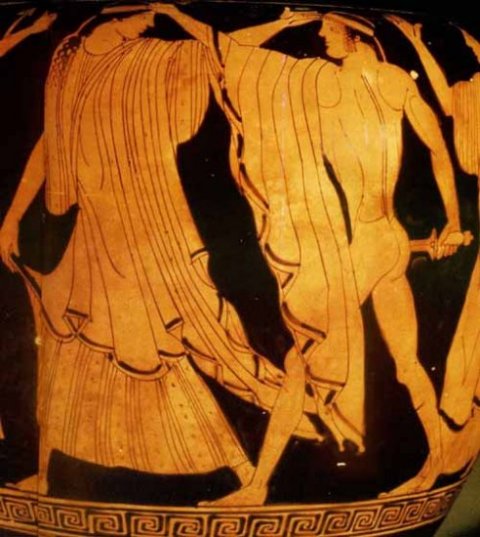
Orestes Slaying Aegisthus

Orestes Slaying Aegisthus
Amphor with black figures, 5th
century BC
British Museum, London

Forced into a dilemma, Orestes returned to Argos with Pylades where he was reunited with his sister, Electra (Ἠλέκτρη). Electra helped him decide to follow the oracle's instructions. With Pylades, he murdered Aegisthus and despite pleas for mercy from his mother, Orestes also killed Clytemnestra.

The Furies (Erinyes) immediately afflicted Orestes with madness for murdering a blood kin, his mother. Though Clytemnestra had plotted with her lover to murder Orestes' father, she did not actually kill him. Even if Orestes did not murder his mother, he would still be afflicted with madness by the Erinyes for not fully avenging his father's death. Such was the duality of the Erinyes' nature.

After wandering from place to place, he sought help from Delphi again. Apollo sent him to Athens to be tried by the Athenian jury, presided over by the goddess Athena. Though the jury was evenly divided on his guilt or innocence, Athena decided to acquit Orestes of murder. To prevent the Erinyes from continuing to persecute Orestes and to restore his sanity, she introduced the worship of the Erinyes in Athens.

The Erinyes (Furies) then became known as the Eumenides, which means the "Kindly Ones".

Sophocles and Euripides also both wrote plays titled Electra. According to Sophocles' play, Electra waited outside while Orestes murdered their mother. According to Euripides, Electra took a far more aggressive role, urging him on and actively helping her brother to kill their mother.

According to another play by Euripides titled Orestes, Tyndareüs arrested Orestes and Electra for murdering his daughter Clytemnestra. Tyndareus was going to try Orestes and Electra and they would have been sentenced to death, but the brother and sister escaped. The pair tried to kill Helen, but Zeus spirited his daughter away, so they took their cousin Hermione, daughter of Menelaüs and Helen, as hostage. At this point Apollo intervened, sentencing Orestes to live in exile for a year before being tried and acquitted in Athens.

Iphigeneia among the Taurians

Another story by Euripides said that he would continue to suffer from madness inflicted by the Erinyes unless he brought back a wooden image of Artemis from the land of the Taurians, north of the Black Sea. The Taurians, like the Colchians, were known for hostilities to foreigners. The Taurians were known to perform human sacrifices upon foreigners to the goddess Artemis.

Accompanied by his loyal friend Pylades, they were soon captured. The two prisoners were brought to the high priestess Iphigeneia (Ἰφιγένεια), Orestes' sister. Neither knew the other's identity until Orestes told his stories. Reunited with his long lost sister, they planned to escape and return home with the statue. They would have been killed by the Taurians had the goddess not intervened on her brother's behalf (Apollo's).

Iphigeneia's return home would have ended in tragedy, according to Hyginus. Electra heard untrue news that Iphigeneia had sacrificed their brother. Electra, in a fit of rage, would have blinded her older sister with a firebrand, but Orestes arrived just in time to intervene.

King of Argos and Sparta

Cured of the madness and no longer persecuted by the Erinyes, Orestes returned to Mycenae. Aletes, son of Clytemnestra and Aegisthus, was ruling Mycenae during Orestes' absence. He had Aletes murdered and Orestes became king of Mycenae. Not long after he ruled Mycenae, Orestes seized the throne from his neighbouring kingdom, Argos, from Cylarabes (). Cylarabes was a descendant of Proëtus (Proetus or Proitos).

Before the war with Troy began, Agamemnon and Menelaüs (Menelaus) had decided to arrange a marriage between Orestes and his cousin Hermione (Ἑρμιόνη), daughter of Menelaüs and Helen. But during his exile in Phocis and later the persecution and madness from the Erinyes, Hermione instead was married to Neoptolemus (Νεοπτόλεμος), son of Achilles and Deïdaemeia, upon their return from Troy. Orestes' jealousy led him to have Neoptolemus murdered. Orestes would have also killed Neoptolemus' sons (Molossus, Pielus and Pergamus) by his Trojan concubine Andromache, had they not been rescued by their great-grandfather Peleus.

By marrying his cousin, Orestes also became the king of Sparta. He ruled two powerful kingdoms, Argos and Sparta. By Hermione, he became the father of Tisamenus. Orestes died in Oresteion, a place named after him in Arcadia, when he was bitten by a snake.

Fifty years after the death of Hyllus, the exiled Heraclids (descendants of Heracles) invaded the Peloponnesus under the leadership of Aristomachus, grandson of Hyllus. Orestes defeated the Heraclids, and Aristomachus was killed in one of the raids. The Heraclids withdrew from the Peloponnesus again and would not return until Orestes' son Tisamenus was ruling both Argos and Sparta.

See the Heraclids, for more detail about the Heraclids' return from exile.

According to a later legend told by Herodotus, Orestes' bone was buried in Tegea, Arcadia. Sparta was at war against the Tegeans and sought advice from the oracle in Delphi. They learned that they could never capture Tegea unless they found the bones of Orestes and re-bury him in Sparta. The Spartans sent a spy to Tegea, and the spy learned that Orestes was buried under the anvil of the blacksmith in Tegea. He recovered the bones and brought them to Sparta. From that point, Sparta captured Tegea, and Arcadia came under the hegemony of Sparta.

Related Information

Name

Orestes, Ὀρέστης.

Sources

The Odyssey, written by Homer.

The Cypria and Nostoi ("The Returns") were part of the Epic Cycle.

Libation Bearers and the Eumenides were written by Aeschylus.

Electra, written by Sophocles.

The following works were written by Euripides:
   Iphigeneia Among the Taurians.
   Orestes.
   Electra.
   Andromache.

Pythian XI was written by Pindar.

Epitome, written by Apollodorus.

Fabulae was written by Hyginus.

Contents

Revenge and Madness
Iphigeneia among the Taurians
King of Argos and Sparta

Related Articles

Agamemnon, Clytemnestra, Aegisthus, Iphigeneia, Electra, Neoptolemus, Peleus, Cylarabes, Temenus, Furies (Erinyes).

Apollo, Artemis, Athena.

Jimmy Joe Timeless Myths

By Jimmy Joe

House of Pelops:

  • • Tantalus
  • • Pelops
  • • Atreus and Thyestes
  • • Agamemnon
  • • Orestes
  • • Tisamenus
  • • Pittheus
  • • Alcathous
Orestes

Orestes

(Tragedy, Greek, c. 407 BCE, 1,629 lines) Introduction | Synopsis | Analysis | ResourcesIntroduction "Orestes" is a late tragedy by the ancient Greek playwright Euripides, first presented in 408 BCE. It continues the story of Orestes after the eve...

October 25th, 2024 • Timeless Myths
Electra

Electra

Electra (Ἠλέκτρη) was the long-suffering heroine of a number of Athenian tragedies. She appeared in the 2nd play of Aeschylus' tragedy titled Libation Bearers. Then there are two other plays both bearing her name – one written by Sophocles and the...

June 22nd, 2003 • Jimmy Joe
Agamemnon

Agamemnon

Agamemnon Iphigeneia in Aulis Murder of AgamemnonAgamemnon According to Homer, Agamemnon (Ἀγαμέμνων) and his brother Menelaüs (Menalaus) were the sons of Atreus and Aerope, the daughter of Catreus of Crete. The two sons of Atreus were known as the...

August 23rd, 2003 • Jimmy Joe
The Oresteia

The Oresteia

(Tragedy, Greek, 458 BCE, 3,796 lines over 3 plays)Introduction - Who Wrote Oresteia "The Oresteia" trilogy by the ancient Greek playwright Aeschylus consists of the three linked plays "Agamemnon", "The Libation Bearers" and "The Eumenides". The t...

January 1st, 2025 • Ancient Literature
Argos after the Trojan War

Argos after the Trojan War

Diomedes, a son of Tydeus, was captain of the Argives forces at Troy and brought eighty ships with him from Argos, Tiryns, Epidaurus and Troezen. His lieutenants Sthenelus, son of Capaneus, and Euryalus, son of Mecisteus, accompanied him. All thre...

April 24th, 1999 • Jimmy Joe
Oedipus

Oedipus

Laïus (Laius or Laios; Λάιος) became the king of Thebes after the death of Amphion and Zethus. He married Jocasta (Ἰοκάστη; some authors call her Epicasta), daughter of Menoeceus and sister of Creon. Laius had at one time visited Pelops, king of P...

May 6th, 1999 • Jimmy Joe
Atreus and Thyestes

Atreus and Thyestes

During Perseus' reign, Pelops was king of Pisa while his wife Hippodaemia bore him many children, including Pittheus (king of Troezen), Atreus (Ἀτρεύς) and Thyestes (Θυέσης). Pelops cleverly married most of his daughters to the sons of Perseus: As...

August 23rd, 2003 • Jimmy Joe
Erinyes (Furies)

Erinyes (Furies)

Female spirits who punished offenders against blood kin. The Erinyes (Ἐρινύες) were named Alector, Tisiphone and Megaera. They were born together with the Giants and the Meliae, from the earth where blood landed from the severed genitals of Uranus...

September 29th, 2002 • Jimmy Joe
House of Pelops

House of Pelops

Children of Pelops House of AtreusChildren of Pelops The family tree of Pelops displays his descendants, such as Agamemnon, Menelaus and Orestes. Several of his daughters were married into Perseus' family, so also see the House of Perseus. You wil...

July 28th, 1999 • Jimmy Joe
Neoptolemus

Neoptolemus

Neoptolemus (Νεοπτόλεμος) was the son of Achilles and Deidameia, the daughter of King Lycomedes of Scyrus. Achilles was staying in Lycomedes' court on the island of Scyrus, where he met Deiddameia. Achilles slept with Deidameia so that Neoptolemus...

April 24th, 1999 • Jimmy Joe
Timeless Myths

Exploring mythology and legends from around the world.

Explore Myths

All Stories Characters All Articles Search Site Map

Mythologies

Norse Mythology Classical Mythology Celtic Mythology Arthurian Legends Mythology Gods Ancient Literature

About Us

Introduction About Jimmy Bibliography FAQs Retro Version

Resources

Timeless Myths All Stories All Articles Characters
© 1999-2026 Timeless Myths • Copyright • Privacy Policy • Cookie Policy • Contact
Follow us: