Timeless Myths Logo
Aphrodite Apollo Ares Artemis Athena Atlas Coeus Crius Cronus Demeter Dionysus Gaia Hades Hephaestus Hera Hermes Hestia Hyperion Iapetus Mnemosyne Oceanus Phobos Phoebe Poseidon Prometheus Rhea Tethys Themis Uranus Zeus
Bacchus Ceres Diana Juno Jupiter Mars Mercury Minerva Neptune Pluto Venus Vesta Vulcan
Amun Anubis Aten Atum Babi Bastet Bes Geb Hapi hathor heqet Horus Isis Khepri Khnum Khonsu Maat Nephthys Nut Osiris Ptah Ra Seshat Seth Shu Sobek Thoth
Alfheim Baldur Freya Freyr Frigg Heimdallr Helheim Idun Jotunheim Loki Nerthus Njord Odin Thor Tyr
Aengus Arawn Badb Brigid Cailleach Ceridwen Cernunnos Cu Chulainn Dagda Danu Gwydion Herne the Hunter Lugh Medb Morrigan Neit Nuada Taliesin Taranis
Chalchiuhtlicue Coatlicue Huitzilopochtli Mictlantecuhtli Mixcoatl Ometeotl Quetzalcoatl Tezcatlipoca Tlaloc Tonatiuh Xipe Totec Xochiquetzal Xolotl
Amaterasu Ame no Uzume Benzaiten Bishamonten Daikokuten Ebisu Fujin Fukurokuju Inari Izanagi Kagutsuchi Raijin Susanoo Tsukuyomi
Caishen Cangjie Dragon King Eight Immortals Erlang Shen Fuxi Guanyin Hou Yi Huxian Jade Emperor King Yama Leizi Lu-ban Mazu Nezha Nuwa Pangu Shennong Sun Wukong Xiwangmu Yue Lao Zhong Kui
Norse Classical Celtic Arthurian
Literature Stories Names
Aphrodite Apollo Ares Artemis Athena Atlas Coeus Crius Cronus Demeter Dionysus Gaia Hades Hephaestus Hera Hermes Hestia Hyperion Iapetus Mnemosyne Oceanus Phobos Phoebe Poseidon Prometheus Rhea Tethys Themis Uranus Zeus
Bacchus Ceres Diana Juno Jupiter Mars Mercury Minerva Neptune Pluto Venus Vesta Vulcan
Amun Anubis Aten Atum Babi Bastet Bes Geb Hapi hathor heqet Horus Isis Khepri Khnum Khonsu Maat Nephthys Nut Osiris Ptah Ra Seshat Seth Shu Sobek Thoth
Alfheim Baldur Freya Freyr Frigg Heimdallr Helheim Idun Jotunheim Loki Nerthus Njord Odin Thor Tyr
Aengus Arawn Badb Brigid Cailleach Ceridwen Cernunnos Cu Chulainn Dagda Danu Gwydion Herne the Hunter Lugh Medb Morrigan Neit Nuada Taliesin Taranis
Chalchiuhtlicue Coatlicue Huitzilopochtli Mictlantecuhtli Mixcoatl Ometeotl Quetzalcoatl Tezcatlipoca Tlaloc Tonatiuh Xipe Totec Xochiquetzal Xolotl
Amaterasu Ame no Uzume Benzaiten Bishamonten Daikokuten Ebisu Fujin Fukurokuju Inari Izanagi Kagutsuchi Raijin Susanoo Tsukuyomi
Caishen Cangjie Dragon King Eight Immortals Erlang Shen Fuxi Guanyin Hou Yi Huxian Jade Emperor King Yama Leizi Lu-ban Mazu Nezha Nuwa Pangu Shennong Sun Wukong Xiwangmu Yue Lao Zhong Kui
Norse Classical Celtic Arthurian
Literature Stories Names
  1. Classical Literature
    Greece Rome Other Ancient Civilizations Timeline of Classical Literature Alphabetical List of Authors Index of Individual Works Index of Important Characters Sources About Us
  2. Rome
    Catullus Vergil (Virgil) Horace Ovid Seneca the Younger Lucan Juvenal Pliny the Younger
  3. Seneca the Younger
    Medea Phaedra Hercules Furens Troades (The Trojan Women) Agamemnon Oedipus Apocolocyntosis Thyestes Phoenissae (The Phoenician Women)
  4. Troades (The Trojan Women)

Troades (The Trojan Women)

(Tragedy, Latin/Roman, c. 54 CE, 1,179 lines)

Introduction

"Troades" ("The Trojan Women") is one of the best-known tragedies of the Roman playwright Seneca the Younger, probably written around 54 CE. Largely based on "The Trojan Women" and "Hecuba" by Euripides, the play explores the folly of war, focussing on the trials of the royal family of the fallen city of Troy (Hecuba, Andromache and their children) as they mourn their past and current sufferings, and the continued assault of the Greeks on the survivors as they look to sacrifice two of the royal progeny, Polyxena and Astyanax.

Synopsis

Dramatis Personae

  • AGAMEMNON, king of Argos

  • PYRRHUS, son of Achilles

  • ULYSSES, king of Ithaca

  • CALCHAS, a priest and prophet

  • TALTHYBIUS, a Greek messenger

  • AN OLD MAN

  • ASTYANAX, little son of Hector and Andromache

  • HECUBA, widow of King Priam of Troy

  • ANDROMACHE, widow of Hector

  • HELENA, wife of Menelaus, king of Sparta
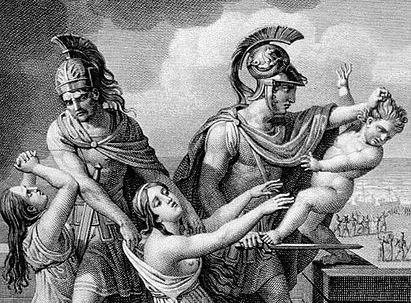
Trojan women mourning after the city's fall

Trojan women lamenting their fate after the fall of Troy

The play opens with Queen Hecuba mourning the misfortunes that have fallen on her and on her city of Troy. She has lost her husband, many of her children, her royalty and her freedom, and it soon becomes apparent that she is about to lose another daughter and a grandson. The Chorus of Trojan women echo her words.

Pyrrhus, the son of Achilles, intends to sacrifice Hecuba’s daughter Polyxena, in order to assuage the spirit of his late father. Agamemnon, fully aware from his own experience of how the guilt of such actions can come back to haunt a man, argues against this murder. Pyrrhus says there is no law forbidding the killing of a prisoner, but Agamemnon says that shame may forbid it even if the law does not. The prophet Calchas, however, insists that Fate has decreed that the Trojan princess must die.
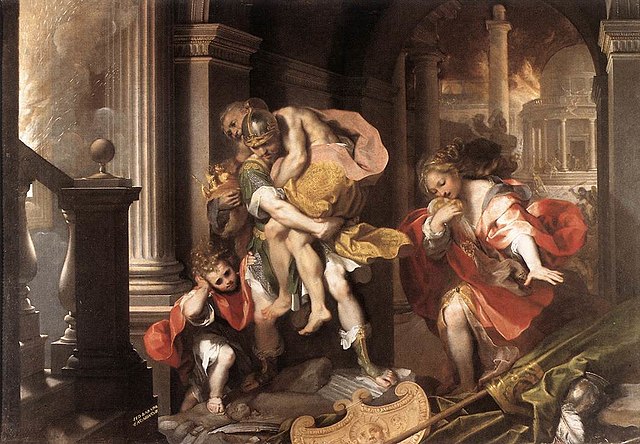
Aeneas carrying Anchises and leading his family away from burning Troy

Aeneas fleeing the burning city with his family

Meanwhile, in a parallel storyline, Andromache tries to hide her little son Astyanax from Ulysses (Odysseus), who has come to kill him too, worried that a royal heir of Troy may later seek revenge against the Greeks. The wily Ulysses eventually succeeds in getting the boy when he threatens to disturb the sacred grave of Andromache’s husband Hector, where she has hidden the child. She condemns Ulysses for blaming the prophet and the innocent gods for his own actions.

Helen then appears and propounds the lie that Polyxena is to be married to Achilles’ son, Pyrrhus. Finally, a messenger describes how the boy Astyanax bravely leaped to his death from the high walls of Troy, and how the princess Polyxena was stabbed by Pyrrhus. Having lost everything, Hecuba declares that the war is now over, once and for all, and the play draws to a close.

Analysis

"Troades" is one of Seneca’s best known and most highly regarded plays, and it was a strong influence on Elizabethan English playwrights like Jonson, Webster, Marlowe and Shakespeare, as well as French writers like Corneille and Racine. Whether or not Seneca’s plays were originally designed for performance in the theatre or merely for recitation remains unknown, but what is certain is that they have been performed many times since the Renaissance and are still being performed today.

Although based in large part on Euripides’ much earlier play of the same name, Seneca’s version adds the story of the murder of both Polyxena and Astyanax from "Hecuba", as well as a sinister, supernatural element which suffuses the whole work, making it most unlike Euripides’ original and calling for it to be examined on its own terms.
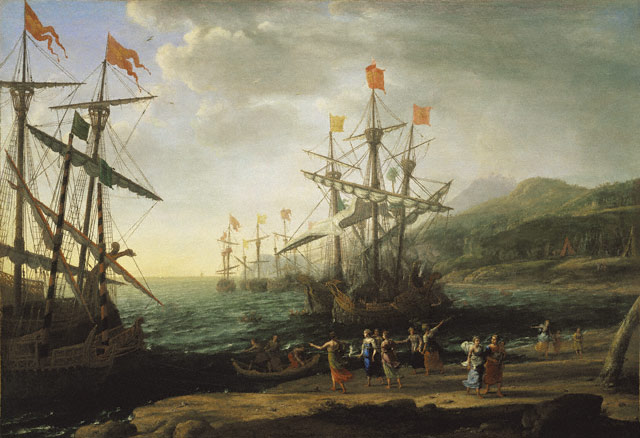
Trojan women setting fire to the Greek fleet

A depiction of the Trojan women setting fire to the Greek fleet

In addition to Euripides, Seneca also mobilizes elements of Catullus (especially "Catullus 64"), Vergil (Virgil)’s "Aeneid" (Books 2 and 3) and Ovid’s "Metamorphoses" (especially Books 12 and 13). To some extent, the Roman dramatist was using Greek material to comment obliquely on the specifically Roman outrages of Nero’s court and to describe a world that he saw as radically evil, and his plays therefore tend to be even more bleak and pessimistic than most Greek tragedies, and might almost be termed religious drama.

The play has a clear cyclic structure and symmetrical elements. The outermost ring or frame is that of Hecuba, who introduces the play in the prologue and provides a bitter summary of the events at the end; within that is Polyxena, who is included towards the beginning of the play as one of the Trojan women to be distributed among their Greek captors, and whose death occurs right before Hecuba’s final lament; the story of little Astyanax forms a third ring, as his death is foreseen by the seer Calchas early on and actually carried out just before Polyxena’s death.

There is no one dominant character in the play, rather a series of double or parallel characters: Hecuba – Andromache (the two lead female roles, mothers of the victims); Astyanax – Polyxena (the two young victims); Agamemnon – Andromache (who have parallel roles in their attempts to save the victims); Pyrrhus – Ulysses (their antagonists in their attempts to destroy the victims); Ulysses – Helen (both thwarted by Andromache); Hector – Achilles (warrior-heroes of their respective sides); Hector – Astyanax (past and potential defender of Troy); Achilles – Pyrrhus (past and present destroyers of Troy); etc.

Hecuba is perhaps the closest thing to a central figure in the play and, despite her long absences, she does contribute to the unity and atmosphere of the play. However, Andromache plays the primary role in Acts 3 and 4, and certainly has the longest stage presence and the most lines in the play overall.
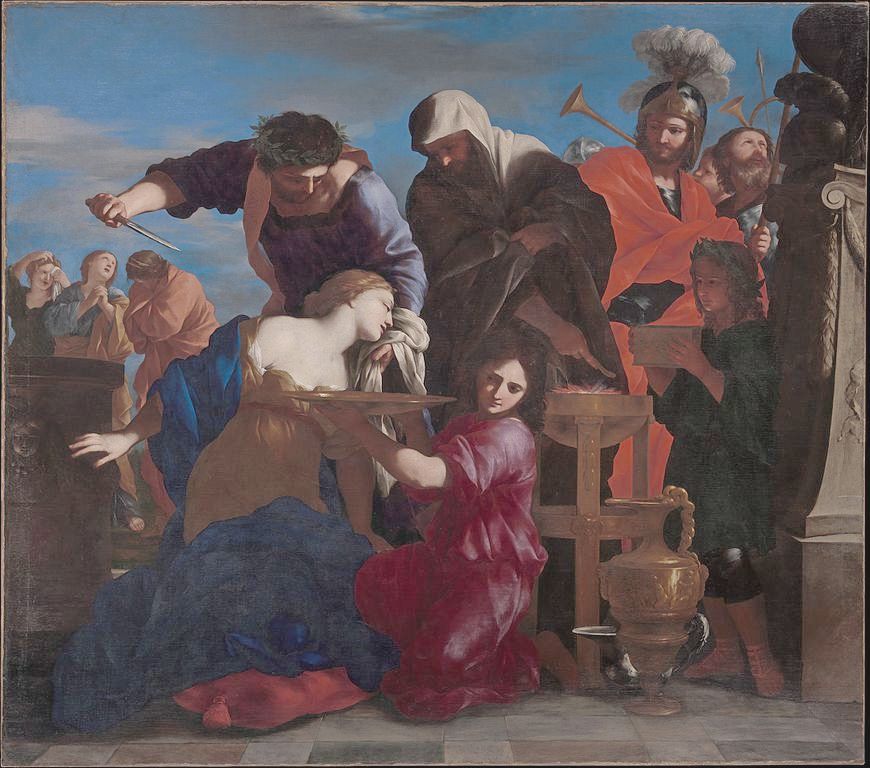
Polyxena taken to the altar for sacrifice

Polyxena led to sacrifice by the Greeks

A major theme in "Troades" is the fickleness and arbitrariness of fortune and the gods, and the resulting unstable position and apparent callousness of those in power, a theme mentioned by several of the characters, including Hecuba, Agamemnon and the messenger. Another theme is the cyclical nature of history, the many associations of the present with the past, and the many parallels of events and personalities.

The single main theme of the play, though, is death and dissolution, especially exemplified by the many losses suffered by Hecuba. Special attention is given by the Stoic Seneca to the brave attitudes of the characters in the face of their deaths, and death is presented more than once as a kind of liberation or moral transcendence.

The link between marriage and death is also explored: marriage, a ceremony that is supposed to promote life, is also shown to cause destruction and death, from the initial “marriage” of Helen and Paris which sparked the Trojan War, to Polyxena’s ill-fated proposed union with Pyrrhus and her subsequent “marriage to death”.

Resources

  • English translation by Frank Justus Miller (Theoi.com): http://www.theoi.com/Text/SenecaTroades.html

  • Latin version (Google Books): http://books.google.ca/books?id=m_JVQzsJrloC&lpg=PA94&ots=CoZIJUetco&dq=seneca%20troades%20latin&pg=PA37

By Timeless Myths

Seneca the Younger:

  • • Medea
  • • Phaedra
  • • Hercules Furens
  • • Troades (The Trojan Women)
  • • Agamemnon
  • • Oedipus
  • • Apocolocyntosis
  • • Thyestes
  • • Phoenissae (The Phoenician Women)
The Trojan Women

The Trojan Women

(Tragedy, Greek, 415 BCE, 1,332 lines)Introduction "The Trojan Women" (Gr: "Troädes") is a tragedy by the ancient Greek playwright Euripides. It was first presented at the City Dionysia of 415 BCE, along with two other unconnected tragedies, "Alex...

October 25th, 2024 • Timeless Myths
The Trachiniae

The Trachiniae

(Tragedy, Greek, c. 440 BCE, 1,278 lines)Introduction “The Trachiniae” (Gr: “Trachiniai”, also known as “The Trachinian Women”, “The Women of Trachis” or “The Maidens of Trachis”) is a tragedy by the ancient Greek playwright Sophocles. It was prob...

January 1st, 2025 • Ancient Literature
Phoenissae (The Phoenician Women)

Phoenissae (The Phoenician Women)

(Tragedy, Latin/Roman, c. 65 CE, 664 lines)Introduction "Phoenissae" ("The Phoenician Women") is a (possibly incomplete) tragedy by the Roman playwright Seneca the Younger, probably written between about 62 and 65 CE. Based on earlier plays by Eur...

October 25th, 2024 • Timeless Myths
The Phoenician Women

The Phoenician Women

"The Phoenician Women" (Gr: "Phoinissai"; Lat: "Phoenissae") is a tragedy by the ancient Greek playwright Euripides. It was written between 411 and 409 BCE, and is a variant of the story Aeschylus treated in his play "Seven Against Thebes" in whic...

October 25th, 2024 • Timeless Myths
Helen (Euripides)

Helen (Euripides)

(Tragedy, Greek, 412 BCE, 1,692 lines)Introduction "Helen" (Gr: "Elene"; Lat: "Helena") is a tragedy by the ancient Greek playwright Euripides, first produced in 412 BCE for the annual Dionysia competition in Athens. Although technically a tragedy...

October 25th, 2024 • Timeless Myths
Euripides

Euripides

(Tragic Playwright, Greek, c. 480 – c. 406 BCE)Introduction Euripides was the last of the three great tragedians of classical Greece (the other two being Aeschylus and Sophocles). Largely due to an accident of history, eighteen of Euripides' ninet...

October 24th, 2024 • Timeless Myths
Heracles (Euripides)

Heracles (Euripides)

(Tragedy, Greek, c. 416 BCE, 1,428 lines)Introduction "Heracles" or "The Madness of Heracles" (Gr: "Herakles Mainomenos"; Lat: "Hercules Furens") is a tragedy by the ancient Greek playwright Euripides. It describes the frenzy of divinely induced m...

October 25th, 2024 • Timeless Myths
Iphigenia in Tauris

Iphigenia in Tauris

"Iphigenia in Tauris" or "Iphigenia among the Taurians" (Gr: "Iphigeneia en Taurois") is a tragedy, although sometimes described as a romance or melodrama, by the ancient Greek playwright Euripides, written sometime between 414 BCE and 412 BCE. It...

October 25th, 2024 • Timeless Myths
The Oresteia

The Oresteia

(Tragedy, Greek, 458 BCE, 3,796 lines over 3 plays)Introduction - Who Wrote Oresteia "The Oresteia" trilogy by the ancient Greek playwright Aeschylus consists of the three linked plays "Agamemnon", "The Libation Bearers" and "The Eumenides". The t...

January 1st, 2025 • Ancient Literature
The Suppliants

The Suppliants

(Tragedy, Greek, 423 BCE, 1,234 lines)Introduction "The Suppliants" (also known as "The Suppliant Women"; Gr: "Hiketides"; Lat: "Supplices") is a tragedy by the ancient Greek playwright Euripides, first produced in 423 BCE. Not to be confused with...

October 25th, 2024 • Timeless Myths
Timeless Myths

Exploring mythology and legends from around the world.

Explore Myths

All Stories Characters All Articles Search Site Map

Mythologies

Norse Mythology Classical Mythology Celtic Mythology Arthurian Legends Mythology Gods Ancient Literature

About Us

Introduction About Jimmy Bibliography FAQs Retro Version

Resources

Timeless Myths All Stories All Articles Characters
© 1999-2026 Timeless Myths • Copyright • Privacy Policy • Cookie Policy • Contact
Follow us: