Timeless Myths Logo
Aphrodite Apollo Ares Artemis Athena Atlas Coeus Crius Cronus Demeter Dionysus Gaia Hades Hephaestus Hera Hermes Hestia Hyperion Iapetus Mnemosyne Oceanus Phobos Phoebe Poseidon Prometheus Rhea Tethys Themis Uranus Zeus
Bacchus Ceres Diana Juno Jupiter Mars Mercury Minerva Neptune Pluto Venus Vesta Vulcan
Amun Anubis Aten Atum Babi Bastet Bes Geb Hapi hathor heqet Horus Isis Khepri Khnum Khonsu Maat Nephthys Nut Osiris Ptah Ra Seshat Seth Shu Sobek Thoth
Alfheim Baldur Freya Freyr Frigg Heimdallr Helheim Idun Jotunheim Loki Nerthus Njord Odin Thor Tyr
Aengus Arawn Badb Brigid Cailleach Ceridwen Cernunnos Cu Chulainn Dagda Danu Gwydion Herne the Hunter Lugh Medb Morrigan Neit Nuada Taliesin Taranis
Chalchiuhtlicue Coatlicue Huitzilopochtli Mictlantecuhtli Mixcoatl Ometeotl Quetzalcoatl Tezcatlipoca Tlaloc Tonatiuh Xipe Totec Xochiquetzal Xolotl
Amaterasu Ame no Uzume Benzaiten Bishamonten Daikokuten Ebisu Fujin Fukurokuju Inari Izanagi Kagutsuchi Raijin Susanoo Tsukuyomi
Caishen Cangjie Dragon King Eight Immortals Erlang Shen Fuxi Guanyin Hou Yi Huxian Jade Emperor King Yama Leizi Lu-ban Mazu Nezha Nuwa Pangu Shennong Sun Wukong Xiwangmu Yue Lao Zhong Kui
Norse Classical Celtic Arthurian
Literature Stories Names
Aphrodite Apollo Ares Artemis Athena Atlas Coeus Crius Cronus Demeter Dionysus Gaia Hades Hephaestus Hera Hermes Hestia Hyperion Iapetus Mnemosyne Oceanus Phobos Phoebe Poseidon Prometheus Rhea Tethys Themis Uranus Zeus
Bacchus Ceres Diana Juno Jupiter Mars Mercury Minerva Neptune Pluto Venus Vesta Vulcan
Amun Anubis Aten Atum Babi Bastet Bes Geb Hapi hathor heqet Horus Isis Khepri Khnum Khonsu Maat Nephthys Nut Osiris Ptah Ra Seshat Seth Shu Sobek Thoth
Alfheim Baldur Freya Freyr Frigg Heimdallr Helheim Idun Jotunheim Loki Nerthus Njord Odin Thor Tyr
Aengus Arawn Badb Brigid Cailleach Ceridwen Cernunnos Cu Chulainn Dagda Danu Gwydion Herne the Hunter Lugh Medb Morrigan Neit Nuada Taliesin Taranis
Chalchiuhtlicue Coatlicue Huitzilopochtli Mictlantecuhtli Mixcoatl Ometeotl Quetzalcoatl Tezcatlipoca Tlaloc Tonatiuh Xipe Totec Xochiquetzal Xolotl
Amaterasu Ame no Uzume Benzaiten Bishamonten Daikokuten Ebisu Fujin Fukurokuju Inari Izanagi Kagutsuchi Raijin Susanoo Tsukuyomi
Caishen Cangjie Dragon King Eight Immortals Erlang Shen Fuxi Guanyin Hou Yi Huxian Jade Emperor King Yama Leizi Lu-ban Mazu Nezha Nuwa Pangu Shennong Sun Wukong Xiwangmu Yue Lao Zhong Kui
Norse Classical Celtic Arthurian
Literature Stories Names
  1. Classical Literature
    Greece Rome Other Ancient Civilizations Timeline of Classical Literature Alphabetical List of Authors Index of Individual Works Index of Important Characters Sources About Us
  2. Rome
    Catullus Vergil (Virgil) Horace Ovid Seneca the Younger Lucan Juvenal Pliny the Younger
  3. Catullus
    Passer, deliciae meae puellae (Catullus 2) Catullus 5 Miser Catulle, desinas ineptire (Catullus 8) Odi et amo (Catullus 85) Catullus Translations
  4. Catullus 5

Catullus 5

(Lyric Poem, Latin/Roman, c. 65 BCE, 13 lines)

Introduction

"Vivamus, mea Lesbia, atque amemus" ("Let us live, my Lesbia, and let us love") is a passionate love poem by the Roman lyric poet Catullus, often referred to as "Catullus 5" or "Carmina V" for its position in the generally accepted catalogue of Catullus works. It dates from around 65 BCE and is perhaps the best known of all the poet's output, and is sometimes considered among the greatest love poems ever written. The poem encourages lovers to ignore the comments of others, and to live only for each other, since life is all too brief and death brings on a night of perpetual sleep.

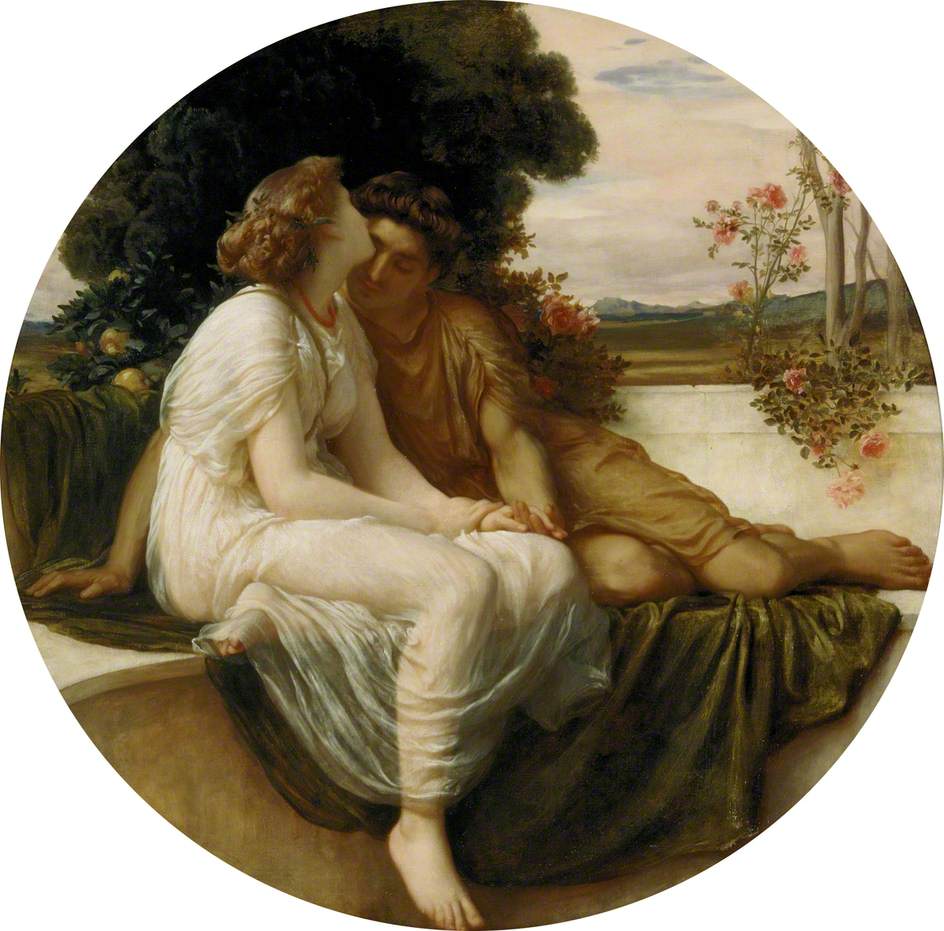
Catullus reading poetry to Lesbia

Catullus reading poetry to Lesbia

Synopsis

The poem begins by calling on the poet's love, Lesbia, to scorn the rumours and insinuations of others, counselling that they should live their short lives to the full before the eternal night of death arrives. He then asks Lesbia to bestow on him innumerable kisses, so many that they lose count and the wicked and the jealous will not be able to call them to account for them.

Analysis

The poem is is one of Catullus first writings about Lesbia, clearly written at a very passionate stage of the affair. "Lesbia", the subject of many of Catullus poems, seems to have been an alias for Clodia, the wife of the eminent Roman statesman, Clodius. The reference to rumours in the second and third lines probably refers to gossip going around the Roman Senate that Catullus was having an affair with Clodia, and Catullus urges Clodia to disregard what people are saying about them, so she can spend more time with him.
Vivamus, mea Lesbia, atque amemus - Latin text of Catullus 5

Vivamus, mea Lesbia, atque amemus - the opening line of Catullus 5

It is written in hendecasyllabic metre (each line has eleven syllables), a common form in Catullus poetry. It abounds in liquid consonants and there is much elision of vowels, so that, read aloud, the poem is truly beautiful.

It can be seen as comprising two parts: the first six lines (down to "nox est perpetua una dormienda") being a kind of breathless seduction, and the following seven lines representing the resulting love-making, rising to an orgasmic climax with the exploding 'b's of 'conturbabimus illa' and then coasting to a quiescent close in the final two lines.

Interestingly, his mention of the "brief light" of life and the "perpetual night" of death in line 6 suggests a rather pessimistic view of life and a belief in no afterlife, a belief which would have been at odds with most Romans of the time. His mention of the "evil eye" in line 12 is linked to the (commonly held) belief in witchcraft, particularly the idea that, if the evil one knew of certain numbers relevant to the victim (in this case the number of kisses) any spell against them would be much more effective.

As one of Catullus most celebrated poems, translated and imitated many times over the centuries, its influence can be traced forward to the poetry of the medieval troubadours as well as to many later authors of the Romantic school of the 19th Century. There have been many derivations from it (the English poets Marlowe, Campion, Jonson, Raleigh and Crashaw, to name just a few, wrote imitations of it), some more subtle than others.

Resources

  • Latin original and literal English translation (WikiSource): https://en.wikisource.org/wiki/Catullus_5

  • Audio reading of the original Latin (Classical Latin): http://jcmckeown.com/audio/la5103d1t06.php

By Timeless Myths

Catullus:

  • • Passer, deliciae meae puellae (Catullus 2)
  • • Catullus 5
  • • Miser Catulle, desinas ineptire (Catullus 8)
  • • Odi et amo (Catullus 85)
  • • Catullus Translations
Catullus 4 Translation

Catullus 4 Translation

Introduction In this poem, Catullus writes about a yacht that once was the best of all ships. He describes her as being the fleetest and that no other boat could match her speed with both oars or with sails. In lines six through nine, Catullus wri...

January 1st, 2025 • Ancient Literature
Catullus 55 Translation

Catullus 55 Translation

Introduction In Catullus 55, the poet is busy searching for his friend Camerius. In the first two lines, he asks his friend to show him what dark corner he is hiding in. In lines three through five, he tells where he has already looked, including ...

January 1st, 2025 • Ancient Literature
Catullus 50 Translation

Catullus 50 Translation

Introduction Catullus 50 tells of a lively poetry writing session between Catullus and his friend Licinius Calvus, as well as lethargy and ennui Catullus feels afterward. It has a mocking tone which is apparent by the use of urbane language as wel...

January 1st, 2025 • Ancient Literature
Catullus 6 Translation

Catullus 6 Translation

Introduction This poem is written to Flavius about his mistress who Catullus calls unrefined and rustic. She is not of the city, according to Catullus. Since she is unrefined, Flavius does not tell her about Catullus. And, Catullus thinks that Fla...

January 1st, 2025 • Ancient Literature
Catullus 3 Translation

Catullus 3 Translation

Introduction In Catullus 3, the poet shares that his girl’s sparrow has died. This is a reference to his lover, Lesbia, who had a pet sparrow. And, according to Catullus, she loved this sparrow more than she loved her own eyes. This sparrow seemed...

January 1st, 2025 • Ancient Literature
Catullus 95 Translation

Catullus 95 Translation

Introduction Catullus is friends with interesting people, like the poet Cinna. In this poem, Cinna spent nine harvests-tides and winters writing a book titled Smyrna. Another man, Hortensius, who is an orator who occasionally wrote poetry publishe...

January 1st, 2025 • R.D.M
Catullus 26 Translation

Catullus 26 Translation

Introduction Catullus addresses Furius in this poem. The exact relationship between Furius and Catullus is uncertain, but some thing that Furius is a rival poet who may have had an affair with Juventius who was one of Catullus’s lovers. Catullus i...

January 1st, 2025 • R.D.M
Catullus 65 Translation

Catullus 65 Translation

Introduction In this poem, Catullus discusses his brother’s death, but the reader doesn’t learn this until line six. In the first five lines, Catullus writes about his grief and sorrow, and how those emotions get in the way of the Muses giving him...

January 1st, 2025 • Timeless Myths
Catullus 9 Translation

Catullus 9 Translation

Introduction In this poem, Catullus shares the joy he has because of his friendship to Veranius. In the first two lines, Catullus talks about how he prefers Veranius over the 3,000 other friends. In the next two lines, he asks Veranius if he has r...

January 1st, 2025 • Ancient Literature
Catullus 31 Translation

Catullus 31 Translation

Introduction In this poem, Catullus wrote about a place that he loved to visit: Sirmio. This is a promontory off of Lake Garda where Catullus seemed to have had a home. There are ruins there that many believe belonged to Catullus. In this poem, it...

January 1st, 2025 • Ancient Literature
Timeless Myths

Exploring mythology and legends from around the world.

Explore Myths

All Stories Characters All Articles Search Site Map

Mythologies

Norse Mythology Classical Mythology Celtic Mythology Arthurian Legends Mythology Gods Ancient Literature

About Us

Introduction About Jimmy Bibliography FAQs Retro Version

Resources

Timeless Myths All Stories All Articles Characters
© 1999-2026 Timeless Myths • Copyright • Privacy Policy • Cookie Policy • Contact
Follow us: