Timeless Myths Logo
Aphrodite Apollo Ares Artemis Athena Atlas Coeus Crius Cronus Demeter Dionysus Gaia Hades Hephaestus Hera Hermes Hestia Hyperion Iapetus Mnemosyne Oceanus Phobos Phoebe Poseidon Prometheus Rhea Tethys Themis Uranus Zeus
Bacchus Ceres Diana Juno Jupiter Mars Mercury Minerva Neptune Pluto Venus Vesta Vulcan
Amun Anubis Aten Atum Babi Bastet Bes Geb Hapi hathor heqet Horus Isis Khepri Khnum Khonsu Maat Nephthys Nut Osiris Ptah Ra Seshat Seth Shu Sobek Thoth
Alfheim Baldur Freya Freyr Frigg Heimdallr Helheim Idun Jotunheim Loki Nerthus Njord Odin Thor Tyr
Aengus Arawn Badb Brigid Cailleach Ceridwen Cernunnos Cu Chulainn Dagda Danu Gwydion Herne the Hunter Lugh Medb Morrigan Neit Nuada Taliesin Taranis
Chalchiuhtlicue Coatlicue Huitzilopochtli Mictlantecuhtli Mixcoatl Ometeotl Quetzalcoatl Tezcatlipoca Tlaloc Tonatiuh Xipe Totec Xochiquetzal Xolotl
Amaterasu Ame no Uzume Benzaiten Bishamonten Daikokuten Ebisu Fujin Fukurokuju Inari Izanagi Kagutsuchi Raijin Susanoo Tsukuyomi
Caishen Cangjie Dragon King Eight Immortals Erlang Shen Fuxi Guanyin Hou Yi Huxian Jade Emperor King Yama Leizi Lu-ban Mazu Nezha Nuwa Pangu Shennong Sun Wukong Xiwangmu Yue Lao Zhong Kui
Norse Classical Celtic Arthurian
Literature Stories Names
Aphrodite Apollo Ares Artemis Athena Atlas Coeus Crius Cronus Demeter Dionysus Gaia Hades Hephaestus Hera Hermes Hestia Hyperion Iapetus Mnemosyne Oceanus Phobos Phoebe Poseidon Prometheus Rhea Tethys Themis Uranus Zeus
Bacchus Ceres Diana Juno Jupiter Mars Mercury Minerva Neptune Pluto Venus Vesta Vulcan
Amun Anubis Aten Atum Babi Bastet Bes Geb Hapi hathor heqet Horus Isis Khepri Khnum Khonsu Maat Nephthys Nut Osiris Ptah Ra Seshat Seth Shu Sobek Thoth
Alfheim Baldur Freya Freyr Frigg Heimdallr Helheim Idun Jotunheim Loki Nerthus Njord Odin Thor Tyr
Aengus Arawn Badb Brigid Cailleach Ceridwen Cernunnos Cu Chulainn Dagda Danu Gwydion Herne the Hunter Lugh Medb Morrigan Neit Nuada Taliesin Taranis
Chalchiuhtlicue Coatlicue Huitzilopochtli Mictlantecuhtli Mixcoatl Ometeotl Quetzalcoatl Tezcatlipoca Tlaloc Tonatiuh Xipe Totec Xochiquetzal Xolotl
Amaterasu Ame no Uzume Benzaiten Bishamonten Daikokuten Ebisu Fujin Fukurokuju Inari Izanagi Kagutsuchi Raijin Susanoo Tsukuyomi
Caishen Cangjie Dragon King Eight Immortals Erlang Shen Fuxi Guanyin Hou Yi Huxian Jade Emperor King Yama Leizi Lu-ban Mazu Nezha Nuwa Pangu Shennong Sun Wukong Xiwangmu Yue Lao Zhong Kui
Norse Classical Celtic Arthurian
Literature Stories Names
  1. Classical Literature
    Greece Rome Other Ancient Civilizations Timeline of Classical Literature Alphabetical List of Authors Index of Individual Works Index of Important Characters Sources About Us
  2. Rome
    Catullus Vergil (Virgil) Horace Ovid Seneca the Younger Lucan Juvenal Pliny the Younger
  3. Horace
    Carmen Saeculare Ars Poetica Tu ne quaesieris (Odes, Book 1, Poem 11) Nunc est bibendum (Odes, Book 1, Poem 37)
  4. Nunc est bibendum (Odes, Book 1, Poem 37)
    Nunc est bibendum (Odes, Book 1, Poem 37)

Nunc est bibendum (Odes, Book 1, Poem 37)

(Lyric Poem, Latin/Roman, c. 30 BCE, 32 lines)

Introduction
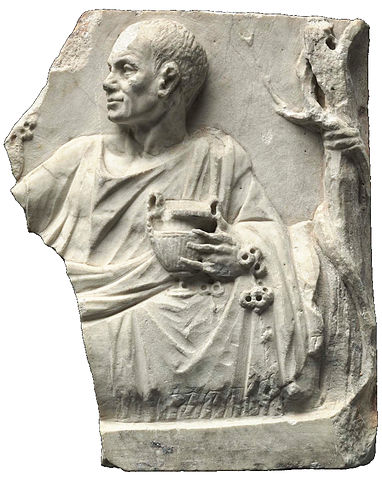
Portrait relief of Quintus Horatius Flaccus (Horace)

Portrait of Horace

"Nunc est bibendum" ("Now is the time for drinking"), sometimes known as the "Cleopatra Ode", is one of the most famous of the odes of the Roman lyric poet Horace, published in 23 BCE as Poem 37 in the first book of Horace's collected "Odes" or "Carmina". The poem is a song of triumph over the defeat and death of Queen Cleopatra of Egypt, and probably dates from the autumn of 30 BCE, when the news of Cleopatra's suicide reached Rome.

Synopsis

The poet exults that now is the time for drinking, dancing and celebration. Although such festivities would have been wrong before, while Cleopatra still posed a threat to Rome, it is now appropriate to bring out the vintage Caecuban wine and to honour the gods with a Salian-style banquet.

He describes how Octavian burned most of Cleopatra's ships and then pursued her back to Egypt in her single remaining ship. However, Cleopatra had the nobility to face up to her defeat, and ended her life with some dignity, taking snake poison rather than facing the indignity of capture and slavery.

Analysis
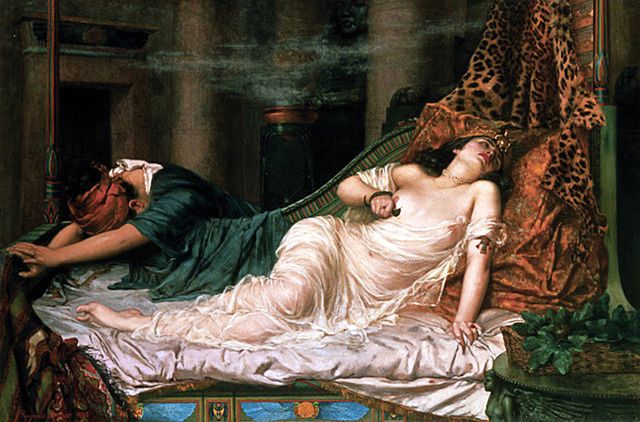
The Death of Cleopatra painting

The Death of Cleopatra

Horace developed his "Odes" in conscious imitation of the short lyric poetry of Greek originals such as Pindar, Sappho and Alcaeus. His genius lay in applying these older forms, largely using the ancient Greek Sapphic and Alcaic metres, to the social life of Rome in the age of Augustus. The first three books of the "Odes", including this one, were published in 23 BCE. "Nunc est bibendum" is the earliest positively-dated poem in the collection, almost certainly dating from the autumn of 30 BCE, when the news of Cleopatra's suicide reached Rome.

The poem focuses on Octavian's defeat of Mark Antony and Cleopatra at the Battle of Actium and the subsequent death of Cleopatra, but it does not mention Mark Anthony at all. Some commentators have hazarded that this was an attempt to portray the conflict as the termination of a foreign threat and not as the resolution of an ongoing civil war. In fact, Cleopatra herself, the subject of the poem, is not actually named as such in the ode either, but is clearly referred to throughout as "the queen".

The first five stanzas are a somewhat gloating celebration of the defeat of Cleopatra, whom Horace describes at one point as a "fatale monstrum" (actually better translated as "doom-bringing portent" rather than "fatal monster"). The final three stanzas, however, change quite radically in their tone and focus, stressing Cleopatra's nobility in the face of defeat. This is probably more an attempt on Horace's part to be magnanimous in victory rather than a demonstration of any ambivalence over Octavian's victory as some have suggested, and it does seem that Horace intended his audience to see both sides of Cleopatra.

Resources

  • English translation by John Conington (Perseus Project): http://www.perseus.tufts.edu/hopper/text.jsp?doc=Perseus:text:1999.02.0025:book=1:poem=37

  • Latin version with word-by-word translation (Perseus Project): http://www.perseus.tufts.edu/hopper/text.jsp?doc=Perseus:text:1999.02.0024:book=1:poem=37

By Timeless Myths

Horace:

  • • Carmen Saeculare
  • • Ars Poetica
  • • Tu ne quaesieris (Odes, Book 1, Poem 11)
  • • Nunc est bibendum (Odes, Book 1, Poem 37)
Tu ne quaesieris (Odes, Book 1, Poem 11)

Tu ne quaesieris (Odes, Book 1, Poem 11)

(Lyric Poem, Latin/Roman, c. 23 BCE, 8 lines)Introduction "Tu ne quaesieris" ("Do not ask") is the most famous of the odes of the Roman lyric poet Horace, published in 23 BCE as Poem 11 in the first book of Horace's collected "Odes" or "Carmina". ...

October 25th, 2024 • Timeless Myths
Odi et amo (Catullus 85)

Odi et amo (Catullus 85)

(Epigram/Elegiac Couplet, Latin/Roman, c. 65 BCE, 2 lines)Introduction "Odi et amo" ("I hate and I love") is a short poem or epigram by the Roman lyric poet Catullus, written in elegiac couplet form sometime around 65 BCE. It is often referred to ...

October 25th, 2024 • Timeless Myths
Catullus 79 Translation

Catullus 79 Translation

Introduction In several of Catullus’s poems, he wrote about his love for Lesbia. In this one, he addresses Lesbia’s brother, who he calls Lesbius. He refers to Lesbius as a pretty boy, and Catullus claims that Lesbia likes her brother better than ...

January 1st, 2025 • Ancient Literature
Catullus 96 Translation

Catullus 96 Translation

Introduction Catullus often wrote verses about his friends and this is one of those poems. He wrote about the death of his friend Calvus and his love, Quintilla. The way the poem is written, it seems as though both are dead and they are enjoying t...

January 1st, 2025 • Ancient Literature
Catullus 97 Translation

Catullus 97 Translation

Introduction This is another poem that many readers find offensive. In it, Catullus writes about a disgusting person named Aemilius. The first two lines make the reader wonder where Catullus is going with this because he says it doesn’t matter if ...

January 1st, 2025 • R.D.M
Catullus 90 Translation

Catullus 90 Translation

Introduction This is another one of Catullus’s poems that focuses on the man he hates: Gellius. In this one, he addresses Gellius’s incestuous relationship with his mother. In the poem, Catullus talks about the relationships resulting in the birth...

January 1st, 2025 • Ancient Literature
Catullus 37 Translation

Catullus 37 Translation

Introduction This poem is about men who visit brothels. In the first line, Catullus talks about people who visit them, and some of them are men who are in the service of the gods. They work in the temples. They think they are the only ones who hav...

January 1st, 2025 • Ancient Literature
Catullus 26 Translation

Catullus 26 Translation

Introduction Catullus addresses Furius in this poem. The exact relationship between Furius and Catullus is uncertain, but some thing that Furius is a rival poet who may have had an affair with Juventius who was one of Catullus’s lovers. Catullus i...

January 1st, 2025 • R.D.M
Catullus 39 Translation

Catullus 39 Translation

Introduction In this poem, Catullus writes about Egnatius, who is a man that had an affair with Lesbia. He was supposedly from Spain and Catullus gossiped that the man washed his teeth with urine. This poem is about the man who had good taste in w...

January 1st, 2025 • Ancient Literature
Catullus 40 Translation

Catullus 40 Translation

Introduction In this poem, Catullus accuses Ravidus for trying to mock or ridicule his poems. Catullus begins the poem by asking what Ravidus is doing by driving headlong into his poems. He uses the word “infatuation” to mock Ravidus, but he wonde...

January 1st, 2025 • Ancient Literature
Timeless Myths

Exploring mythology and legends from around the world.

Explore Myths

All Stories Characters All Articles Search Site Map

Mythologies

Norse Mythology Classical Mythology Celtic Mythology Arthurian Legends Mythology Gods Ancient Literature

About Us

Introduction About Jimmy Bibliography FAQs Retro Version

Resources

Timeless Myths All Stories All Articles Characters
© 1999-2026 Timeless Myths • Copyright • Privacy Policy • Cookie Policy • Contact
Follow us: