What Do the Muses Do for Hesiod? His Encounter With the Muses
What do the muses do for Hesiod becaus he is regarded as one of the greatest Greek poets that lived as evidenced by his literary works, especially the Theogony. The Theogony is an extensive account of the origins and genealogies of the Greek deities – from the primordial to the demigods. Many scholars admire the details and his poetic style but Hesiod attributes his skill to the Muses, but what did the Muses do for Hesiod? Keep reading to find out.
What Do the Muses Do for Hesiod?
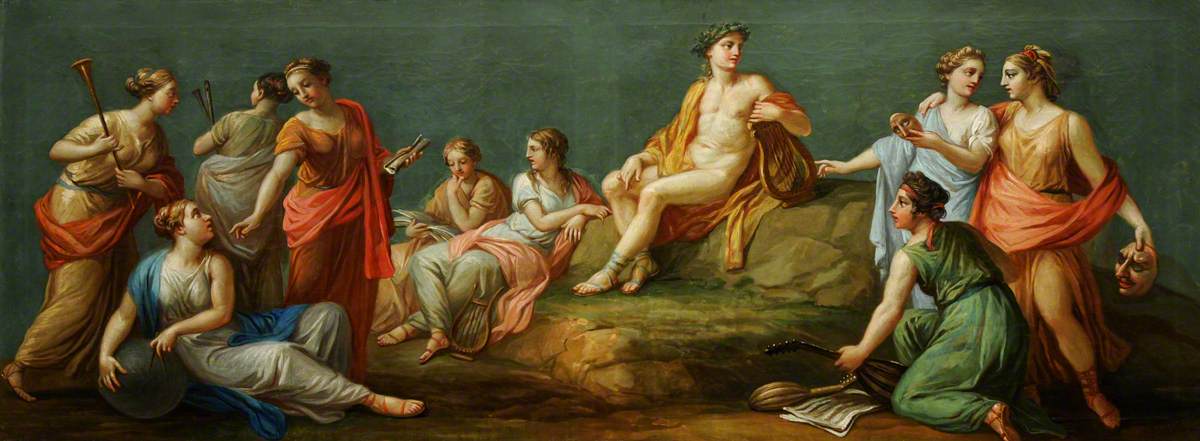
Hesiod narrated that the nine Muses gave him the gift of poetry and blessed him with a beautiful voice to sing their praises. However, an encounter with the Muses changed his life forever and according to him, the goddesses taught him the origins and genealogies of the gods.
He met these Muses on Mount Helicon where he was tending his father's sheep. However, before he met the Muses, Hesiod said he was a man with no skill in poetry, oratory, or writing.
How Did He Encounter the Muses?
As already stated, Hesiod claimed he encountered the Muses on Mount Helicon where they used to take occasional breaks from their work on Mount Olympus. According to him, the Muses amused themselves while on the mountain with songs and dances and sometimes went for a swim in the glassy streams. Hesiod's admiration for the beautiful deities led to an encounter with them and the rest is history.
Some skeptics believe that Hesiod didn't have direct contact with the muses, rather he was influenced by the stories of the poets who visited his city, Boetia. He then improved on these oral traditions while shepherding his father's flock on Mount Helicon and became great at it. However, others think that the Muses appeared to Hesiod in a moment of epiphany and blessed him with great poetry skills.
What Does Hesiod Want the Muses to Tell Him?
According to Hesiod, he wanted the Muses to tell him the truth albeit wrapped with embellishments to make his mythologies exciting.
Who Were the Muses?
The Muses were daughters of Zeus, the chief god, and his wife Mnemosyne, the goddess of memory. They included Clio, Calliope, Melpomene, Erato, Polyhymnia, Thalia, Urania, Terpsichore and Euterpe. Together, the deities oversaw science, the arts and literature but individually the Muses had their specific dominions.
Clio was the goddess of history, Erato was the Muse of erotic poetry, Calliope was in charge of epic poetry while Euterpe presided over music. Melpomene was the muse of tragedy, Polyhymnia was the goddess of sacred hymns, and Terpsichore oversaw dance and supervised comedy. The last muse, Urania, was the goddess of astronomy and the stars.
The Number of Muses
Initially, there was confusion as to how many Muses are there. The Muses were originally three and were worshipped on Mount Helicon. These were Mneme, the goddess of memory, Aoede, the deity of song, and Melete, the muse of meditation. Together, these three goddesses were referred to as the Boeotian Muses due to their locality.
Later, the other nine Muses were formulated and they became known as the Olympian Muses. According to the first Century Greek historian Diodorus Siculus, Homer and Hesiod popularized the concept of nine Muses as opposed to three.
The Muses were known for inspiring the study and interest in science, music, literature and dancing. They are believed to have inspired great Greek writers such as Hesiod and Homer in penning some of the best literary works of all time.
FAQ
Who Are the Muses in the Odyssey?
The Muses were present at the beginning of the epic poem when Homer called on them to inspire him as he penned the Odyssey. Thus, it is an invocation and a prayer to them which was a popular practice in Homer's time. The prayer to them also serves as a prologue to the Odyssey.
Where Else Do The Muses Appear?
Some sources indicate that Osiris, the god of fertility and the afterlife, engaged the Muses as he taught people how the art of farming and harvesting. According to the texts he recruited the goddesses while traveling through Aethiopia and took them on his journeys to Asia and Europe.
Where Were the Muses Born and from Whom?
The Muses were born by Zeus and his wife Mnemosyne at the foot of Mount Olympus located in the region of Pieria. The ancient Greeks celebrated the festival of the Muses every four years where a singing and playing contest was organized.
Several accounts indicate that the Muses slept with some deities and had children with them. One of the children was the legendary musician and bard, Orpheus, who was the son of Apollo and Calliope. Another was the articulate orator, Linus, the son of Apollo and either Terpsichore or Calliope. The divine hero Hyacinth was birthed by Clio while the god of marriage, Hymenaeus, was birthed by Apollo and either Urania, Terpsichore, Calliope or Clio.
Conclusion
The article has looked at how the Muses recruited Hesiod and blessed him with immense poetic prowess with which he wrote timeless masterpieces. Here is a summary of all that we've read so far:
The Muses met up with Hesiod at the foot of Mount Helicon where he was shepherding his father's flock and gave him his poetic and oratory skills.
The Muses were originally three but became nine as the years went by and eventually Hesiod and Homer popularized the version of the nine Muses.
According to Greek mythology, Zeus and Mnemosyne, the goddess of Memory, gave birth to the Muses on Mount Olympus but they often sang, danced and played on the slopes of Mount Helicon.
Ancient Egyptian texts mention the Muses as recruits of the god Osiris who accompanied him on his journey through Asia and Europe as he taught people the art of agriculture.
Greek writers like Hesiod and Homer dedicated the beginning of their poems to the goddesses, invoking the deities to inspire them as they wrote their epics.
The Muses had children who became renowned bards and musicians such as Orpheus, Linus and the divine hero Hyacinth.