Timeless Myths Logo
Aphrodite Apollo Ares Artemis Athena Atlas Coeus Crius Cronus Demeter Dionysus Gaia Hades Hephaestus Hera Hermes Hestia Hyperion Iapetus Mnemosyne Oceanus Phobos Phoebe Poseidon Prometheus Rhea Tethys Themis Uranus Zeus
Bacchus Ceres Diana Juno Jupiter Mars Mercury Minerva Neptune Pluto Venus Vesta Vulcan
Amun Anubis Aten Atum Babi Bastet Bes Geb Hapi hathor heqet Horus Isis Khepri Khnum Khonsu Maat Nephthys Nut Osiris Ptah Ra Seshat Seth Shu Sobek Thoth
Alfheim Baldur Freya Freyr Frigg Heimdallr Helheim Idun Jotunheim Loki Nerthus Njord Odin Thor Tyr
Aengus Arawn Badb Brigid Cailleach Ceridwen Cernunnos Cu Chulainn Dagda Danu Gwydion Herne the Hunter Lugh Medb Morrigan Neit Nuada Taliesin Taranis
Chalchiuhtlicue Coatlicue Huitzilopochtli Mictlantecuhtli Mixcoatl Ometeotl Quetzalcoatl Tezcatlipoca Tlaloc Tonatiuh Xipe Totec Xochiquetzal Xolotl
Amaterasu Ame no Uzume Benzaiten Bishamonten Daikokuten Ebisu Fujin Fukurokuju Inari Izanagi Kagutsuchi Raijin Susanoo Tsukuyomi
Caishen Cangjie Dragon King Eight Immortals Erlang Shen Fuxi Guanyin Hou Yi Huxian Jade Emperor King Yama Leizi Lu-ban Mazu Nezha Nuwa Pangu Shennong Sun Wukong Xiwangmu Yue Lao Zhong Kui
Norse Classical Celtic Arthurian
Literature Stories Names
Aphrodite Apollo Ares Artemis Athena Atlas Coeus Crius Cronus Demeter Dionysus Gaia Hades Hephaestus Hera Hermes Hestia Hyperion Iapetus Mnemosyne Oceanus Phobos Phoebe Poseidon Prometheus Rhea Tethys Themis Uranus Zeus
Bacchus Ceres Diana Juno Jupiter Mars Mercury Minerva Neptune Pluto Venus Vesta Vulcan
Amun Anubis Aten Atum Babi Bastet Bes Geb Hapi hathor heqet Horus Isis Khepri Khnum Khonsu Maat Nephthys Nut Osiris Ptah Ra Seshat Seth Shu Sobek Thoth
Alfheim Baldur Freya Freyr Frigg Heimdallr Helheim Idun Jotunheim Loki Nerthus Njord Odin Thor Tyr
Aengus Arawn Badb Brigid Cailleach Ceridwen Cernunnos Cu Chulainn Dagda Danu Gwydion Herne the Hunter Lugh Medb Morrigan Neit Nuada Taliesin Taranis
Chalchiuhtlicue Coatlicue Huitzilopochtli Mictlantecuhtli Mixcoatl Ometeotl Quetzalcoatl Tezcatlipoca Tlaloc Tonatiuh Xipe Totec Xochiquetzal Xolotl
Amaterasu Ame no Uzume Benzaiten Bishamonten Daikokuten Ebisu Fujin Fukurokuju Inari Izanagi Kagutsuchi Raijin Susanoo Tsukuyomi
Caishen Cangjie Dragon King Eight Immortals Erlang Shen Fuxi Guanyin Hou Yi Huxian Jade Emperor King Yama Leizi Lu-ban Mazu Nezha Nuwa Pangu Shennong Sun Wukong Xiwangmu Yue Lao Zhong Kui
Norse Classical Celtic Arthurian
Literature Stories Names
  1. Classical Mythology
    Pantheon Heroic Age Royal Houses Geographia Facts & Figures Genealogy Bibliography About Classical Myths
  2. Pantheon
    Creation Primeval Deities Titans Olympians Mother Goddesses House of Hades Thracian Deities Anatolian Deities Nymphs Minor Greek Deities Etruscan Deities Roman Deities The Wrath of Heaven Mysteries
  3. Minor Greek Deities
    Helius Selene Eos Aeolus Proteus Triton Doris Amphitrite Thetis Pan Silenus Aristaeüs Metis Hebe Eileithyia Iris Eris Muses Graces Nemesis Horae (Seasons) Moerae (Fates) Tyche Nike Paeëon Asclepius Circe Despoina Enyo Ate Deimus Phobus Ananke
  4. Muses

Muses

Goddesses who inspired men and women; they were proficient in arts, literature and science.
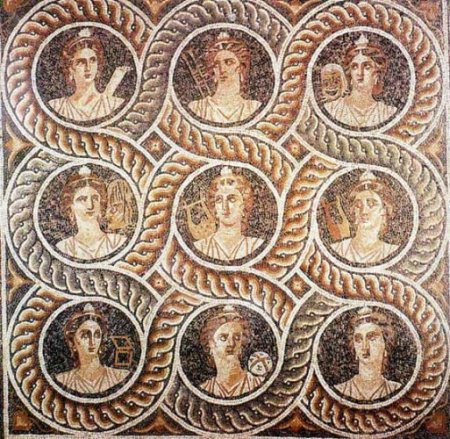
The Nine Muses

The Nine Muses
Roman mosaic found in Kos,
1st century BC
Great Master's Palace,
Rhodas

According to the Boeotians, there were originally three daughters, possibly of Uranus and Gaea:

  • Aoide - "song"

  • Melete - "meditation" or "practice"

  • Mneme - "memory"

The Boeotian version said that the Muses lived at Mount Helicon, while the later version said that the Muses' home was near Mount Olympus, in Peiria, Macedon. They were first worshipped by the Aloadae, the twin giants named Otus and Ephialtes, at Mount Helicon (in Boeotia) which was reputably the place they were born.


The later and more popular version said that the Muses were the nine daughters of Zeus and the Titaness Mnemosyne ("Memory"), and were sometimes known as Camenae. Zeus had slept with their mother for nine consecutive nights so that Mnemosyne could bear nine daughters. They were born and resided in and around Peiria.

The Muses presided over arts and science:

Calliope

Καλλιόπη

"epic poetry"

Cleio

Κλειω

"history"

Erato

Ἐρατώ

"love poetry"

Euterpe

Ευτερπη

"lyric poetry"

Melpomene

Μελπομένη

"tragedy"

Polyhymnia or Polhymnia

Πολύμνια

"sacred poetry"

Terpsichore

Τερψιχόρη

"choral songs" and the "dance"

Thaleia

Θαλία

"comedy"

Urania

Οὔρανια

"astronomy"

The Muses were known for skill in dancing and music, particularly in singing. They were normally seen around Apollo, the god of music in Olympus.

Calliope was probably the most famous of the Muses. Not only was she the eldest sister and their leader, Calliope was also the mother of two great musicians, Orpheus and Linus, either by Apollo or by the Thracian king named Oeagus, the son of Pierus.

Alternately, in an unknown fragment, one line said that Linus was the son of Urania, Calliope's sister, while in the Contest of Homer and Hesiod Linus was the son of Apollo and Aethusa, daughter of Poseidon.

Linus tried to teach the young Heracles, but the musician struck the young hero for his poor performance. Heracles struck back with his lyre, instantly killing Linus. Heracles was acquitted of murder because it was Linus who struck his pupil first.

The Muses were said to have brought up Orpheus the musician, and one of the Argonauts. They taught him singing while Apollo probably taught him the lyre. The maenads, women followers of Dionysus, tore Orpheus to pieces. The Muses mourned for Orpheus' death.

They sang at the wedding of Cadmus and Harmonia, as well as at Achilles' funeral.

They were sometimes quite vindictive when challenged by mortal musicians. They blinded Thamyris for his boasting and challenging them. They turned the daughters of Pierus into magpies for challenging them in a contest.

They also blinded the Phaeacian bard named Demodocus at the court of King Alcinous, in the Odyssey. However, the Muses compensated him by giving Demodocus the gift of song, for taking away his sight.

Related Information

Name

Muses, Μοὓσαι (Greek).
Camenae (daughters of Zeus and Mnemosyne).

Heliconian Muses, Μουσαων ´Ελικωνιαδων.

Related Articles

Uranus, Gaea, Mnemosyne, Zeus, Apollo, Orpheus, Linus, Heracles, Thamyris, Otus and Ephialtes.

Jimmy Joe Timeless Myths

By Jimmy Joe

Minor Greek Deities:

  • • Helius
  • • Selene
  • • Eos
  • • Aeolus
  • • Proteus
  • • Triton
  • • Doris
  • • Amphitrite
  • • Thetis
  • • Pan
  • • Silenus
  • • Aristaeüs
  • • Metis
  • • Hebe
  • • Eileithyia
  • • Iris
  • • Eris
  • • Muses
  • • Graces
  • • Nemesis
  • • Horae (Seasons)
  • • Moerae (Fates)
  • • Tyche
  • • Nike
  • • Paeëon
  • • Asclepius
  • • Circe
  • • Despoina
  • • Enyo
  • • Ate
  • • Deimus
  • • Phobus
  • • Ananke
Greek Mythology: What is a Muse in the Odyssey?

Greek Mythology: What is a Muse in the Odyssey?

The Muse in the Odyssey is a deity or goddess whom Homer, the author, made an appeal to as he began writing the epic poem. In Greek mythology, there were Greek goddesses who are in charge of giving an author inspiration, skill, knowledge, and even...

February 16th, 2024 • Ancient Literature
Mnemosyne

Mnemosyne

Titaness of memory. Mnemosyne ("Memory") was the daughter of Uranus and Gaea. She was the abstract personification of memory. In Roman myths, she was called Moneta. By Zeus, she was the mother of nine daughters, known as the Muses. Zeus slept with...

April 19th, 1999 • Jimmy Joe
Mnemosyne

Mnemosyne

Mnemosyne: The Personification of Memory and Reason Grocery shoppers who get home with everything they meant to buy can thank Mnemosyne, Titan of memory. Like many of the first-generation Titans, Mnemosyne played only minor roles in the actual myt...

April 2nd, 2002 • Timeless Myths
Odyssey Muse: Their Identities and Roles in Greek Mythology

Odyssey Muse: Their Identities and Roles in Greek Mythology

Odyssey's Muse does not pertain to a figure that evokes inspiration from our Greek author. Instead, The Odyssey starts with the invocation of the Muse. To further explain who is/are the muse/s of The Odyssey, we must go over the entirety of the pl...

February 16th, 2024 • Ancient Literature
What Do the Muses Do for Hesiod? His Encounter With the Muses

What Do the Muses Do for Hesiod? His Encounter With the Muses

What do the muses do for Hesiod becaus he is regarded as one of the greatest Greek poets that lived as evidenced by his literary works, especially the Theogony. The Theogony is an extensive account of the origins and genealogies of the Greek deiti...

February 16th, 2024 • Ancient Literature
Kleio (Clio): The Muse of History

Kleio (Clio): The Muse of History

Kleio was one of the goddesses of music, dance, and song, famously known as the Muses in Greek mythology. Clio muse was commonly depicted holding an open parchment scroll, sitting beside a chest of books or a set of tablets. Keep on reading throug...

February 16th, 2024 • Ancient Literature
Ourania: The Mythology of the Greek Goddess of Astronomy

Ourania: The Mythology of the Greek Goddess of Astronomy

Ourania was a muse in charge of astronomy and astronomical writings during the Classical period. She often held a globe in one hand and pointed rod in the other.Who Was Ourania? Ourania, also known as Urania, was the daughter of Zeus and Mnemosyne...

February 16th, 2024 • Ancient Literature
The Wives of Zeus: The Mythology Behind Zeus’ Lovers

The Wives of Zeus: The Mythology Behind Zeus’ Lovers

Zeus is arguably the most prominent figure in all of Greek mythology. Aside from his role as the king of the gods, one of the most famous things about Zeus is that he had a lot of lovers. His affairs often made his wife, Hera, very angry. However,...

November 15th, 2024 • Caleb Howells
Gaea and her Daughters

Gaea and her Daughters

In Greek mythology, Gaea and her daughters – Rhea, Themis and Dione – were the earliest earth and mother goddesses. These goddesses played decisive roles in Hesiod's Theogony, where they made or removed rulers.Gaea Gaea (Γαἳα) was seen as the eart...

June 22nd, 2003 • Jimmy Joe
Graces

Graces

Personification of beauty and grace. They were known to the Greeks as Charties and to the Romans as Gratiae. They were the three daughters of Zeus and Eurynome, who was the daughter of Oceanus and Tethys. The three sisters were named: Charis or Ag...

April 24th, 1999 • Jimmy Joe
Timeless Myths

Exploring mythology and legends from around the world.

Explore Myths

All Stories Characters All Articles Search Site Map

Mythologies

Norse Mythology Classical Mythology Celtic Mythology Arthurian Legends Mythology Gods Ancient Literature

About Us

Introduction About Jimmy Bibliography FAQs Retro Version

Resources

Timeless Myths All Stories All Articles Characters
© 1999-2026 Timeless Myths • Copyright • Privacy Policy • Cookie Policy • Contact
Follow us: