Timeless Myths Logo
Aphrodite Apollo Ares Artemis Athena Atlas Coeus Crius Cronus Demeter Dionysus Gaia Hades Hephaestus Hera Hermes Hestia Hyperion Iapetus Mnemosyne Oceanus Phobos Phoebe Poseidon Prometheus Rhea Tethys Themis Uranus Zeus
Bacchus Ceres Diana Juno Jupiter Mars Mercury Minerva Neptune Pluto Venus Vesta Vulcan
Amun Anubis Aten Atum Babi Bastet Bes Geb Hapi hathor heqet Horus Isis Khepri Khnum Khonsu Maat Nephthys Nut Osiris Ptah Ra Seshat Seth Shu Sobek Thoth
Alfheim Baldur Freya Freyr Frigg Heimdallr Helheim Idun Jotunheim Loki Nerthus Njord Odin Thor Tyr
Aengus Arawn Badb Brigid Cailleach Ceridwen Cernunnos Cu Chulainn Dagda Danu Gwydion Herne the Hunter Lugh Medb Morrigan Neit Nuada Taliesin Taranis
Chalchiuhtlicue Coatlicue Huitzilopochtli Mictlantecuhtli Mixcoatl Ometeotl Quetzalcoatl Tezcatlipoca Tlaloc Tonatiuh Xipe Totec Xochiquetzal Xolotl
Amaterasu Ame no Uzume Benzaiten Bishamonten Daikokuten Ebisu Fujin Fukurokuju Inari Izanagi Kagutsuchi Raijin Susanoo Tsukuyomi
Caishen Cangjie Dragon King Eight Immortals Erlang Shen Fuxi Guanyin Hou Yi Huxian Jade Emperor King Yama Leizi Lu-ban Mazu Nezha Nuwa Pangu Shennong Sun Wukong Xiwangmu Yue Lao Zhong Kui
Norse Classical Celtic Arthurian
Literature Stories Names
Aphrodite Apollo Ares Artemis Athena Atlas Coeus Crius Cronus Demeter Dionysus Gaia Hades Hephaestus Hera Hermes Hestia Hyperion Iapetus Mnemosyne Oceanus Phobos Phoebe Poseidon Prometheus Rhea Tethys Themis Uranus Zeus
Bacchus Ceres Diana Juno Jupiter Mars Mercury Minerva Neptune Pluto Venus Vesta Vulcan
Amun Anubis Aten Atum Babi Bastet Bes Geb Hapi hathor heqet Horus Isis Khepri Khnum Khonsu Maat Nephthys Nut Osiris Ptah Ra Seshat Seth Shu Sobek Thoth
Alfheim Baldur Freya Freyr Frigg Heimdallr Helheim Idun Jotunheim Loki Nerthus Njord Odin Thor Tyr
Aengus Arawn Badb Brigid Cailleach Ceridwen Cernunnos Cu Chulainn Dagda Danu Gwydion Herne the Hunter Lugh Medb Morrigan Neit Nuada Taliesin Taranis
Chalchiuhtlicue Coatlicue Huitzilopochtli Mictlantecuhtli Mixcoatl Ometeotl Quetzalcoatl Tezcatlipoca Tlaloc Tonatiuh Xipe Totec Xochiquetzal Xolotl
Amaterasu Ame no Uzume Benzaiten Bishamonten Daikokuten Ebisu Fujin Fukurokuju Inari Izanagi Kagutsuchi Raijin Susanoo Tsukuyomi
Caishen Cangjie Dragon King Eight Immortals Erlang Shen Fuxi Guanyin Hou Yi Huxian Jade Emperor King Yama Leizi Lu-ban Mazu Nezha Nuwa Pangu Shennong Sun Wukong Xiwangmu Yue Lao Zhong Kui
Norse Classical Celtic Arthurian
Literature Stories Names
  1. Classical Literature
    Greece Rome Other Ancient Civilizations Timeline of Classical Literature Alphabetical List of Authors Index of Individual Works Index of Important Characters Sources About Us
  2. Greece
    Homer Hesiod Aesop Sappho Pindar Aeschylus Sophocles Euripides Aristophanes Menander Apollonius of Rhodes
  3. Apollonius of Rhodes
    The Argonautica

Apollonius of Rhodes

(Epic Poet, Greek, 3rd Century BCE)

Introduction

Apollonius of Rhodes (Apollonius Rhodius) was an innovative and influential Hellenistic Greek epic poet, best known as the author of the epic poem "The Argonautica", the popular myth of Jason and the Argonauts' quest for the Golden Fleece. Following in the ancient tradition of Homer, Apollonius provided a more contemporary model for subsequent Latin poets, particularly Vergil, but also Catullus and Ovid.

Biography
Bust sculpture believed to represent Apollonius of Rhodes, ancient Greek epic poet

Bust of Apollonius of Rhodes

Very little is known about the life of Apollonius, and even his connection with the island of Rhodes is actually mere speculation. Biographical information from other scholars is sparse and often contradictory, and even his own works offer little or no biographical details.

The best we can say is that Apollonius was born some time in the early 3rd Century BCE, probably in Alexandria, Egypt, or possibly further south in Naucratis, and that his mother may (or may not) have been from the Greek island of Rhodes. He was a student (or at least a contemporary) of the Hellenistic poet and scholar Callimachus. He was, for a time, the head of the prestigious Library of Alexandria, a position in which he succeeded Zenodotus, and was in turn succeeded by Eratosthenes (which would have put Apollonius' time there as prior to 246 BCE).

Some reports indicate a high-profile literary feud between Apollonius and the more flamboyant figure of Callimachus, and this may even have been why Apollonius removed himself from Alexandria to Rhodes for a time, but even this is questionable, and the dispute may well have been sensationalized. Other reports have Apollonius removing himself to Rhodes after his work was poorly received in Alexandria, only to return to great acclaim after a significant redrafting and reworking of his "Argonautica".

Apollonius died in mid to late 3rd Century BCE, either in Rhodes or Alexandria, and, according to some sources, he was buried in style with his friend and literary rival Callimachus in Alexandria.

Writings
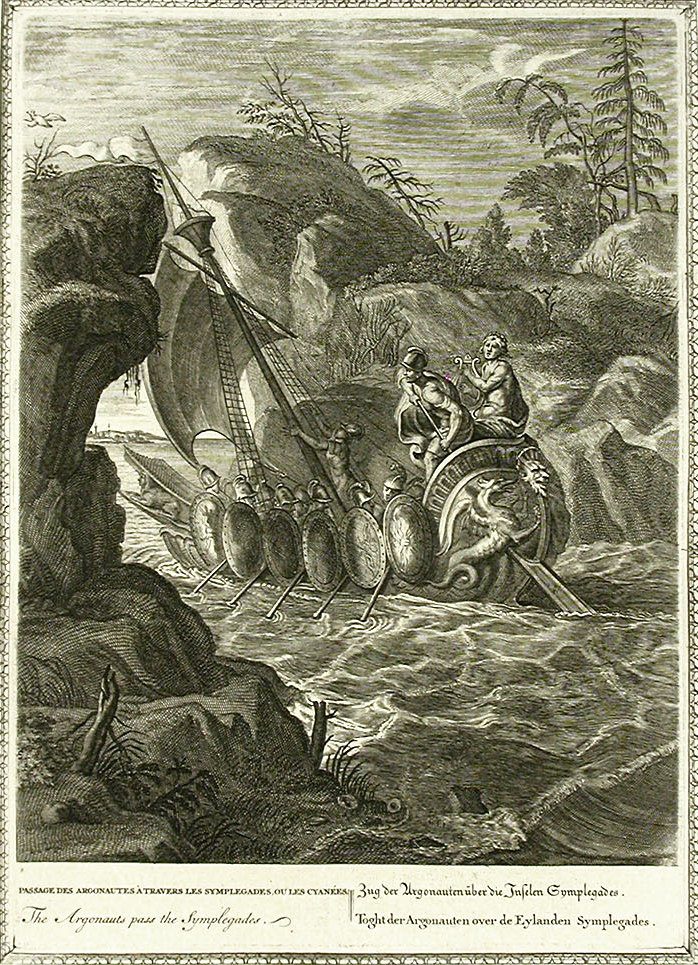
Painting depicting the Argonauts passing through the Symplegades, the clashing rocks

The Argonauts Pass the Symplegades

Apollonius was considered one of the foremost scholars of Homer in Alexandrian times, and wrote critical monographs on Homer, as well as on Archilochus and Hesiod.

He is best known, though, for his "Argonautica", a Homer-style epic poem on Jason's quest for the Golden Fleece, and he may have tried to incorporate into it elements of his own Homeric research, as well as some of the recent Hellenistic scientific advances in geography. For all that, recent studies have established the "Argonautica"'s reputation as not merely a derivative reworking of Homer, but as a vibrant and successful epic in its own right.

His other poetry survives only in small fragments, and mainly concern the origins and founding of various cities, such as Alexandria, Cnidus, Caunus, Naucratis, Rhodes and Lesbos. These "foundation-poems" have some geo-political significance for Ptolemaic Egypt, but they also relate to some extent to parts of the "Argonautica".

Major Works

  • "The Argonautica"

By Timeless Myths

Greece:

  • • Homer
  • • Hesiod
  • • Aesop
  • • Sappho
  • • Pindar
  • • Aeschylus
  • • Sophocles
  • • Euripides
  • • Aristophanes
  • • Menander
  • • Apollonius of Rhodes
Apollonius of Rhodes' Argonautica

Apollonius of Rhodes' Argonautica

Of all the accounts about Jason and the Argonauts, the most authoritative version came from Apollonius of Rhodes. His work was titled the Argonautica, which was an epic poem written during the mid-3rd century BC. People usually referred to this ep...

May 22nd, 1999 • Jimmy Joe
The Argonautica

The Argonautica

(Epic Poem, Greek, c. 246 BCE, 5,835 lines)Introduction "The Argonautica" is the best known work by the 3rd Century BCE Hellenistic poet and scholar, Apollonius of Rhodes. It is an epic poem in the style of Homer, and tells the story of Jason and ...

October 25th, 2024 • Timeless Myths
Euripides

Euripides

(Tragic Playwright, Greek, c. 480 – c. 406 BCE)Introduction Euripides was the last of the three great tragedians of classical Greece (the other two being Aeschylus and Sophocles). Largely due to an accident of history, eighteen of Euripides' ninet...

October 24th, 2024 • Timeless Myths
Pythian Ode 1

Pythian Ode 1

(Lyric Poem, Greek, 470 BCE, 100 lines)Introduction "Pythian Ode 1" is one of the better known of the many victory poems (or "epinicia") of the ancient Greek lyric poet Pindar. Like "Olympic Ode 1", it celebrates a victory of the Sicilian tyrant H...

January 1st, 2025 • Ancient Literature
Other Versions of the Quest

Other Versions of the Quest

Our most authoritative work about the Jason and the Quest of the Golden Fleece come from Apollonius of Rhodes, in the epic Argonautica (3rd century BC), which I have already retold. There are many scattered references about the Argonauts, but very...

May 22nd, 1999 • Jimmy Joe
The Phoenician Women

The Phoenician Women

"The Phoenician Women" (Gr: "Phoinissai"; Lat: "Phoenissae") is a tragedy by the ancient Greek playwright Euripides. It was written between 411 and 409 BCE, and is a variant of the story Aeschylus treated in his play "Seven Against Thebes" in whic...

October 25th, 2024 • Timeless Myths
Crew List of the Argo

Crew List of the Argo

ARGONAUTS The list of Argonauts who sailed with Jason are those given by the Alexandrian author, Apollonius of Rhodes. He gives the most complete account of the quest for the Golden Fleece. Jason (Ἰάσων) son of Aeson & Alcimede; captain of Argo Ar...

August 8th, 1999 • Jimmy Joe
The Iliad

The Iliad

(Epic Poem, Greek, c. 750 BCE, 15,693 linesIntroduction - Who wrote the Iliad "The Iliad" (Gr: "Iliás") is an epic poem by the ancient Greek poet Homer, which recounts some of the significant events of the final weeks of the Trojan War and the Gre...

January 1st, 2025 • Ancient Literature
Philoctetes

Philoctetes

(Tragedy, Greek, 409 BCE, 1,471 lines)Introduction Philoctetes (Gr: Philoktetes) is a tragedy by the ancient Greek playwright Sophocles, first performed at the City Dionysia of Athens in 409 BCE, where it won first prize. The story takes place tow...

October 24th, 2024 • Timeless Myths
Hercules Furens

Hercules Furens

(Tragedy, Latin/Roman, c. 54 CE, 1,344 lines)Introduction "Hercules Furens" ("The Mad Hercules" or "The Madness of Hercules") is a tragedy by the Roman playwright Seneca the Younger, considered one of his best, written in or before 54 CE. Closely ...

October 25th, 2024 • Timeless Myths
Timeless Myths

Exploring mythology and legends from around the world.

Explore Myths

All Stories Characters All Articles Search Site Map

Mythologies

Norse Mythology Classical Mythology Celtic Mythology Arthurian Legends Mythology Gods Ancient Literature

About Us

Introduction About Jimmy Bibliography FAQs Retro Version

Resources

Timeless Myths All Stories All Articles Characters
© 1999-2026 Timeless Myths • Copyright • Privacy Policy • Cookie Policy • Contact
Follow us: