Timeless Myths Logo
Aphrodite Apollo Ares Artemis Athena Atlas Coeus Crius Cronus Demeter Dionysus Gaia Hades Hephaestus Hera Hermes Hestia Hyperion Iapetus Mnemosyne Oceanus Phobos Phoebe Poseidon Prometheus Rhea Tethys Themis Uranus Zeus
Bacchus Ceres Diana Juno Jupiter Mars Mercury Minerva Neptune Pluto Venus Vesta Vulcan
Amun Anubis Aten Atum Babi Bastet Bes Geb Hapi hathor heqet Horus Isis Khepri Khnum Khonsu Maat Nephthys Nut Osiris Ptah Ra Seshat Seth Shu Sobek Thoth
Alfheim Baldur Freya Freyr Frigg Heimdallr Helheim Idun Jotunheim Loki Nerthus Njord Odin Thor Tyr
Aengus Arawn Badb Brigid Cailleach Ceridwen Cernunnos Cu Chulainn Dagda Danu Gwydion Herne the Hunter Lugh Medb Morrigan Neit Nuada Taliesin Taranis
Chalchiuhtlicue Coatlicue Huitzilopochtli Mictlantecuhtli Mixcoatl Ometeotl Quetzalcoatl Tezcatlipoca Tlaloc Tonatiuh Xipe Totec Xochiquetzal Xolotl
Amaterasu Ame no Uzume Benzaiten Bishamonten Daikokuten Ebisu Fujin Fukurokuju Inari Izanagi Kagutsuchi Raijin Susanoo Tsukuyomi
Caishen Cangjie Dragon King Eight Immortals Erlang Shen Fuxi Guanyin Hou Yi Huxian Jade Emperor King Yama Leizi Lu-ban Mazu Nezha Nuwa Pangu Shennong Sun Wukong Xiwangmu Yue Lao Zhong Kui
Norse Classical Celtic Arthurian
Literature Stories Names
Aphrodite Apollo Ares Artemis Athena Atlas Coeus Crius Cronus Demeter Dionysus Gaia Hades Hephaestus Hera Hermes Hestia Hyperion Iapetus Mnemosyne Oceanus Phobos Phoebe Poseidon Prometheus Rhea Tethys Themis Uranus Zeus
Bacchus Ceres Diana Juno Jupiter Mars Mercury Minerva Neptune Pluto Venus Vesta Vulcan
Amun Anubis Aten Atum Babi Bastet Bes Geb Hapi hathor heqet Horus Isis Khepri Khnum Khonsu Maat Nephthys Nut Osiris Ptah Ra Seshat Seth Shu Sobek Thoth
Alfheim Baldur Freya Freyr Frigg Heimdallr Helheim Idun Jotunheim Loki Nerthus Njord Odin Thor Tyr
Aengus Arawn Badb Brigid Cailleach Ceridwen Cernunnos Cu Chulainn Dagda Danu Gwydion Herne the Hunter Lugh Medb Morrigan Neit Nuada Taliesin Taranis
Chalchiuhtlicue Coatlicue Huitzilopochtli Mictlantecuhtli Mixcoatl Ometeotl Quetzalcoatl Tezcatlipoca Tlaloc Tonatiuh Xipe Totec Xochiquetzal Xolotl
Amaterasu Ame no Uzume Benzaiten Bishamonten Daikokuten Ebisu Fujin Fukurokuju Inari Izanagi Kagutsuchi Raijin Susanoo Tsukuyomi
Caishen Cangjie Dragon King Eight Immortals Erlang Shen Fuxi Guanyin Hou Yi Huxian Jade Emperor King Yama Leizi Lu-ban Mazu Nezha Nuwa Pangu Shennong Sun Wukong Xiwangmu Yue Lao Zhong Kui
Norse Classical Celtic Arthurian
Literature Stories Names
  1. Classical Literature
    Greece Rome Other Ancient Civilizations Timeline of Classical Literature Alphabetical List of Authors Index of Individual Works Index of Important Characters Sources About Us
  2. Greece
    Homer Hesiod Aesop Sappho Pindar Aeschylus Sophocles Euripides Aristophanes Menander Apollonius of Rhodes
  3. Sophocles
    Ajax Antigone The Trachiniae Oedipus Rex Electra Philoctetes Oedipus at Colonus
  4. Philoctetes
    Philoctetes

Philoctetes

(Tragedy, Greek, 409 BCE, 1,471 lines)

Introduction

Philoctetes (Gr: Philoktetes) is a tragedy by the ancient Greek playwright Sophocles, first performed at the City Dionysia of Athens in 409 BCE, where it won first prize. The story takes place towards the end of the Trojan War, after the events recounted in Homer's "The Iliad", and describes the attempt by Neoptolemus and Odysseus to persuade or trick the disabled Philoctetes into accompanying them to Troy, in order to fulfill a prophecy and finally bring the ten-year war to a close.

Synopsis

Dramatis Personae

  • ODYSSEUS, King of Ithaca

  • NEOPTOLEMUS, son of Achilles

  • PHILOCTETES, son of Poeas, and companion of Heracles

  • A SPY

  • HERACLES

  • CHORUS, composed of the companions of Odysseus and Neoptolemus
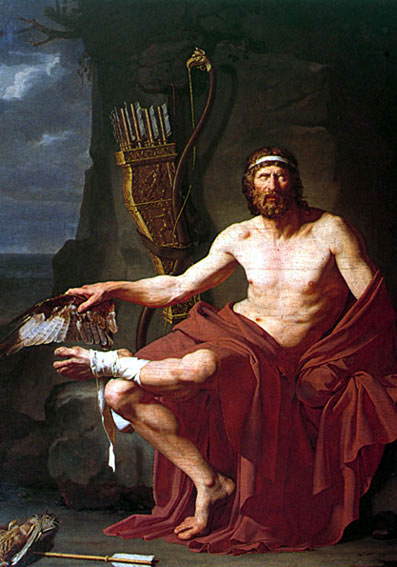
Philoctetes Greek Hero Painting

Philoctetes, the Greek hero abandoned on Lemnos

The assumed background to the story goes back to when Heracles was near death (as recounted in another play by Sophocles, "The Trachiniae"), and he wished to be burned alive in order to cut short his agony. However, no-one but the young Philoctetes was willing to light the fire, and in return for this favour Heracles gave Philoctetes his magical bow whose arrows infallibly kill.

Later, when Philoctetes (by then a great warrior and archer) left with the other Greeks to participate in the Trojan War, he was bitten on the foot by a snake (possibly as a result of a curse for revealing the location of Heracles' body). The bite festered, leaving him in constant agony and giving off a sickening smell. The stench and Philoctetes' constant cries of pain drove the Greeks (mainly at Odysseus' instigation) to abandon him on the desert island of Lemnos, while they continued on to Troy.

After ten years of war, the Greeks seemed unable to finish off Troy. But, on capturing King Priam's son, Helenus (the twin brother of the prophetess Cassandra, and himself a seer and prophet), they found out that they will never win the war without Philoctetes and the bow of Heracles. So, Odysseus (against his will), accompanied by Neoptolemus, the young son of Achilles, is forced to sail back to Lemnos to retrieve the bow and to face the bitter and twisted Philoctetes.
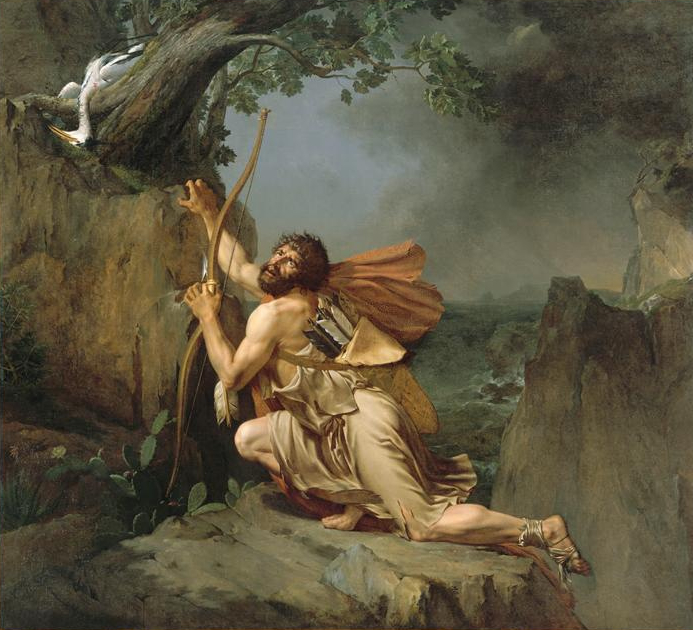
Philoctetes on the Island of Lemnos

Philoctetes on the Island of Lemnos

As the play begins, Odysseus explains to Neoptolemus that they must perform a shameful action in order to garner future glory, namely to trick Philoctetes with a false story while the hated Odysseus hides. Against his better judgement, the honourable Neoptolemus goes along with the plan.

Philoctetes is full of joy at seeing fellow Greeks again after all his years of isolation and exile and, as Neoptolemus proceeds to trick Philoctetes into thinking he hates Odysseus as well, a friendship and trust is soon built up between the two men.

Philoctetes then suffers a series of unbearable fits of pain in his foot and asks Neoptolemus to hold his bow, before falling into a deep sleep. Neoptolemus is torn between taking the bow (as the Chorus of sailors advises) and returning it to the pitiful Philoctetes. Neoptolemus' conscience eventually gains the upper hand and, also conscious that the bow is useless without Philoctetes himself, he returns the bow and reveals to Philoctetes their true mission. Odysseus now also reveals himself and tries to persuade Philoctetes but, after a raging argument ensues, Odysseus is finally forced to flee before the incensed Philoctetes kills him.

Neoptolemus tries, unsuccessfully, to talk Philoctetes into coming to Troy of his own free will, arguing that they must trust in the gods, who have fated (according to Helenus' prophecy) that he and Philoctetes will become friends in arms and be instrumental in the taking of Troy. But Philoctetes is unconvinced, and Neoptolemus eventually gives in and agrees to take him back to his home in Greece, thus risking the wrath of the Greek army.

As they are leaving, however, Heracles (who has a special connection to Philoctetes, and who is now a god) appears and commands Philoctetes that he should go to Troy. Heracles confirms Helenus' prophecy and promises that Philoctetes will be cured and will earn much honour and fame in battle (although it is not actually covered in the play, Philoctetes is in fact one of those chosen to hide inside the Trojan Horse and distinguished himself during the sack of the city, including the killing of Paris himself). Heracles concludes by warning everyone to respect the gods or face the consequences.
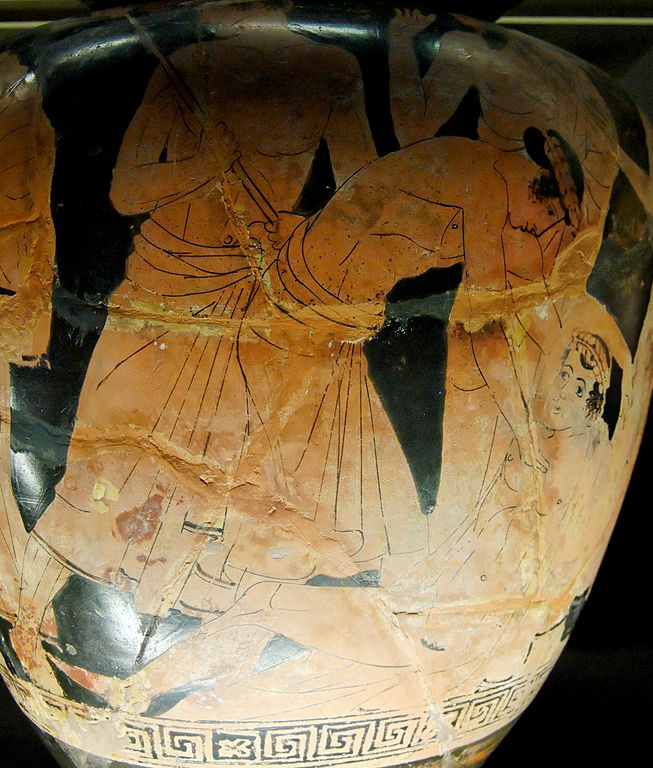
Philoctetes depicted on an ancient Greek vase by Hermonax

Philoctetes depicted on an ancient Greek vase by Hermonax

Analysis

The legend of Philoctetes' wounding and his enforced exile on the island of Lemnos, and his eventual recall by the Greeks, was mentioned briefly in Homer's "The Iliad". The recall was also described in more detail in the lost epic, "The Little Iliad" (in that version he was brought back by Odysseus and Diomedes, not Neoptolemus). Despite its somewhat peripheral position at the edges of the main Trojan War story, it was clearly a popular tale, and both Aeschylus and Euripides had already written plays on the subject before Sophocles (although neither of their plays have survived).

In Sophocles' hands, it is not a play of action and doing but of emotions and feeling, a study in suffering. Philoctetes' sense of abandonment and his search for meaning in his suffering still speaks to us today, and the play poses tough questions regarding the doctor/patient relationship, questions about the subjectivity of pain and the difficulty of pain management, the long-term challenges of caring for the chronically ill and the ethical boundaries of medical practice. Interestingly, the two plays of Sophocles' old age, Philoctetes and "Oedipus at Colonus", both treat the aged, decrepit heroes with great respect and almost awe, suggesting that the playwright understood suffering, both from medical and psycho-social perspectives.

Also central to the play is the opposition between the honest and honourable man of action (Neoptolemus) and the cynical and unscrupulous man of words (Odysseus), and the whole nature of persuasion and deception. Sophocles appears to suggest that deception is unjustifiable in democratic discourse no matter how high the stakes may be, and that common ground outside of politics must be found if conflicts are to be resolved.

The supernatural appearance of Heracles towards the end of the play, in order to achieve a resolution of the seemingly intractable problem, is very much in the ancient Greek tradition of the "deus ex machina".

Resources

  • English translation by Thomas Francklin (Internet Classics Archive): http://classics.mit.edu/Sophocles/philoct.html

  • Greek version with word-by-word translation (Perseus Project): Perseus Digital Library

By Timeless Myths

Sophocles:

  • • Ajax
  • • Antigone
  • • The Trachiniae
  • • Oedipus Rex
  • • Electra
  • • Philoctetes
  • • Oedipus at Colonus
Philoctetes

Philoctetes

A Malian archer. Philoctetes (Φιλοκτήτης) was the son of Poeas, king of Malis, and Demonassa. He may have sailed with Jason as an Argonaut. Either Philoctetes or his father set alight Heracles' pyre. Heracles rewarded him by giving his bow and arr...

April 24th, 1999 • Jimmy Joe
The Phoenician Women

The Phoenician Women

"The Phoenician Women" (Gr: "Phoinissai"; Lat: "Phoenissae") is a tragedy by the ancient Greek playwright Euripides. It was written between 411 and 409 BCE, and is a variant of the story Aeschylus treated in his play "Seven Against Thebes" in whic...

October 25th, 2024 • Timeless Myths
Phoenissae (The Phoenician Women)

Phoenissae (The Phoenician Women)

(Tragedy, Latin/Roman, c. 65 CE, 664 lines)Introduction "Phoenissae" ("The Phoenician Women") is a (possibly incomplete) tragedy by the Roman playwright Seneca the Younger, probably written between about 62 and 65 CE. Based on earlier plays by Eur...

October 25th, 2024 • Timeless Myths
Phylace

Phylace

Phylace was a Thessalian city west of the Pagasaean Gulf. Phylacus, son of the Aeolid Deïon and Diomede, founded Phylace and named the city after himself. His son Iphiclus was one of the fastest runners in the world. Iphiclus took part in the ques...

August 8th, 1999 • Jimmy Joe
Pholus

Pholus

Pholus was one of the few Centaurs who was friendly towards mortals. Pholus was a friend of Heracles. Pholus lived in a cave at Mount Pholus, which was named after him; this mountain was in Arcadia. He had wine that would drive other Centaurs craz...

January 11th, 2006 • Jimmy Joe
Pholus: The Bother of the Great Centaur Chiron

Pholus: The Bother of the Great Centaur Chiron

Pholus was an intelligent centaur and a dear friend to Heracles. He lived away from the population in a cave and rarely came out. His personality and origin are very different from the common centaurs. Here we bring you all the information on this...

February 16th, 2024 • Ancient Literature
Pythian Ode 1

Pythian Ode 1

(Lyric Poem, Greek, 470 BCE, 100 lines)Introduction "Pythian Ode 1" is one of the better known of the many victory poems (or "epinicia") of the ancient Greek lyric poet Pindar. Like "Olympic Ode 1", it celebrates a victory of the Sicilian tyrant H...

January 1st, 2025 • Ancient Literature
Pheneüs

Pheneüs

Pheneüs was a city in northeastern Arcadia. The only mythical significance of this city had to do with the myth of Heracles. When Heracles was defeated in the first war against the kingdom of Elis, the hero came to Pheneüs to recover from his illn...

August 8th, 1999 • Jimmy Joe
The Trachiniae

The Trachiniae

(Tragedy, Greek, c. 440 BCE, 1,278 lines)Introduction “The Trachiniae” (Gr: “Trachiniai”, also known as “The Trachinian Women”, “The Women of Trachis” or “The Maidens of Trachis”) is a tragedy by the ancient Greek playwright Sophocles. It was prob...

January 1st, 2025 • Ancient Literature
Aristophanes

Aristophanes

(Comic Playwright, Greek, c. 446 – c. 386 BCE)Introduction Aristophanes was a prolific and much acclaimed comic playwright of ancient Greece, sometimes referred to as the Father of Comedy. Eleven of his forty plays have come down to us virtually c...

October 24th, 2024 • Timeless Myths
Timeless Myths

Exploring mythology and legends from around the world.

Explore Myths

All Stories Characters All Articles Search Site Map

Mythologies

Norse Mythology Classical Mythology Celtic Mythology Arthurian Legends Mythology Gods Ancient Literature

About Us

Introduction About Jimmy Bibliography FAQs Retro Version

Resources

Timeless Myths All Stories All Articles Characters
© 1999-2026 Timeless Myths • Copyright • Privacy Policy • Cookie Policy • Contact
Follow us: