Timeless Myths Logo
Aphrodite Apollo Ares Artemis Athena Atlas Coeus Crius Cronus Demeter Dionysus Gaia Hades Hephaestus Hera Hermes Hestia Hyperion Iapetus Mnemosyne Oceanus Phobos Phoebe Poseidon Prometheus Rhea Tethys Themis Uranus Zeus
Bacchus Ceres Diana Juno Jupiter Mars Mercury Minerva Neptune Pluto Venus Vesta Vulcan
Amun Anubis Aten Atum Babi Bastet Bes Geb Hapi hathor heqet Horus Isis Khepri Khnum Khonsu Maat Nephthys Nut Osiris Ptah Ra Seshat Seth Shu Sobek Thoth
Alfheim Baldur Freya Freyr Frigg Heimdallr Helheim Idun Jotunheim Loki Nerthus Njord Odin Thor Tyr
Aengus Arawn Badb Brigid Cailleach Ceridwen Cernunnos Cu Chulainn Dagda Danu Gwydion Herne the Hunter Lugh Medb Morrigan Neit Nuada Taliesin Taranis
Chalchiuhtlicue Coatlicue Huitzilopochtli Mictlantecuhtli Mixcoatl Ometeotl Quetzalcoatl Tezcatlipoca Tlaloc Tonatiuh Xipe Totec Xochiquetzal Xolotl
Amaterasu Ame no Uzume Benzaiten Bishamonten Daikokuten Ebisu Fujin Fukurokuju Inari Izanagi Kagutsuchi Raijin Susanoo Tsukuyomi
Caishen Cangjie Dragon King Eight Immortals Erlang Shen Fuxi Guanyin Hou Yi Huxian Jade Emperor King Yama Leizi Lu-ban Mazu Nezha Nuwa Pangu Shennong Sun Wukong Xiwangmu Yue Lao Zhong Kui
Norse Classical Celtic Arthurian
Literature Stories Names
Aphrodite Apollo Ares Artemis Athena Atlas Coeus Crius Cronus Demeter Dionysus Gaia Hades Hephaestus Hera Hermes Hestia Hyperion Iapetus Mnemosyne Oceanus Phobos Phoebe Poseidon Prometheus Rhea Tethys Themis Uranus Zeus
Bacchus Ceres Diana Juno Jupiter Mars Mercury Minerva Neptune Pluto Venus Vesta Vulcan
Amun Anubis Aten Atum Babi Bastet Bes Geb Hapi hathor heqet Horus Isis Khepri Khnum Khonsu Maat Nephthys Nut Osiris Ptah Ra Seshat Seth Shu Sobek Thoth
Alfheim Baldur Freya Freyr Frigg Heimdallr Helheim Idun Jotunheim Loki Nerthus Njord Odin Thor Tyr
Aengus Arawn Badb Brigid Cailleach Ceridwen Cernunnos Cu Chulainn Dagda Danu Gwydion Herne the Hunter Lugh Medb Morrigan Neit Nuada Taliesin Taranis
Chalchiuhtlicue Coatlicue Huitzilopochtli Mictlantecuhtli Mixcoatl Ometeotl Quetzalcoatl Tezcatlipoca Tlaloc Tonatiuh Xipe Totec Xochiquetzal Xolotl
Amaterasu Ame no Uzume Benzaiten Bishamonten Daikokuten Ebisu Fujin Fukurokuju Inari Izanagi Kagutsuchi Raijin Susanoo Tsukuyomi
Caishen Cangjie Dragon King Eight Immortals Erlang Shen Fuxi Guanyin Hou Yi Huxian Jade Emperor King Yama Leizi Lu-ban Mazu Nezha Nuwa Pangu Shennong Sun Wukong Xiwangmu Yue Lao Zhong Kui
Norse Classical Celtic Arthurian
Literature Stories Names
  1. Classical Literature
    Greece Rome Other Ancient Civilizations Timeline of Classical Literature Alphabetical List of Authors Index of Individual Works Index of Important Characters Sources About Us
  2. Greece
    Homer Hesiod Aesop Sappho Pindar Aeschylus Sophocles Euripides Aristophanes Menander Apollonius of Rhodes
  3. Aeschylus
    The Persians The Suppliants Seven Against Thebes Agamemnon The Libation Bearers The Eumenides The Oresteia Prometheus Bound
  4. Seven Against Thebes
    Seven Against Thebes

Seven Against Thebes

(Tragedy, Greek, 467 BCE, 1,084 lines)

Introduction

"Seven Against Thebes" (Gr: "Hepta epi Thebas"; Lat: "Septem contra Thebas") is a tragedy by the ancient Greek playwright Aeschylus, dating from 467 BCE. It is the classic statement of the myth (also covered by Euripides' play "The Phoenician Women") of the battle for the city of Thebes after the shamed Oedipus relinquished power to his two sons, Eteocles and Polynices
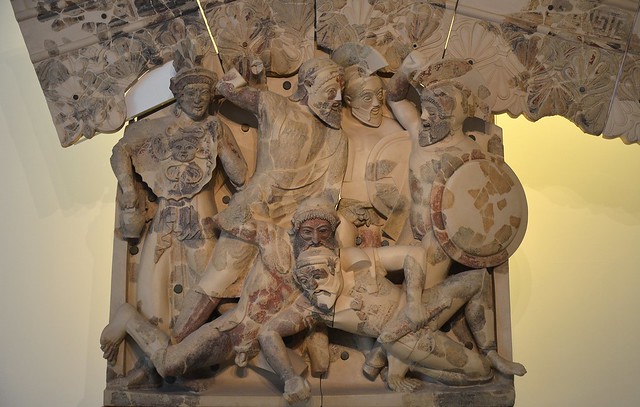
Statue depicting Seven Against Thebes

Statue depicting Seven Against Thebes

Synopsis

"Seven Against Thebes" tells how, when the shamed Oedipus stepped down as king of Thebes, he gave the kingdom to his two sons, Eteocles and Polynices (Polyneices), on the understanding that they would alternate the throne every year. However, after the first year, Eteocles refused to step down and drove out Polynices, who fled to Argos. There, Polynices and the Argive king Adrastus gathered together a force under seven captains or leaders (Tydeus, Capaneus, Eteoclus, Hippomedon, Parthenopaeus, Amphiaraus and Polynices himself).

As the play opens, Polynices and his Argive supporters are about to attack and lay seige to his own home city of Thebes in order to claim the throne. The reigning king, his brother Eteocles, appears and warns the people, calling them to arms. He appoints Theban commanders (Creon, Megareus, Poriclymenus, Melanippus, Polyphontes, Hyperbius, Actor, Lasthenes and himself) to defend the seven gates of the city against the seven attacking leaders. When his brother Polynices is revealed to be one of the seven attacking captains, Eteocles resolves to meet him in single combat.

The "battle" itself occurs off-stage, during a choral ode, after which a messenger enters and announces that Eteocles and Polynices have killed each other. The other six attacking chieftains are all slain, and the enemy beaten off. The bodies of the two princes are brought on stage, and the Chorus mourns them, as do the sisters of the killed men, Antigone and Ismene, who alone are left of the royal house.
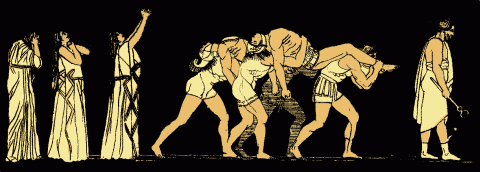
Eteocles and Polynices

Eteocles and Polynices

Analysis

It was first performed in 467 BCE when it won first prize in the annual City Dionysia drama competition, as the third play in a Thebes trilogy. The first first two (lost) plays of the trilogy were "Laius" and "Oedipus", which dealt with the first two generations of the Oedipus myth, while "Seven Against Thebes" follows the story of Oedipus' two sons, Eteocles and Polynices, who die by each other's hands in the fight for the Theban crown. The concluding satyr play was called "The Sphinx" (also lost).

The original kernel of the myth of the "Seven", the seven Argive generals who threatened the ancient city of Thebes, goes back to Bronze Age history a generation or so before the Trojan War (the 12th or 13th Century BCE). The drama has very little plot as such, and much of the play consists of a scout or messenger describing each of the seven captains that lead the Argive army against Thebes (down to the devices on their respective shields) and Eteocles' announcements of which Theban commander he will send against each Argive attacker.
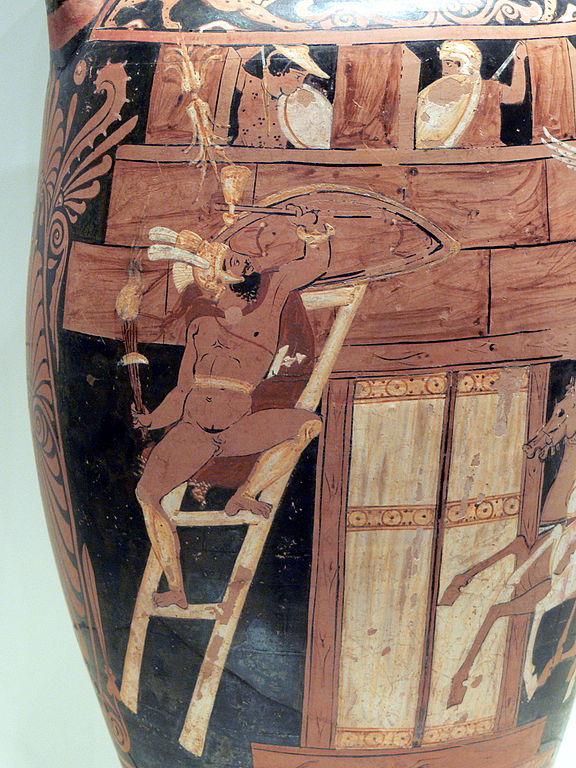
A vase depicting Seven Against Thebes

A vase depicting Seven Against Thebes

Unlike Aeschylus' very early plays, however, the opening of the play is no longer lyric but dramatic. It also contains the first passage of general reflexion of life (which later became a regular feature of tragedy), where Eteocles muses on the fate which involves an innocent man in the company of the wicked so that he unjustly has to share their deserved fate. The Chorus in the play, which has more lines than any other character, consists of the women of Thebes.

It explores themes of fate and the interference of the gods in human affairs, as well as the polis (or city) as a vital development of human civilization (a theme which would recur through many of Aeschylus' later plays).

Due to the popularity of Sophocles' later play "Antigone", the ending of "Seven Against Thebes" was rewritten about fifty years after Aeschylus' death, with Antigone announcing her intention to defy the announced edict against burying Polynices.

Resources

  • English translation by E. D. A. Morshead (Internet Classics Archive)

  • Greek version with word-by-word translation (Perseus Project)

By Ancient Literature

Aeschylus:

  • • The Persians
  • • The Suppliants
  • • Seven Against Thebes
  • • Agamemnon
  • • The Libation Bearers
  • • The Eumenides
  • • The Oresteia
  • • Prometheus Bound
Seven Against Thebes

Seven Against Thebes

Two generations of war between two powerful cities: Argos and Thebes. The first war took shortly after the quest of Jason and the Argonauts and after the reign of Oedipus in Thebes. The second war was set just before the Trojan War began. Facts & ...

May 6th, 1999 • Jimmy Joe
Seven Against Thebes - War

Seven Against Thebes - War

The Seven Against Thebes was a famous war between the Argive army, led by seven champions, and the city of Thebes. The war was set after the reign of Oedipus in Thebes, and a generation before the Trojan War. The tales were popular during the clas...

May 6th, 1999 • Jimmy Joe
Seven Against Thebes and Epigoni

Seven Against Thebes and Epigoni

Seven Against Thebes EpigoniSeven Against Thebes Here is a list of the seven Argive champions who fought against Thebes. It also shows the gate the hero fought at, and which Theban champions they were killed by. Champions Parentage Gate Killed By ...

August 8th, 1999 • Jimmy Joe
The Phoenician Women

The Phoenician Women

"The Phoenician Women" (Gr: "Phoinissai"; Lat: "Phoenissae") is a tragedy by the ancient Greek playwright Euripides. It was written between 411 and 409 BCE, and is a variant of the story Aeschylus treated in his play "Seven Against Thebes" in whic...

October 25th, 2024 • Timeless Myths
The Trachiniae

The Trachiniae

(Tragedy, Greek, c. 440 BCE, 1,278 lines)Introduction “The Trachiniae” (Gr: “Trachiniai”, also known as “The Trachinian Women”, “The Women of Trachis” or “The Maidens of Trachis”) is a tragedy by the ancient Greek playwright Sophocles. It was prob...

January 1st, 2025 • Ancient Literature
The Suppliants

The Suppliants

(Tragedy, Greek, 423 BCE, 1,234 lines)Introduction "The Suppliants" (also known as "The Suppliant Women"; Gr: "Hiketides"; Lat: "Supplices") is a tragedy by the ancient Greek playwright Euripides, first produced in 423 BCE. Not to be confused with...

October 25th, 2024 • Timeless Myths
The Suppliants

The Suppliants

(Tragedy, Greek, c. 469 BCE, 1,073 lines)Introduction "The Suppliants" (Gr: "Hiketides"; Lat: "Supplices") is a tragedy by the ancient Greek playwright Aeschylus. It is sometimes known as "The Suppliant Women" or "The Suppliant Maidens". Along wit...

January 1st, 2025 • Ancient Literature
The Trojan Women

The Trojan Women

(Tragedy, Greek, 415 BCE, 1,332 lines)Introduction "The Trojan Women" (Gr: "Troädes") is a tragedy by the ancient Greek playwright Euripides. It was first presented at the City Dionysia of 415 BCE, along with two other unconnected tragedies, "Alex...

October 25th, 2024 • Timeless Myths
After the War

After the War

At the death of Polyneices and Eteocles, Creon again became regent, this time for Laodamas, the young son of Eteocles. Laodamas' reign was brief, ruling for a short time before a new Argive army returned a second time. Ten years later after the fi...

May 6th, 1999 • Jimmy Joe
Heracles (Euripides)

Heracles (Euripides)

(Tragedy, Greek, c. 416 BCE, 1,428 lines)Introduction "Heracles" or "The Madness of Heracles" (Gr: "Herakles Mainomenos"; Lat: "Hercules Furens") is a tragedy by the ancient Greek playwright Euripides. It describes the frenzy of divinely induced m...

October 25th, 2024 • Timeless Myths
Timeless Myths

Exploring mythology and legends from around the world.

Explore Myths

All Stories Characters All Articles Search Site Map

Mythologies

Norse Mythology Classical Mythology Celtic Mythology Arthurian Legends Mythology Gods Ancient Literature

About Us

Introduction About Jimmy Bibliography FAQs Retro Version

Resources

Timeless Myths All Stories All Articles Characters
© 1999-2026 Timeless Myths • Copyright • Privacy Policy • Cookie Policy • Contact
Follow us: